
Can You Jumpstart a Lawnmower With a Car? (The Safe Way to Do It)
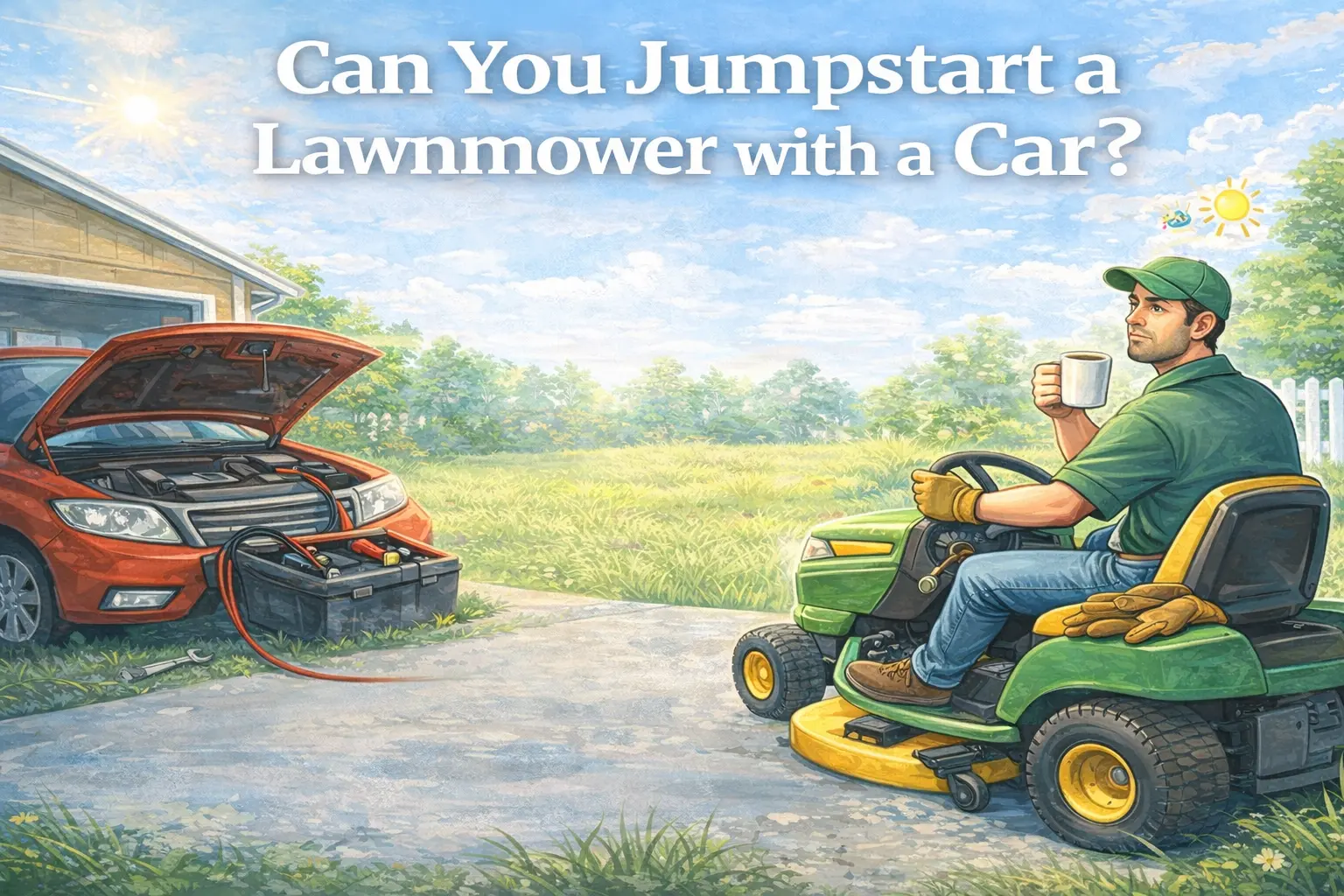
It was a Saturday morning in mid-July. The sun was already beating down on the driveway. I had my coffee in one hand. I was ready to tackle the front yard. The grass was getting tall. It looked a bit messy.
After climbing onto my riding mower, I turned the key and waited for the familiar engine roar. Instead, I heard a sad click. Then silence. I tried again. Click. Nothing else happened. The engine wouldn’t turn over.
I paused for a moment, feeling the heat build, then looked at my car parked nearby and remembered the jumper cables in the trunk. A thought popped into my head. Can you jumpstart a lawnmower with a car? It seemed like an easy fix. The car has a battery. The mower has a battery.
The short answer is yes. You absolutely can. I have done it many times. But you have to be careful. It is not exactly like jumping into another car. If you do it wrong, you can fry the mower’s little brain.
I have spent years fixing engines. I’ve worked on everything from old push mowers to big zero-turns. I’ve seen what happens when people rush this. It gets expensive fast.
In this guide, I will walk you through it. We will talk about safety. We will check the voltage. I will show you how to get that engine running without a trip to the shop. Let’s save your weekend.
Understanding Your Mower’s Battery System
Before we grab any cables, we need to look under the hood. Mower batteries are small, but they are specific. If we mix them up, sparks will fly.
The 12-Volt vs. 6-Volt Dilemma
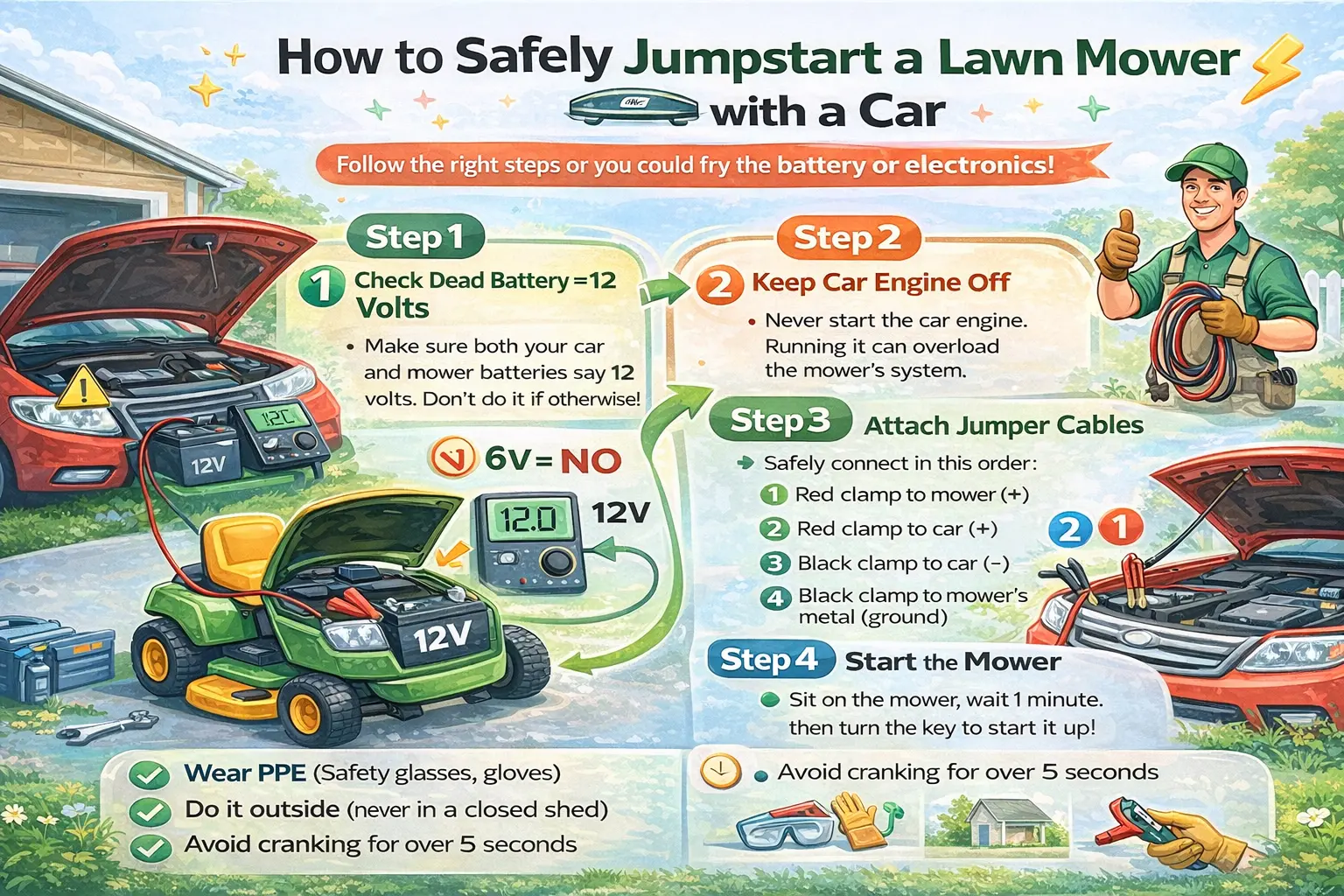
Most cars on the road today use a 12-volt battery. That is the standard. Most modern riding mowers use 12-volt batteries too. If you have a John Deere or a Craftsman from the last ten years, it is likely 12-volt.
But you have to check. This is vital.
Some older tractors use 6-volt systems. Some small rear-engine riders do too. If you hook a 12-volt car battery to a 6-volt mower, bad things happen. You will overpower the system instantly.
- Check the label: Look at the battery case. It should say “12V” clearly.
- Check the caps: Sometimes the voltage is stamped on the plastic caps.
- Count the cells: If you can see the caps, count them. 6 caps usually mean 12 volts. 3 caps mean 6 volts.
I once helped a neighbor in Ohio. He owned an old vintage tractor and attempted to jump-start it with his truck, which melted the wires within seconds. The smoke smelled like burning plastic. It ruined his whole day.
If your mower is 6-volt, stop now. Do not use your car. You need a specific charger for that. But if you see “12V” on both batteries, you are in the clear. We can proceed.
Lead-Acid vs. AGM vs. Lithium
Not all batteries are built the same inside. The chemistry matters. It changes how they handle a surge of power.
Standard Lead-Acid This is the most common type. It is heavy. It is full of liquid acid. You will find these in almost every garden tractor at Home Depot or Lowes. They are tough and cheap. They handle a jump start just fine.
AGM (Absorbent Glass Mat) These are getting popular. They are spill-proof. They handle vibrations better. If you have a zero-turn mower that bounces around a lot, you might have an AGM. They are safe to jump too. Just treat them like a standard battery.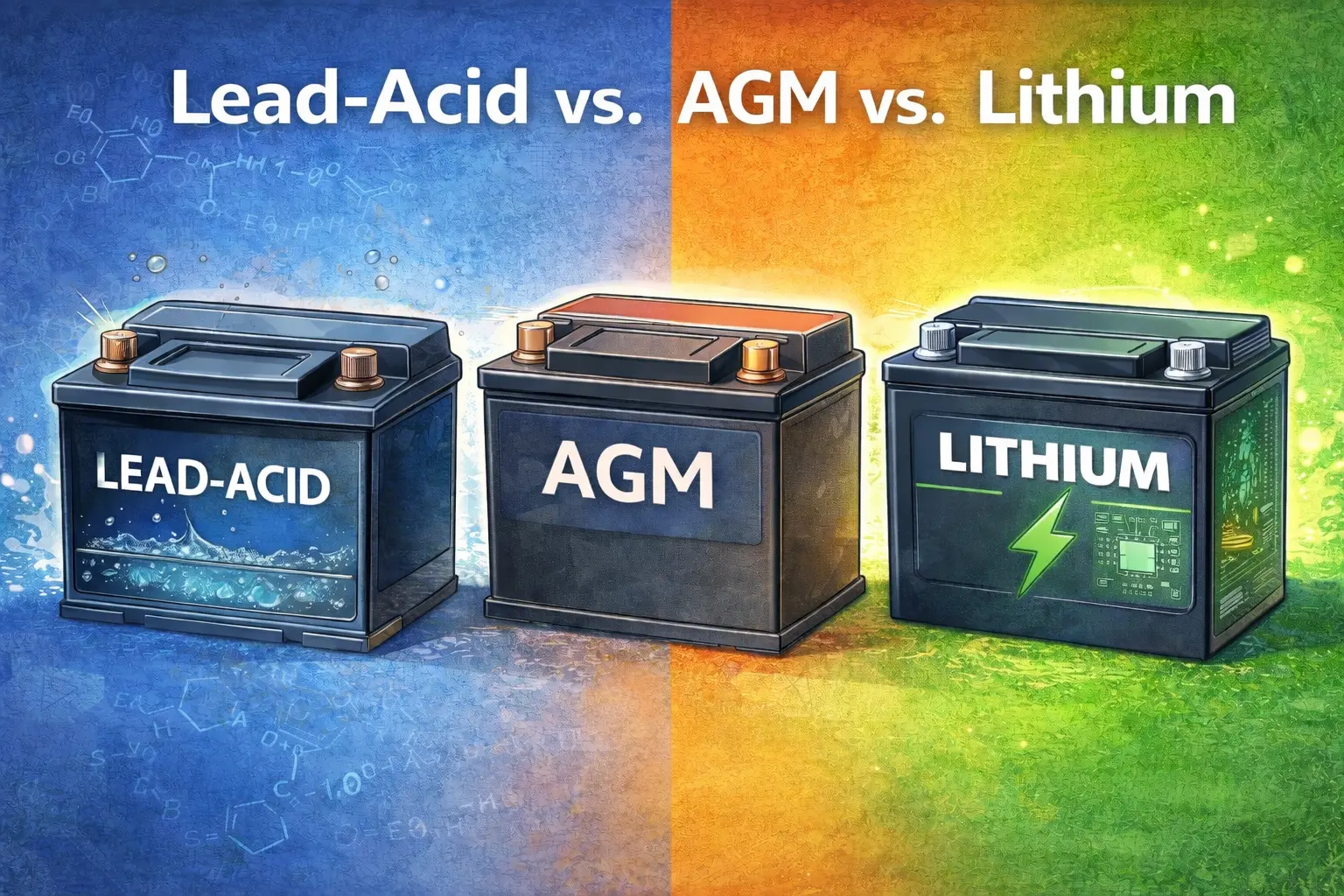
Lithium-Ion This is where you must be careful.
- New electric riding mowers use lithium.
- Some high-end gas mowers use a small lithium battery for starting.
Do not jump on a lithium battery with a car.
Lithium batteries have computers inside. They are very sensitive. A surge from a car can kill the battery management system. If you have a lithium battery, you need its specific charger. Do not risk it.
Why Mower Batteries Die So Fast
It feels like these batteries never last. You buy a new one, and two years later, it’s dead. It is not just bad luck. It is how we use them.
The Seasonal Gap Think about winter. In many parts of the US, the mower sits for months. In the Midwest, it might sit in a freezing garage from November to April.
- Batteries lose charge over time.
- When they sit empty in the cold, the chemistry changes.
- The lead plates inside get hard. We call this sulfation.
By the time spring comes, the battery is too weak. It can’t hold a charge anymore.
The Vibration Factor Mowing is rough work. Mowing involves driving over tree roots, hitting curbs, and working across uneven terrain.
- Mower batteries are small.
- They don’t have much shock absorption.
- All that shaking can break the internal connections.
I had a mower that died once every three months. I couldn’t figure it out. Then I realized my yard was just too bumpy. It was shaking the battery to death. I switched to an AGM battery, and it lasted for years.
Corrosion from Humidity If you live in the South, you know about humidity. The air is thick. Moisture gets everywhere.
- It builds up on the battery terminals.
- You see that white or green fuzzy powder? That is corrosion.
- It blocks the power flow.
Sometimes the battery isn’t even dead. The connection is just dirty. We will check that later. But first, we need to talk about the risks.
The Risks of Using a Car to Jump a Mower
It works, but it is risky. A car battery is a fire hose of power. Your mower is a garden hose. You have to manage the flow carefully.
Amperage Overload Explained
We need to talk about amps. Voltage is the pressure. Amps are the volume of current.
- A car battery is a beast. It has 500 to 800 Cold Cranking Amps (CCA). It needs that power to turn a big V6 or V8 engine.
- Your mower is small. It only needs about 200 to 300 amps.
When you connect them, the car battery pushes hard. The mower starter can usually handle the extra amps for a few seconds. But heat builds up fast.
The Alternator Danger This is the most important rule. Never start the car engine.
When the car is running, the alternator is spinning. It pumps out even more power. It can send spikes of 14 volts or more.
- A running car pushes too much current.
- It can overwhelm the mower’s tiny voltage regulator.
- It can fuse wires together.
Years ago, I discovered this the hard way when I rushed the process, left the truck running, and connected the mower. It started, but then the mower lights blew out. I fried the charging coil.
So, keep the car off. The battery alone has plenty of juice to start a small mower engine.
Sensitive Electronics on Modern Mowers
Old mowers were simple. They had a battery, a starter, and a key. You could do almost anything to them.
New mowers are different.
- They have Electronic Control Units (ECUs).
- They have digital displays.
- They have electric fuel injection.
These parts are like computers. They hate voltage spikes. If you connect the cables wrong, you can blow a board.
The Cost of a Mistake A new battery costs about $50. A new control board can cost $300. Plus, you have to wait for the part.
- It’s not worth the risk to rush.
- Take your time.
- Double-check every clip.
If you have a very expensive, high-tech commercial mower, check your manual. Some brands say “Do Not Jump.” If the manual says no, listen to it. Use a trickle charger instead.
Safety First (PPE for the Garden)
I know it sounds silly. You are just in your driveway. You aren’t in a shop. But batteries are dangerous. They contain acid. They produce gas.
Eye Protection When you connect a jumper cable, it often sparks.
- Sparks can ignite battery gas.
- Batteries can explode. It is rare, but it happens.
- Wear safety glasses. Sunglasses are better than nothing.
Gloves Battery terminals are often dirty. They have lead and acid residue on them.
- You don’t want that on your skin.
- It itches and burns.
- Wear leather gloves or rubber mechanics gloves.
Ventilation Do this outside. Never do it inside a closed shed.
- Charging batteries release hydrogen gas.
- It is flammable.
- You need fresh air to clear it away.
I always keep a pair of safety glasses in my mower’s cup holder. That way, I never have an excuse not to wear them. It’s a small habit that keeps your eyes safe.
Step-by-Step: How to Jumpstart Your Mower Correctly
Here is the meat of it. Follow these steps exactly. This is the safe method. We will get that engine roaring again without breaking anything.
Step 1: Positioning and Prep
First, we need to get everything in place. You don’t want to be stretching cables tight.
Park Close Pull your car up to the mower.
- Get the hoods or battery compartments close.
- But do not let the bumpers touch.
- If the metal touches, it can create a ground loop. That can cause sparks.
Engine Off Turn off the car. I cannot say this enough. Turn the car off. Take the keys out of the ignition just to be safe. You want the car to be a cold, silent power source.
Secure the Mower You are about to send power to the machine. You don’t want it to take off.
- Put the mower in neutral.
- Set the parking brake.
- Crucial: Make sure the blade engagement switch (PTO) is OFF.
- If the blades are on, the starter has to spin the engine and the blades. That is too much load.
I was helping a friend once. He left the blades on. The mower tried to jump forward when it started. It scared us both half to death. Always check the brake.
Step 2: Cleaning the Terminals
Before you clip anything on, look at the lead posts.
The Barrier If the posts are covered in white or green gunk, the electricity can’t get through. You can hook up the best cables in the world, and it won’t work.
The Quick Fix
- Use a wire brush if you have one.
- Scrub the posts until they shine a little.
- If you don’t have a brush, use a bit of sandpaper.
- In a pinch, pour a little Coke or baking soda and water on them. It eats the corrosion.
Wipe them dry with a rag. A clean connection makes a huge difference. It lets the full power flow instantly.
Step 3: Connecting the Cables (The Order Matters)
This is the part where people get nervous. Just memorize the order. We make a circle.
- Red to Dead Take one red clamp. Connect it to the Positive (+) post on the dead mower battery.
- Make sure it bites into the metal.
- Wiggle it a bit to get a good grip.
- Red to Good Take the other red clamp. Connect it to the Positive (+) post on the car battery.
- Be careful not to let the other black clamp touch anything yet.
- Black to Good Take the black clamp. Connect it to the Negative (-) post on the car battery.
- Black to Ground (The Safety Step) Take the final black clamp. Do not connect this to the mower battery.
- Look for a shiny metal bolt on the mower’s engine block or frame.
- Connect it there.
- This is your ground.
Why not the battery? Batteries vent gas. If you connect the last clamp to the battery, it will spark. A spark near gas equals a boom. Connecting to the frame keeps the spark far away from the battery.
I usually clamp it to a bolt on the engine block. It is solid metal and grounds perfectly.
Step 4: Starting the Mower
Now we are hooked up. The power is flowing.
Wait a Minute Don’t turn the key yet. Just stand there for a minute or two.
- Let the car battery “soak” some power into the mower battery.
- This wakes up the chemicals.
Turn the Key Now, sit on the mower. Press the brake. Turn the key.
- It should crank fast.
- It should fire right up.
Troubleshooting If it clicks but doesn’t start, wiggle the clamps. The connection might be loose. If it cranks but won’t fire, check the fuel. Do you have gas? Is the choke on?
Do Not Crank Long If it doesn’t start in 5 seconds, stop.
- Let the starter cool down.
- Starters get hot fast.
- Wait a minute, then try again.
Step 5: Disconnecting Safely
Once the mower is running, leave it running. Do not turn it off. Now we take the cables off in reverse order.
- Remove the Black clamp from the mower frame.
- Remove the Black clamp from the car.
- Remove the Red clamp from the car.
- Remove the Red clamp from the mower.
Don’t let the clamps touch each other until they are all off. Coil them up and toss them back in the trunk. You did it. The mower is running.
Alternative Ways to Charge a Dead Mower Battery
Maybe your car is parked too far away. Maybe the mower is stuck behind the shed in the mud. Or maybe you just don’t like messing with jumper cables. I get it. It can be scary.
There are safer, easier ways to get power. You don’t always need a car. In fact, some of these methods are actually better for your mower’s health.
Using a Portable Jump Starter (The Best Way)
If you own a home, you should own one of these. They are small lithium battery packs. They are about the size of a thick paperback book.
- I keep a NOCO Boost in my truck.
- They are foolproof.
- You can’t mess up the connections.
If you put the red clamp on the black post, it just beeps at you. There are no sparks or blown fuses, and the device simply waits until the connection is corrected.
Why I Love Them
- Portability: You can carry it anywhere. You don’t need to drive a car onto the lawn.
- Safety: They have internal sensors. They won’t send power unless the connection is perfect.
- Power: One charge can jump a mower twenty times.
I used one last week on my neighbor’s Cub Cadet. It was dead in the backyard. I just walked back there, clipped it on, and it started instantly. No drama. No heavy cables.
Trickle Chargers and Maintainers
This isn’t a quick fix. It is a slow fix. But it is the right fix.
- We call them “Battery Tenders.”
- They plug into a standard wall outlet.
- They send a tiny, steady stream of power to the battery.
The “Desulfation” Magic When a battery sits, the lead plates inside get coated in sulfur crystals. That kills the battery.
- Good chargers have a “desulfation” mode.
- They pulse electricity to break up those crystals.
- It can actually bring a “dead” battery back to life.
If you live in the Snow Belt—places like Michigan or Upstate New York—you need one. Winter kills batteries. If you leave your mower in a freezing shed for five months, it will be dead in April. Hook this up, and it stays fresh all winter.
The “Hill Start” (Manual Gearbox Only)
This is old school. This is how my grandpa started his tractor. But you have to be careful. This only works if you have a manual transmission with a clutch.
Do NOT do this on a hydrostatic mower. Most modern mowers are automatic (hydrostatic). They use fluid to move.
- If you push them, you force fluid through the pump.
- You can blow the seals.
- You will ruin the transmission.
The Process (Manual Only)
- Put the mower in high gear (usually 3rd or 4th).
- Hold the clutch pedal down.
- Have a friend push you. Or roll down a hill.
- When you get some speed, pop the clutch (let it go fast).
The engine will jerk. It will cough. Then, hopefully, it will roar to life. It’s fun, but it’s a last resort.
Diagnosing Why It Died (So It Doesn’t Happen Again)
Jumping the mower gets you cutting grass today. But it doesn’t fix the problem. Why did it die? Was it just old? Or is something broken?
You don’t want to do this every Saturday. Let’s figure it out.
Testing the Alternator/Stator
Your mower has a tiny generator. This component is known as the stator, located beneath the flywheel, and it generates electricity to recharge the battery while the mower runs.
- If the stator is bad, the battery drains while you run the engine.
- Eventually, the mower just dies in the middle of the yard.
The Headlight Test This is the easiest trick in the book. You don’t even need tools.
- Jumpstart the mower. Get it running.
- Drive it up to a wall or a garage door.
- Turn on the headlights.
- Rev the engine up.
The Result
- If the lights get brighter: Your charging system is working! The stator is pushing power.
- If the lights stay dim: Your stator might be dead. The battery is running the whole show.
If the lights don’t change, you have a problem. You might need a new stator or a voltage regulator.
Multimeter Check If you have a cheap multimeter (you can get one at Harbor Freight for $7), use it.
- Set it to DC Volts (20V setting).
- Touch the probes to the battery while the engine runs.
- You want to see 13 volts or higher.
- If it stays at 12.2V, it’s not charging.
Parasitic Drain
Sometimes, the mower is fine. The battery is fine. But something is stealing power.
- Maybe a brake light switch is stuck on.
- Maybe a relay is “sticky.”
- Maybe a mouse chewed a wire and it is touching the frame.
Finding It Turn the mower off. Disconnect the negative (black) cable. Wait overnight. Connect it in the morning.
- If it starts right up, something was draining it while it was connected.
- If it is still dead, the battery itself is bad.
Is the Battery Just Too Old?
Batteries do not last forever. In a mower, they live a hard life.
- Lifespan: A good mower battery lasts 3 to 4 years.
- The Date Code: Look for a sticker on the side. It usually has a letter and a number (like J4 for October 2024).
- The Bloat: Look at the plastic case. Is it bulging out at the sides?
If the case looks swollen, stop. It is dangerous. The internal plates are warped. It could crack and leak acid. Just buy a new one. It isn’t worth the risk.
Regional Lawn Care & Equipment Tips
I have lived all over the US. I know that mowing in Florida is different than mowing in Arizona. The climate changes how your equipment behaves. Your battery feels the weather just like you do.
The Humid South (Florida, Georgia, Texas)
I spent a summer in Georgia once. The air was so thick you could chew it.
- Corrosion is King: That humidity eats metal.
- The Green Gunk: You will see fuzzy green corrosion grow on your terminals in weeks.
My Tip: Use dielectric grease. You can buy a little packet at any auto parts store.
- Smear it on the clean battery posts.
- It seals out the moisture.
- It keeps the connection clean for the whole season.
Also, check the water levels. If your battery has removable caps, pop them off. The heat in Texas evaporates the water inside. Add distilled water if the plates look dry.
The Cold North (Midwest, Northeast)
If you live in Minnesota or Maine, winter is the enemy.
- A fully charged battery can survive the cold.
- A dead battery will freeze.
- When the liquid freezes, it expands. It cracks the plastic case.
Storage Rule: Do not leave the battery in the mower in the shed.
- Take it out in November.
- Bring it into the basement or a heated garage.
- Put it on a piece of wood.
People say “don’t put batteries on concrete.” That used to be true for old rubber batteries. Modern plastic cases are fine on concrete. But I still put mine on wood. It keeps them warmer.
The Dry West (Arizona, Nevada, SoCal)
Out West, it is the dust and the sun.
- Dust: It gets everywhere. It coats the battery.
- Short Circuits: Believe it or not, a thick layer of dusty dirt can conduct electricity. It can slowly drain the battery across the top of the case.
Clean It Often: Take a rag and wipe the top of the battery. Keep it shiny.
- Dry Rot: The intense UV sun dries out cables.
- Inspect your red and black cables.
- If the insulation is cracking, tape it up or replace it. Exposed copper is bad news.
Weighing Your Options: Pros and Cons
We have talked about a few ways to get your mower started. Which one is right for you? It depends on what you have in your garage and how much time you have.
Here is a quick breakdown based on my experience.
Jumpstarting with a Car
Pros:
- It’s Free: You likely already own jumper cables and a car.
- It’s Fast: You can get back to mowing in five minutes.
- High Power: Even a weak car battery has plenty of juice for a mower.
Cons:
- High Risk: One mistake can fry the mower’s electrical board.
- Awkward: You have to drive your car onto the lawn or push the mower to the driveway.
- Safety Hazard: Sparks near gas are always dangerous.
Using a Portable Lithium Jump Starter
Pros:
- Safest Option: Most have “reverse polarity protection.” If you hook it up wrong, nothing happens.
- Convenient: You can carry it to the back shed. No cars needed.
- Multi-Use: You can use it to charge your phone or jump your truck too.
Cons:
- Cost: Good units (like NOCO or DEWALT) cost between $80 and $150.
- Charging: You have to remember to keep the jump starter itself charged.
Using a Trickle Charger / Maintainer
Pros:
- Best for Battery Health: It charges slowly and gently.
- Desulfation: It can actually fix a damaged battery over time.
- Set and Forget: You can leave it plugged in all winter.
Cons:
- Slow: It takes hours (or overnight) to get a full charge.
- Not a Quick Fix: If the grass is tall and you need to mow now, this won’t help you today.
Choosing the Right Replacement Battery
Sometimes, the jumpstart works once, and then the battery dies again the next week. That means it is time to let it go. You need a new one.
But don’t just grab the cheapest black box on the shelf. You need to know what you are looking for.
Understanding “CCA” (Cold Cranking Amps)
You will see this number on the sticker. It usually says “230 CCA” or “300 CCA.”
- What it means: This is how much power the battery can push when it is cold (0°F).
- The Rule: Higher is better.
- The Standard: Most garden tractors run fine on 230 CCA in the summer.
My Advice: If you live in a cold state like Vermont or Wisconsin, spend the extra $10 for 300+ CCA.
- Thick oil is harder to turn over in the cold.
- A higher CCA gives you that extra kick on a frosty October morning.
Terminal Position (U1 vs. U1R)
This is the most common mistake people make at the store.
- Mower batteries come in two main shapes: Group U1 and Group U1R.
- They look identical. They are the same size.
- The Difference: The positive (+) post is on opposite sides.
U1: Positive post is on the Left. U1R: Positive post is on the Right.
If you buy the wrong one, your mower’s red cable won’t reach. It is a huge pain.
- Check: Look at your old battery. Is the red cable on the left or right?
- Take it with you: The safest bet is to bring the old battery into the store. Put them side-by-side to match the posts.
Where to Buy in the US
You have plenty of options. Here is where I usually go.
- Auto Parts Stores: AutoZone, O’Reillys, or NAPA. They have fresh stock because they sell a lot.
- Tractor Supply Co: They usually have the best selection for heavy-duty mowers and garden tractors.
- Big Box Stores: Home Depot or Lowes. Warning: Check the date sticker. Sometimes these sit on the shelf for a year. Do not buy a dusty battery.
Maintenance Schedule for Peak Performance
A little love goes a long way. If you treat your battery right, it will last 3 to 5 years easily. Add these checks to your mental calendar.
Spring Startup Checklist
- Charge: Put it on a slow charger overnight before you try to start it.
- Clean: Scrub those posts with a wire brush.
- Tighten: Vibrations loosen bolts. Wrench them down snug.
Monthly Checks
- Visual: Pop the hood. Look for acid leaks or white powder.
- Debris: Remove dry grass from around the battery. Mice love to build nests there. It is a fire hazard.
Winterization (The Most Important Step)
- Remove: Take the battery out of the mower.
- Store: Bring it inside. Keep it in a cool, dry place (not freezing).
- Maintain: Hook up a trickle charger (Battery Tender). It costs pennies of electricity and saves you $50 on a new battery in the spring.
Frequently Asked Questions (FAQ)
People ask me these questions all the time. Here are the quick answers.
- Can I jump a mower with another mower?
- Yes! This is actually safer than using a car. The voltages match perfectly (12V to 12V), and the amps are similar. Just pull them alongside each other.
- How long should I leave the mower running to charge the battery?
- At least 30 minutes. An hour is better. Mower charging systems are weak. They need time to push energy back into the cells.
- Can I use a car battery charger on my mower battery?
- Yes, but be careful. Set it to the lowest amp setting (usually 2 amps). Do not blast it with 10 or 50 amps. That will boil the acid and ruin the battery.
- Why does my solenoid just click?
- That is the sound of low voltage. The starter wants to go, but the battery says no. It doesn’t have enough push to turn the engine.
Final Thoughts on Keeping Your Green
We covered a lot. But really, it is about being able to enjoy your yard without the headache of a dead machine.
Know Your Machine Read the manual. I know, it is boring. But it tells you exactly what voltage you need. If you lost it, google the model number.
Trust Your Gut If a wire looks frayed, tape it. If a battery looks swollen, replace it. Don’t guess with electricity.
Enjoy the Mow There is nothing like the smell of fresh-cut grass on a Saturday morning. A well-maintained battery means you start on the first turn, every time. You get the job done, and you get back to relaxing.
So, next time you hear that sad click, don’t panic. Grab the cables. Follow the steps. You’ve got this.
Read More: Can a Lawn Mower Be Left Out