
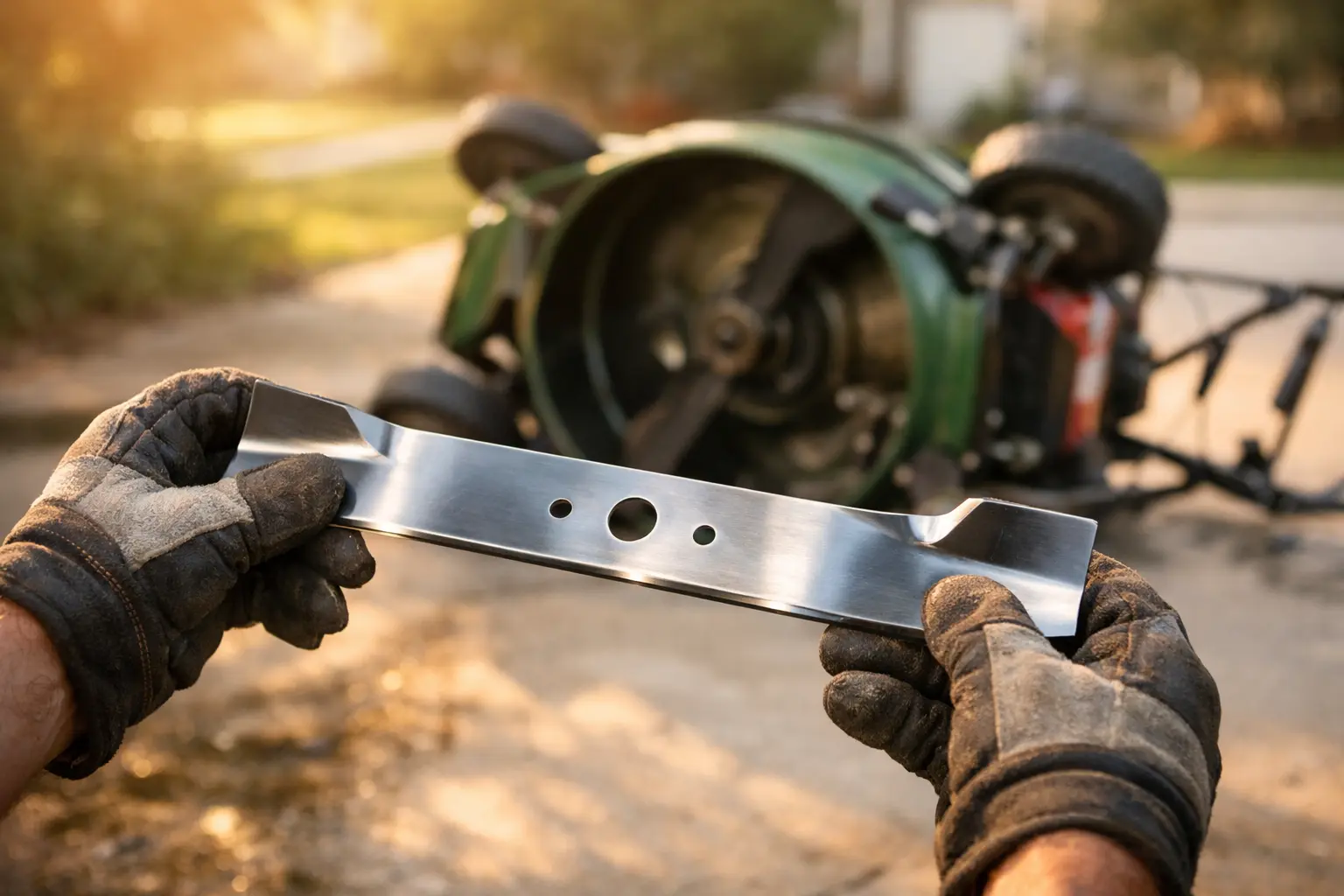
It was a Saturday morning in late May. I had my coffee. The sun was out. I walked to my garage in suburban Indiana, fired up my Toro, and pushed it across the front lawn.
The grass looked terrible.
Not because I hadn’t mowed. I had. But every blade of grass looked torn, not cut. The tips were brown and ragged. My neighbor walked by, looked at my lawn, and said nothing. That silence said everything.
That was the day I finally learned how to replace lawn mower blade the right way. And honestly? It changed how I take care of my lawn completely.
If your grass looks shredded after mowing, your mower sounds like it’s chewing rocks, or you feel a weird vibration in the handle — your blade is probably done. Maybe dull. Maybe bent. Maybe both.
The good news? You can fix it yourself. In your driveway. In under an hour.
I’ve done this on my Honda HRX, my neighbor’s old Craftsman, and my dad’s Husqvarna riding mower down in Tennessee. Each time, I learned something new. I’m going to share all of it with you here. New to using a mower altogether? Start here first. The Complete Guide to Using a Lawn Mower at Home covers everything you need to know before you begin.
No fluff. No manual copy-paste. Just what actually works.
Why Replacing Your Lawn Mower Blade Actually Matters
Most people don’t think about the blade until something goes really wrong. I was that person too.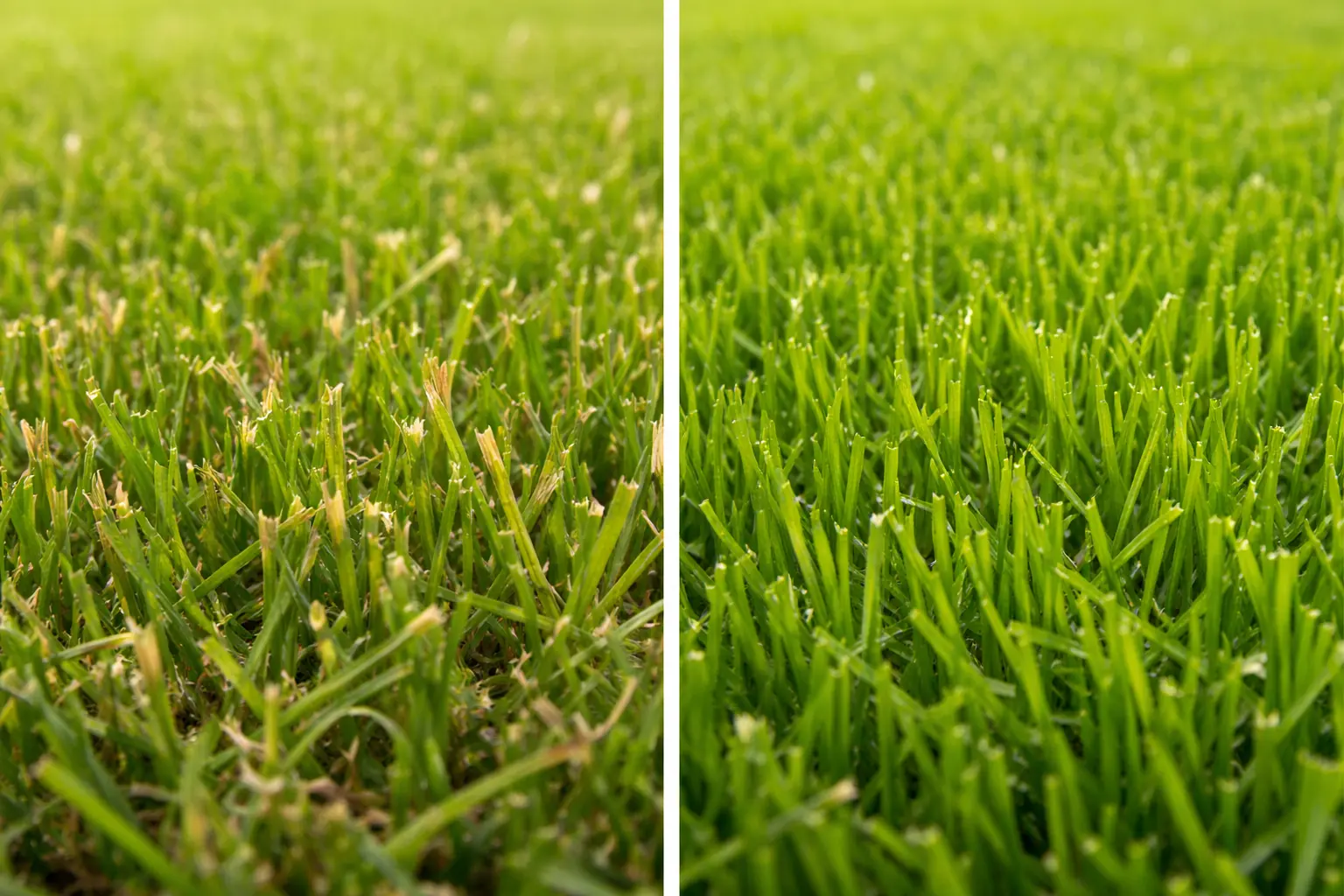
A Dull Blade Does More Damage Than You Think
Here’s something I didn’t know for years. A dull mower blade doesn’t just cut badly. It tears the grass.
When grass gets torn instead of cut, the wound stays open. That open tip turns brown. It becomes a door for disease and fungus. Especially in humid states like Florida or Georgia, that’s a real problem.
I remember the first time I noticed this clearly. I had two sections of lawn — one I’d mowed with a fresh blade and one with the old one. The fresh-cut section was bright green a few days later. The torn section had brown tips for almost two weeks.
The difference was obvious. Like night and day.
A dull blade also makes your mower work harder. The engine strains. On a gas mower, you burn more fuel. On a battery mower, you drain the charge faster. Neither is good.
Here’s how a dull blade shows up:
- Brown or frayed grass tips after mowing
- Uneven cut height across the lawn
- Loud rattling or vibration during use
- Mower bogging down on thicker grass
- Stripes of uncut grass left behind
That last one happened to me in August during a Texas summer visit at my brother’s house. His Bermuda grass is thick and aggressive. His blade was so dull, the mower left actual strips of uncut grass behind. He thought his mower was broken. It wasn’t. The blade just needed to go.
How Often Should You Really Replace It?
This is the question I get asked most. And the honest answer is — it depends.
A general rule: replace the blade every one to two seasons or after every 20 to 25 hours of use. But that’s just a starting point.
Some people mow once a week. Some mow twice. Some have big yards with thick grass. Some mow small flat lawns with fine fescue. The wear rate is different for all of them.
Here’s when to sharpen versus when to replace:
Sharpen if:
- The edge is just dull, no cracks
- The blade is still straight and flat
- No deep nicks or missing metal
Replace if:
- The blade is bent or twisted
- There are cracks near the center hole
- Metal is chipped out along the edge
- The blade wobbles after sharpening
I once ran over a buried sprinkler head in my Arizona backyard. Didn’t even see it. The blade hit it at full speed. After that, there was no sharpening that blade back to life. It needed a full replacement. The blade had a visible bend and a chunk missing from one tip.
That’s when you replace. Full stop.
The Real Cost of Ignoring the Blade
A replacement blade costs between $10 and $40 for most walk-behind mowers. Riding mower blades run $15 to $60 per blade, usually sold in sets.
Now compare that to what happens if you ignore it.
A bad blade puts extra stress on the spindle bearings. Spindle replacement? That’s $80 to $150 at a shop, sometimes more. Engine strain from overworking a dull blade can cause premature wear on the carburetor and air filter. That’s another repair bill you didn’t need.
Fix the blade early. It’s the cheap fix that prevents the expensive ones.
Safety First — And I Mean It
I know. You want to skip this section. Don’t.
This is the part where I tell you what happened to my neighbor Mark in North Carolina. He decided to change his blade one afternoon without disconnecting the spark plug. He wedged his hand under the deck to hold the blade. The mower didn’t start. But his heart nearly stopped when he realized what he’d done.
He got lucky. Not everyone does.
Gear Up Before You Touch Anything
This is non-negotiable. Before you touch the blade, put these on:
- Heavy-duty work gloves — not the thin garden ones. I use Mechanix gloves. They’re thick enough to protect against cuts and still let you grip things well.
- Safety glasses — debris flies when you’re scraping the deck or dealing with a stuck bolt.
- Long pants — blades stay sharp even when they’re “dull” for cutting. They’ll still cut you.
The blade on a lawn mower is a serious piece of metal spinning at thousands of RPM. Even when the mower is off, treat it with respect.
Disconnect Power — Every Single Time
This is the most important step in the whole process. I’ll say it loud and clear.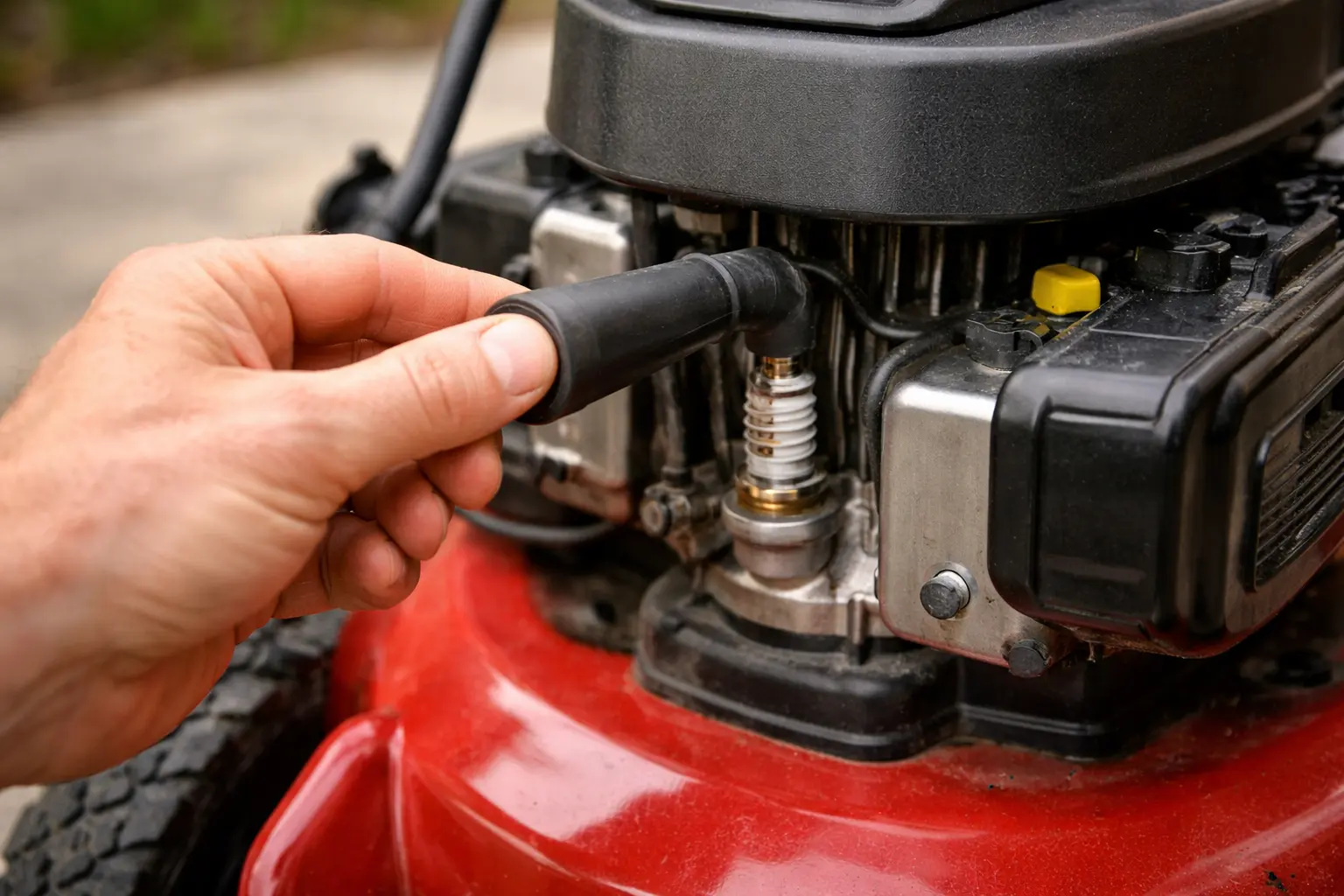
On a gas mower: Disconnect the spark plug wire.
It takes three seconds. Pull the rubber boot off the spark plug tip. That’s it. Now the engine physically cannot start.
On a battery-powered mower: Remove the battery pack completely.
Don’t just turn it off. Remove the battery. I have an EGO mower, and I learned early that these can sometimes engage unexpectedly if the safety switch isn’t fully released.
Here’s a quick checklist before you start:
- Spark plug wire disconnected (gas mower)
- Battery pack removed (electric mower)
- Fuel petcock closed (if your mower has one)
- Mower on a flat, stable surface
- Blade has fully stopped spinning — wait at least two minutes
That last one matters more than people think. I once went to flip my mower thirty seconds after shutting it off. The blade was still spinning — slowly, barely visible. Slow is still spinning.
Wait.
Tipping the Mower Safely
You need to tip the mower onto its side to access the blade. This is where a lot of people mess up — not on the blade itself, but on the tipping.
Always tip the mower so the air filter and carburetor face UP.
This is critical. If you tip it the wrong way, engine oil flows into the air filter. Then into the carburetor. You’ll get white smoke on startup, a fouled spark plug, and a mower that won’t run right until you clean everything out.
I’ve seen this happen. My buddy in Tennessee tipped his Briggs & Stratton mower the wrong way. Called me twenty minutes later wondering why his mower was blowing white smoke like a steam engine. I had to walk him through the whole cleanup over the phone.
Don’t do that to yourself.
Place a piece of cardboard or an old rubber mat under the deck. It protects both the deck and your driveway surface. Then tip slowly and carefully, making sure the mower rests stable on its side.
Locking the Blade So It Doesn’t Spin
When you go to loosen the blade bolt, the blade will want to spin. You need to stop it.
The easiest method: wedge a small block of wood between the blade and the inside of the deck. Just push it in so the blade can’t rotate. It doesn’t need to be tight — just enough to resist turning.
You can also buy a blade removal tool — a small metal holder that grips the blade. They’re available at Home Depot, Lowe’s, or Amazon for under $10. If you plan to do this more than once, it’s worth having.
Never hold the blade with your bare hand while turning the bolt. Even with gloves, your grip can slip.
Tools You’ll Need to Replace a Lawn Mower Blade
Good news here. You probably already own most of these.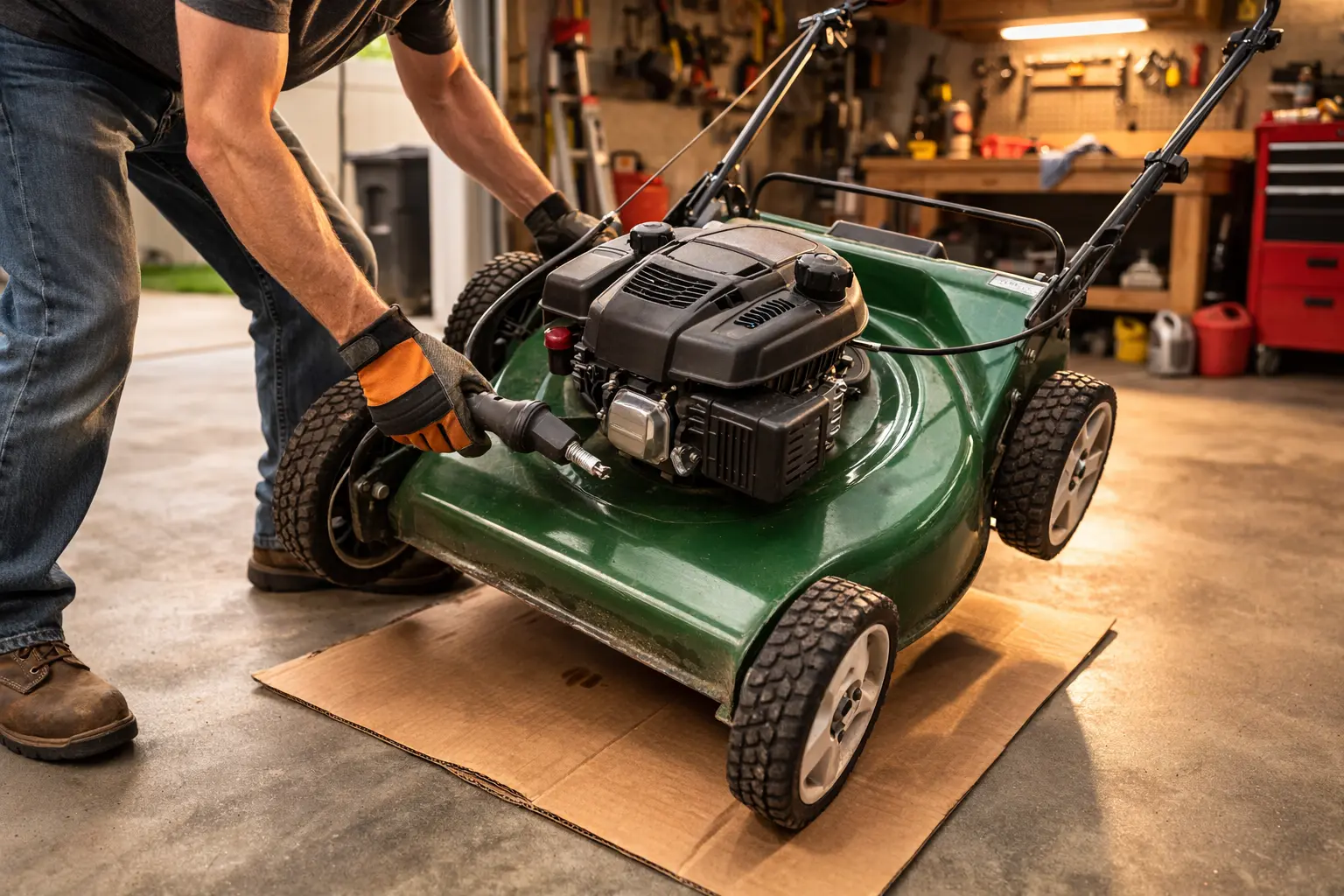
The Essential Tool List
Here’s what you actually need:
- Breaker bar or impact wrench — that blade bolt is usually tight. Very tight. Especially on older mowers.
- Socket set — most mower bolts are 5/8″ or 3/4″. Have a range just in case.
- Torque wrench — for reinstalling the bolt correctly. Don’t skip this.
- Blade holder or wooden block — to stop the blade from spinning
- Wire brush — for cleaning the deck underside
- Penetrating oil — PB Blaster is my go-to. WD-40 works for light rust. For serious corrosion, Kroil is the best I’ve ever used.
- Work gloves and safety glasses
Optional But Helpful Tools
These aren’t required, but they make the job easier and better:
- Blade balancer — a small cone-style tool that checks if your new blade is balanced. They cost about $5 and save you from spindle damage later.
- Rubber mallet — helps break loose a stubborn blade after the bolt is removed
- Permanent marker or paint pen — mark the bottom side of the old blade before removing it. This tells you exactly which way to install the new one.
- Your phone — take a photo of the blade position before removing it. I started doing this back in 2019. Never installed a blade upside down again after that.
Where to Buy Replacement Blades
You have a few solid options:
- Home Depot and Lowe’s — carry blades for common brands like Craftsman, Toro, and Husqvarna
- Amazon — huge selection, easy to search by mower model number
- Brand-specific dealers — Husqvarna dealers, Honda Power Equipment dealers, Toro service centers. Better for exact OEM fits.
OEM vs. aftermarket — here’s my honest take.
OEM blades (from the original brand) are guaranteed to fit perfectly. They cost more. For most residential walk-behind mowers, aftermarket blades from brands like Oregon, Stens, or Maxpower work just as well at half the price.
I’ve run Oregon blades on my Honda HRX for two seasons. Zero issues.
For riding mowers, I lean toward OEM. The deck geometry is more precise, and a slightly wrong fit causes more problems on a riding mower than a push mower.
How to Find the Right Replacement Blade
Getting the wrong blade is the number one mistake beginners make. I know because I made it on my first try.
Locate Your Mower’s Model Number
Before you order anything, find your mower’s model number. Here’s where to look for common brands:
- Toro — sticker under the rear of the deck
- Honda — on the engine block, usually near the oil fill cap
- John Deere — on the frame near the seat (riding mowers), or under the deck on walk-behinds
- Craftsman — sticker under the deck or on the frame
- Husqvarna — on the deck near the discharge chute
Take a photo with your phone. Don’t try to memorize a 12-digit number in a dark garage.
Measure Your Old Blade
Even better than using the model number — measure the old blade directly.
Here’s what to note:
- Length — tip to tip. Common sizes: 18″, 20″, 21″, 22″
- Center hole size (arbor hole) — most common is 5/8″
- Blade thickness — affects cutting power and durability
- Blade style — this matters for performance
Blade types explained simply:
- Standard blade — basic cutting, great for dry, flat lawns
- High-lift blade — creates strong airflow, excellent for bagging. Very popular in the Southeast where grass grows thick and fast.
- Mulching blade — chops clippings finely and drops them back into the lawn. Big in the Midwest and Pacific Northwest.
- 3-in-1 (combo) blade — mulch, bag, or side discharge. Very versatile. My personal favorite for Indiana lawns.
Matching Blade to Your Grass Type
This part surprised me when I first learned it. Not every blade works equally well on every grass type.
- Bermuda grass (Texas, Georgia, Carolinas) — high-lift or standard blade works best. Bermuda is dense and fast-growing.
- St. Augustine (Florida, Gulf Coast) — mulching or 3-in-1. This grass is wide-bladed and benefits from mulched clippings.
- Kentucky Bluegrass and Fescue (Midwest, Northeast) — mulching blade is ideal. Keeps nitrogen in the soil, especially in fall.
- Zoysia (Southeast and transition zone) — standard or low-lift. Zoysia doesn’t need aggressive airflow.
I switched to a mulching blade on my Kentucky Bluegrass lawn in central Indiana about three years ago. By late August, I stopped needing to bag clippings entirely. The lawn fed itself.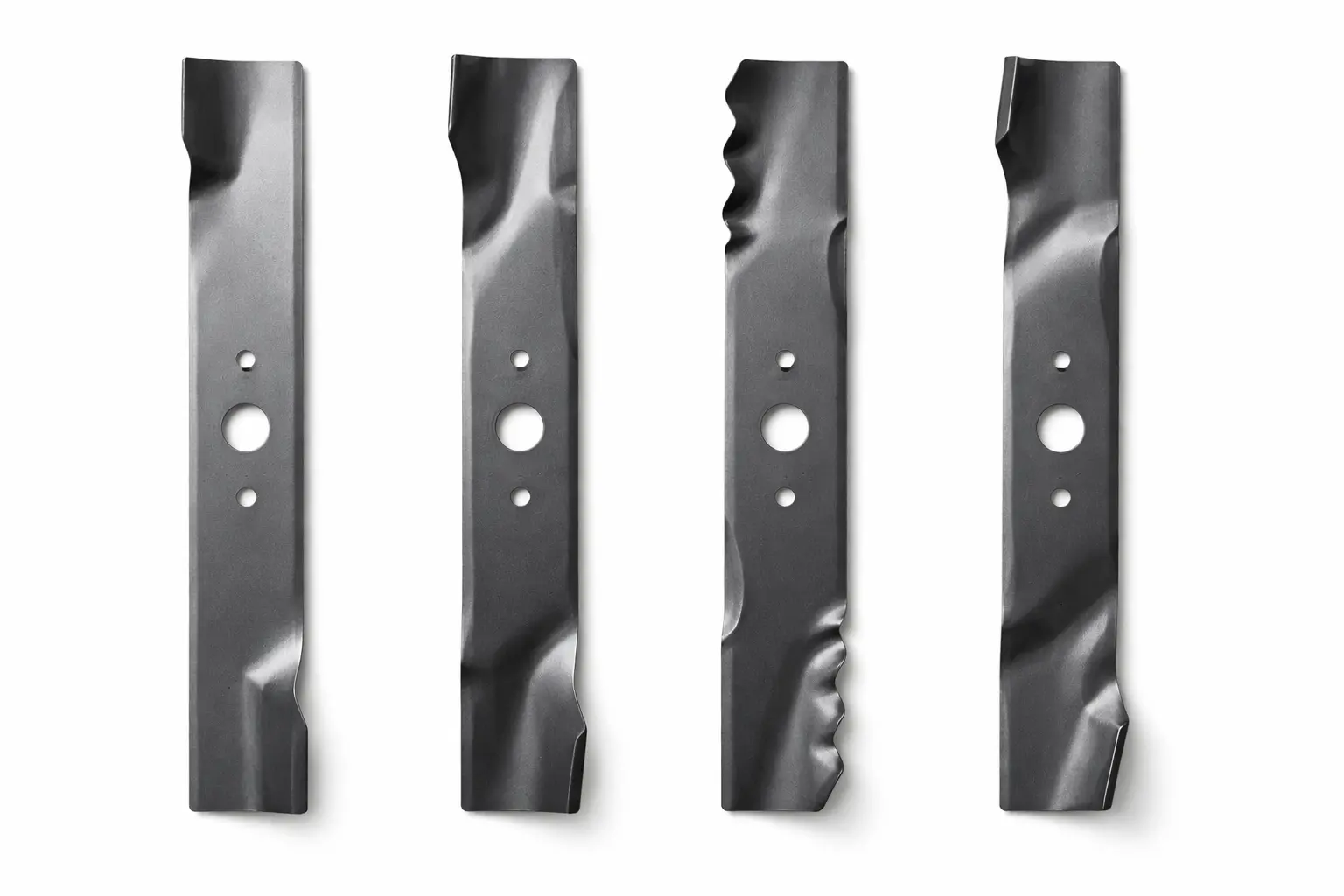
Don’t Cheap Out on Blade Quality
Blade hardness matters. Cheap blades dull faster and can flex under impact.
Look for heat-treated or hardened steel blades. Oregon, Stens, and Maxpower are the three aftermarket brands I trust. They’re widely available across the US, usually $12 to $40 for walk-behind mower blades.
Riding mower blade sets run $15 to $60 per blade. Always buy heat-treated for riding mowers — the additional weight and speed make blade quality more important.
Step-by-Step Guide — How to Replace Lawn Mower Blade
Alright. This is the main event. Read through this once before you touch anything. Trust me on that.
Step 1 — Prep Your Mower and Work Area
Pick a flat surface. Garage floor, concrete driveway, solid ground. Not grass, not gravel.
I prefer doing this in the morning. Cooler temperatures, good light, and I’m not in a rush. One Sunday morning in June, I had my blade replaced and was back inside with a second cup of coffee by 9am.
Here’s what to do before you start:
- Gather every tool you need — don’t hunt for things mid-job
- Run the mower until it’s nearly out of gas, or drain the fuel (especially if you’re in the Midwest and storing it through winter after this)
- Let the mower cool down if you just used it
- Disconnect the spark plug wire or remove the battery
Say it with me: disconnect the spark plug wire. I’ll keep saying it.
Step 2 — Tip the Mower onto Its Side
Take your photo first. Get a clear shot of the blade position, which way it’s facing, and any washers or adapters visible below the deck.
Then tip the mower air filter side up.
Lay it down slowly onto cardboard or a rubber mat. Make sure it’s stable. If you have to, lean it against a wall — just make sure it won’t slide.
Use your marker to mark the bottom side of the blade before you touch the bolt. Just a quick “X” or “BOTTOM” on the face pointing toward the ground. This will save you from reinstalling it upside down.
Step 3 — Loosen the Blade Bolt
Here’s the part that trips people up the most.
Most lawn mower blade bolts are reverse-threaded. That means you turn them clockwise to loosen.
I know. That sounds wrong. The whole “righty tighty, lefty loosey” rule you grew up with? Doesn’t apply here on many mowers. The blade bolt is reverse-threaded so the spinning motion of the blade keeps it tight during use.
Wait — not all mowers are reverse-threaded. Honda walk-behind mowers, for example, use a standard right-hand thread. So you’d turn counterclockwise to loosen, as normal.
If you’re not sure, try counterclockwise first with light pressure. If it doesn’t move, try clockwise. Don’t force it either direction until you know.
Wedge your block of wood between the blade and deck. Get your socket on the bolt — usually 5/8″ or 3/4″. Apply firm, steady pressure with your breaker bar.
If the bolt doesn’t budge:
- Spray penetrating oil around the bolt base
- Let it sit for 10 to 15 minutes
- Try again with a longer breaker bar for more leverage
- Tap the end of the breaker bar with a rubber mallet to break the corrosion
Be patient. Rusty bolts need time. I’ve had bolts that didn’t move for 25 minutes after the first oil spray, then came loose with one smooth pull after a second application.
Dealing With Stuck or Rusted Bolts
Rust is real, especially in high-humidity areas or if the mower sat outside all winter in the Midwest or Northeast.
PB Blaster is my first choice for stuck mower bolts. It’s available at every hardware store in America. Spray it on, let it sit. For really stubborn bolts, Kroil is even more effective — a little pricier but worth keeping in the garage.
A few things to avoid:
- Don’t use a high-torque impact gun on aluminum decks — you can strip the spindle threads easily
- Don’t apply heat near the fuel tank or carburetor
- If the bolt head is rounded off already — stop. Take it to a shop. A rounded bolt becomes a much bigger repair.
Step 4 — Remove the Old Blade
Once the bolt is loose, spin it off by hand the rest of the way. Keep your gloves on.
Set the bolt in a small container — a cup, a magnetic tray, anything. Same with any washers, spacers, or adapters that come off with the blade. These small parts matter. Losing a washer means a trip to the hardware store at the worst possible moment.
Look at what came off carefully:
- Some mowers have a star washer between the blade and deck
- Some have a blade adapter that looks like a curved metal plate
- Some have just a flat washer
- Some have nothing between the blade and spindle
Lay them all out in order on your cardboard. Left to right, in the sequence they came off. This is your reinstall guide.
Now look at the spindle — the post the blade sits on. Check for cracks, rust, or wobble. Grab the spindle and try to wiggle it gently. There should be zero play. If it wobbles at all, the spindle bearings are bad. That’s a separate repair.
Use your wire brush to clean the underside of the deck. You’ll probably find a thick layer of dried grass. Clean it off. Wet grass buildup causes rust and corrosion. Takes two minutes. Worth doing every time.
Inspecting the Spindle and Adapter
A damaged spindle or adapter will cause problems even with a perfect new blade.
If the adapter is cracked or bent — replace it before installing the new blade. They’re cheap, usually $5 to $15, and available online or at any mower shop.
A bad spindle will make the mower vibrate no matter how good the blade is. If you feel that vibration after the new blade is on — suspect the spindle. Most spindle replacements are shop jobs for average homeowners. It involves bearing removal and press-fitting. Not a fun DIY on a tight deadline.
Step 5 — Install the New Blade
Okay. New blade in hand. Here’s how to get this right.
The cutting edge must face down when the mower is in its normal upright position.
Most quality blades have a stamp that says “this side down” or “grass side down.” Look for it. If it’s there, trust it.
If there’s no marking, look at the blade shape. The cutting edge is the angled, sharpened side. The flat side faces up, toward the deck.
Use your marker photo for reference. The new blade should mirror the old blade’s orientation exactly.
Slide the blade onto the spindle. Reinstall any adapters, washers, or spacers in the exact order you removed them. This is why laying them out in sequence matters.
Hand-tighten the bolt first. Make sure it threads easily. If it feels tight immediately, stop — the thread is wrong or the blade isn’t seated correctly.
Torquing the Blade Bolt Correctly
This step matters a lot. Under-tighten and the blade can come loose — that’s dangerous. Over-tighten and you strip the spindle threads — that’s expensive.
Use a torque wrench. Here are common torque specs:
- Honda walk-behind mowers — approximately 40 ft-lbs
- Husqvarna walk-behind — approximately 45 ft-lbs
- Toro Recycler series — approximately 35 to 45 ft-lbs (check your manual)
- Most residential walk-behinds — 35 to 50 ft-lbs is the safe range
Riding mower torque specs vary more widely. Always check the manual for riding mowers. Getting this wrong on a riding mower with a heavier blade at higher RPM is much more serious.
Step 6 — Check Blade Balance Before Finalizing
I almost skipped this the first few times. I wish I hadn’t.
Even brand-new aftermarket blades can be slightly unbalanced. It’s not common, but it happens. And an unbalanced blade causes constant vibration, which slowly destroys the spindle bearings.
A cone-style blade balancer costs $5 to $10 at Home Depot, Lowe’s, or Amazon. You hang the blade on the cone and see which side dips.
If one side is heavier, use a metal file to remove a small amount from that tip. Not much — just enough to bring it level. Recheck. Repeat until the blade hangs horizontally.
Think of it like new car tires. Even brand-new tires need to be balanced. You wouldn’t skip that. Don’t skip this.
Step 7 — Reassemble and Test
Lower the mower back to its upright position. Do it slowly — don’t let it drop.
Reconnect the spark plug wire. Or reinstall the battery pack. Fill with fresh fuel if you drained it.
Start the mower. Stand to the side for the first few seconds — not directly in front.
Listen for:
- Smooth, even sound — good, you’re done
- Vibration or rattling — blade may be loose or unbalanced
- Unusual grinding noise — blade may be hitting the deck
Take one test pass across a section of lawn. Clean, even cut across the full width? Perfect. You did it.
If the cut looks messy or patchy — the blade may be upside down. It happens. Shut it down, disconnect the spark plug, flip the blade, and try again. No shame in it.
Common Mistakes People Make When Replacing Mower Blades
I’ve made most of these. So now you don’t have to.
Installing the Blade Upside Down
This is the most common beginner mistake. Hands down.
You can tell immediately when the mower runs. The grass gets pushed flat instead of cut. It looks almost the same as before you started. Frustrating.
Fix is simple: remove the blade, flip it, reinstall. The whole thing takes five minutes once you know what happened.
Forgetting the Blade Adapter or Washer
These small parts are easy to knock aside while you’re wrestling with a stuck bolt. Then they roll under the mower, and suddenly you’re on your knees with a flashlight at 11am.
Lay all hardware out in order as you remove it. Every single piece.
Over-Tightening the Bolt
This is the one that causes real damage. Stripped spindle threads mean the bolt can’t grip properly anymore. The spindle may need replacement.
Use a torque wrench. Not guesswork. Not “as tight as I can get it.” A torque wrench gives you the exact number, every time.
Tipping the Mower the Wrong Way
Carburetor down = oil in the air filter. White smoke on startup, fouled spark plug, mower running rough.
Air filter side UP. Always. Write it on your garage wall if you need to.
Skipping the Spark Plug Disconnect
Mentioned before. Mentioning again. This is the step that prevents serious injury. The mower can start without warning if the spark plug is connected and the engine is bumped.
Three seconds. Remove the boot from the spark plug tip. That’s all it takes.
Buying the Wrong Blade Size
Measure the old blade before ordering online. Blade length, arbor hole size, and style all need to match.
Don’t assume the same brand means the same blade. A Toro 21″ model from 2019 may use a different blade than a Toro 21″ model from 2023. Always verify with the model number.
Riding Lawn Mower Blade Replacement — Key Differences
Walk-behind mowers and riding mowers are a different job. Similar principles, different process.
Getting Under a Riding Mower Safely
A riding mower is heavy. Don’t ever work under it supported only by a floor jack.
Use a proper floor jack and jack stands. Place the jack stands under the frame, not the deck. Make sure the mower is on level ground and the parking brake is fully engaged. Chock the rear wheels with blocks.
Mower lift ramps — made by Craftsman, Husqvarna, and others — are a great investment if you own a riding mower. They’re like car ramps but made for the lower profile of a mower deck. Makes the whole job much easier and safer.
Multiple Blades, Multiple Spindles
Most residential riding mowers have two or three blades side by side on the deck.
Here’s what to do:
- Replace all blades at the same time — mixing a new blade with old ones creates uneven cutting height and uneven lift
- Each blade has its own bolt and spindle — the removal process is the same for each one
- Label them as you remove them: left, center, right — helps during reinstall
Deck Belt and Pulley Check
While you’re under the deck, look at the belt and pulleys.
Run your hand along the belt and look for cracks, fraying, or glazing on the surface. A belt that breaks mid-mow is a frustrating afternoon.
Spin each pulley by hand. It should rotate freely with no grinding, no stiffness, no wobbling. A bad pulley is cheap to replace now and expensive to ignore later.
Clean the deck underside while you’re at it. Dry grass buildup traps moisture and causes rust, especially in humid Southern states.
When to Call a Professional Instead
Some issues are beyond a DIY blade swap:
- Damaged spindle housing (cracked metal around the spindle)
- Bent blade shaft (the spindle itself is bent)
- Cracked or warped deck
- PTO clutch failure — blade won’t engage or disengage properly
Professional blade replacement for a riding mower typically runs $60 to $120 in labor plus parts. For complex issues like spindle damage, you’re looking at more.
If your mower is still under warranty, take it to an authorized dealer. DIY repairs can sometimes void manufacturer coverage.
Maintaining Your New Blade for Longer Life
You did the work. Now make it last.
Clean the Deck After Every Few Mows
Grass buildup is the silent enemy of mower blades. It holds moisture against the metal. Rust starts underneath where you can’t easily see it.
After every two or three mows:
- Tip the mower to the side (air filter up, always)
- Use a deck scraper or stiff brush to knock off dried clippings
- A garden hose rinse works well — just avoid blasting water directly into spindle bearings
- Let the deck dry before storing
This takes five minutes. Skipping it for a season causes a rust problem you’ll spend an hour fixing later.
Sharpen Before Replacing — Know the Line
A blade doesn’t need replacing every time it gets dull. Sharpening is usually the right call first.
Sharpen after every 8 to 10 hours of mowing. For most homeowners, that’s every 4 to 6 weeks during the growing season.
Methods:
- Flat file — slow but controlled. Good for beginners.
- Angle grinder — faster. Requires steady hands and safety glasses.
- Bench grinder — fastest. Great if you already own one.
Maintain the original blade angle — usually 30 to 35 degrees. Keep the bevels even on both ends.
Check balance after every sharpening. Every time you remove metal, the balance can shift slightly.
When sharpening is no longer enough: the blade has deep nicks you can’t file out, visible cracks, or the metal has thinned below the minimum stamp thickness on the blade. At that point — replace it.
Seasonal Storage Tips
This matters a lot in the northern half of the country. Midwest winters, Northeast winters — mowers sit for four to six months.
Here’s what I do every October:
- Do a final blade inspection before the last mow of the season
- Sharpen or replace if needed — don’t start spring with a dull blade
- Coat the blade lightly with oil to prevent rust during storage
- If possible, remove the blade and store it inside the garage
- When spring arrives: re-inspect before the first mow
April in Michigan is my ritual. Coffee in hand, garage door open, first morning above 50 degrees. I check the blade, check the oil, and add fresh fuel. Twenty minutes. Then the season starts right.
Building a Lawn Mower Maintenance Calendar
A simple schedule keeps things easy:
Spring (March–April):
- Blade inspect, sharpen or replace
- Engine oil change
- Fresh fuel or fuel stabilizer flush
- New spark plug if needed
Summer (May–August):
- Clean deck every 2 to 3 mows
- Check blade bolt torque monthly
- Watch for vibration or unusual sounds
Fall (September–October):
- Final sharpen or full blade replacement
- Deck cleaning and inspection
- Belt and pulley check on riding mowers
Winter (November–March in Northern US):
- Drain fuel or add stabilizer
- Coat blade with light oil
- Store in a dry, covered space
Blade Replacement for Specific Popular Mower Brands
A quick guide for the mowers most Americans actually own.
Honda HRX and HRN Series
Honda makes tight blade bolts. Plan for it. A breaker bar is almost always necessary on Honda walk-behind mowers.
The HRX217 uses a 21″ blade with a 5/8″ center hole. Honda’s blade bolt is standard right-hand thread — counterclockwise to loosen. Different from many other brands.
Honda’s NeXite deck doesn’t rust like steel decks. Still worth cleaning, though. The spindle is solid — Honda mowers hold up well when maintained properly.
OEM Honda blades are pricier but excellent. Oregon aftermarket blades for Honda are a reliable budget option.
Toro Recycler and TimeMaster Series
The Toro TimeMaster uses two 15″ blades side by side. Both need replacement at the same time.
Toro’s PartSmart tool online is genuinely helpful. Enter your model number and it shows you exactly which blade fits. No guessing.
Most Toro walk-behind models have reverse-threaded blade bolts — clockwise to loosen.
For homeowners in the Southeast US who bag their clippings, upgrading to an Oregon high-lift blade on a Toro Recycler makes a noticeable difference in bagging performance.
Husqvarna Walk-Behind and Riding Mowers
Husqvarna makes a wide range of mowers. The most important thing: always verify by deck size, not just model name.
Husqvarna recommends 45 ft-lbs torque for most residential walk-behind models. That’s on the higher end — don’t skip the torque wrench on these.
The Husqvarna blade part finder on their website is straightforward. Enter the model number, get the exact part.
In the Carolinas and Virginia, I’ve seen a lot of Husqvarna owners upgrade to mulching blades. The moderate climate with regular rainfall makes mulching work really well. Clippings break down fast and feed the lawn naturally.
John Deere E100, E130, E150 Series
The E-series John Deeres are everywhere in suburban America. They’re reliable, common, and well-supported for parts.
The E150 and similar larger models have three-blade decks. Always replace all three at the same time.
John Deere OEM blades are worth the premium for riding mowers. The deck geometry on John Deere machines is precise, and a slightly wrong-fitting aftermarket blade causes more vibration than on a push mower.
The GX20249 blade set fits multiple E-series models and is widely available. Always verify compatibility with your specific model before ordering.
Engage the parking brake before you go under a John Deere deck. It sounds obvious. It’s still worth saying.
Craftsman and Ryobi Budget-Friendly Options
Craftsman (sold at Lowe’s) and Ryobi (sold at Home Depot) are two of the most common mower brands across the country. Affordable, accessible, and easy to find parts for.
For both brands, Maxpower and Oregon aftermarket blades are reliable and widely available. I’ve used both with good results.
One thing to note: Budget-oriented mowers sometimes have softer spindle materials. This makes over-torquing the blade bolt a bigger risk. Use a torque wrench. Stick to the lower end of the recommended range — around 35 ft-lbs for most Craftsman and Ryobi walk-behind models.
The Craftsman T110 and T130 riding mowers are common suburban US models with 42″ two-blade decks. Oregon blade sets for these are easy to find and work well.
Electric and Battery-Powered Mower Blades — What’s Different?
Battery mowers are everywhere now. The blade replacement process is similar — but not identical.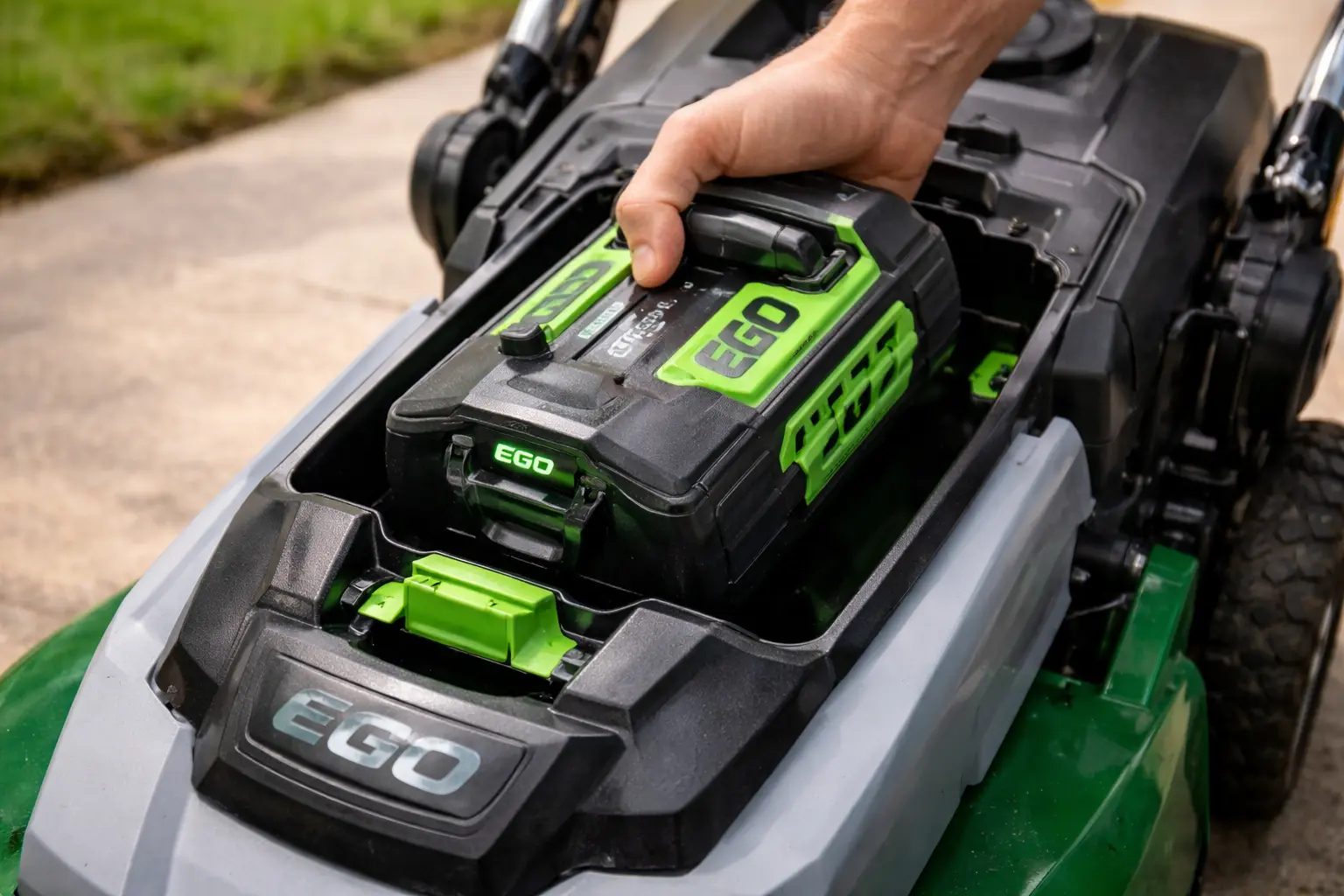
EGO, Greenworks, and Ryobi Battery Mower Blades
Rule one: remove the battery pack first. Not just power it off. Pull the battery.
These mowers can have unexpected blade engagement if the battery stays in and a safety switch is bumped. Three seconds to remove the pack. Always worth it.
Battery mower blade bolts are typically standard right-hand thread — counterclockwise to loosen. Torque specs are also lower, usually 25 to 35 ft-lbs, because the decks are lighter.
Blade replacement frequency is similar to gas mowers — every one to two seasons, or when you see the signs.
Why Battery Mower Blades Dull Faster on Some Grasses
Here’s something worth knowing. Battery-powered motors deliver power differently than gas engines. They don’t have the same torque surge when the blade hits thick resistance.
This means the blade sometimes drags through dense grass rather than cutting cleanly. The edge dulls faster.
Bermuda and Zoysia grass — common across the Southeast US — are particularly abrasive. If you’re mowing these grass types with a battery mower, invest in a high-quality hardened steel blade. Not the cheapest option. The durability difference is real.
Robotic Mower Blades
This is worth a quick mention because people sometimes ask.
Husqvarna Automower and similar robotic mowers use a completely different blade system. Small replaceable plastic or metal blades on a spinning disc. Replace them every one to three months per manufacturer recommendations.
No tools needed on most models — just twist the old blades off and twist the new ones on.
Don’t try to apply any of the steps in this article to a robotic mower. The systems are entirely different.
Frequently Asked Questions
The questions people actually search at 9pm the night before they plan to mow.
Can I Sharpen Instead of Replace?
Yes — if the blade is straight, has no cracks, and still has enough metal thickness.
Most blades have a minimum thickness stamped on them. If you’ve sharpened it down past that line, replace it.
A local shop will sharpen a mower blade for $10 to $20. DIY sharpening costs nothing if you already own a file or grinder.
Which Direction Does the Blade Bolt Turn to Loosen?
This depends on your mower.
Most gas mowers: clockwise to loosen (reverse thread) Honda walk-behinds: counterclockwise to loosen (standard thread) Most battery mowers: counterclockwise to loosen (standard thread)
When in doubt, check your owner’s manual. Or try counterclockwise gently — if it doesn’t move, try clockwise.
How Long Does It Take?
First time: 30 to 45 minutes, especially if a bolt is stuck.
Once you’ve done it once or twice: 15 to 20 minutes for a walk-behind mower.
Riding mower with multiple blades: 30 to 60 minutes.
How Much Does a Shop Charge?
Walk-behind blade replacement at a shop: $30 to $60 labor, plus the blade cost.
Riding mower: $60 to $120 labor, plus blades.
Doing it yourself saves real money. And after you’ve done it once, it’s easy.
Do I Need to Balance a New Blade?
Technically, yes. Even new blades can be slightly off.
A cone-style balancer is $5. The spindle bearing it protects costs $80 to $150 to replace.
Easy math. Check the balance.
Can One Person Do This Job Alone?
Absolutely. This is a solo job. Good lighting, the right tools, and a safe workspace matter more than having a second person.
Just don’t rush. And don’t skip the safety steps.
The first time I replaced a blade, I Googled it three times, watched two YouTube videos, and still managed to install it upside down on the first try. I had to do the whole thing over.
That’s fine. Honestly. That’s how you learn.
The second time took half as long. The third time was automatic.
Knowing how to replace a lawn mower blade is one of those small skills that saves real money and makes your lawn look genuinely better. It’s not complicated. It just takes the right information and a free Saturday morning.
You’ve got the information now. Pick a morning. Grab your tools. You’ll have it done before lunch.