
I bought my first lawn mower on a Saturday morning in June.
It was hot. I had a new house in the suburbs of Nashville, a backyard full of crabgrass, and absolutely zero idea what I was doing. I walked into the hardware store, pointed at a mid-priced gas mower, and said, “That one looks fine.” The guy at the counter nodded. I paid. I drove home.
Three hours later, the mower had stalled five times, the yard looked like a poorly shaved dog, and I had grass clippings in places I won’t mention. That was my introduction to lawn care. And honestly? I’m glad it happened.
Because those early mistakes pushed me to actually learn this stuff. Over the years, I’ve used push mowers, self-propelled gas mowers, battery-powered cordless mowers, riding mowers, and yes — even a robotic mower that I let wander around my yard like a confused Roomba. I’ve mowed thick Southern Bermuda grass in July heat. I’ve mowed wet Kentucky Bluegrass in the Midwest spring. I’ve dealt with blade problems, carburetor clogs, dead batteries, and one memorable incident involving a sprinkler head I forgot to mark.
This complete lawn mower guide is everything I wish I had read before I bought that first mower. It’s not a sales pitch. It’s just honest, practical experience written down — organized so you can actually use it.
Whether you’re a first-time homeowner staring at an overgrown lawn or a seasoned DIYer looking to upgrade your setup, there’s something here for you. Let’s get into it.
What Is a Lawn Mower, Really? (And Why Your Choice Matters More Than You Think)
Most people think a lawn mower is just a lawn mower. It cuts grass. That’s it. But after years of using different types, I can tell you — the right mower changes everything about your lawn care experience.
The Basic Idea
According to Wikipedia, lawn mowers have evolved significantly since their invention in 1830 — from simple reel designs to today’s robotic and electric models. Learn more about lawn mower history on Wikipedia. Simple enough. But inside that simple idea lives a world of engine types, blade systems, power sources, deck sizes, drive mechanisms, and design choices that affect how your lawn looks, how much effort you spend, and how long the machine lasts.
Think of it like shoes. You could technically run a marathon in sneakers. But running shoes, trail shoes, and flip-flops all exist for different reasons. Mowers are the same way. The wrong one makes everything harder than it needs to be.
Why the Right Mower Changes Your Lawn
I’ve seen it firsthand. When I switched from a cheap push mower to a properly sized self-propelled gas mower for my half-acre lot, mowing went from a 90-minute workout to a 45-minute chore I actually didn’t dread. Same yard. Completely different experience.
The right cutting height, blade type, and deck size produce a clean, even cut. A clean cut means healthier grass. Healthier grass crowds out weeds naturally. It’s a chain reaction that starts with your mower selection.
What Affects Your Mower Choice
- Yard size — the single biggest factor. Small yard, small mower. Large yard, larger machine.
- Terrain — flat, sloped, obstacle-heavy, or wide open all point to different mower types.
- Grass type — thick warm-season grass like Bermuda needs more power than fine fescue.
- Physical ability — pushing a heavy mower on a slope isn’t for everyone. Self-propelled or riding mowers exist for a reason.
- Storage space — a zero-turn mower needs a garage bay. Not everyone has that.
- Budget — mowers range from $100 to $12,000+. There’s a right option at every price point.
Keep these six things in mind as you read through this complete lawn mower guide. They’ll help you filter out the noise and zero in on what actually works for your specific situation.
Types of Lawn Mowers Explained — From Push Reel to Robot
There are more mower types than most people realize. I’ve used most of them at this point. Here’s what each one is actually like to live with — not just what the spec sheet says.
Push Reel Mowers
Let’s start old school. A reel mower has no engine. You push it, the rotation of the wheels spins a cylinder of helical blades, and they cut grass in a scissor-like action. That’s it.
I used one for two summers on a small city lawn in Knoxville. The pros are real — near silent operation, zero fuel cost, zero emissions, and a surprisingly clean cut on short, fine grass. There’s something meditative about it, too. Just you, the mower, and the sound of blades snipping.
But the cons are real too. Reel mowers struggle with grass taller than 3 or 4 inches. They bog down in thick turf. They can’t handle twigs or uneven ground well. If you let your lawn get away from you for two weeks in summer, a reel mower will make you regret it.
- Best for: Small, flat lawns under 1,500 square feet with fine grass
- Not ideal for: Thick grass, uneven terrain, infrequent mowing schedules
- Brands worth looking at: Fiskars, American Lawn Mower Company (a classic U.S. brand), Scotts
Walk-Behind Gas Push Mowers
This is the quintessential American lawn mower. Gas engine on top, spinning blade underneath, you push it across the yard. It’s what most of us grew up watching our parents use.
Gas push mowers are powerful, durable, and affordable. A decent one runs $250 to $450. Engines from Briggs & Stratton, Honda, or Kawasaki power most of them. They handle thick grass, long grass, and irregular terrain better than any reel or budget electric mower.
The trade-off is maintenance. Oil changes, air filter replacements, spark plug swaps, and carburetor cleaning are all part of owning a gas mower. They’re loud. They smell like exhaust. And that pull cord — oh, that pull cord. On a cold March morning when you’re tugging at it six times before the engine catches, you question all your life choices.
But for raw cutting performance and reliability on a medium suburban yard? A good gas push mower is genuinely hard to beat.
- Best for: Yards from 1/4 to 1/2 acre, flat or mildly sloped
- Not ideal for: Anyone who hates engine maintenance or wants a quiet mow
- Popular models: Honda HRX217, Toro Recycler 22, Husqvarna HU800AWD
Self-Propelled Gas Mowers
Same idea as a push mower, but the drive system moves the mower forward on its own. You guide it — you don’t muscle it. This single feature changes the mowing experience dramatically, especially if you have a sloped yard or a back that’s not what it used to be.
Front-wheel drive is better for flat yards and tight turns around garden beds. Rear-wheel drive is better for traction going uphill — the weight of the mower sits over the rear, giving the drive wheels more grip. Some premium mowers offer all-wheel drive, which handles any terrain.
I used a Toro self-propelled for three seasons on a hilly lot in Chattanooga. Going uphill was effortless. The mower pulled itself. My job was just to steer. When I went back to a push mower temporarily, the difference was jarring.
- Best for: Yards with slopes, anyone with physical limitations, yards 1/3 to 3/4 acre
- Popular models: Toro 21565, Honda HRX217VKA, Husqvarna HU800AWDH
Battery-Powered Cordless Mowers
This is where the industry is right now. Battery technology has genuinely caught up with gas — and in some ways, surpassed it. I was a skeptic for a long time. Then I tried the EGO Power+ LM2135SP.
It cut through thick late-summer Bermuda grass on my current lot. One charge. No stalling. Button start. And quiet enough that I could hear the birds. I’ve been battery-convert ever since for residential mowing.
The real breakthrough was lithium-ion battery voltage. Today’s 56V and 80V batteries from brands like EGO, Greenworks, Ryobi, and Milwaukee Tool deliver sustained torque that doesn’t fade. Older 20V and 40V batteries would bog down in heavy grass — those days are mostly gone with the newer high-voltage platforms.
The main limitation is runtime. A 5.0Ah battery gives most mowers 45 to 60 minutes of cut time. That’s enough for up to about half an acre. If you have a larger yard, you’d need a spare battery or two charges per session.
- Best for: Yards up to 1/2 acre, noise-sensitive neighborhoods, eco-conscious homeowners
- Not ideal for: Large properties over 1/2 acre without multiple batteries
- Top picks: EGO LM2135SP, Greenworks Pro 80V, Ryobi 40V HP, Milwaukee M18 FUEL
Corded Electric Mowers
The budget option for small yards. You plug them into an outdoor outlet, and they run indefinitely — no battery to charge, no gas to buy. Consistent power from start to finish.
The obvious limitation is the cord. A 100-foot extension cord covers a lot of ground, but it’s still a cord. You’ll spend some mental energy managing it — making sure it doesn’t get run over, keeping it from tangling around garden features, and staying conscious of where the outlet is relative to where you’re mowing.
For a city lot or a small backyard under 5,000 square feet? A corded electric makes a lot of practical sense. I used one in an apartment complex in Atlanta where the mowing area was basically a postage stamp. It was perfect.
- Best for: Small, simple lawns under 5,000 sq ft
- Not ideal for: Anything requiring movement away from an outlet or around obstacles
- Reliable options: Sun Joe MJ401E, Greenworks 14-inch corded, Black+Decker MM2000
Riding Lawn Mowers
Once your yard crosses half an acre, a walk-behind mower starts to feel like punishment. I crossed that threshold when we moved to a property with just over an acre in middle Tennessee. Mowing with a walk-behind took two hours. I bought a riding mower. It now takes 45 minutes.
Riding mowers come in two main styles: traditional rear-engine or front-engine tractors. Tractor-style riding mowers are the most common — steering wheel up front, engine under a hood, cutting deck in the middle. They’re intuitive to drive, handle wide open areas well, and many include bagging attachments, mulching capability, and tow hitches for small utility work.
Entry-level riding mowers from Craftsman and Troy-Bilt start around $1,200 to $1,600. Mid-range models from Cub Cadet and Husqvarna run $2,000 to $3,500. Premium John Deere models run $3,000 to $5,500 and above.
The cutting deck is measured in inches — typically 30 to 54 inches wide. A 42-inch deck on an acre lot is a solid match. Going bigger helps on wide open terrain but becomes awkward around tight obstacles.
- Best for: Properties 1/2 acre to 3 acres with open terrain
- Not ideal for: Properties with lots of trees, beds, and tight obstacles to navigate
- Best models: John Deere E130, Cub Cadet XT1 LT42, Husqvarna YTA24V48
Zero-Turn Radius (ZTR) Mowers
If riding mowers are pickup trucks, zero-turns are sports cars. They use dual hydrostatic transmissions controlled by two lap bars instead of a steering wheel. Each lever controls one rear drive wheel independently. Pull both back, you reverse. Push one forward and one back, you spin in place. Zero turning radius — that’s where the name comes from.
The result is unmatched maneuverability around obstacles combined with cutting speeds of 6 to 10 mph. A lawn that takes a riding mower 45 minutes might take a zero-turn 25 minutes. That speed and precision is why every commercial lawn care crew you’ve ever seen uses them.
I spent a Saturday on a friend’s Husqvarna Z254F on his two-acre property in Georgia. The learning curve takes maybe 20 minutes — then you’re weaving around trees and garden edges with a precision that feels almost surgical. It’s genuinely fun.
The downside? Price. Entry-level zero-turns start around $2,500. Mid-range models run $3,500 to $5,500. And they’re not suited for steep slopes — the rear-heavy design combined with lap bar steering can be unpredictable on grades above 15 degrees.
- Best for: Large flat properties 1 to 5+ acres, homeowners who value speed and precision
- Not ideal for: Steep terrain, tight budgets, small yards
- Top brands: Husqvarna, Ariens, Gravely, Bad Boy, Ferris, Scag
Robot Lawn Mowers
Yes. These are real. And yes, I’ve used one.
My neighbor in Brentwood, Tennessee set up a Husqvarna Automower 115H two summers ago. It runs a boundary wire around the perimeter of his yard. The robot stays inside the wire, mowing a little bit every day, automatically returning to its charging dock when the battery runs low or rain starts.
Watching it work is genuinely surreal. The lawn it produces is exceptional — because it mows so frequently in small increments, the clippings are microscopic and act as constant natural fertilizer. The grass was the greenest, most consistent lawn on the street.
The setup cost is significant — $600 to $3,500 depending on yard size and model. Installation of the perimeter wire takes 2 to 4 hours. And the mowing deck is small, so complex or very large yards may need more planning.
But if you want a truly hands-off lawn? Robot mowers are no longer science fiction.
- Best for: Tech enthusiasts, people with physical limitations, consistency-obsessed homeowners
- Not ideal for: Yards with lots of obstacles, tight budgets, complex terrain
- Notable brands: Husqvarna Automower, WORX Landroid, Mammotion LUBA, Robomow
The Future of Lawn Mowers — Electric Riding and Smart Lawn Technology
The lawn care industry is rapidly shifting toward electric and automated solutions.
Electric Riding Mowers
Battery-powered riding mowers now offer zero emissions, lower noise, and minimal maintenance. Brands like Ryobi and EGO offer models capable of cutting up to two acres per charge.
Smart Lawn Technology
Modern robot mowers use GPS mapping, mobile app control, and obstacle detection. Future models will eliminate boundary wires and use AI-based navigation.
Electric lawn equipment adoption continues to grow as battery technology improves and environmental regulations expand.
Commercial vs Residential Lawn Mowers — What’s the Difference?
Residential mowers are designed for occasional weekly use, while commercial mowers handle daily heavy workloads.
Key Differences
-
Commercial mowers use heavier steel decks
-
More powerful engines with longer lifespan
-
Higher cutting speeds
-
Greater durability for large properties
-
Higher upfront cost
Homeowners typically only need commercial equipment for large or demanding properties.
How to Choose the Right Lawn Mower — My Honest Step-By-Step Process
Choosing a mower gets simple when you ask the right questions first. I’ve watched friends spend $800 on a riding mower for a tiny yard and others buy a push mower for a property that desperately needed a zero-turn. Here’s how to avoid both mistakes.
Step 1: Measure Your Yard
Not estimate. Measure. Walk it. Use Google Maps satellite view if you need a rough number. Most people underestimate their lawn size — which leads to buying an underpowered mower that struggles on every hot summer Saturday.
- Under 5,000 sq ft (roughly 1/8 acre) — Corded electric, reel, or budget battery mower
- 5,000 to 10,000 sq ft (1/8 to 1/4 acre) — Battery or gas push mower
- 10,000 to 20,000 sq ft (1/4 to 1/2 acre) — Self-propelled gas or premium battery
- 1/2 acre to 1 acre — Entry riding mower or large-deck self-propelled
- 1 to 2+ acres — Riding mower or zero-turn
Step 2: Assess Your Terrain
Flat, obstacle-free properties are the easy case. You have maximum mower options. But most real yards have something going on.
Slopes change everything. Walk-behind mowers should be used across slopes (side to side), never up and down — that’s a safety issue. For slopes steeper than 20 degrees, a rear-wheel-drive self-propelled becomes almost essential. Riding mowers and zero-turns have different slope guidelines — more on that in the safety section.
Trees, flower beds, garden borders, and playground equipment all add complexity. Zero-turns excel here. Riding tractors struggle with tight spaces. Walk-behinds are most nimble.
Step 3: Understand Your Grass Type
Grass type affects what cutting height you need and how tough your mower needs to be. Warm-season grasses like Bermuda and Zoysia grow dense and low — they respond well to sharp blades and consistent cut heights. Cool-season grasses like Tall Fescue and Kentucky Bluegrass prefer higher cut settings and do fine with most standard mowers.
In the Southeast — Florida, Georgia, Alabama — Bermuda and St. Augustine grass grow aggressively in summer heat and humidity. They need more cutting frequency and more mower power than, say, a Kentucky lawn with Bluegrass.
In the Pacific Northwest, lush grass grows fast but stays soft. In the Southwest’s dry heat, some lawns barely need mowing in summer.
Step 4: Pick Your Power Type
Gas, battery, or corded electric. Each has a different profile of pros and cons — and the right answer depends on your priorities.
- Gas: Maximum power, longest run time, no charging. But maintenance-heavy, noisy, and produces emissions.
- Battery: Clean, quiet, push-button start. Runtime limited by battery capacity. Growing fast in performance.
- Corded electric: Consistent power, lowest cost. Limited range, cord management required.
For most American suburban homeowners with yards between 1/4 and 1/2 acre, a premium battery mower now competes directly with gas. Under 1/4 acre? Battery wins on convenience. Over 1 acre? Gas or riding is still the practical choice for most people.
Step 5: Set a Real Budget
Include accessories in your mental budget. A mower that needs a $40 mulching plug, a $25 blade sharpener, and a $30 cover costs more than the sticker price. That’s normal — just plan for it.
- $100 to $250 — Manual reel mower or entry corded electric
- $250 to $450 — Solid gas push mower or entry battery
- $450 to $800 — Self-propelled gas or premium battery with larger battery
- $800 to $1,500 — Commercial-grade walk-behind or entry riding mower
- $1,500 to $3,500 — Mid-range riding mower or entry zero-turn
- $3,500 and up — Premium zero-turn or commercial equipment
Gas vs Electric vs Battery Lawn Mowers — My Real-World Comparison
This debate comes up constantly. I’ve been on all three sides of it at different points. Here’s an honest comparison based on actual use, not marketing.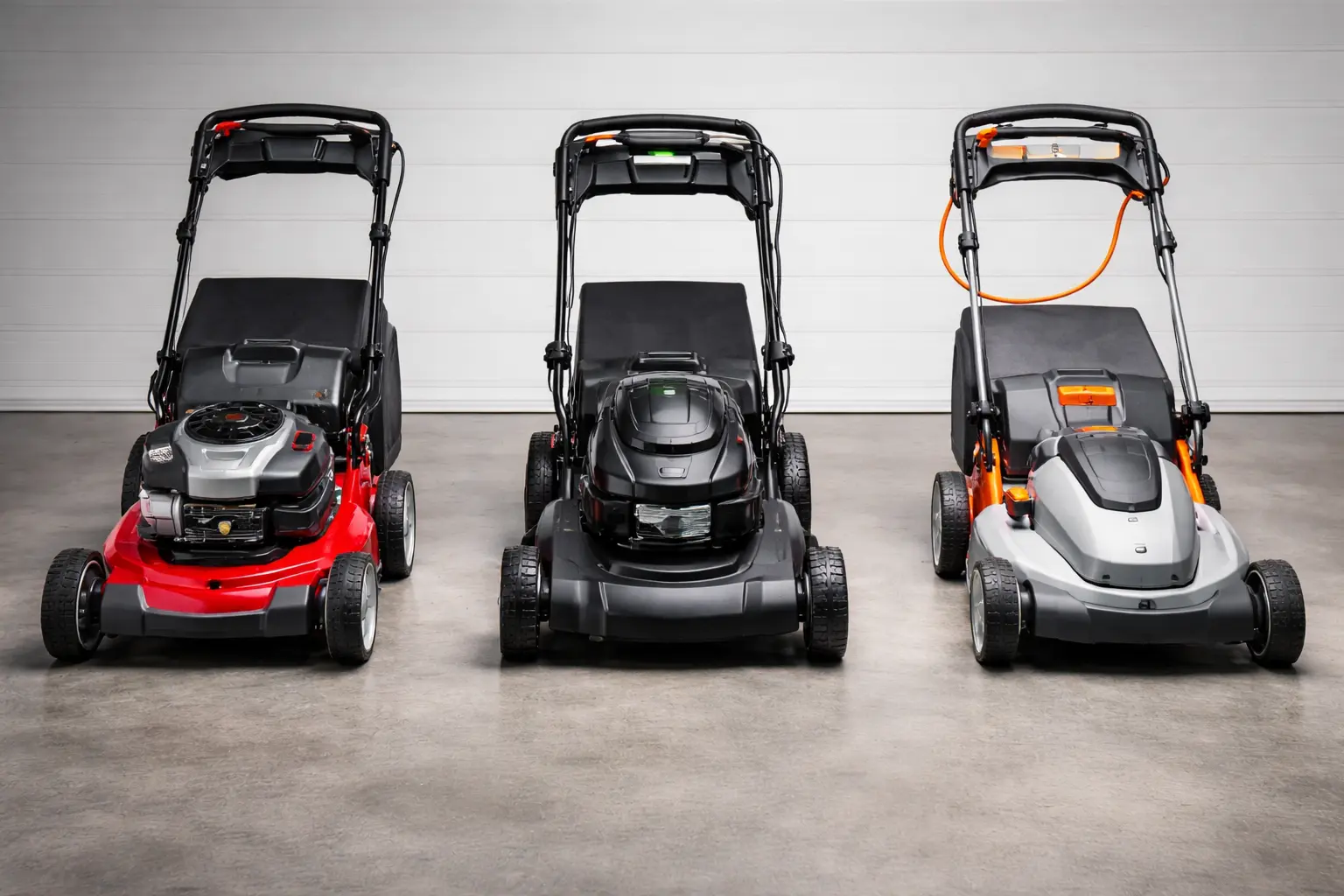
Power and Performance
Gas wins on raw, sustained power. Period. A 190cc Honda engine handles anything you throw at it — tall grass, thick grass, wet grass. It doesn’t slow down. It doesn’t fade at the end of a charge cycle.
Premium battery mowers at 56V and 80V get very close. In normal mowing conditions — grass that’s cut regularly, reasonable length — most people couldn’t tell the difference. But push into heavy, overgrown grass and a top-tier gas mower still has the edge.
Corded electric is consistent but modest. It’s not designed for heavy-duty work, and the power reflects that.
Convenience and Ease of Use
Battery wins this category decisively. Press a button, mow, put it away. No oil changes. No spark plug checks. No carburetor drama. No ethanol-related fuel problems if you forget to add stabilizer before winter storage.
Gas mowers require real maintenance commitment. That pull cord on a cold morning? I’ve had sessions where I pulled that cord eight times and considered throwing the whole machine into the street. That’s rare with a well-maintained mower, but it happens.
Corded electric is simple to operate but the cord management adds a layer of mental effort that gets old.
Noise
Walk into a neighborhood on Saturday morning. The gas mowers sound like a small airport. Battery mowers sound like a large fan. The difference is significant — especially if you have young kids napping, close neighbors, or an HOA that gets noise complaints.
Many U.S. municipalities and HOAs now have noise ordinances that restrict gas-powered equipment before 8 AM or after 7 PM. Battery mowers give you more flexibility around those windows.
Environmental Impact
One gas-powered lawn mower run for an hour produces roughly as much air pollution as driving a modern car for 300 miles. That’s a real number from EPA data. Battery mowers produce zero direct emissions.
If you care about this — and plenty of people do — battery or electric is the clear answer. Some states like California have already moved to restrict or ban small gas engine sales. This is a trend that’s going to accelerate.
Lawn Mower Noise and Environmental Regulations
Many regions regulate lawn equipment noise and emissions.
-
Some states have begun restricting new gas-powered lawn equipment sales.
-
Many neighborhoods and homeowner associations limit mower use before 8 AM.
-
Electric and battery mowers help meet strict noise and emission standards.
Always check local regulations before purchasing a new mower.
Cost Over Time
Gas mowers cost less upfront at the entry level. But add up three to five years of oil, filters, spark plugs, and occasional carburetor service — the gap shrinks. Battery mowers have higher upfront costs (largely because of battery prices) but very low ongoing operating costs.
If you keep a mower for 10+ years — which you should — the total cost of ownership often favors battery, especially as battery prices continue to fall.
My Personal Take
If my current yard were under half an acre, I’d go battery-only. The EGO platform has my full trust for that size. For my current lot at just over an acre, I run a self-propelled gas mower for the main cutting and use a battery-powered string trimmer for edges. That hybrid approach works well.
For anything over an acre, I’d look seriously at a riding mower — gas or electric — before any walk-behind option.
True Cost of Owning a Lawn Mower (5-Year Cost Comparison)
The purchase price is only part of the total cost. Fuel, maintenance, and replacement parts add up over time.
Estimated 5-Year Ownership Cost
| Type | Purchase Cost | Maintenance | Operating Cost | Total 5-Year Cost |
|---|---|---|---|---|
| Gas Mower | $300–$600 | $150–$300 | $200–$400 fuel | $650–$1,300 |
| Battery Mower | $500–$900 | $50–$100 | Minimal | $550–$1,000 |
| Corded Electric | $150–$300 | Very low | Electricity | $200–$350 |
Battery mowers typically cost more upfront but often have lower long-term ownership costs.
The Complete Lawn Mower Buying Guide — What to Look For Before You Buy
Shopping for a mower in person or online can feel overwhelming. There are dozens of specs. Here’s what actually matters — and what’s mostly marketing noise.
Cutting Deck Size
The deck is the housing that covers the blade. Measured in inches — usually 17 to 22 inches on walk-behind mowers, 30 to 72 inches on riding and zero-turn mowers. Wider deck means fewer passes, which means faster mowing on open terrain.
But wider isn’t always better. A 21-inch deck mower is more maneuverable in tight spaces than a 30-inch model. For most suburban yards with garden beds and obstacles, 20 to 22 inches is the sweet spot for walk-behinds.
Engine Power (CC vs. HP)
Gas mowers are rated in cubic centimeters (cc) or horsepower (hp). More cc generally means more torque, which matters in heavy grass. For a standard residential walk-behind, 140cc to 160cc handles most conditions. 163cc to 190cc is better for thick or tall grass.
Don’t get too fixated on horsepower numbers — torque matters more for cutting. A high-torque 160cc engine can outperform a low-torque 200cc in real cutting conditions.
Drive Type
Push, front-wheel drive, rear-wheel drive, or all-wheel drive. Rear-wheel drive is the best choice for slopes. Front-wheel drive is better for flat yards with lots of turning. All-wheel drive handles everything.
For riding mowers, look at the transmission type — automatic is easier to use; manual (gear-driven) is more durable but requires clutching.
Height Adjustment System
Single-lever height adjustment is far more convenient than individual wheel adjustments. Being able to change cutting height across all four wheels in one motion sounds minor until you’ve spent five minutes crouching down adjusting four separate wheels. Pay attention to this feature.
Grass Handling Options
Most quality mowers offer three grass handling modes:
- Mulching: Clippings are chopped finely and returned to the lawn as fertilizer. Best for regular mowing schedules.
- Side Discharge: Clippings are thrown out to the side. Best for tall or overgrown grass where mulching would clump.
- Bagging: Clippings are collected in a rear or side bag. Best for a clean appearance or if grass has disease.
A mower that does all three gives you maximum flexibility. Some cheaper models only side-discharge or bag — be aware of that before buying.
Blade Quality
Standard blades, mulching blades, and high-lift blades all cut differently. Mulching blades have a curved design that creates airflow to lift and re-cut clippings. High-lift blades create strong suction, great for bagging. Standard blades are the middle ground.
For most homeowners, a good mulching blade on a regular mowing schedule produces excellent results. Replace blades every one to two seasons or sharpen after every 20 to 25 hours of use.
Brand Reputation and Parts Availability
Buy from a brand with U.S. service availability. Honda, Toro, Husqvarna, Craftsman, EGO, Greenworks, Cub Cadet, John Deere — all of these have either national service networks or widely available parts through online retailers.
Obscure brands might save you $50 upfront, but finding a replacement carburetor or drive cable 18 months later can be a nightmare. I’ve been there. It’s not fun.
Warranty
Residential gas mowers should carry at least a 2-year warranty. Battery mowers should have at least 3 years on the tool and 2 to 3 years on the battery. Riding mowers should carry 2 to 3 years minimum.
Pay attention to what the warranty actually covers — some cover only defects, not wear items like belts and blades. Read the fine print before you buy.
Best Lawn Mower Brands Compared — Reliability, Price, and Performance
Not all lawn mower brands are built the same. Some focus on durability, others on innovation, and some prioritize affordability. Choosing a trusted brand ensures better parts availability, longer lifespan, and easier repairs.
Top Lawn Mower Brands Overview
| Brand | Best Known For | Price Range | Reliability |
|---|---|---|---|
| Honda | Premium engine quality | High | Excellent |
| Toro | Durability + performance balance | Mid–High | Excellent |
| Husqvarna | Riding & zero-turn mowers | Mid–High | Very High |
| John Deere | Premium riding mowers | High | Excellent |
| EGO Power+ | Battery technology leader | Mid | Very High |
| Greenworks | Affordable electric mowers | Low–Mid | Good |
| Craftsman | Budget-friendly options | Low–Mid | Good |
Quick Recommendation
-
Best overall reliability: Honda, Toro
-
Best battery technology: EGO Power+
-
Best riding mowers: John Deere, Husqvarna
-
Best budget option: Greenworks
Choosing a brand with strong service availability makes long-term ownership much easier.
Lawn Care and Grass Maintenance — What I’ve Learned From Mowing Across Multiple Climates
Mowing technique and lawn care knowledge matter as much as the machine. I’ve mowed grass in Tennessee, Georgia, Ohio, and Colorado — each taught me something different.
The One-Third Rule — The Most Important Lawn Care Principle
Never cut more than one-third of the grass blade height in a single mowing session. This is the most important rule in lawn care — and the one most people break.
When you cut too much at once, you stress the grass. Roots lose their energy source too quickly. The grass becomes vulnerable to drought, disease, and weed invasion. I learned this the hard way during a stretch when I let my lawn go two and a half weeks between mows in July. When I cut it back to normal height, the lawn went brown and thin.
If grass is 4.5 inches tall, cut to 3 inches. Not 2. Not 1.5. Three.
Cutting Height by Grass Type
Different grasses thrive at different heights. Cutting Bermuda grass too tall or Fescue too short stresses the plant in ways that compound over time.
- Bermuda grass: 1 to 2 inches — keep it low and sharp
- Zoysia: 1.5 to 2.5 inches — tolerates a range well
- Augustine: 2.5 to 4 inches — don’t scalp this one
- Kentucky Bluegrass: 2.5 to 3.5 inches — classic Midwestern lawn grass
- Tall Fescue: 3 to 4 inches — grows well at height, handles shade
- Centipede: 1.5 to 2 inches — slow grower, doesn’t need much
- Buffalo grass (Southwest): 2 to 3 inches — drought tolerant, minimal mowing needed
Mowing Frequency
The standard guidance is once per week during the active growing season. But that varies significantly by region. For a detailed breakdown by grass type and climate, read How Often Should You Mow Your Lawn. In Atlanta and Orlando, Bermuda grass can genuinely need mowing twice a week during July — growth is that aggressive. In Phoenix, warm-season grasses might need mowing every ten days.
In Ohio and Michigan, cool-season lawns peak in May and September. Summer growth slows. Fall brings a second surge. Mowing every 10 to 14 days in mid-summer is often fine there.
Pay attention to growth rate, not calendar. If grass is approaching the top of your cutting height range, it’s time to mow.
Never Mow Wet Grass
I know. It’s Saturday, you have a break in the rain, the lawn needs cutting, and you think it’ll be fine. I’ve done it. It’s not fine.
Wet grass clippings clump and clog the deck underside. Wet clumps on the lawn can smother grass beneath them if left. Wet conditions make ruts easier to form, especially with riding mowers. Wet grass blades also deflect, producing an uneven cut.
Wait until mid-morning after the dew has dried. If it rained the day before, check that the soil isn’t still soggy — soft ground plus wheel pressure creates ruts that take weeks to fill.
Mowing Patterns
This sounds fancy, but it’s practical. Mowing in the same direction every time causes grass to lean that direction and can compact soil in wheel tracks. Alternate your pattern each session — horizontal one week, vertical the next, diagonal after that.
This also creates the striped effect you see on sports fields and well-maintained professional lawns. You’re just bending the grass blades in opposite directions. The effect comes from light reflecting differently off bent grass. A striped roller attachment makes this more pronounced.
Mulching vs. Bagging vs. Side Discharge
I mulch 90% of the time during the regular mowing season. Properly mulched clippings return nutrients to the soil — the nitrogen alone is worth the equivalent of one or two fertilizer applications per season. That’s real money saved.
I bag in early spring to remove winter debris and dead material. I bag if the lawn gets overgrown and clippings are too long to mulch effectively. I side discharge occasionally when cutting very tall grass that would overwhelm the mulching system.
There’s no single right answer here. Match the method to the condition.
Seasonal Lawn Care Calendar
Spring (March to May)
- Resume mowing as growth begins — cut at the lower end of your grass type’s range first to remove dead material
- Fertilize cool-season grasses in early spring; wait on warm-season grasses until the soil warms
- Aerate compacted lawns in spring before peak growth begins
Summer (June to August)
- Raise your cutting height by 0.5 to 1 inch during summer heat — taller grass shades roots and retains moisture
- Water deeply and infrequently — 1 inch per week including rainfall
- Mow more frequently during peak growing periods; let the one-third rule be your guide
Fall (September to November)
- Lower cutting height gradually back to normal
- Final mow of the season should bring warm-season grass to the low end of its range before dormancy
- Cool-season grasses hit their best growth period — fertilize and overseed thin areas now
Winter (December to February)
- Warm-season grass is dormant — minimal or zero mowing needed
- Cool-season grasses may still need light mowing in mild climates
- Use this time for mower maintenance and preparation for spring
How to Set Up and Use a Lawn Mower — The First-Timer’s Complete Walkthrough
The first mow on a new mower — or the first mow ever — can feel stressful. It shouldn’t. Follow this process and you’ll start strong.
Before Your First Mow — Setup Checklist
Before you even start the engine, take fifteen minutes to do this:
- Read the owner’s manual. Yes, really. Every mower has quirks specific to its model. Ten minutes of reading prevents hours of frustration.
- Check the oil level on gas mowers — some ship without oil and starting them dry destroys the engine immediately. Check before the first start.
- For battery mowers, charge the battery fully on the first use.
- Set the cutting height to the appropriate level for your grass type (see the Lawn Care section above).
- Walk the yard before mowing and remove sticks, rocks, toys, sprinkler heads, and any debris. A mower blade hitting a rock at 3,000 RPM is a projectile event.
Starting a Gas Mower — Step by Step
For a cold engine with a choke:
- Engage the choke by moving the lever to the ‘choke’ or ‘start’ position
- Turn the fuel valve to ‘on’ if your mower has one
- Press the primer bulb three times if equipped — this moves fuel into the carburetor
- Squeeze the blade engagement bail (safety handle) against the handlebar — you must hold this throughout mowing
- Pull the starter cord with a firm, smooth pull — not a jerk, not a hesitant tug
- Once the engine starts, let it warm up for 30 seconds, then move the choke to ‘run’
If it doesn’t start after three pulls, stop. Let it rest for 90 seconds. Flooding the engine is common — opening the choke and trying again after a rest usually fixes it.
Starting a Battery Mower
Insert the battery until it clicks into place. Install the key or push the safety lockout button. Press and hold the power button, then engage the blade switch. Done. That’s why people love these.
Mowing Technique for Beginners
Start at the outer perimeter of the lawn and mow one full pass around the edge. This creates a headland — a turning area — for when you mow the interior in rows.
Then mow in straight rows across the main body of the yard. Overlap each pass by about two inches to avoid leaving strips of uncut grass. Walk at a comfortable, steady pace.
Keep the deck out of flower beds and gardens. Mower blades and root systems don’t coexist well. Give garden edges a comfortable margin and clean them up later with a string trimmer.
Navigating Obstacles
Trees, posts, and garden beds — approach them, stop just before your blade would touch the obstacle, back up slightly, then swing around in a U-turn. Don’t try to force the mower in tight circles — let the geometry work in your favor.
With a zero-turn, this becomes almost intuitive. With a riding tractor, you’ll get a feel for the turn radius within a session or two. With a walk-behind, it’s the most flexible option for tight spaces.
After Mowing — What to Do
- Disengage the blade and engine before cleaning the deck
- On gas mowers, disconnect the spark plug wire before reaching under the deck
- Rinse the underside of the deck with a hose to remove grass buildup — buildup corrodes metal over time
- Empty the grass bag if you were bagging
- Wipe down the exterior and return it to storage
- Charge the battery fully on electric mowers before the next session
Lawn Mower Maintenance — The Complete Annual Care Guide
A lawn mower that gets proper maintenance lasts 15 to 20 years. One that doesn’t might give you 5. I’ve seen both outcomes. Maintenance is not glamorous — but it’s the difference between a mower that starts on the first pull every spring and one that leaves you stranded on a July Saturday.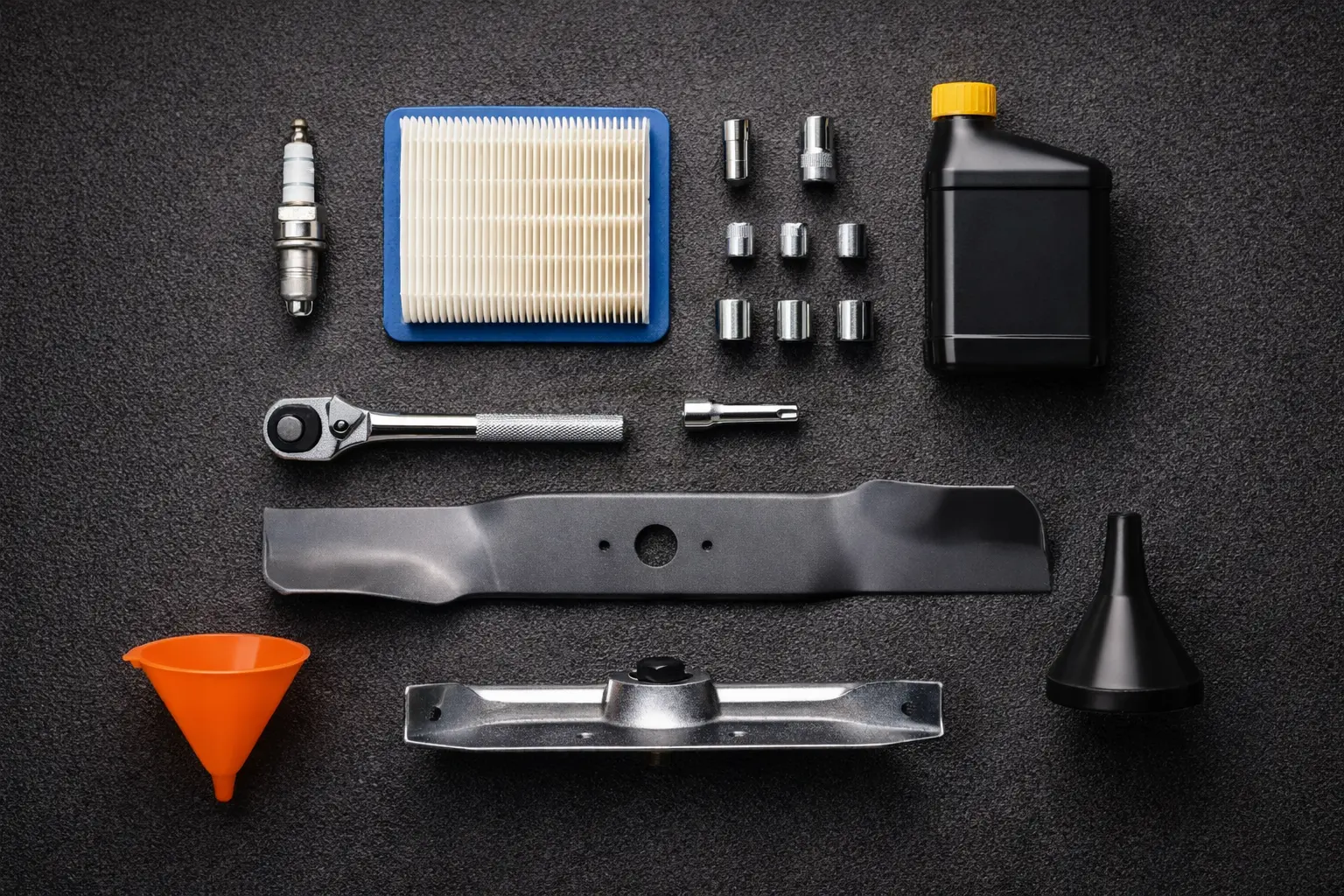
Annual Maintenance — Do This Every Season
- Engine oil change — every 50 hours of operation or once per season, whichever comes first
- Air filter inspection and replacement — once per season or when visibly dirty/oily
- Spark plug replacement — once per season for consistent starting performance
- Blade sharpening or replacement — at least once per season, more if you hit obstacles
- Fuel system check — inspect fuel lines for cracks; drain old fuel if stored over winter
- Deck cleaning and inspection — check for rust, warping, or cracks in the deck housing
- Wheel and axle lubrication — prevents squeaking and early bearing wear
- Cable inspection — throttle, choke, and drive cables can fray or stretch over time
How to Change the Engine Oil
Warm the engine first — run it for two minutes. Warm oil drains faster and more completely. Then kill the engine. Disconnect the spark plug wire. Find the oil drain plug on the base of the engine, or use the dipstick tube method if your mower uses it.
For most residential mowers, SAE 30 oil works in warm temperatures. Not sure which oil is right for your mower? Check out What Kind of Oil Does a Lawn Mower Take for a full breakdown. If you’re in a climate with cold springs, 10W-30 is more versatile. Fill to the ‘Full’ mark on the dipstick — never overfill.
Change the oil on the first mow of each spring. Write the date on a piece of tape stuck inside the engine bay or on the handle. Easy reference.
Air Filter Service
Paper air filters should be replaced when they look tan-to-brown, have visible debris, or if you’ve been mowing in dusty conditions. Never try to wash a paper filter — that destroys the filtering material.
Foam pre-filters can be washed with warm, soapy water, rinsed thoroughly, dried completely, then lightly coated with clean engine oil before reinstalling. A clogged air filter is one of the most common causes of hard starting and poor power.
Spark Plug Replacement
A spark plug is a $3 to $8 part that takes five minutes to replace. Do it every spring regardless of how it looks. A fresh plug means reliable ignition, better fuel efficiency, and easier starting.
Remove the plug with a spark plug wrench. Check the replacement number on the old plug or in your manual. Common residential plugs include Champion RJ19LM and NGK BR6HS. Check the gap on the new plug with a feeler gauge — most residential engines spec a 0.030-inch gap. Thread by hand to start, then snug with the wrench. Don’t overtighten — you’ll strip the threads in the aluminum engine head.
Blade Sharpening
Dull blades don’t cut — they tear. Torn grass tips turn brown, creating a lawn that looks rough and stressed. If the tips of your grass look ragged and light brown after mowing, your blade needs sharpening.
Remove the blade using the process described in the Parts section. Use a file, bench grinder, or angle grinder to restore the cutting edge at the original bevel angle — usually around 30 to 35 degrees. After sharpening, check blade balance on a blade balancer or a horizontal nail. If one end drops, it’s heavier — sharpen the lighter side until balanced. An unbalanced blade causes vibration that damages engine bearings over time.
Cleaning the Deck
Grass is moisture-rich. Grass paste left on a metal deck corrodes it from the inside. Clean the deck after every mow if you can, or at least every two to three sessions.
Tip the mower on its side (carburetor side up on gas mowers — tipping it the wrong way floods the air filter with oil). Use a garden hose and stiff brush or putty knife to remove buildup. Let it dry before storing.
Some people coat the underside of the deck with spray silicone or deck spray — this reduces grass adhesion and makes cleaning faster. It works. I do it at the start of every season.
Winter Storage
This is where many people get lazy — and pay for it the following spring when the mower won’t start.
- Gas mowers: Run the engine until the fuel tank is completely empty, OR add fresh fuel with fuel stabilizer and run for five minutes to distribute it through the system
- Change the oil before storing — old oil contains combustion byproducts that corrode engine internals over winter
- Remove and inspect the spark plug; apply a small drop of engine oil into the cylinder and pull the cord a few times to distribute it before reinstalling the plug
- Clean the deck thoroughly and apply a light coat of rust-inhibiting spray on metal surfaces
- Battery mowers: Store the battery at 40 to 80 percent charge in a temperature-controlled space — not a freezing cold garage. Extreme cold kills lithium-ion cells permanently.
- Cover the mower and store in a dry location out of direct moisture
How to Store a Lawn Mower Properly — Space and Storage Tips
Proper storage protects your mower and extends its lifespan.
Best Storage Practices
-
Store in a dry, covered location
-
Fold handles on compatible models to save space
-
Keep away from moisture and direct sunlight
-
Hang smaller electric mowers on wall mounts if possible
-
Store batteries indoors at room temperature
For limited garage space, compact or foldable mowers are often the best choice.
Lawn Mower Parts and Replacement Guide — What Wears Out and What to Do About It
Every mower has parts that wear out on a predictable schedule. Knowing what they are and how to replace them keeps you ahead of breakdowns instead of reacting to them on mow day.
The Mower Blade — Replace More Often Than You Think
The blade takes more abuse than any other part. It spins at 3,000 to 3,500 RPM and encounters rocks, roots, soil, and hard debris constantly. After one or two seasons, most blades have accumulated enough wear and micro-damage that sharpening no longer fully restores them.
Signs a blade needs replacement: visible large nicks or gouges, thinned metal along the cutting edge, any bending or warping, or vibration that won’t resolve after sharpening and balancing.
How to Remove a Lawn Mower Blade — Step by Step
This is one of the most important skills in home mower maintenance. It’s not complicated, but doing it wrong is dangerous. Here’s exactly how I do it:
- Step 1: Disconnect the spark plug wire completely on gas mowers. Remove the battery on battery-powered models. This is non-negotiable — the engine must be unable to start.
- Step 2: Let the engine cool fully if it was recently running. A hot engine near your hands is unpleasant in the best case.
- Step 3: Tip the mower on its side — carburetor and air filter facing UP. Tipping it the wrong way allows oil to flow into the air filter.
- Step 4: Wedge a wooden block between the blade and the inside of the deck. This prevents the blade from spinning when you apply torque to the bolt. Never hold the blade with your hand.
- Step 5: Locate the center bolt. Use a socket wrench — typically 5/8 inch or 3/4 inch — or an impact driver. Most mower blade bolts loosen counterclockwise. However, some older Craftsman, Murray, and Poulan mowers have reverse-threaded bolts (turn clockwise to remove). Always check your manual if you’re unsure.
- Step 6: Remove the bolt, then the blade. Note how any washers or adapter spacers are assembled — take a photo with your phone before removing them. Reassembly gets easier when you have a reference.
- Step 7: Inspect the blade thoroughly. Sharpen on a bench grinder or with a file if it’s in good shape. Replace if it’s excessively worn, bent, or cracked.
- Step 8: Reinstall the blade with the correct orientation — the blade’s cutting edge should face the direction of rotation. The stamped or angled surface faces up toward the engine.
- Step 9: Torque the center bolt to the manufacturer’s specification — typically 35 to 50 ft-lbs for walk-behind mowers. Undertightening allows the blade to slip; overtightening can crack the blade adapter.
That’s it. Do this once and you’ll feel totally comfortable with it. The whole process takes about 15 minutes the first time, 5 minutes once you know the routine.
Drive Belt
Self-propelled and riding mowers use drive belts to transfer engine power to the wheels and cutting deck. These belts stretch, crack, and wear over time. Signs of a failing drive belt include slipping when engaging the drive, squealing noise, or the self-propel suddenly losing effectiveness.
Replacement belts are model-specific — look up your mower’s model number on the manufacturer’s website or an aftermarket parts site like RepairClinic or Jack’s Small Engines. The replacement process involves removing the deck housing and routing the new belt according to the diagram in your manual.
Carburetor
The carburetor mixes air and fuel for combustion. It’s also the part most likely to cause problems from old fuel. Ethanol-blended gasoline — which is most U.S. gasoline — absorbs moisture over time and leaves sticky deposits in the carburetor’s tiny fuel jets.
Symptoms of a clogged or failing carburetor: engine starts then dies within 30 seconds, surging or hunting engine speed, poor throttle response. The fix is often as simple as removing the carburetor bowl, cleaning the jet with carburetor cleaner spray and a thin wire, and reassembling.
If cleaning doesn’t resolve the issue, replacement carburetors for common residential engines run $12 to $40 and take about 30 minutes to swap.
Wheels and Drive System
Wheels crack, especially plastic ones after years of UV exposure. Replacement wheels are universal and inexpensive — most run $8 to $20 each. If a self-propelled mower loses drive on one side, the problem is often the drive gear inside the wheel assembly — a small plastic or composite gear that wears down after years of use. Replacement gears are cheap and the repair is usually achievable with basic tools.
Battery Pack (Electric Mowers)
Lithium-ion batteries degrade with charge cycles. After three to five years of regular use, most battery packs hold notably less charge. When runtime has dropped significantly from original specs, it’s replacement time.
Always replace with the same brand’s battery — the battery management system (BMS) is designed for the manufacturer’s cells. Third-party batteries sometimes work fine, but they carry risks of incompatibility and can void warranties.
Air Filter
Replaced yearly as part of regular maintenance. A $4 to $12 part. If you’re mowing in dusty, dry conditions — common in Texas, Colorado, or the Southwest — check and replace more frequently. A choked air filter is a leading cause of loss of power and poor starting.
Ignition Coil
If your mower starts fine when cold but dies after warming up and won’t restart until it cools down — the ignition coil may be failing. It’s a less common failure but a real one. Replacement coils run $15 to $40 and require removing the flywheel cover to access. If you’re comfortable with basic engine work, this is a DIY repair. Otherwise, a small engine shop can do it in under an hour.
Lawn Mower Safety — Rules I Follow Every Single Time
Lawn mowers send over 80,000 Americans to emergency rooms every year. That’s not a statistic designed to scare you — it’s a reminder that a machine with a spinning blade moving at 200 mph deserves real respect.
Personal Protective Equipment — Non-Negotiable
- Closed-toe shoes or boots — always. No sandals, no bare feet, not even once.
- Safety glasses — debris ejection is real and unpredictable. A small stone can permanently damage an eye.
- Hearing protection for gas mowers — sustained exposure above 85 decibels causes gradual hearing loss. Gas mowers run at 85 to 95 dB. A simple pair of foam earplugs is enough.
- Long pants — protect legs from debris. Not strictly required for experienced mowers on cleared yards, but good habit.
- Gloves — when handling blades or performing under-deck maintenance.
Pre-Mow Safety Walk
Every session. Walk the entire area you plan to mow. Remove anything that can become a projectile — sticks, stones, toys, decorative edging that might have shifted, dog toys, garden tools left out. A mower blade hits these objects and turns them into high-speed projectiles with enough force to break windows, injure bystanders, and damage the mower itself.
Mark sprinkler heads with a small flag or stake on the first mow of the season until you’ve memorized their locations. I once destroyed a brass rotor head worth $45 because I forgot where I’d installed it. The blade won, but barely.
Bystander Safety
Keep children and pets completely clear of the mowing area — not just off to the side, but inside the house or a fenced separate area. The discharge area of a mower can throw debris 50 feet. I once watched a neighbor’s push mower fling a piece of wire across a yard and into a fence. Easily could have been a person.
Never, ever let a child ride on a riding mower as a passenger. It’s tempting because kids love it. But if anything changes — a sudden terrain change, a stall, an emergency stop — a child in your lap has no protection whatsoever.
Slope Safety Rules
Slopes are where most serious lawn mower accidents happen. These rules are non-negotiable:
- Walk-behind mowers on slopes: mow side to side across the slope, never up and down. Walking downhill behind a mower is dangerous — if you slip, you go under the machine.
- Riding mowers on slopes: mow up and down (perpendicular to the slope), never across it. A riding mower is top-heavy and can roll sideways on slopes.
- Zero-turn mowers: do not use on slopes exceeding 15 degrees. The lap bar steering system doesn’t translate well to significant slopes — the mower can slide sideways.
- Any mower: reduce speed on slopes. Increase stopping distance. Be extra careful on wet grass.
Fueling Safety for Gas Mowers
- Always fill the fuel tank outdoors, never in a garage or enclosed space. Gasoline fumes in an enclosed space are a serious fire and explosion hazard.
- Let the engine cool for at least two minutes before refueling. Fuel on a hot engine can ignite.
- Use an approved gas container with a proper pour spout. Sloshing fuel from a large can creates spills.
- Clean up any spills before starting the engine.
- Store gasoline in an approved container, away from heat sources, in a cool and ventilated space.
- Never smoke near the fueling process. This should go without saying. But here we are.
Operating Safety Habits
- Never disable safety features. The blade bail, seat switch on riding mowers, and tip sensor on robot mowers all exist to prevent injury. Bypassing them is illegal in some states and dangerous everywhere.
- Disengage the blade before crossing driveways, gravel paths, sidewalks, or any non-grass surface.
- Never reach under the deck while the engine is running. Not even briefly. Not even with gloves. Blade engagement takes milliseconds.
- Shut off the engine completely before making any adjustments, cleaning, or inspections.
- Keep discharge chute pointed away from people, pets, vehicles, and structures.
Common Lawn Mower Problems and Troubleshooting — My Real-World Solutions
When a mower breaks down in the middle of mowing season, it’s genuinely stressful. But most problems are simpler than they look. Here’s what I’ve encountered and how I’ve fixed it.
Problem: Mower Won’t Start
Start with the simplest possible causes before going deeper.
- Is there fuel in the tank? Add fresh fuel if it’s been sitting more than 30 days.
- Is the spark plug wire connected? A wire that vibrated loose is embarrassingly common.
- Is the safety bail or blade engagement handle fully held down?
- Remove the spark plug and inspect it. Black and sooty means rich fuel mixture. White or very clean might indicate an air leak. Replace the plug as a starting point.
- Check the air filter — a completely clogged filter prevents the engine from breathing.
- If the engine is flooded, open the choke, wait two full minutes, and retry.
- If still no start, spray a small amount of carburetor cleaner directly into the carburetor intake and try starting — if it fires briefly then dies, fuel delivery is the issue.
Problem: Engine Starts Then Dies
This is almost always a fuel delivery issue. The engine gets enough fuel to start but can’t maintain it.
- Most likely cause: clogged carburetor from old fuel with ethanol deposits
- Fix 1: Add fresh fuel, run a fuel system cleaner additive through the tank
- Fix 2: Remove the carburetor bowl, clean the main jet with carburetor cleaner and thin wire
- Fix 3: If cleaning fails, replace the carburetor — inexpensive for most residential models
- Also check: the fuel cap vent — a clogged vent creates a vacuum that starves the carburetor. Loosen the cap slightly and test. If the mower runs normally, the cap vent is the issue.
Problem: Uneven Cut or Scalping
- Check that all four wheels are set to the same height position
- Inspect the blade for bending, warping, or imbalance
- Check the deck for warping from a hard impact
- Are you mowing too fast, causing the deck to bounce on uneven terrain?
- Is the grass too long for a single pass? Double-cut by raising the height first, then lowering for the final pass
Problem: Excessive Vibration
Excessive vibration almost always means the blade is bent, unbalanced, or the blade adapter (spindle) is damaged.
- Remove the blade and check it on a blade balancer — one side should not drop significantly
- Inspect the blade adapter where the blade mounts to the crankshaft — if it’s cracked or bent, replace it immediately
- A bent crankshaft from a hard impact is a more serious diagnosis — this typically requires a shop visit
Problem: Self-Propelled Drive Not Working
- Check the drive cable from the handle to the transmission — cables stretch and can slip off their anchor points
- Inspect the drive belt if the mower has one — a slipping or broken belt means no drive
- On wheel-driven self-propelled mowers, the plastic drive gear inside the rear wheels wears out after several seasons — a common and inexpensive repair
- Make sure the drive lever is making full contact when engaged — sometimes the adjustment simply needs to be tightened at the cable anchor
Problem: Grass Clumping Under Deck
- Grass is too wet — wait for drier conditions
- Grass is too long — raise the cutting height and do a first pass before cutting to final height
- Deck underside is clogged with built-up grass paste — clean the deck thoroughly
- The mulching plug is installed but conditions require side discharge — remove the plug and switch modes
Problem: Blue or White Smoke from Engine
Blue smoke means oil is burning. White smoke usually means the same — oil in the combustion chamber.
- Most likely cause: the mower was tipped incorrectly and oil flowed into the cylinder and air filter
- Solution: Let the engine run outdoors for two to five minutes — the smoke usually clears as the oil burns off
- Check the air filter for oil saturation — a soaked foam filter needs washing and drying; a soaked paper filter needs replacement
- If blue smoke continues consistently, check for low compression or worn piston rings — that’s a shop-level diagnosis
Problem: Battery Mower Losing Power Faster Than Before
- Normal degradation after 2 to 3 years of regular use — battery capacity reduces over time
- Store the battery at room temperature — repeated exposure to extreme heat or cold accelerates degradation
- Discharge and fully recharge the battery monthly during storage periods
- If capacity has dropped more than 20% within the warranty period, contact the manufacturer — most offer battery warranties
Problem: Riding Mower or Zero-Turn Cutting Unevenly
- Check all blades — riding mowers have two to three blades, and one damaged blade creates visible stripe patterns
- Check belt tension — a slipping deck belt lets the blades slow down inconsistently under load
- Level the cutting deck according to the manual’s procedure — a deck that’s slightly tilted side to side cuts at different heights across its width
- Check for debris wrapped around spindles — string, wire, and long grass can pack tightly around blade spindles and cause drag
Essential Lawn Mower Tools and Accessories Worth Owning
The mower is the main event. But the right supporting tools make maintenance easier, mowing more effective, and your lawn look better. These are the ones I actually use.
Blade Sharpening Tools
A blade file or bench grinder handles occasional sharpening well. If you want faster, more consistent results, a dedicated blade sharpening kit with an angle guide makes the process nearly foolproof. Oregon makes good blade sharpeners in the $20 to $50 range.
A blade balancer is cheap — usually $5 to $8 — and tells you immediately if one end of the blade is heavier than the other. Use one every time you sharpen.
Impact Driver or Breaker Bar
Blade bolts that have been on for a season are often torqued on tight by heat cycles and vibration. A basic impact driver or breaker bar with the right socket makes removal fast and easy. Trying to use a standard socket wrench on a stubborn blade bolt is an exercise in frustration.
Fuel Stabilizer
Sta-Bil is the go-to brand. Add it to fresh fuel at the end of the mowing season before storage. It prevents the ethanol in gasoline from separating and leaving gummy deposits in the fuel system. A $10 bottle lasts years and prevents a very common and annoying class of problems.
Mulching Plug
If your mower can mulch but doesn’t come with a mulching plug, buy one. They’re model-specific — usually $10 to $20 — and convert a side-discharge mower into a mulching machine. Returning clippings to the lawn is the easiest free fertilizer program you can run.
Lawn Mower Cover
A weather-resistant mower cover protects against UV degradation, dust, and moisture. Basic polyester covers run $15 to $30 for walk-behinds. If your mower lives in an open shed or carport, a cover is worth every dollar.
Oil Drain Kit
Draining oil from a mower without a dedicated drain kit is messy. A drain kit — typically a tube and fitting that connects to the oil drain port — directs oil cleanly into a collection container. $15 to $25. Makes oil changes genuinely quick.
Lawn Striping Roller
Attaches to the rear of a walk-behind mower and bends grass blades in the direction of travel, creating the striped pattern you see on baseball fields and well-maintained parks. It’s purely aesthetic but genuinely satisfying. Prices run $40 to $80 depending on compatibility.
Garden Kneeler and Tool Tray
When you’re doing blade work, spark plug swaps, or deck cleaning, a padded kneeler saves your knees and keeps tools organized. A surprisingly underrated comfort upgrade.
Tachometer
A small handheld tachometer measures engine RPM without contact. Useful for confirming the engine is running at proper blade tip speed and for diagnosing surging or governor issues. Not essential for everyone, but useful if you want to tune performance.
Frequently Asked Questions About Lawn Mowers
How long does a lawn mower last?
With proper maintenance, most residential lawn mowers last 8–15 years.
How often should I sharpen the mower blade?
Every 20–25 hours of use or at least once per season.
What size mower do I need for my yard?
Small yards under 5,000 sq ft need a push or electric mower. Larger yards may require riding mowers.
Is a battery mower powerful enough?
Modern 56V and 80V battery mowers provide sufficient power for most residential lawns.
Should I mulch or bag grass clippings?
Mulching is best for lawn health, while bagging is useful for overgrown or diseased grass.
Wrapping It Up — What I’d Tell My Younger Mowing Self
Looking back at that Nashville Saturday where I grabbed a random mower off a shelf and hoped for the best — I wasn’t dumb. I was just uninformed. That’s fixable. That’s why this guide exists.
The complete lawn mower guide you just read covers everything I’ve accumulated across years of mowing, maintaining, troubleshooting, and occasionally arguing with machines that didn’t want to cooperate. It’s not theoretical. Every problem I described, I’ve dealt with in some form. Every solution I offered, I’ve tested.
Here’s the condensed version of everything:
- Match your mower to your yard size, terrain, grass type, and budget — don’t skip this step.
- Gas for power and large properties. Battery for convenience and mid-sized yards. Riding or zero-turn for anything over an acre.
- Never cut more than one-third of the grass blade in a single mow. This single rule does more for lawn health than anything else.
- Maintain the mower proactively — oil, filter, spark plug, and blade every season. It takes 90 minutes and saves you years of headaches.
- Learn how to remove and replace the blade yourself. It’s the most valuable skill a mower owner can have.
- Wear closed-toe shoes. Every single time. Never just this once.
Lawn care doesn’t have to be complicated. The right tool, basic knowledge, and a little consistency — that’s the entire formula. Your lawn will respond. Good grass is more forgiving than people think.
Now go mow something. You’ve got everything you need.