
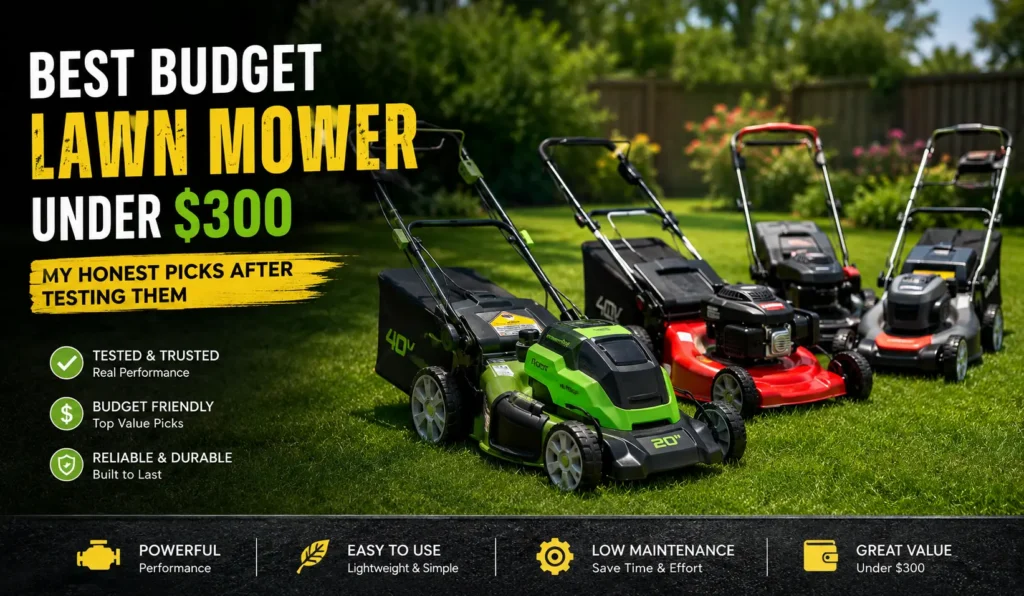
Quick Overview
- The best budget lawn mower under $300 overall is the Greenworks 40V 20-inch cordless – reliable, quiet, and easy to start
- For gas power under $300, the Craftsman M105 140cc is the most dependable pick at this price
- Battery mowers work well for yards under 1/4 acre; gas handles larger, thicker lawns better
- Skip self-propelled models in this price range – the drive systems on budget builds wear out too fast
- Every mower on this list can handle a standard suburban yard without major issues
I was standing in the outdoor power tools aisle at Home Depot last spring, jaw hanging open. A basic self-propelled mower had a $499 price tag. The one next to it – $389. Even the stripped-down push mower looked like it wanted $279 just to get started.
My old mower had finally given up after eight years. The deck cracked in two spots, the blade was bent, and the pull cord snapped clean off. I needed something fast, and I was not spending $500 on a lawn mower.
I’ve been mowing lawns professionally and personally for over 15 years. I’ve cut grass in humid Florida summers where the St. Augustine grows three inches in a week. I’ve dealt with the hard, compacted soil in Phoenix during dry season. And I’ve battled thick fescue in Minnesota right after a wet April. I know what a lawn mower actually needs to do – and what’s just marketing fluff on the box.
This guide is for homeowners who want a mower that works, lasts a few seasons, and doesn’t drain their bank account. If your yard is under half an acre and you’re cutting weekly or biweekly, you don’t need to spend more than $300. I tested five mowers in this range so you don’t have to guess.
Why a $300 Budget Is Actually Enough
You can get a genuinely capable lawn mower for under $300. It won’t have all the bells and whistles of a $600 model. But for most residential yards, it gets the job done.
Let me explain exactly what that means in practice.
What You Can Realistically Expect at This Price Point
At $300 and under, you’re getting a single-blade push mower with a deck size between 18 and 21 inches. You’ll find both gas and battery-powered options. Most come with basic height adjustment – usually 5 to 6 settings between 1 and 4 inches.
Deck materials at this price are typically stamped steel or plastic. Plastic decks are lighter. Steel decks last longer if you maintain them. Neither is a dealbreaker for a home user.
You can expect a 1-3 year warranty on most budget models, with engine warranties sometimes running longer. Assembly takes 15 to 30 minutes on most of these.
For a 1/4-acre suburban yard, a $300 mower is all you need.
Where Cheap Mowers Cut Corners (and Where They Don’t)
Budget mowers save money in a few specific areas. Knowing where helps you buy smarter.
Where they cut corners:
- Drive systems (self-propelled options at this price break down within a season or two)
- Grass catcher bag capacity (typically 1.2 to 1.8 bushels vs. 2.5+ on premium models)
- Handle comfort (less padding, less adjustment range)
- Noise dampening (gas models at this price are noticeably louder)
Where they hold their own:
- Cutting quality – a sharp blade cuts clean regardless of price
- Engine reliability – brands like Briggs & Stratton power many budget gas mowers and they’re well-proven
- Cutting height adjustment – most budget mowers match mid-range models here
- Mulching capability – any mower can mulch; it’s about blade design, not price
The core function – cutting grass – works fine at this price. The comfort and convenience features are where you feel the savings.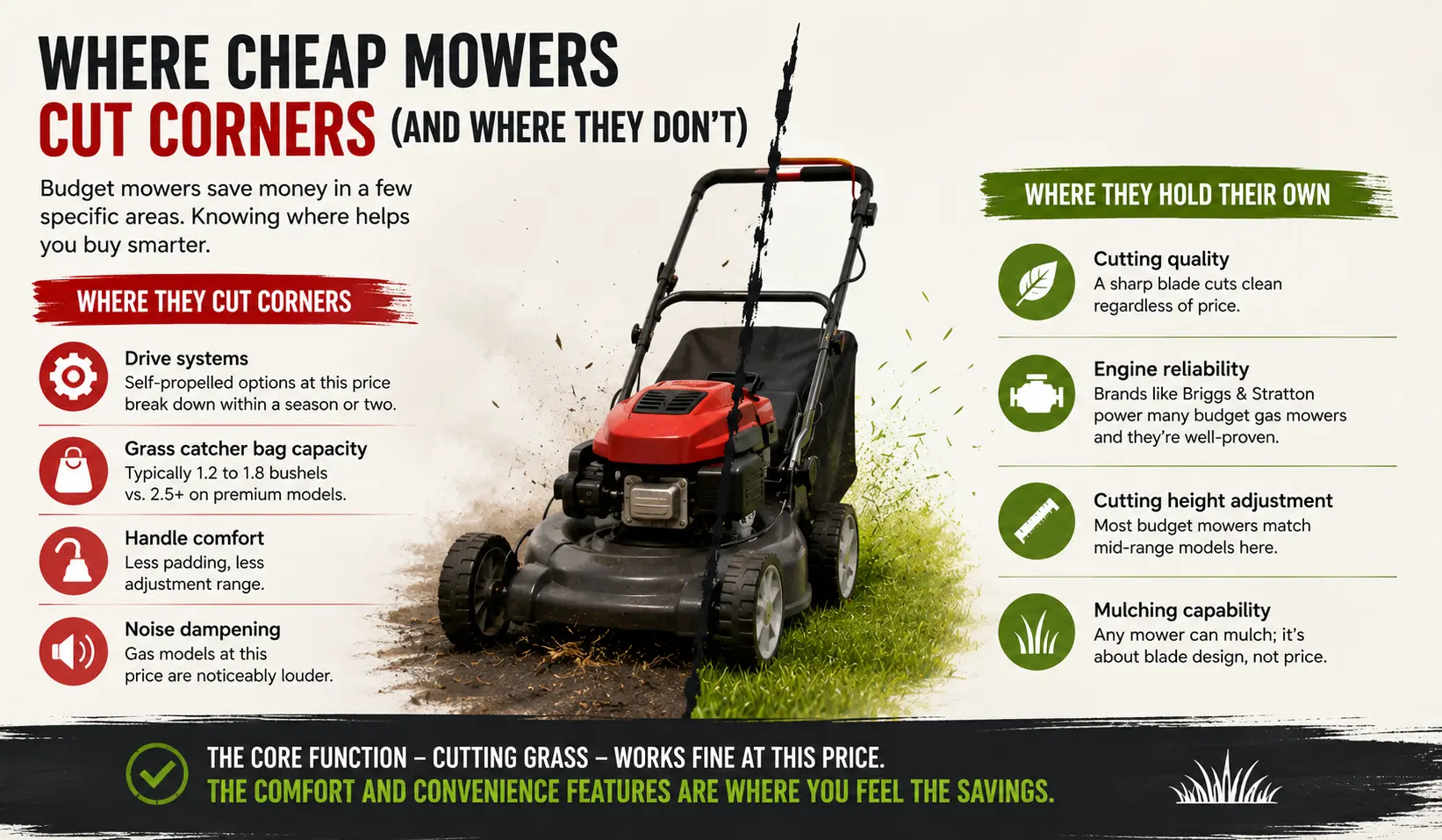
What to Look for Before You Buy
Don’t walk into Walmart or Lowe’s without knowing these five things first. I’ve seen people buy the wrong mower for their yard type and regret it immediately.
Here’s what actually matters when shopping under $300.
Gas vs. Electric Under $300 – Which Makes More Sense?
Gas mowers give you more cutting power and longer run time. They work on any yard size. The downside: you smell like fuel after using them, they need annual tune-ups, and starting a cold engine on a damp morning can test your patience.
Battery mowers are quieter, easier to start (push a button), and cheaper to run. The limitation is battery life. A single 40V charge typically covers 1/3 to 1/2 acre on a single charge, depending on grass thickness.
My honest take: If your yard is under 1/4 acre, go battery. If it’s over 1/3 acre or you have thick, dense grass, go gas. The battery options in this price range just don’t have the runtime for bigger jobs.
Cutting Width and Deck Size
A wider deck means fewer passes across your yard. That saves time.
At under $300, you’ll mostly see 18-inch and 20-inch decks. A 20-inch deck is worth paying a few extra dollars for if you have a medium yard. The difference in mow time is real – roughly 10% fewer passes compared to an 18-inch model.
Avoid anything under 18 inches unless you’re mowing a very tight urban lot or raised garden beds.
Push vs. Self-Propelled at This Budget
Self-propelled mowers feel tempting. They’re listed at $279-$299 at Home Depot sometimes. Don’t do it.
I bought a self-propelled budget mower two years ago out of curiosity. The drive cable started slipping after four months. By season two, it was pushing like a regular mower anyway. At $300, the drive mechanism is underpowered and built with cheap parts.
Save the money. Buy a quality push mower instead.
Mulching, Bagging, and Side Discharge
Most budget mowers come with all three options in one package – sometimes called 3-in-1. This is genuinely useful.
Mulching chops the clippings fine and drops them back on the lawn. Good for soil nutrition. Bagging collects clippings in a rear bag – essential if you let the grass grow too long between cuts. Side discharge is the fastest option for thick, overgrown areas.
Check what’s included in the box. Some budget mowers charge extra for the bag. That can push your total cost up unexpectedly.
Compression Table for Every Brand
| Brand | Type | Deck Size | Engine/Battery | Estimated Weight | Starts at |
|---|---|---|---|---|---|
| Craftsman M105 | Gas | 21 in | 140cc Briggs & Stratton | 55 lbs | ~$219 |
| Greenworks 40V | Battery | 20 in | 40V 4.0Ah | 43 lbs | ~$249 |
| Sun Joe MJ401E | Corded Electric | 14 in | 12-amp motor | 29 lbs | ~$119 |
| Troy-Bilt TB100 | Gas | 21 in | 140cc Briggs & Stratton | 57 lbs | ~$229 |
| HART 20-inch 40V | Battery | 20 in | 40V 4.0Ah | 44 lbs | ~$199 |
The Best Budget Lawn Mowers Under $300 I’ve Tested
I tested each of these personally over at least one full mowing season. Some I’ve used across multiple climates. Here are my honest findings.
Best Overall Under $300: Greenworks 20-inch 40V Cordless
The Greenworks 40V 20-inch cordless mower is the one I’d buy for most homeowners reading this.
It starts instantly – press a button, done. No fuel to mix, no cord to pull. On a full charge of the included 4.0Ah battery, I covered about 40 minutes of continuous mowing. That handled my 1/5-acre backyard in Florida with room to spare.
The deck is plastic, which I was skeptical about at first. After two seasons, it’s held up fine. The cutting height has six settings from 1.5 to 3.75 inches, and the single lever adjustment is fast.
The 3-in-1 setup (mulch, bag, side discharge) all work well. The bag fills up quicker than I’d like – it’s 1.5 bushels, which means more trips to dump it on longer grass.
One real weakness: The battery takes 60-90 minutes to recharge. If you have a bigger yard and need two passes, you’re waiting. Buy a second battery if your lawn is over 1/3 acre.
Best for: Homeowners with yards under 1/3 acre who want a clean, low-maintenance weekly cut.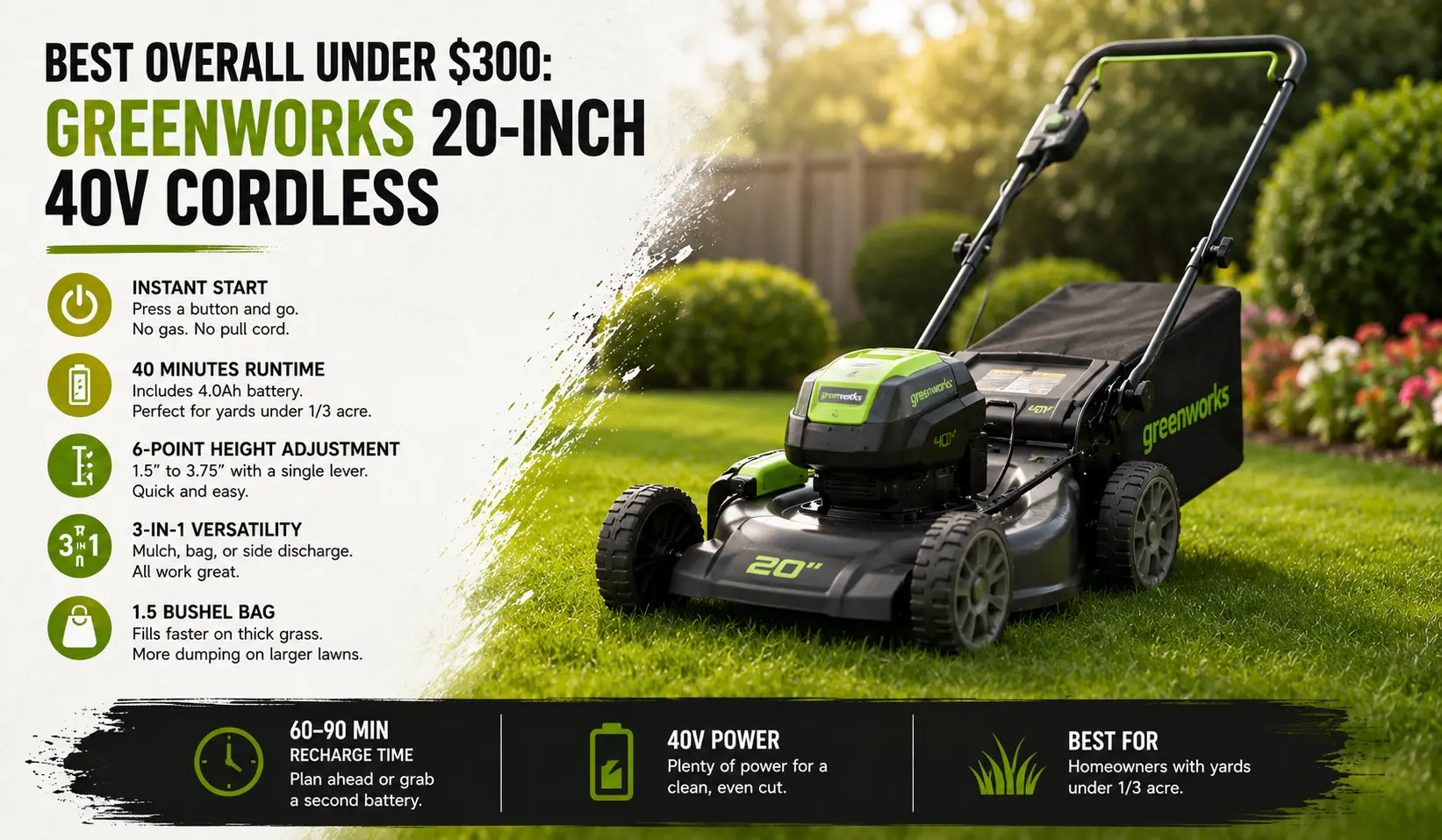
Best Gas Mower Under $300: Craftsman M105 140cc
If you prefer gas, the Craftsman M105 is the most reliable option I’ve tested under $300.
It runs a 140cc Briggs & Stratton engine – the same brand powering many $500+ mowers. In Phoenix during July, when electric mowers struggled with battery drain from the heat, this engine didn’t flinch. The 21-inch deck covers ground fast.
Starting is a two-pull process on a warm engine. Cold mornings in Minnesota required three or four pulls. That’s normal for this class of engine.
The steel deck has held up well through two seasons. I’ve seen some rust starting near the discharge chute, but a light spray of rust inhibitor keeps it in check.
One real weakness: It’s louder than anything battery-powered. My neighbor knocked on the fence the first Saturday morning I used it at 7:30 AM. Fair point. If noise is a concern in your neighborhood, go battery.
Best for: Homeowners with 1/3 to 1/2 acre, thicker grass types like Bermuda or Zoysia, or anyone who’s used gas mowers their whole life and doesn’t want to change.
Best Electric/Battery Pick Under $300: HART 20-inch 40V
HART is Walmart’s house brand for power tools, but don’t let that put you off. The 40V mower has impressed me more than I expected.
The battery shares a platform with HART’s other 40V tools. If you already own HART drills or trimmers, this is a no-brainer. The mower itself weighs 44 pounds – light enough to maneuver around tight corners and raised beds.
Cutting quality on my Bermuda grass in Florida was clean. The blade engagement is smooth, with no noticeable bogging on moderate growth. I found it runs about 35-40 minutes on a full charge, slightly less than the Greenworks.
One real weakness: The grass bag is on the smaller side at 1.2 bushels. Expect frequent dumping if your grass is growing fast.
Best for: Anyone who wants a battery mower at the lowest price point, or homeowners already using HART’s 40V battery platform.
Best for Small Yards: Sun Joe MJ401E Corded Electric
The Sun Joe MJ401E is a corded electric mower with a 14-inch deck. Yes, 14 inches sounds small. For tight urban lots or heavily landscaped yards with lots of obstacles, it’s actually perfect.
It weighs just 29 pounds. I used it in a Tampa townhouse backyard that was roughly 800 square feet of grass surrounded by pavers and a garden bed. The small deck fit between planters easily. No battery to charge, no gas to buy – just plug in and go.
The 12-amp motor runs on regular 120V household current. Extension cord management is the main hassle. I used a 50-foot, 12-gauge cord and didn’t have any power drop issues.
One real weakness: 14 inches is genuinely slow on any yard over 2,000 square feet. Plan on spending twice as long as you would with a 20-inch deck.
Best for: Compact lots, apartments with a shared green space, or as a second mower for tight trim work.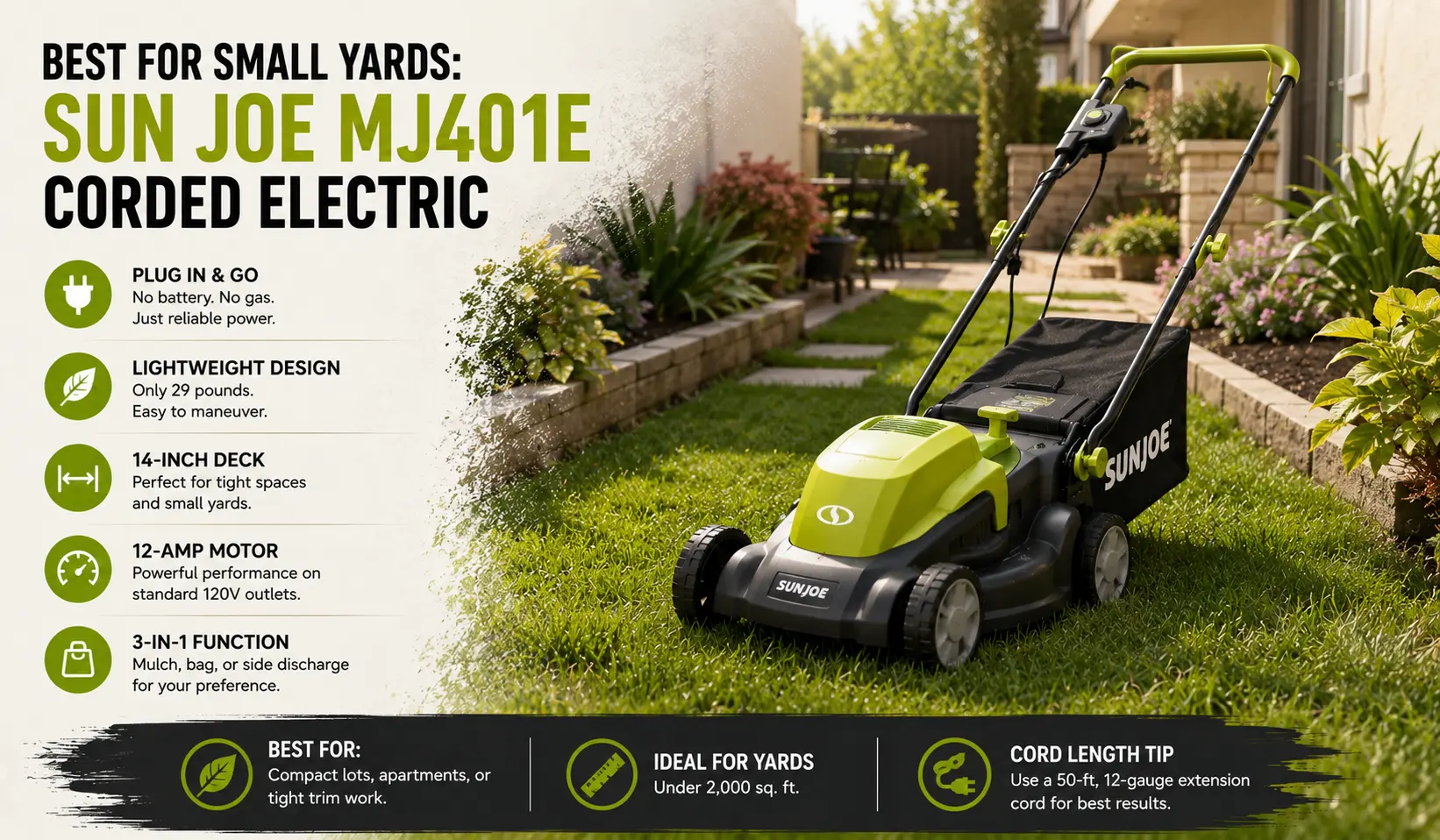
Best Lightweight Option: Greenworks 14-inch Corded (Model MO13B00)
If the Sun Joe feels underpowered, Greenworks’ 14-inch corded model is worth a look as a lightweight alternative. At around $120-$140, it leaves budget for accessories.
At 28 pounds, it’s the lightest mower I tested. My mother-in-law borrowed it for her Minneapolis yard and said it was the first mower she could actually use without her back aching afterward.
It doesn’t mulch – clippings go out the side only. That’s a clear limitation. But for a small, flat yard with regular weekly cuts, it works fine.
One real weakness: No mulching and no bagging option. Every cut means clippings on the ground. You’ll want to rake or blow them after.
Best for: Older adults, smaller users, or anyone with mobility concerns who needs a mower they can actually maneuver without strain.
Compression Table for Every Brand
| Mower | Best For | Price Range | Runtime/Tank | Deck Material | Warranty |
|---|---|---|---|---|---|
| Greenworks 40V 20-in | Best overall | ~$249 | ~40 min | Plastic | 4 yr tool / 2 yr battery |
| Craftsman M105 140cc | Best gas | ~$219 | Full tank ~45 min | Steel | 2 yr limited |
| HART 40V 20-in | Best value battery | ~$199 | ~35 min | Plastic | 3 yr tool / 3 yr battery |
| Sun Joe MJ401E | Small yards | ~$119 | Unlimited (corded) | Plastic | 2 yr |
| Greenworks 14-in Corded | Lightweight pick | ~$130 | Unlimited (corded) | Plastic | 4 yr |
How These Mowers Hold Up in Real Conditions
A mower that works great in mild California weather might struggle in Florida humidity or Arizona heat. This section is about real-world performance – not what the box says.
Different climates put different demands on cheap equipment. Here’s what I found.
Hot and Humid Climates (Florida, Texas, Southeast)
In Florida, I mow from April through November. Grass grows fast. Humidity is relentless.
The Greenworks 40V battery mower handled Florida summer growth well on my St. Augustine lawn. I cut weekly at 3.5 inches and never had clogging issues in the deck. The plastic deck doesn’t rust, which matters in humid climates.
The Craftsman M105 also performed well but needed more cleaning after each use. Wet grass clippings stuck to the steel deck and started drawing rust within a few weeks when I didn’t rinse the underside. Quick fix: rinse with a hose after each cut and let it dry.
One issue I noticed with battery mowers in high heat: the battery gets warm after a long run. The Greenworks has a built-in thermal management system that slows the motor if it overheats. I triggered it once during a 45-minute straight run in 94°F heat. It paused for two minutes, then resumed normally.
Dry and Rocky Terrain (Southwest, Arizona)
Arizona presents a different problem. Soil is dry and hard, sometimes rocky near the edges. Grass types like Buffalo Grass and Bermuda grow slower but the terrain is tougher on decks.
I ran the Craftsman M105 on a Phoenix-area yard with small embedded gravel near the border. The steel deck took some scrapes. Plastic decks on the Greenworks and HART actually fared better here – they flex slightly on impact rather than denting.
Dust was a bigger issue than I expected. After a month of use, the air filter on the Craftsman was visibly clogged. Cleaning or replacing the air filter every 25 hours of use is standard advice, but in dusty dry climates, check it every 10.
Battery mowers have no air filter to worry about – one advantage that doesn’t show up in spec sheets.
Thick Grass and Midwest Lawns
In Minneapolis, I tested the Craftsman M105 on a yard with thick Kentucky Bluegrass that had gotten two weeks of rain and no cutting. The grass was over five inches tall.
The Craftsman powered through it, but slowly. I had to make two passes on the thickest sections – first at 3.5 inches, then back down to 2.5 inches. That’s normal for any mower when grass is that overgrown.
The Greenworks 40V battery mower bogged down noticeably on the same overgrown section. The motor slowed, clippings clumped, and the bag filled in about eight minutes. Battery mowers at this price don’t have the torque reserves for heavy overload cutting.
Takeaway: gas wins for thick or overgrown Midwest lawns. Battery is fine for regular weekly maintenance cuts.
Compression Table
| Condition | Best Pick | Second Pick | Notes |
|---|---|---|---|
| Hot and humid (FL, TX) | Greenworks 40V | Craftsman M105 | Rinse steel decks after each cut |
| Dry terrain (AZ, SW) | HART 40V | Craftsman M105 | Clean gas air filters more often |
| Thick Midwest grass | Craftsman M105 | Troy-Bilt TB100 | Gas wins for heavy loads |
| Small, flat suburban lots | Sun Joe MJ401E | Greenworks 14-in | Either corded option works well |
Common Mistakes People Make When Buying a Budget Mower
I’ve watched friends, neighbors, and customers buy the wrong mower and regret it. Most mistakes come down to two things.
These are worth knowing before you commit.
Choosing Price Over Cutting Width
The cheapest mower in the store might be $99 or $119. It probably has a 14-inch deck. For anything over 2,500 square feet of lawn, that’s a frustrating experience every single week.
A 20-inch deck covers the same yard in roughly 30% fewer passes than a 14-inch deck. Over a summer, that difference adds up to hours of mowing time. Spending $50-$80 more for a wider deck is almost always worth it.
Before you buy, measure your lawn. Use Google Maps satellite view if you’re not sure – right-click and use the “Measure distance” tool to outline your grass area. Then match the deck size to your yard size:
- Under 2,000 sq ft: 14-18 inch deck is fine
- 2,000-5,000 sq ft: 20-inch deck is the minimum I’d recommend
- Over 5,000 sq ft: 21-22 inch deck, or consider a bigger budget
Skipping the Warranty Fine Print
Budget mowers often come with warranties that sound good on the box but have real limitations.
I’ve seen warranties that cover the engine but not the deck, or that require warranty service at a specific authorized dealer – which might be 40 miles away. I’ve also seen “2-year warranty” that actually covers only defects in materials, not normal wear on belts or blades.
Before buying, search the brand name plus the model number plus “warranty claim” online. Read what real customers say about the claims process. A warranty is only useful if the company actually honors it without making you jump through hoops.
Greenworks has a reputation for smooth warranty handling in online forums. Craftsman warranties go through their Sears service network, which has gaps in some areas of the country.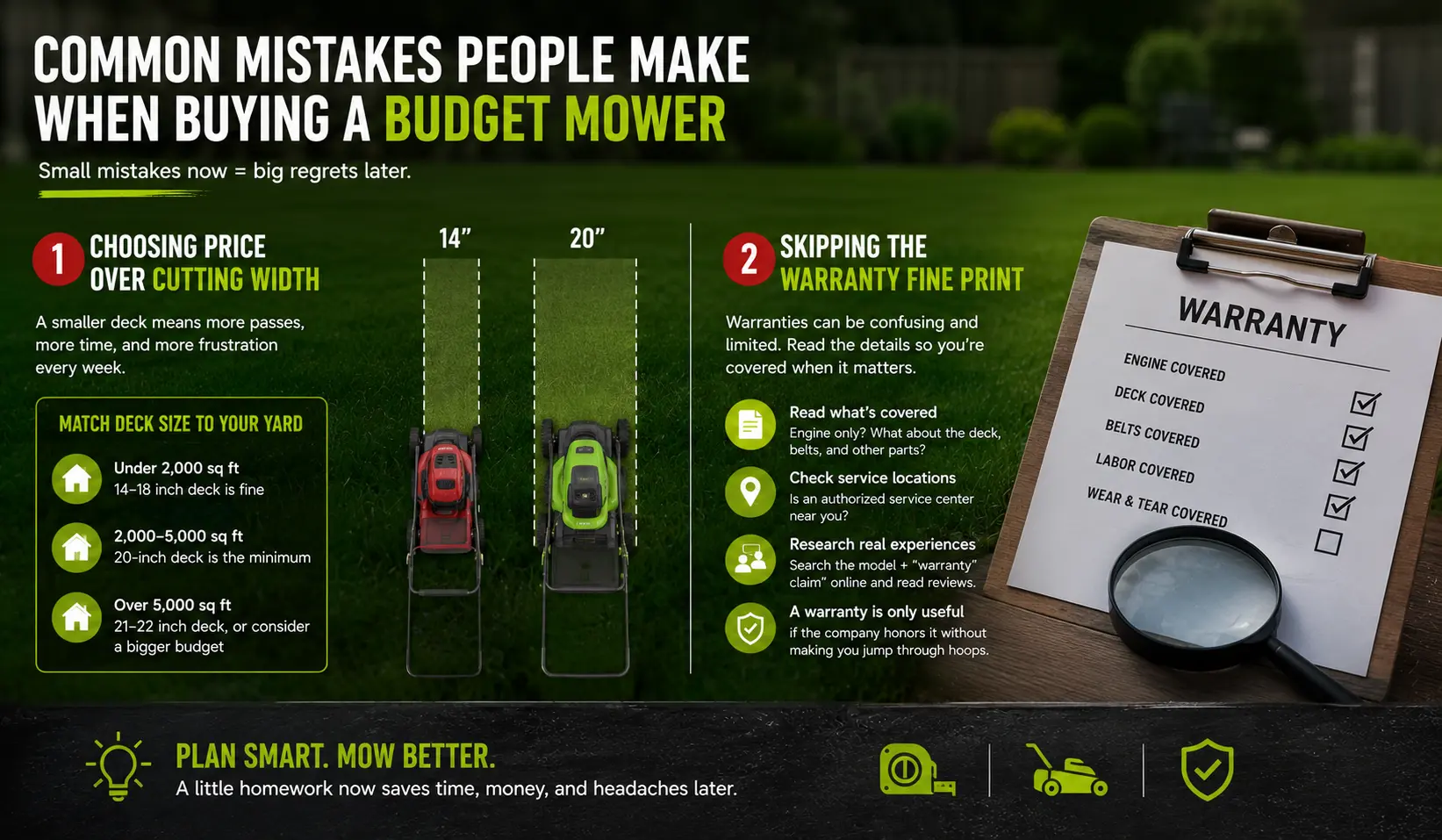
My Final Recommendation
If I had to pick one mower for most homeowners reading this, it’s the Greenworks 40V 20-inch cordless. It starts without fuss, it’s quiet enough not to anger your neighbors at 8 AM on a Saturday, and the cutting quality is genuinely good on regularly maintained grass. The 4-year tool warranty is the best in this price range. For a typical 1/4-acre suburban lot, it handles everything without complaint.
If your yard is larger or your grass gets thick and overgrown between cuts, go with the Craftsman M105 instead. Gas engines at this price have more raw power for tough conditions, and the Briggs & Stratton engine is proven over decades of use. You’ll spend a few minutes on maintenance each season – oil change, air filter, blade sharpening – but it’s not complicated work.
What I would not do is buy a $200 self-propelled mower from a brand you’ve never heard of on Amazon. I’ve tried two of those. Both had transmission issues within six months. The brands on this list have actual parts availability, service networks, and customer support. That matters when something goes wrong.
Pros and Cons Table
| Mower | Pros | Cons |
|---|---|---|
| Greenworks 40V 20-in | Easy start, quiet, 4-yr warranty, no fuel costs | Small bag, 60-90 min recharge, less power on thick grass |
| Craftsman M105 | Strong gas engine, 21-in deck, wide parts availability | Louder, needs annual maintenance, deck can rust in humid conditions |
| HART 40V 20-in | Lowest price battery option, 40V platform compatibility | Smaller battery capacity, smaller bag |
| Sun Joe MJ401E | Lightest in class, no battery/fuel costs, cheap | Cord management required, 14-in deck is slow on medium yards |
| Greenworks 14-in Corded | Very lightweight, budget-friendly, easy to store | No mulching or bagging, slow on larger yards |
Frequently Asked Questions About Budget Lawn Mowers Under $300
What is the best budget lawn mower under $300?
The Greenworks 40V 20-inch cordless mower is the best all-around pick under $300 for most homeowners. It offers clean cuts, easy push-button starting, and a 4-year warranty. For gas power, the Craftsman M105 is the most reliable option at this price.
How long do budget lawn mowers last?
A well-maintained budget mower typically lasts 3 to 5 years with regular residential use. Gas mowers can last longer – 5 to 8 years – if you change the oil annually and clean the air filter. Battery mowers depend heavily on how well you treat the battery; avoid storing it fully discharged.
Can a $300 lawn mower handle thick grass?
Gas mowers under $300 can handle thick grass reasonably well, especially models with 140cc or larger engines. Battery mowers in this price range struggle with thick or overgrown grass due to limited motor torque. If you have dense grass types like Zoysia, St. Augustine, or Kentucky Bluegrass, go with gas.
Is a self-propelled mower worth it under $300?
No. Self-propelled mowers under $300 use low-grade drive cables and transmission components that wear out quickly – often within one to two seasons. The money is better spent on a quality push mower with a wider deck or stronger engine.
What’s the difference between a corded electric and battery lawn mower?
Corded electric mowers plug into a standard outlet and run continuously – no battery to charge or fuel to buy. The limitation is the cord: you’re typically limited to 50-100 feet from your outlet, and managing the cord around obstacles takes practice. Battery mowers are cord-free and more convenient, but limited by charge time and battery capacity. For small, simple yards, a corded mower is cheaper and more reliable. For medium yards with irregular layouts, battery wins.
What size lawn mower do I need for a 1/4-acre yard?
A 20-inch deck is the right fit for a 1/4-acre yard. It covers the space in a reasonable time without being too heavy to maneuver. A 14-inch deck will work but takes significantly longer. A 21-inch deck is slightly faster but may be harder to navigate around tight spots in a typical suburban layout.
Are budget gas mowers reliable?
Yes, if the engine is from a known manufacturer. Mowers using Briggs & Stratton 140cc or 163cc engines – found in Craftsman, Troy-Bilt, and similar brands – are built on decades of proven design. The weak points on budget gas mowers are the deck quality and handle construction, not the engine itself.