
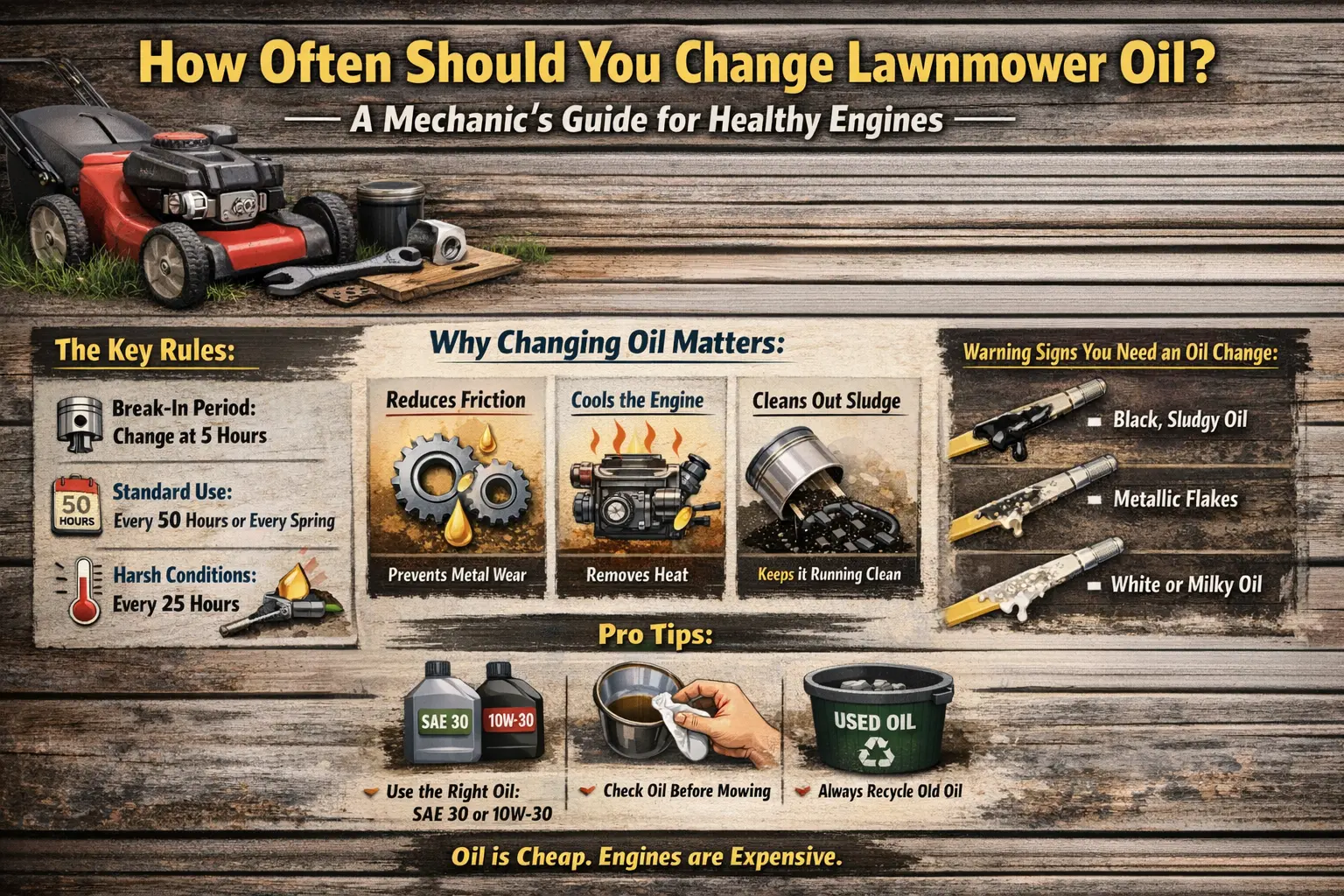
I still remember the first time I killed a mower. It was a hot July day in Georgia. The humidity was thick enough to chew on. I was trying to cut tall fescue in the heat. The engine sputtered. Then it clunked. It stopped dead. I checked the oil. It was black sludge. I felt sick. That engine was toast.
Since then, I have fixed hundreds of mowers. From tiny push mowers in Ohio suburbs to big zero-turns on Texas ranches. The oil is the life of the machine. If you ignore it, you lose money. It is that simple.
So, how often should you change lawnmower oil to stay safe?
Most folks guess. They wait until it looks bad. That is a mistake. Fresh oil keeps the metal parts cool. It stops them from grinding down. I treat my mowers like my truck. I want them to run for years.
In this guide, I will share what I know. We will look at run times. We will talk about harsh weather. I will help you pick the right oil, too. Let’s get your hands a little dirty. It’s time to work.
2. Why Oil Matters More Than Gas
Oil does three big jobs inside your engine: cooling, cleaning, and sealing. It is the only thing standing between a smooth cut and a seized piston.
The invisible barrier
We don’t see the oil working. It hides inside the crankcase. But it is fighting a war in there. It coats the metal. It stops parts from touching.
Reducing friction between metal parts
The piston moves fast. It goes up and down thousands of times a minute. Without oil, metal rubs on metal. This creates heat. Lots of heat.
- Oil creates a film.
- The parts glide on this film.
- It prevents “galling,” which tears the metal apart.
I have heard engines run dry. It is a terrible sound. It screeches and grinds, sounding like the machine is in pain. Good oil stops this. It makes the engine purr.
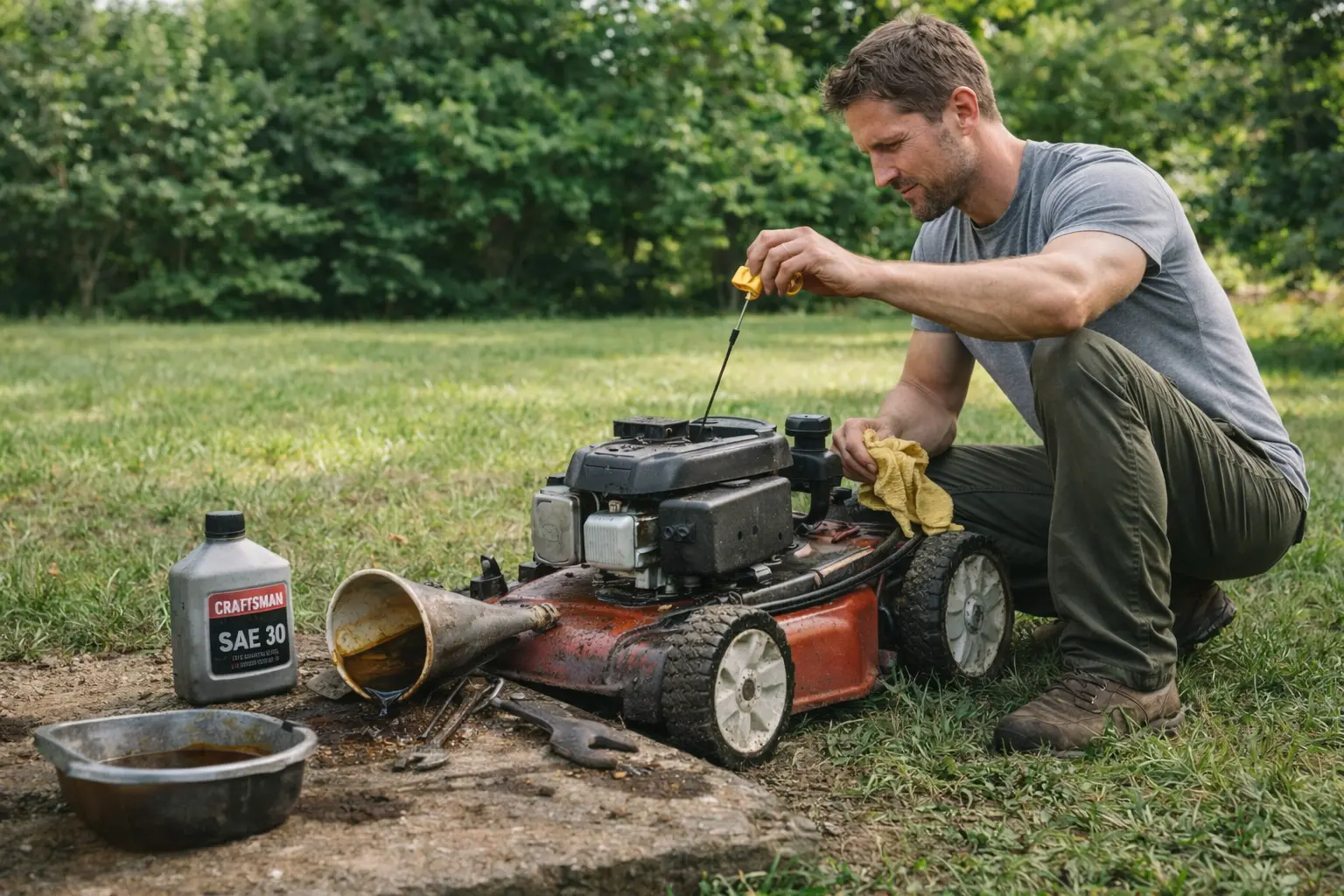
Cooling the engine block
Most mowers in the US are air-cooled. They don’t have radiators like cars. They rely on air and oil.
- The fins on the side catch air.
- The oil inside absorbs heat.
- It moves heat away from the piston.
I worked on a mower in Phoenix once. It was 110°F outside. The air was hot. The oil was the only thing saving that engine. If the oil gets low, the engine cooks. It melts from the inside out.
Cleaning sludge and carbon
Gas does not burn clean. It leaves soot. It leaves carbon. This stuff tries to stick to the walls.
- Oil has detergents.
- It grabs the dirt.
- It holds the dirt until you drain it.
This is why old oil turns black. It is full of trash. That is a good thing. It means the oil is doing its job. But you have to get that trash out.
The cost of neglecting your oil
I see people skip this step. They think, “It runs fine.” But damage happens slowly. Then it happens all at once.
Reduced engine life
I saw two Toros side by side last week. Both were five years old. One got oil changes every spring. The other never did.
- The maintained mower started on the first pull.
- The neglected mower smoked blue.
- It had low compression.
The first mower will last ten more years. The second one is ready for the dump. That is a $400 loss. Just because of $5 worth of oil.
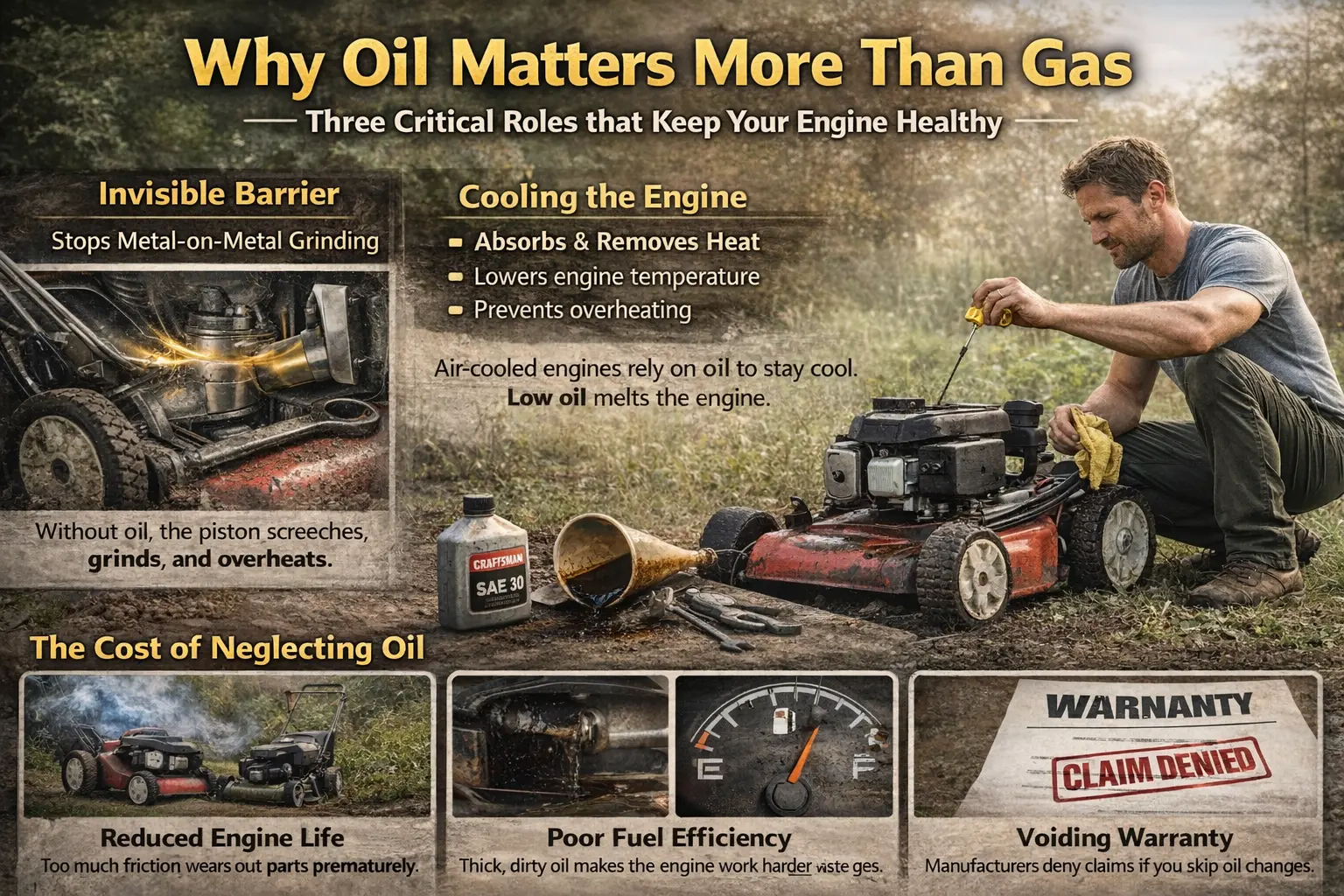
Poor fuel efficiency
Thick oil is like honey. The engine has to push hard to move through it. This wastes power.
- You use more gas.
- The cut feels weaker.
- The engine bogs down in tall grass.
I notice this in the spring. I change the oil. Suddenly, the mower feels stronger. It cuts cleaner, uses less gas, and feels new again.</span>
Voiding your warranty
Companies like Craftsman and Honda are smart. They know when you skip maintenance.
- They look for sludge.
- They look for heat damage.
- If they see it, they deny your claim.
I read the manual for my new zero-turn. It was clear. No maintenance log means no warranty. I keep a notebook in my shed. I write down every date. It protects my wallet.
3. The Golden Rules of Oil Change Frequency
Timings vary based on how you use the machine, but there are standard benchmarks we use in the shop. Stick to these to be safe.
The 50-Hour Rule
This is the big rule. Most manuals say it. Mechanics swear by it. Fifty hours of use is the limit for standard oil.
What counts as a “mowing hour”?
It is hard to guess time. We lose track.
- My lawn takes 45 minutes.
- I mow once a week.
- That is roughly 3 hours a month.
In a six-month season, that is 18 hours. So, for me, 50 hours is two seasons. But I don’t wait that long. I change it sooner. 50 hours is the absolute max.
Tracking time without an hour meter
Big mowers have clocks. Push mowers don’t. I use a trick.
- I use masking tape on the handle.
- I make a tally mark every time I mow.
- When I hit 25 marks, I change the oil.
It is simple. It works. I never have to guess. I just look at the handle and know exactly where I stand.
Why 50 hours is the industry standard
Oil breaks down. The heat shears the molecules. The additives wear out.
- After 50 hours, the oil is thin.
- It protects less.
- It holds too much acid.
I sent oil to a lab once. Just out of curiosity. The oil with 60 hours on it was shot. It had no zinc left. It was just dirty water. Don’t push past 50.
The “Once a Season” Minimum
Maybe you have a small yard. You only put 10 hours on your mower a year. You still need to change the oil.
Why spring is the best time
I do my maintenance in March. The grass is starting to wake up. Ideally, you change it before the first cut.
- You start fresh.
- You check the blade too.
- It sets the tone for the year.
Some folks do it in the fall. That is okay too. But I like fresh oil for the start of the work season. It feels right.
The risks of leaving old oil over winter
Used oil is acidic. It has sulfur from the gas.
- It sits in the crankcase all winter.
- It eats at the metal.
- It causes pitting on the bearings.
I learned this the hard way. I left dirty oil in a tiller one winter. In the spring, it had rust inside. Now, if I store it, I store it clean.
The Break-In Period (The First 5 Hours)
This is the most important oil change of all. If you buy a new mower, listen up. You must change the oil after the first 5 hours.
New engines shed metal
Factory parts are tight. They rub together to find their fit. This shears off microscopic metal.
- We call it “break-in glitter.”
- If you look at the oil, it sparkles.
- That is metal dust.
You do not want that dust circulating. It acts like sandpaper. It will ruin the cylinder walls. You have to flush it out.
Seating the piston rings
The rings need to seal against the wall. This happens in the first few hours.
- The oil carries away the friction heat.
- It helps the rings set hard.
- This ensures good compression later.
I bought a brand new Honda last year. I ran it for one Saturday. Then I dumped the oil. It was silver with metal. I was glad to get that out.
Don’t skip this step!
I have seen people skip this. They think new oil is good for a year.
- Their engines smoke early.
- They lose power after two years.
- It is a tragic waste.
Set a timer. Watch the clock. Do that first change. It is the secret to a 20-year mower.
4. Factors That Change the Schedule
Not all lawns are the same, and where you live changes how fast your oil degrades. A dusty yard in Arizona kills oil faster than a green lawn in Oregon.
Dusty and dry conditions
I lived in West Texas for a bit. The dust was unreal. It got everywhere. Mowing there is different than mowing in lush Kentucky.
Dirt ingestion
Air filters are good. But they are not perfect. Fine dust gets in.
- It mixes with the oil.
- It turns the oil into grinding paste.
- It wears out the rings fast.
If you kick up dust when you mow, you are at risk. You see a cloud behind you? That cloud is entering your engine.
Frequency adjustment: Every 25 hours
In dusty places, I cut the schedule in half.
- I change oil every 25 hours.
- Sometimes even sooner.
- Oil is cheap. Engines are expensive.
I check the oil color often in dust. If it turns gray or dark brown quickly, I change it. I don’t care about the hours. The color tells the truth.
High heat and heavy loads
Heat kills oil. If you work your mower hard, the oil dies young.
Mowing tall, wet grass
Sometimes rain keeps us inside. The grass grows tall. It gets thick.
- The engine has to rev high.
- It gets very hot.
- This cooks the oil.
I tackled a neglected lot last summer. The grass was knee-high. I could smell the engine heat. I changed the oil right after that job. It smelled like burnt toast.
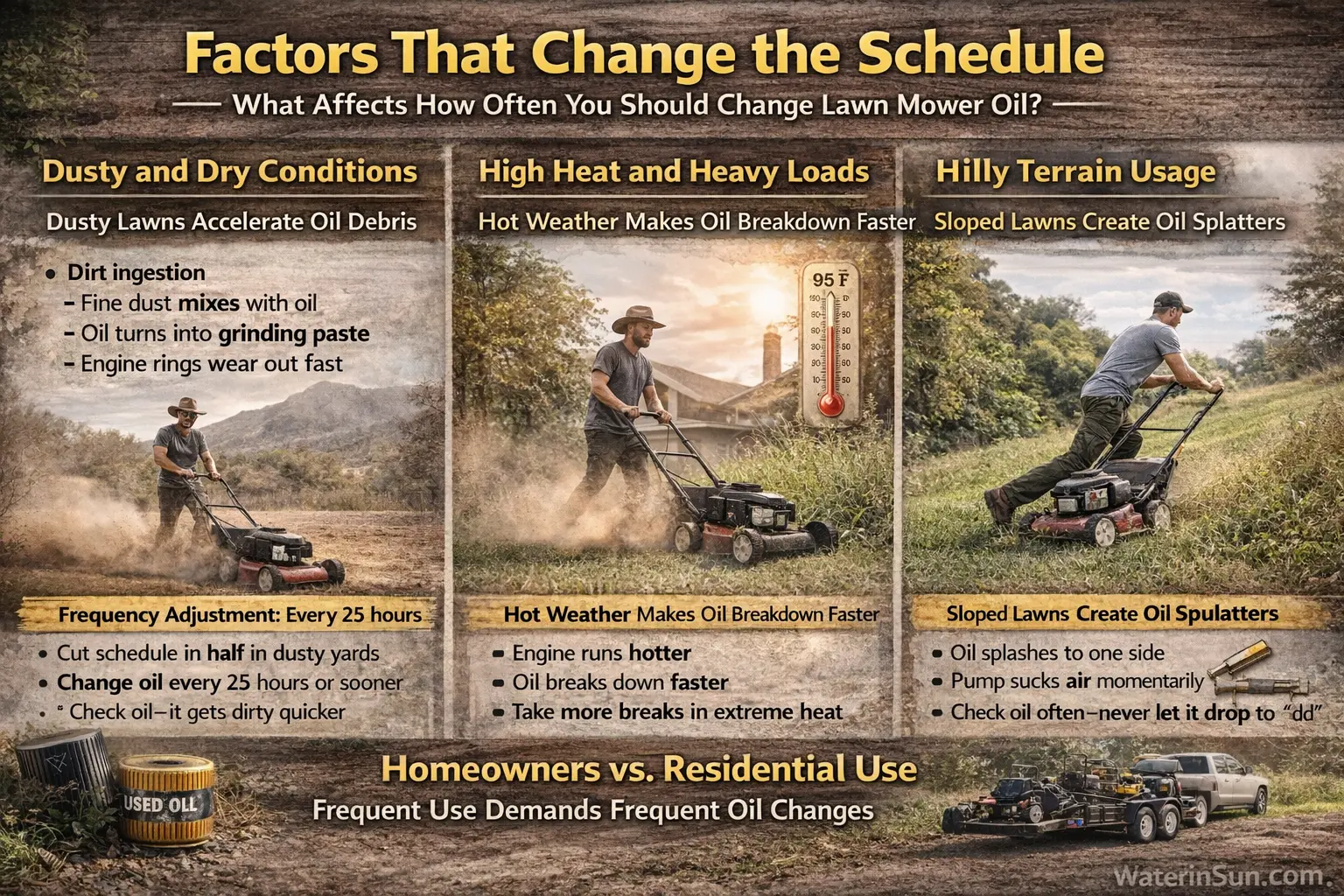
Operating in 90°F+ weather
July and August are brutal in the US.
- Air cooling works less well.
- The oil temperature spikes.
- Standard oil thins out too much.
When it is that hot, I take breaks. I let the mower cool down. It helps the oil survive.
Hilly terrain usage
Mowing hills is tricky.
- The oil splashes to one side.
- Sometimes the pump sucks air.
- This causes momentary dry spots.
If you have steep hills, check your oil level often. Keep it to the “Full” mark. Do not let it drop to “Add.” You need every drop for safety.
Commercial vs. Residential Use
Are you a homeowner? Or do you mow for cash? The rules change.
The weekend warrior
You mow once a week. The machine rests for six days.
- You have time to check things.
- One change a year is usually fine.
- Stress is low.
The daily cutter
Pros run their machines 8 hours a day.
- They change oil every week.
- They use bulk oil.
- They can’t afford downtime.
I have a buddy who runs a landscape crew. Friday is maintenance day. Every machine gets fresh oil. No exceptions. His mowers run forever.
5. Choosing the Right Oil Weight
You can’t just grab any bottle from the garage shelf. The viscosity needs to match the temperature outside.
SAE 30: The warm weather standard
This is the classic oil. It is what your grandpa used. It is a straight-weight oil.
Best for 40°F and up
It works great in summer.
- It stays thick in heat.
- It coats well.
- It is perfect for simple engines.
I use this in my old Briggs & Stratton. It loves it. It doesn’t burn a drop.
Why it’s common in older mowers
Older engines have looser gaps.
- They need thick oil.
- Thinner oil leaks past the rings.
- SAE 30 seals them up.
If your mower is 15 years old, stick with SAE 30. It is safe. It is proven.
10W-30: The variable temperature hero
This is a multi-grade oil. It acts thin when cold and thick when hot.
Cold starts in spring and fall
Sometimes I mow in November. It is chilly.
- SAE 30 gets waxy in the cold.
- 10W-30 flows instantly.
- It protects the engine at start-up.
If you live in the Midwest, this is a good choice. The weather swings a lot there. You need flexibility.
Higher consumption rates
There is a catch.
- Some engines burn 10W-30 faster.
- It is thinner.
- It sneaks past the rings.
If you use this, check the level every time. You might need to add a splash now and then.
Synthetic 5W-30
This is the high-tech stuff. It is synthetically engineered. It is pure.
Superior protection
Synthetic oil does not break down easily.
- It handles high heat.
- It flows in freezing cold.
- It keeps the engine cleaner.
I switched my new generator to synthetic. It runs smoother. It starts easier.
Is it worth the extra cost?
It costs more. Maybe double the price.
- For a cheap mower? Maybe not.
- For a $3,000 zero-turn? Absolutely.
I think it is worth it. You only use 20 ounces. The extra $3 is nothing compared to the peace of mind.
Oil brands and labels
The shelves are full of brands. It is confusing.
Automotive oil vs. Small engine oil
People ask me, “Can I use car oil?”
- Generally, yes.
- 10W-30 car oil works in mowers.
- Just check the rating (API rating).
However, small engine oil often has more zinc. Zinc is an anti-wear additive. Car oils removed zinc to save catalytic converters. Mowers don’t have those. So, “Small Engine” oil is slightly better.
Detergent vs. Non-detergent
Always use detergent oil.
- Non-detergent is for pressure washers or air compressors.
- Engines need detergent to clean soot.
- Check the label carefully.
I bought non-detergent by mistake once. I realized it before I poured it. That was a close call.
6. How to Check Your Oil Properly
Checking the dipstick seems easy, but I see people do it wrong all the time. An accurate reading prevents overfilling or running dry.
The cold check vs. the warm check
When should you check? Before you start.
Letting the oil settle
If you run the engine, the oil is flying around.
- It is up in the cylinder head.
- It is on the walls.
- The dipstick will read low.
Wait 5 minutes after shutting down. Let gravity work. Let the oil drain back to the pan. Then check.
Cleaning the area first
Look at the cap. Is it covered in grass clips?
- Wipe it off.
- Use a rag.
- Don’t let dirt fall in the hole.
I use a cheap paintbrush. I keep it on my bench and brush the dirt away before opening the cap. It takes two seconds.
Reading the dipstick
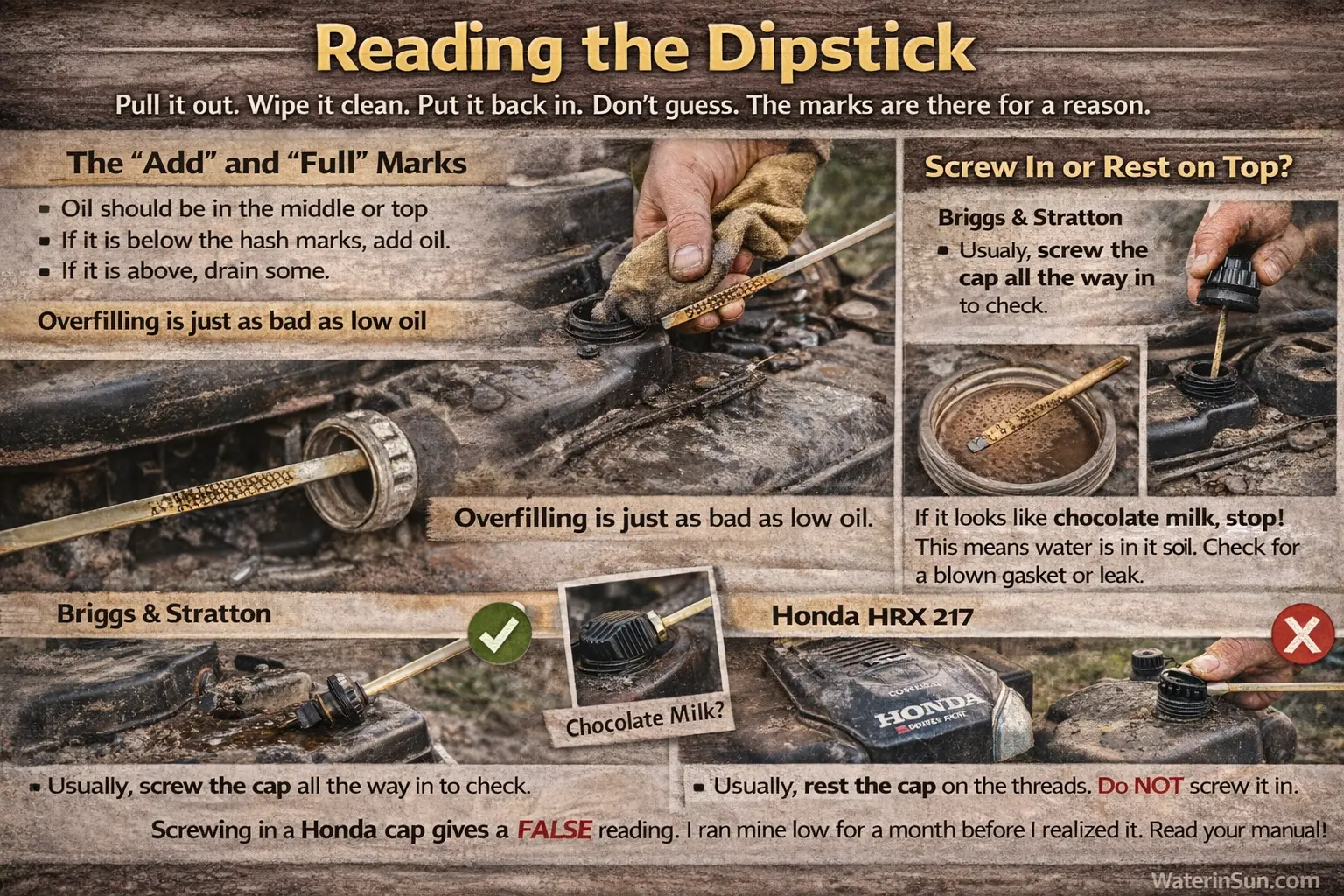
Pull it out. Wipe it clean. Put it back in.
The “Add” and “Full” marks
There is a cross-hatched area.
- Oil should be in the middle or top.
- If it is below the hash marks, add oil.
- If it is above, drain some.
Don’t guess. The marks are there for a reason. Overfilling is just as bad as low oil.
Dark oil vs. Honey oil
New oil looks like honey.
- After 5 hours, it gets amber.
- After 20 hours, it gets brown.
- Pitch black means change it.
If it looks like chocolate milk, stop! That means water is in there. You have a blown gasket or a leak.
Screw in or rest on top?
This is the tricky part. Read your manual!
- Briggs & Stratton: Usually, you screw the cap all the way in to check.
- Honda: Usually, you just rest the cap on the threads. You do NOT screw it in.
If you screw in a Honda cap, you get a false high reading. You think you are full, but you are low. I learned this on a Honda HRX. I was running it low for a month. Luckily, I caught it.
7. Step-by-Step: Changing Oil in a Walk-Behind Mower
This is a messy job if you aren’t careful. I’ll walk you through my “no-spill” method for standard push mowers.
Preparation and Safety
Don’t rush. Get your tools ready.
Disconnect the spark plug wire
This is Rule #1.
- Engines can start if you spin the blade.
- It happens.
- Pull the rubber boot off the plug.
I value my fingers. I never touch the blade without pulling the plug. It is a habit.
Warm up the engine
Cold oil is thick. It flows slow.
- Run the mower for 2 minutes.
- This stirs up the sludge.
- The warm oil carries the dirt out.
Don’t get it blazing hot. Just warm. You don’t want to burn your hand.
Empty the gas tank (or seal it)
You are going to tip the mower. Gas will spill.
- Run it dry if you can.
- Or, put a plastic bag under the gas cap and tighten it. This creates a seal.
I prefer running it dry. It is safer. Gas spills kill grass.
The Tipping Method
Most push mowers don’t have drain plugs underneath anymore. You have to dump it out the fill tube.
Which way to tip?
This is crucial. Look at the engine. Find the carburetor and air filter.
- Tip the mower so the air filter is UP.
- Never tip the filter down.
- Oil will soak the filter and ruin it.
I did this wrong once. I tipped filter-down. Oil poured into the carb. The mower wouldn’t start for a week. Smoke everywhere.
Catching the oil
I use an old plastic milk jug.
- I cut the side out.
- It fits right under the spout.
- It has a handle.
It is free. It works. When I am done, I pour it into a recycling container.
Gravity is your friend
Hold it there.
- Let it drip.
- Wait a full minute.
- Rock the mower a little to get the last drops.
The dirty stuff is at the bottom. You want that out. Patience pays off.
The Siphon Method (Alternative)
Maybe your mower is heavy. Or you hate tipping it.
Using an oil extractor
You can buy a syringe pump.
- Stick the tube in the oil fill.
- Suck the oil out.
- It is clean and easy.
Pros and cons
- Pro: No heavy lifting. No gas spills.
- Con: It doesn’t get all the sludge.
I use a pump on my generator. It is too heavy to lift. For mowers, I prefer tipping. It drains better.
Refilling
Now put the good stuff in.
Checking the manual for capacity
Small mowers take small amounts.
- Usually 15 to 20 ounces.
- That is slightly more than half a quart.
- Do not dump the whole quart in!
Pouring slowly
Pour a little. Stop. Check the stick.
- It takes time for oil to run down.
- If you overfill, it is a pain to drain.
- Go slow.
I use a funnel. I pour 10 ounces, then check the dipstick. After that, I add 2 ounces at a time. It is precise.
8. Step-by-Step: Changing Oil in a Riding Mower
Riding mowers and zero-turns are different beasts. They usually have drain plugs and oil filters that need attention.
Locating the drain plug
Crawl under the side. Look for a bolt or a valve on the engine base.
Using the drain hose extension
Many new mowers come with a plastic tube.
- You snap it onto the drain.
- It directs the oil past the frame.
- It keeps the mess off your deck.
If you lost yours, buy one. It saves so much cleanup. Cleaning oil off a mower deck is miserable.
Tools needed
- You usually need a 10mm or 12mm wrench.
- Some have a square drive (3/8 inch).
- Some have a “twist and pull” yellow valve.
I have a Craftman rider. It has the twist valve. No tools needed. I love that feature.
Changing the Oil Filter
Big engines have filters. They look like mini car filters.
Do all riders have filters?
Check your engine.
- If it has a round canister on the side, yes.
- Some cheaper riders don’t.
- Most 15HP+ engines do.
Change the filter every time you change the oil. Don’t be cheap. A dirty filter blocks flow.
Pre-filling the new filter
Here is a mechanic’s trick.
- Pour a little fresh oil into the new filter.
- Let it soak in.
- This primes it.
When you start the engine, oil flows instantly. There is no dry lag. It protects the bearings.
Hand-tightening only
Put a little oil on the rubber gasket.
- Screw it on by hand.
- Turn it until it touches.
- Then do a 3/4 turn more.
Do not use a wrench. You will crush the gasket. It will leak. Or you will never get it off again. Hand tight is enough.
The refill process
Riders take more oil.
Larger capacities
- They often take 1.5 to 2 quarts. (48 to 64 oz).
- You will need two bottles.
Running and re-checking
Pour it in. Check the stick.
- Start the engine.
- Let it run for 30 seconds.
- Shut it off.
The filter will absorb some oil. The level will drop. Check it again. Top it off to the “Full” line. Now you are done.
9. Signs Your Oil Needs Changing Immediately
Sometimes you shouldn’t wait for the 50-hour mark. If you see these signs, stop mowing and change the oil now.
Visual indicators
Pull the dipstick. Look at it in the sunlight.
The oil is pitch black and thick
If it drips slow, it is too old.
- It has oxidized.
- It is sludge.
- Change it now.
Metallic flakes (The Glitter of Death)
If you see sparkles, panic slightly.
- That is metal from your engine.
- Something is wearing out.
- Change the oil and pray.
If it keeps glittering, your engine is dying. It might be a rod knocking.
Milky or gray oil
This is water.
- Did you leave it in the rain?
- Did you pressure wash it?
- Water ruins lubrication.
Drain it immediately. Flush it with cheap oil. Drain that too. Then fill with good oil. Get that water out.
Performance indicators
Listen to the machine. It talks to you.
The engine runs hotter than usual
You feel the heat on your legs. The metal ticks when you shut it off.
- Old oil holds heat.
- Fresh oil cools.
Smoke from the exhaust
Blue smoke is oil. White smoke can be oil too.
- If it smokes while running, the rings are worn.
- Thicker oil might help.
- But usually, it needs a rebuild.
Increased fuel consumption
I track my gas. If I usually mow the whole yard on one tank, and suddenly I need a refill, I check the oil. Friction burns gas.
10. Tools That Make the Job Easier
I have a few favorite tools in my shed that make this 10-minute job feel like a 2-minute job. They are worth the few bucks.
Oil extractor pumps
These are great for mowers with hard-to-reach plugs.
Manual hand pumps
- They look like a big syringe.
- Cost about $15.
- Simple and durable.
I keep one dedicated for oil. I don’t use it for gas. It keeps the seals good.
Vacuum extractors
- You pump it up.
- It sucks the oil out automatically.
- Holds a gallon or more.
If you have a boat or a big truck, get one of these. It makes life easy.
The right funnel
Don’t use a kitchen funnel. Get a garage funnel.
Long-neck funnels
Engines are often buried under plastic covers.
- A long neck reaches the hole.
- It prevents spills on the muffler.
- Spilled oil can produce a lot of smoke.
Flexible funnels
- You can bend them.
- They hold their shape.
- Great for draining oil from awkward spots.
I have a “Form-A-Funnel”. It is a lead sheet covered in rubber. I mold it under the drain. It guides the oil right into the pan. Best $20 I ever spent.
Disposal containers
Don’t use old coffee cans. They spill.
Sealable drain pans
- The pan has a spout and a lid.
- You drain into it.
- You seal it.
- You drive it to the store.
No mess in my truck. It is clean.
11. Mistakes to Avoid
I have seen perfectly good mowers ruined by simple mistakes during an oil change. Don’t be that guy.
Overfilling the crankcase
More is not better.
Why it happens
People pour blindly. They assume “one bottle fits all.”
- It doesn’t.
- Engines hold specific amounts.
The consequences
- The crankshaft hits the oil.
- It whips it into foam.
- Air bubbles don’t lubricate.
- Oil blows out the breather tube.
I overfilled a Tecumseh once. It sprayed oil all over the hot muffler. The smoke cloud was massive. My neighbors thought my house was on fire. Embarrassing.
How to fix it
If you overfill, don’t run it.
- Tip it and drain some out.
- Use a turkey baster to suck it out.
- Get it right before you start.
Underfilling
This is risky.
The danger zone
- Oil splashes around to lube parts.
- If the level is low, the splash is weak.
- Top parts run dry.
Tilt sensors
Some engines have “Low Oil Shutoff.”
- If you mow a hill, the oil shifts.
- The sensor thinks it is empty.
- The engine dies.
If your mower cuts out on slopes, check the oil level. It is likely low.
Tipping the wrong way
I repeat this because it is the #1 mistake.
Oil in the carburetor
- If you tip carb-down, oil floods it.
- The float gets stuck.
- The engine won’t start.
Soaking the air filter
- Paper filters soak up oil like a sponge.
- Air cannot get through.
- The engine chokes.
If you soak a paper filter, throw it away. You cannot clean it. Buy a new one.
12. Brand-Specific Advice
Different manufacturers have different quirks. Here are some quick notes on the big names I see in the US market.
Toro
Toro is huge here.
The “No Change” engines
Toro uses Briggs engines with “Just Check & Add” technology (Exit series).
- They say you never need to change oil.
- Just add more when low.
My honest opinion: Don’t believe it.
- Where does the dirt go? It stays in the engine.
- It turns to sludge.
- They want you to buy a new mower in 5 years.
I tell all my customers: Change the oil anyway. Ignore the sticker. Your Toro will last twice as long.
Honda
Honda makes legendary engines (GCV series).
Twin blades and high RPM
Honda mowers often have two blades (MicroCut).
- They spin fast.
- They create load.
- They need clean oil to handle the stress.
The dipstick quirk
I mentioned this before, but it is vital.
- Do not screw the cap in to check.
- Rest it on the threads.
- This is the “Honda Way.”
John Deere (Riding Mowers)
The green machines are everywhere.
The Easy Change™ system
Some new Deeres have a 30-second system.
- The oil and filter are in one canister.
- You twist the whole thing off.
- You twist a new one on.
- It includes the oil.
Is it convenient? Yes. Very.
Is it expensive? Yes. The canister costs $40-$50.
Standard oil and filter costs $15. You pay for the speed. If you have bad knees, it is worth it. If you are on a budget, buy the conversion kit to use standard filters.
Briggs & Stratton
The classic American engine.
The workhorse
- They are loose.
- They are loud.
- They are tough.
They thrive on SAE 30. They are not picky. Just keep oil in them, and they will run forever. I have a 30-year-old Briggs that still starts on the first pull.
13. Environmental Responsibility
We love our green lawns, so let’s keep the ground green too. Dumping oil is a jerk move and it is illegal.
Where to recycle used oil
Do not pour it in the drain. Do not pour it on the weeds.
Auto parts stores
- AutoZone, O’Reilly, Advance Auto, NAPA.
- They all take used oil for free.
- Most have a tank in the back.
I keep a 5-gallon bucket. When it fills up, I take it to AutoZone. They smile and point to the back. Easy.
Municipal recycling centers
Check your city website.
- Many have hazardous waste days.
- They take oil, paint, and batteries.
Cleaning up spills
Accidents happen.
Kitty litter or sawdust
If you spill on concrete:
- Throw kitty litter on it immediately.
- Step on it. Grind it in.
- Let it sit for an hour.
- Sweep it up.
Dish soap for the stain
For the grease mark left behind:
- Squirt Dawn dish soap on it.
- Scrub with a stiff brush.
- Rinse with hot water.
My driveway is clean. My wife is happy. That is important.
14. Conclusion
Taking care of your equipment is a point of pride. A well-oiled mower cuts better, sounds better, and lasts longer.
Recap of the schedule
Let’s make it simple.
- New Mower: Change at 5 hours.
- Standard Use: Change every 50 hours (or every Spring).
- Hard Use (Dust/Heat): Change every 25 hours.
FAQs for How Often Should You Change Lawnmower Oil
How often should I change the oil in my mower?
Most experts say change it every 50 hours or once a spring. New mowers need it after 5 hours. This simple task stops heat and saves the engine from heavy wear.
Can I use regular car oil in my lawn mower?
Yes, 10W-30 car oil often works well. It handles heat and cold. Always check your manual first. Some engines need specific additives to stay safe and run smooth.
How do I know if my lawn mower oil is bad?
Check the stick. If the oil is pitch black or gritty, change it fast. Good oil looks like clear honey. Dark sludge causes high heat and ruins the metal parts.
Do I need to change the oil filter every time?
Yes, always swap the filter with the oil. A dirty filter blocks flow. This starves the engine and causes damage. It is a small cost for a long engine life.
What happens if I never change the oil?
Old oil turns into thick sludge. It cannot cool the parts. The engine will get too hot and seize up. Regular changes are the best way to save your machine.
Final Thoughts from the shed
If you want a reliable machine for a standard yard, Lawn mower is a solid choice. However, if you have steep hills or very thick grass, you might want to look at heavy-duty options. I really enjoyed using this mower, but remember that even the best tools need care. Knowing how often should you change lawnmower oil is the real secret to keeping this engine running smooth for years.
Oil is cheap insurance.
- A bottle costs $5.
- A new mower costs $400+.
- Do the math.
I actually enjoy changing the oil. It is quiet time in the shed. I get my hands dirty. I know my machine is ready for war against the grass. Make it a habit. Pair it with blade sharpening every spring. Your lawn will look better for it.
Now, go check your dipstick.
Read More: Sharpen Lawnmower Blades