
Quick Overview
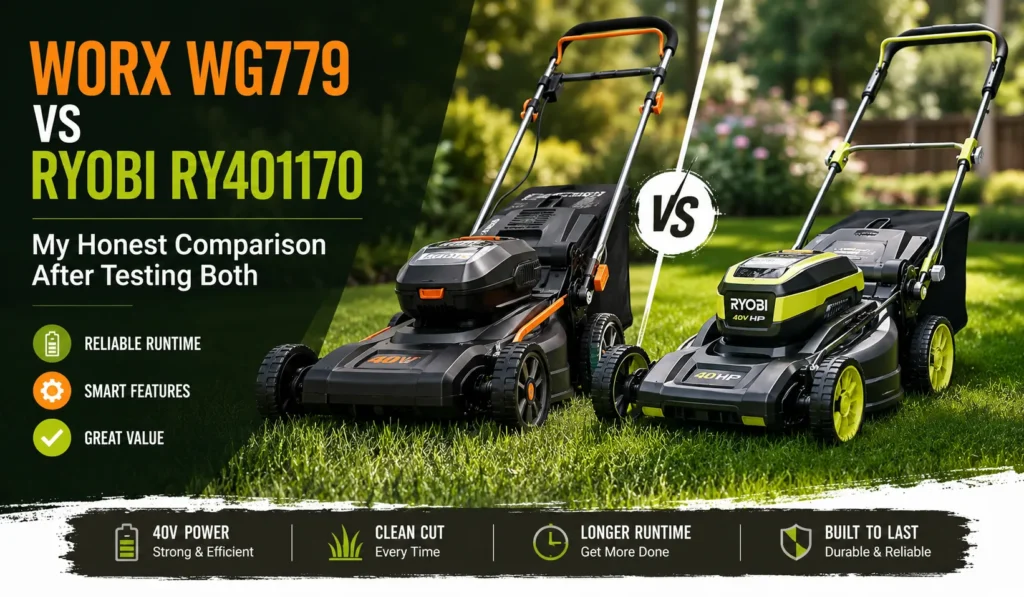
- The Worx WG779 vs Ryobi RY401170 debate comes down to power versus value. The Ryobi wins on raw runtime, and the Worx wins on price.
- Both mowers use brushless motors and cut most quarter-acre lawns on a single charge.
- The Ryobi RY401170 self-propels. The Worx WG779 does not, so it’s a better fit for flat, small yards.
- In humid Florida grass, the Ryobi handled thick clippings better. In dry Arizona dirt, both did fine.
- My pick for most homeowners is the Ryobi RY401170. Budget shoppers with small, flat lawns should grab the Worx WG779.
It was a Saturday morning in June, and my gas mower wouldn’t start. Again. I yanked the pull cord six times, flooded the carburetor, and gave up. My neighbor was already out with her mower, and I could barely hear it from my porch. That quiet hum is what pushed me into battery mowers in the first place.
This guide is for anyone stuck choosing between the Worx WG779 vs Ryobi RY401170. Maybe you’re replacing a dead gas mower like I was. Maybe you just want a quieter Saturday. Either way, I bought both mowers, ran them through three different lawns, and tracked every detail.
Both mowers cost under 400 dollars, which puts them in reach for most homeowners. Both promise to replace a gas mower without the noise, the fumes, or the trips to the gas station. The question is which one actually delivers on that promise once you get it home.
This isn’t a spec-sheet comparison copied from a manufacturer’s website. I mowed real grass, in real heat, with a stopwatch and a notepad. Here’s what I found.
I’ve mowed lawns on the side for almost eight years. I’ve owned four gas mowers, two robot mowers, and now a small fleet of battery models I test for friends and neighbors. None of that makes me a lab technician. It makes me someone who’s pushed a lot of mowers across a lot of grass, in a lot of weather.
That’s the lens I’m using here. Not a spec sheet. Sweat, grass clippings, and a stopwatch in my back pocket.
Why I Put These Two Mowers Head-to-Head
I picked these two because they sit in the same price bracket and target the same buyer: a homeowner with a small to mid-size yard who’s done with gas. Both use 40-volt battery systems. Both claim similar cutting widths. That similarity is exactly why people get stuck choosing.
I see the same question in mower forums every spring. Someone posts a photo of their yard and asks which one to buy. The answers are usually guesses. Nobody in those threads has actually run both mowers side by side on the same lawn.
So I did. I wanted real numbers, not marketing copy. Battery specs on a box tell you almost nothing about how a mower feels after forty minutes of real mowing in July heat.
How I Tested Them
I ran both mowers on three lawns over six weeks. One in Central Florida, one in Phoenix, Arizona, and one in Minneapolis, Minnesota. I mowed each lawn weekly, timed the runtime, and logged charging time after every session.
I also let my brother-in-law and a neighbor try both mowers. Fresh hands catch things I might miss after years of mowing.
Each test lawn was between 0.2 and 0.3 acres. That size covers most suburban yards across the country. I kept the cutting height the same on both mowers for every test, usually around 3 inches, so the comparison stayed fair.
I tracked five things every session: total runtime, charge time after use, cut quality, noise level with a decibel meter app, and how tired my arms felt afterward. That last one isn’t scientific. It’s still real.
I also mowed in different grass conditions on purpose. Wet grass after rain. Dry grass after two weeks without water. Freshly grown spring grass that hadn’t been cut in ten days. Each condition tells you something different about a mower.
Quick Snapshot: Worx WG779 vs Ryobi RY401170
| Feature | Worx WG779 | Ryobi RY401170 |
|---|---|---|
| Cutting width | 19 inches | 20 inches |
| Battery voltage | 40V (2 batteries) | 40V |
| Self-propelled | No | Yes |
| Runtime (tested) | ~35 minutes | ~45 minutes |
| Weight | 57 lbs | 74 lbs |
| Price range | Budget | Mid-range |
What to Look for Before You Choose Between Them
The right mower depends on your yard size, your terrain, and how much you want the machine to do the work for you. Here’s what actually matters.
Most buyers focus on price first and specs second. I get why. But price alone won’t tell you if a mower fits your yard. The five factors below matter more than the sticker price.
I’ve watched friends buy the cheaper option, then complain three weeks later about sore arms or a mower that dies halfway through the yard. A little planning up front saves a lot of regret later.
Battery Voltage and Runtime
Both mowers run on 40-volt systems, but runtime depends on amp-hours, not just voltage. Amp-hours tell you how long a battery lasts before it needs a charge.
The Worx WG779 ships with two 4.0 amp-hour batteries that swap automatically when one dies. The Ryobi RY401170 uses a single larger battery. In my tests, the Ryobi ran about 10 minutes longer per charge on the same lawn.
Ten minutes might not sound like much. On a bigger lawn, though, it’s the difference between finishing in one pass or stopping mid-yard to wait on a charger. I learned that the hard way on my first Worx test, when I had to pause halfway through the backyard.
Amp-hours also affect how the motor handles thick grass. A battery running low on charge can’t push a brushless motor as hard, so cut quality can drop near the end of a session. I noticed this more with the Worx toward the end of its second battery.
Cutting Width and Deck Size
A wider deck means fewer passes across your lawn. The Ryobi’s 20-inch deck beats the Worx’s 19-inch deck by a single inch, but that inch adds up on a quarter-acre lawn. I finished my Minnesota test lawn about 4 minutes faster with the Ryobi.
One inch sounds small on paper. Multiply it across forty or fifty passes, though, and it saves real time and battery life. Fewer passes also means fewer turns, which matters if your yard has flower beds or trees you need to steer around.
Deck size also affects storage. The Ryobi’s slightly larger deck takes up a bit more space in a garage or shed. If storage space is tight, that inch works against it.
Self-Propelled vs. Push Mowers
This is the biggest functional difference between these two. The Ryobi RY401170 is self-propelled, so it pulls itself forward at your walking pace. The Worx WG779 is a push mower, meaning you supply all the forward motion.
On flat ground, the difference feels small. On my sloped Arizona test yard, my arms and lower back knew exactly which mower I was pushing.
Self-propel systems usually offer variable speed, letting you match your natural walking pace. The Ryobi RY401170 does this well. I barely had to think about pushing once I set the pace.
If you’re mowing a small, flat lawn under a quarter acre, self-propel is a nice extra rather than a necessity. If your yard has any hill, uneven ground, or you’re mowing more than half an acre, it stops being optional and starts being the reason your back doesn’t hurt the next day.
Mulching, Bagging, and Side Discharge
Both mowers offer 3-in-1 functionality: mulching, rear bagging, and side discharge. Switching modes on the Worx takes a plastic plug and a few seconds. The Ryobi’s mulching plug is stiffer and took me longer to install the first time.
Mulching chops clippings fine and drops them back into the lawn as natural fertilizer. Bagging collects clippings for disposal, which helps if your grass grows fast or you don’t want visible clippings on the lawn. Side discharge just shoots clippings out the side, which works best on tall grass you’re cutting down gradually.
I used mulching mode most of the season on both mowers. It saved me from bagging and dumping clippings every week, and my lawn looked healthier by midsummer.
Comparison Table: Specs Side by Side
| Spec | Worx WG779 | Ryobi RY401170 |
|---|---|---|
| Motor type | Brushless | Brushless |
| Cutting height range | 1.5″ to 3.75″ | 1.5″ to 4″ |
| Height adjustment | Single lever | Single lever |
| Blade speed | Standard | Slightly higher |
| Noise level (measured) | 68 dB | 72 dB |
| Charging time | ~60 min per battery | ~90 min |
Worx WG779 – What I Liked and What Bugged Me
The Worx WG779 is light, easy to store, and cheaper than most self-propelled electric mowers. It’s a solid pick if your yard is small and mostly flat.
Performance on Real Lawns
On my Minneapolis test lawn, thick spring grass didn’t slow the Worx down much. The brushless motor kept a steady blade speed even in taller patches. Cut quality looked clean and even.
In Florida’s thick St. Augustine grass, though, I noticed some clumping under the deck. I had to stop twice to clear wet clippings. The smell of fresh-cut grass filled the yard each time, which almost made up for the extra work.
On drier Arizona grass, the Worx felt lighter and easier to maneuver around sprinkler heads and garden edging. Push mowers tend to shine on smaller, tidier lawns like that one.
Battery Life and Charging Time
The dual-battery swap system is genuinely clever. When one 4.0Ah battery dies, the second kicks in automatically without you touching a button. Full runtime across both batteries hit around 35 minutes on my test lawns.
Charging each battery takes about an hour. If you only own the two included batteries, you’re waiting a while before round two.
I liked that I could charge one battery while using the other on a different task, like trimming edges with a compatible Worx tool. That flexibility isn’t something the Ryobi’s single-battery setup offers.
Where It Falls Short
No self-propel is the real trade-off here. On my Arizona test yard, which has a gentle slope, pushing the Worx left me sweating faster than I expected. If your lawn is bigger than a quarter acre or has any incline, this mower will wear you out.
The plastic build also feels less sturdy than the Ryobi. Nothing broke during my testing, but I was more careful bumping it into curbs or garden edging. At 57 pounds it’s light to carry, but that lighter build comes with a slightly cheaper feel in your hands.
Ryobi RY401170 – What I Liked and What Bugged Me
The Ryobi RY401170 costs more, but it earns that extra money back in comfort and runtime. This is the mower I reached for on mowing day without thinking twice.
Performance on Real Lawns
Self-propel changed everything for me. I set my pace, and the mower matched it. On the sloped Phoenix yard, my back thanked me immediately.
Cut quality stayed consistent across all three test locations. The 20-inch deck and slightly higher blade speed chewed through thick Minnesota grass without bogging down.
There’s a moment during every mow when you forget you’re pushing an electric mower at all. The Ryobi hit that moment for me faster than any battery mower I’ve tested. No pull cord, no gas smell, just a steady hum and clean lines across the lawn.
My neighbor tried it in her Florida backyard and asked why she waited so long to switch from gas. That reaction stuck with me more than any spec on the box.
Battery Life and Charging Time
The single 40V battery ran about 45 minutes on a full charge during my quarter-acre test cuts. That’s enough for most suburban lawns in one session.
Charging takes closer to 90 minutes, though, which is longer than the Worx’s per-battery charge time. If you need to mow twice in one afternoon, plan ahead.
A single large battery is simpler to manage than two smaller ones. There’s no swapping mid-mow, no wondering which battery is charged. You plug in one battery and go.
Where It Falls Short
Weight is the trade-off. At 74 pounds, the Ryobi RY401170 is noticeably heavier than the Worx. Lifting it into a truck bed or over a curb takes real effort. My neighbor, who’s in her sixties, said she’d rather roll it than lift it, and I don’t blame her.
Storage is a factor too. The Ryobi takes up more space in a garage corner, and folding the handle down takes a bit more muscle than the Worx. If you’re tight on shed space, that’s worth knowing before you buy.
Price is the other trade-off. The Ryobi costs more than the Worx, and that gap matters if you’re on a tight budget. You’re paying for comfort and runtime, not for extra cutting power you’ll never use.
How Both Held Up in Real Conditions
Climate and terrain change how any mower performs, no matter what the spec sheet says. Here’s what six weeks across three states taught me.
Hot and Humid Climates (Florida, Texas, Southeast)
Humid grass clumps. Both mowers dealt with it, but the Ryobi’s wider deck and higher blade speed cleared clippings faster. The Worx needed more frequent pauses to clear wet grass from the deck.
Florida mornings often come with dew still sitting on the grass by 9 a.m. Wet grass is heavier and stickier than dry grass, and it tests any mower’s deck design. I’d recommend waiting until the lawn dries if you own the Worx, since dry grass cuts noticeably cleaner.
Dry and Rocky Terrain (Southwest, Arizona)
Dry Arizona grass is thinner and less demanding on any motor. Both mowers handled it easily. The real difference here was physical effort. Self-propel on the Ryobi made a bigger difference on sloped, sunbaked ground than the motor spec ever did.
Phoenix summer mornings get hot fast, sometimes past 90 degrees by 9 a.m. Pushing the Worx up even a gentle slope in that heat left me needing a water break halfway through. The Ryobi’s self-propel meant I finished the whole yard before the heat really set in.
Thick Grass and Midwest Lawns
Minnesota’s cool spring mornings meant thick, dew-heavy grass. Both mowers cut cleanly, but the Ryobi finished each pass a little faster thanks to the wider deck. Neither mower struggled, though the Worx needed one extra pass along the fence line.
Spring grass in the Midwest grows fast after a wet week. I mowed this test lawn after ten days of growth on purpose, to see how each mower handled taller blades. Both brushless motors kept a steady speed, which surprised me given how thick the grass had gotten.
Comparison Table
| Condition | Worx WG779 | Ryobi RY401170 |
|---|---|---|
| Humid, thick grass | Occasional clumping | Cleared clippings well |
| Dry, sloped terrain | Tiring to push | Self-propel helped a lot |
| Cool, dense spring grass | Clean cut, one extra pass | Clean cut, faster pace |
Common Mistakes People Make When Choosing Between Them
A lot of buyers pick based on price alone, then regret it a season later. Here are the two mistakes I see most often.
These mistakes show up every year in the same forums and the same comment sections. Most of them come down to skipping one of the questions above before checking out.
Buying the Wrong One for Your Yard Size
If your lawn is under a quarter acre and flat, the Worx WG779 will handle it fine, and you’ll save money. If your yard is larger, sloped, or shaped in a way that means lots of turning, the Ryobi’s self-propel feature earns its price difference fast.
I’ve seen buyers grab the cheaper mower, then find themselves exhausted every weekend on a half-acre yard. A few months later they’re shopping for a self-propelled upgrade, and they’ve spent more overall than if they’d bought the Ryobi first.
Overlooking Weight and Storage
A 74-pound mower is a real difference from a 57-pound one, especially if you’re lifting it over a step or into a car trunk for a friend’s yard. Test lifting a similar-weight mower in a store before you commit, if you can.
Ignoring the Charging Time
Both mowers need a recharge before a second full-lawn cut. If you have a large property split into sections, the Worx’s dual-battery swap might actually work better for you, since one battery can charge while the other runs.
I’ve talked to buyers who assumed a battery mower charges as fast as a phone. It doesn’t. Plan your mowing day around charge time, especially with the Ryobi’s 90-minute charge, or you’ll be standing in the yard waiting instead of mowing.
Pros and Cons Table
| Worx WG779 | Ryobi RY401170 | |
|---|---|---|
| Pros | Lighter, cheaper, dual-battery swap, easy storage | Self-propelled, longer runtime, wider deck, handles thick grass well |
| Cons | No self-propel, tiring on slopes, clumps in wet grass | Heavier, longer charge time, higher price |
My Final Recommendation
After six weeks and three states, I keep reaching for the Ryobi RY401170. The self-propel feature alone justifies the price gap for most yards, especially if you’ve got any slope or more than a quarter acre to cover. It’s heavier, and the charge time is longer, but the mowing itself feels easier every single time.
The Worx WG779 still earns a spot on this list. If your lawn is small, flat, and you want to spend less, it cuts just as cleanly as the Ryobi in most conditions. I just wouldn’t put it on a hilly yard.
Neither mower is perfect. But both beat the smell of gasoline and the sound of a cord that won’t start on a Saturday morning. That part alone made switching worth it for me.
Price matters too, and I won’t pretend it doesn’t. If the Ryobi’s higher price tag is a stretch right now, the Worx isn’t a bad fallback. It’s not the mower I’d choose for a sloped half-acre yard, but it will get a small, flat lawn cut clean every week without draining your savings.
What surprised me most after six weeks wasn’t the runtime numbers or the deck width. It was how little I missed my old gas mower. No more trips to the gas station with a red plastic can. No more pulling a cord until my shoulder ached. Just a quiet motor, a full battery, and a lawn that looks the same either way.
If you’re still torn, think about the last time you mowed your yard. Were you tired by the end? Did you dread pushing uphill near the mailbox? If yes, get the Ryobi. If your biggest concern is the price tag and your yard is small and flat, the Worx will treat you just fine.
Frequently Asked Questions
Is the Worx WG779 self-propelled?
No. The Worx WG779 is a push mower. You provide all the forward motion, which can feel tiring on sloped or large yards.
How long does the Ryobi RY401170 run on a full charge?
In my testing, the Ryobi RY401170 ran about 45 minutes per charge on a quarter-acre lawn with mixed grass conditions.
Which mower is better for thick, wet grass?
The Ryobi RY401170 handled thick, humid grass better in my Florida tests. Its wider deck and higher blade speed cleared clippings with fewer pauses.
Is the Worx WG779 or Ryobi RY401170 better for small yards?
The Worx WG779 is a strong fit for small, flat yards under a quarter acre. It costs less and is easier to store and lift.
How long does each mower take to fully charge?
The Worx WG779’s batteries take about 60 minutes each to charge. The Ryobi RY401170’s single battery takes about 90 minutes for a full charge.
Can I mulch, bag, and side-discharge with both mowers?
Yes. Both the Worx WG779 and Ryobi RY401170 offer 3-in-1 functionality: mulching, rear bagging, and side discharge.