
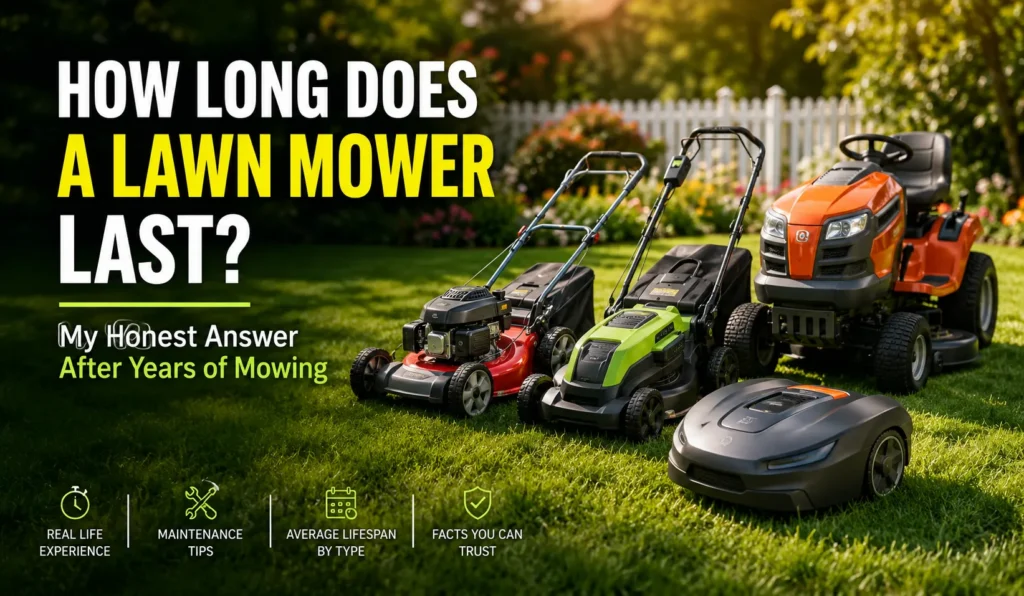
Quick Overview
- Most gas push mowers last 8 to 10 years, or about 500 to 750 engine hours, with regular oil changes.
- Battery mowers often last 5 to 8 years, limited mainly by battery cycles, not the motor.
- Gas riding mowers can run 12 to 15 years if you keep up with blade sharpening and air filter checks.
- Robotic mowers typically last 6 to 9 years, with the battery as the first part to wear out.
- Skipping maintenance cuts any mower’s lifespan in half, no matter what type you own.
My Toro wouldn’t start one Saturday morning in June. I pulled the cord ten times. Nothing. Just that dry, clicking sound that tells you something’s wrong.
That mower was six years old. I’d changed the oil maybe twice. I’d never touched the air filter. Standing in my driveway with grass already a foot tall, I started wondering how long does a lawn mower last, really, if you take care of it the right way.
I’ve owned four mowers over the years. I’ve also spent plenty of weekends helping neighbors fix theirs. Some machines died young. Others outlived the sheds they were stored in.
This guide is for anyone staring at a mower that won’t start, wondering if it’s worth fixing or time to buy new. Maybe you just inherited your dad’s old Toro and want to know if it’s worth keeping running. Maybe you’re comparing a gas mower to a battery model and want the honest trade-offs, not a sales pitch.
I’ll walk through what actually determines lifespan, what kills mowers early, and what I’ve learned works to stretch the life of any machine you own, whether it runs on gas, battery, or nothing but its own sensors and wheels.
Why Lawn Mower Lifespan Isn’t the Same for Everyone
Two people can buy the identical mower and get completely different results. One gets 15 years. The other is shopping again in year four.
The difference comes down to two things: what type of mower you bought, and how you treat it. I’ve watched both play out across mowers I’ve owned and ones I’ve helped neighbors troubleshoot, and the pattern holds up every time.
It Depends on the Type of Mower
Gas engines, battery motors, and robotic mowers all age differently. A gas engine wears out through moving parts – pistons, valves, rings. A battery mower wears out mostly through charge cycles in its battery pack.
This matters because the failure point is different. A gas mower usually dies from engine wear. A battery mower often runs fine mechanically long after the battery can’t hold a charge anymore.
It Depends on How You Use It
A mower cutting a quarter-acre flat lawn once a week has an easier life than one cutting a hilly, half-acre lot twice a week. Load matters. Heat matters. Moisture matters.
I mowed a steep slope in northern Georgia for three summers. That mower worked harder than my old flat-lot mower in Ohio ever did. It showed – the blade needed sharpening twice as often, and the engine ran hotter.
Frequency matters just as much as terrain. A lawn mowed once every two weeks lets grass grow long between cuts, forcing the mower to work harder each time. A lawn mowed weekly stays shorter and easier to cut, which is gentler on the blade, belt, and engine over a full season.
Climate plays a role too, though it’s easy to overlook. A mower used through a long Southern growing season, sometimes eight or nine months a year in states like Florida or Louisiana, logs far more hours annually than one used for a shorter four-month season in Minnesota or Wisconsin. More hours per year means the same lifespan in years translates to very different total engine hours.
Average Lifespan by Mower Type
Here’s the direct answer: gas push mowers last 8 to 10 years on average. Riding mowers last 12 to 15 years. Battery mowers last 5 to 8 years. Robotic mowers last 6 to 9 years. These numbers assume basic maintenance, not perfection.
Gas Push Mowers
A gas push mower typically lasts 500 to 750 engine hours before major wear sets in (Briggs & Stratton, 2024). For a homeowner mowing weekly during a 7-month season, that works out to roughly 8 to 10 years.
I had a Honda push mower for nine years. I changed the oil every spring, replaced the air filter yearly, and sharpened the blade twice a season. It started on the second pull every single time, right up until I sold it to a neighbor.
The trade-off with gas mowers is maintenance time. Oil changes, spark plug swaps, and carburetor cleaning take effort a battery mower doesn’t ask for.
Lawn size changes these numbers more than people expect. A quarter-acre lawn mowed weekly might only rack up 30 engine hours a season. A half-acre lawn mowed twice weekly during a wet spring can hit 60 or more. That’s double the wear in the same number of years.
My cousin in Ohio has a smaller lot than mine and mows a flat yard once a week. His base-model Craftsman push mower is on year twelve. Mine, cutting a bigger and hillier lawn, needed a new carburetor by year seven. Same brand tier, very different workloads.
Gas Riding Mowers
Riding mowers last longer because their engines are built for more hours of work. A quality riding mower can hit 1,500 to 2,000 engine hours, translating to 12 to 15 years of typical residential use (Cub Cadet, 2024).
A neighbor of mine in rural Minnesota still runs a Craftsman riding mower from 2011. He services it every fall before it goes into an unheated garage for winter. It fires up every April like it’s brand new.
The trade-off here is upfront cost and storage space. Riding mowers need a garage or shed, and repairs, when they happen, cost more than push mower repairs.
Terrain plays a bigger role with riding mowers than most buyers realize. A flat one-acre lot in Nebraska puts far less strain on a deck and drive belt than a sloped two-acre property in the Appalachian foothills. Hills mean more belt slippage, more blade contact with uneven ground, and more wear on the drive system overall.
I helped a friend service his John Deere riding mower after eight years on a hilly Tennessee property. The drive belt had worn thin and the mower deck had a few dents from rocks on the slope. A flat-lawn owner with the same mower and same age would likely still be on the original belt.
Battery-Powered Mowers
Battery mowers are limited by battery cycles more than by the mower itself. Most lithium-ion mower batteries hold a meaningful charge for 300 to 500 full charge cycles before capacity drops significantly (EGO Power+, 2024). For weekly mowing, that’s about 5 to 8 years.
I switched to an EGO battery mower three years ago. No more gas smell in my garage, no more pull cord. The brushless motor has needed zero maintenance so far – no oil, no spark plug, no carburetor to clean.
The honest trade-off: when the battery finally dies, replacing it can cost close to half the price of a new mower. The mower body might outlast the battery entirely.
Runtime per charge is another thing that shifts with climate and lawn size. A Greenworks mower cutting a small suburban lot in Oregon might finish the whole job on one charge, cool weather all season. The same mower cutting a larger lawn in a hot Texas summer may need a battery swap partway through, since heat reduces battery efficiency temporarily during use.
A coworker of mine bought a Ryobi battery mower for a small Pennsylvania yard. Four years in, the battery still holds close to its original runtime, because he never lets it sit fully drained or fully charged for long stretches. That single habit seems to matter more than anything else for battery longevity.
Robotic Mowers
Robotic mowers average 6 to 9 years of service life, with the battery pack again the first component to wear down (Husqvarna, 2024). The cutting motor and wheels tend to outlast the battery by several years.
A friend running a Segway Navimow in Arizona has dealt with something unexpected: heat. Arizona summers push the battery harder than a shaded lawn in the Pacific Northwest would. He’s noticed slightly shorter runtime by year four.
The trade-off with robotic mowers is upfront cost and the need for boundary wire setup or GPS mapping, plus periodic blade replacement since the small cutting blades wear faster than traditional mower blades.
Lawn shape and obstacles matter too. A simple rectangular lawn lets a robotic mower run efficient, predictable paths with less wheel and motor strain. A yard full of tight corners, garden beds, and narrow side passages forces the mower to stop, reverse, and re-route constantly, adding wear over time.
Another neighbor runs a Husqvarna Automower on a fairly open half-acre lawn in Wisconsin. Six years in, it’s still on its original battery, just running slightly shorter cycles than when it was new. Cold winters don’t seem to have hurt it, since he stores it indoors from November through March.
Comparison Table: Lawn Mower Lifespan by Type
| Mower Type | Average Lifespan | Main Wear Point | Typical Maintenance Load |
|---|---|---|---|
| Gas Push Mower | 8-10 years | Engine hours | High |
| Gas Riding Mower | 12-15 years | Engine hours | Medium-High |
| Battery Mower | 5-8 years | Battery cycles | Low |
| Robotic Mower | 6-9 years | Battery cycles | Low-Medium |
What Shortens a Mower’s Life (Things I’ve Seen Firsthand)
Most mowers don’t die of old age. They die of neglect. I’ve traced almost every early mower failure I’ve seen back to one of five habits.
Skipping Regular Maintenance
Oil changes matter more than most people think. Old, dirty oil breaks down and stops protecting engine parts the way fresh oil does. Running a gas engine on old oil for years is the single fastest way to wear out a piston.
I skipped oil changes on my first mower, a cheap Murray, for almost two full seasons. The engine started using oil between changes and eventually seized. That mower lasted four years total.
Wrong Fuel or Old Gas
Gas that sits in a tank for months breaks down and gums up the carburetor. Ethanol-blended gas absorbs moisture over time, which causes rust inside the fuel system (Toro, 2024).
I once left gas sitting in a mower over a Midwest winter. Come spring, the smell hit me before I even opened the choke – stale, sour, nothing like fresh gas. The carburetor needed a full cleaning before that mower would run again.
Mowing Wet or Overgrown Grass Too Often
Wet grass clumps under the deck and strains the blade and motor. Overgrown grass forces the engine to work far harder than it’s built for, generating extra heat and wear.
I learned this the hard way in a humid Georgia summer, mowing after a storm because I was behind schedule. The engine bogged down constantly. That kind of strain, repeated often enough, wears bearings and belts years before their time.
Poor Storage Habits
A mower left outside, exposed to rain and sun, rusts and degrades far faster than one stored in a dry space. Moisture is the enemy of both metal decks and battery packs.
A dusty Arizona shed sounds like a rough environment, but dry heat is actually gentler on metal than damp cold. A snowy Minnesota garage with humidity swings is harder on unprotected mowers than most people realize.
Running on a Dull Blade Too Long
A dull blade rips grass instead of slicing it cleanly, and that ragged cut forces the engine or motor to work harder than it should. Over months of use, that extra strain adds up on bearings, belts, and the motor shaft.
I put off sharpening my blade one year, telling myself the lawn “looked fine enough.” By late summer, the grass tips were browning from the tearing, and the mower sounded noticeably strained compared to spring. A ten-minute sharpening job would have prevented months of unnecessary wear.
Signs Your Mower Is on Its Last Leg
The clearest warning sign is a mower that needs repeated repairs for the same problem. If you’ve fixed the same issue twice in one season, the mower is telling you something bigger is wrong.
There are usually three or four warning signs that show up before a mower fully quits, and catching them early gives you time to plan a repair or a replacement on your own schedule, instead of scrambling on a Saturday morning.
Starting Problems That Keep Coming Back
An occasional hard start can mean old gas or a fouled spark plug – simple fixes. But starting problems that return again and again, even after cleaning and fresh fuel, usually point to internal engine wear.
I dealt with this on an old Murray mower years back. I replaced the spark plug, cleaned the carburetor, and it ran fine for two weeks. Then the hard starts came back. That pattern, a fix that only holds briefly, is usually the engine telling you the real problem is deeper than fuel or spark.
Losing Power Mid-Mow
A mower that bogs down in grass it used to handle easily is losing compression or wearing out internally. This is different from struggling in unusually thick or wet grass. If it happens on a normal, dry lawn, that’s a real warning sign.
Low compression means the engine can’t build enough pressure in the cylinder to burn fuel efficiently. It shows up as a mower that used to power through your lawn without issue, but now stalls or slows down on the same grass it handled easily last season.
Rising Repair Costs
Track what you spend on repairs each year. When that number starts approaching half the cost of a new mower, it’s rarely worth continuing to repair the old one.
I keep a simple note on my phone with every repair cost for each mower I own. It sounds excessive, but it removes the guesswork. When I saw one mower’s yearly repair total creeping past $150, on a mower that cost $300 new, the decision to replace it became obvious.
Comparison Table: Repair Signals and What They Usually Mean
| Symptom | Likely Cause | Repair Urgency |
|---|---|---|
| Hard start, one-time | Old gas or fouled plug | Low – easy fix |
| Hard start, recurring | Engine wear or carburetor damage | Medium-High |
| Losing power on normal grass | Low compression | High |
| Battery won’t hold charge | Battery cycle limit reached | Medium (battery replaceable) |
| Excessive vibration | Bent blade or worn bearing | Medium – inspect soon |
How to Make a Lawn Mower Last Longer
The short answer: change the oil on schedule, keep the blade sharp, and store the mower somewhere dry. These three habits account for most of the difference between a mower that dies at year four and one that runs for fifteen.
Simple Maintenance Habits That Actually Work
- Change the oil once per season for gas mowers, or per the owner’s manual’s engine hour recommendation. Fresh oil keeps internal parts lubricated and carries away heat, which is the single biggest factor in how long a gas engine lasts.
- Sharpen the blade every 20 to 25 hours of use. A dull blade tears grass instead of cutting it, which strains the motor and leaves your lawn looking rough within a day or two of mowing.
- Clean or replace the air filter yearly. A clogged filter starves the engine of clean air, causing it to run rich, burn more fuel, and build up carbon deposits faster than it should.
- Drain old gas before long storage periods, or use a fuel stabilizer if the mower will sit for more than a month. Stale gas is behind a large share of the spring no-start calls small engine shops get every year.
- Wipe down the underside of the deck after mowing wet grass. Built-up clippings hold moisture against the metal, which speeds up rust and eventually eats through thinner decks.
- Check and grease moving parts on riding mowers, including wheel bearings and the drive belt, at least once per season. A five-minute grease job now prevents a much bigger belt or bearing replacement later.
Storage Tips for Every Season
Store the mower somewhere dry, ideally with stable temperature. A detached garage or shed works better than an open carport exposed to rain.
For winter storage of gas mowers, either run the tank dry or add a fuel stabilizer. Running the engine for a few minutes after adding stabilizer helps circulate it through the carburetor, not just the tank.
For battery mowers, store the battery at partial charge, somewhere around 40 to 60 percent, in a cool, dry spot rather than fully charged in extreme heat or cold. Storing a lithium-ion battery at full charge through a hot summer or freezing winter shortens its usable life faster than normal use would.
Robotic mowers usually do best brought indoors for winter entirely, especially in climates with hard freezes. A cold garage floor is fine. A shed with wide temperature swings between sunny afternoons and freezing nights is harder on the battery than steady cold.
Riding mowers benefit from a fuel stabilizer and a battery tender over winter, since a small trickle charger keeps the starting battery from draining fully during months of inactivity. A dead battery in spring is one of the most common, and most avoidable, seasonal repair calls.
Common Mistakes People Make That Shorten Mower Life
The most common mistake is never reading the owner’s manual. The second most common is guessing at oil type or blade specs instead of checking what the manufacturer actually recommends.
I get it. Manuals aren’t exciting reading, and most of them end up in a junk drawer the same week the mower gets delivered. But five minutes with the manual, specifically the maintenance schedule page, tells you almost everything you need to know about keeping that specific mower running for its full expected lifespan.
Ignoring the Owner’s Manual
Every mower has a specific maintenance schedule based on its engine and design. Guessing at intervals, instead of following the manual, means either over-maintaining unnecessarily or under-maintaining and missing real problems.
Most manuals list exact engine hour intervals for oil changes, air filter checks, and spark plug replacement. Briggs & Stratton engines, for example, often call for oil changes every 25 hours, while some Honda engines stretch to 50 hours between changes (Honda Engines, 2024). Those numbers aren’t interchangeable across brands.
Using the Wrong Blade or Oil
Using the wrong oil weight for your climate can thicken in cold weather and struggle to lubricate properly at startup. Using a generic blade instead of the manufacturer’s specified type can throw off balance and strain the motor shaft over time.
I made this mistake once, grabbing a universal blade at a hardware store instead of ordering the exact model for my mower. It fit, technically, but it sat slightly off-balance. Within a season, I noticed a faint vibration that hadn’t been there before. Swapping in the correct blade fixed it immediately.
Cost of Ownership Over a Mower’s Lifespan
The cheapest mower upfront isn’t always the cheapest mower over time. Gas mowers cost less to buy but more to maintain. Battery mowers cost more upfront but need almost no ongoing maintenance until the battery wears out.
A gas push mower averaging $350 upfront typically adds another $40 to $60 per year in oil, spark plugs, and air filters (Toro, 2024). Over a 9-year lifespan, that’s roughly $700 to $900 in maintenance on top of the purchase price.
A battery mower averaging $500 upfront usually adds close to nothing in yearly upkeep, since there’s no oil or spark plug to replace. The one large expense is a replacement battery, often $150 to $250, typically needed once around year 5 or 6.
Riding mowers cost the most upfront, often $1,800 to $3,500, but spread that cost over 12 to 15 years of use. Annual upkeep, including belts, blades, and occasional part replacement, tends to run $80 to $150 per year (Cub Cadet, 2024).
Comparison Table: Estimated Total Cost of Ownership
| Mower Type | Typical Purchase Price | Annual Upkeep | Lifespan | Estimated Total Cost |
|---|---|---|---|---|
| Gas Push Mower | $300-$400 | $40-$60 | 8-10 years | $700-$1,000 |
| Gas Riding Mower | $1,800-$3,500 | $80-$150 | 12-15 years | $2,900-$5,750 |
| Battery Mower | $400-$600 | $10-$20 (plus one battery swap) | 5-8 years | $600-$900 |
| Robotic Mower | $800-$1,500 | $20-$40 (plus one battery swap) | 6-9 years | $1,100-$1,900 |
These numbers won’t match every household exactly. A larger lawn pushes maintenance costs up for any mower type, and a mower that gets neglected will need repairs well before these ranges suggest.
Gas prices and electricity rates also shift these totals slightly depending on where you live. A gallon of gas at $3.50 versus $4.50 changes the yearly fuel cost for a gas mower, though fuel is a small piece of the total compared to parts and labor.
Repair vs. Replace: A Quick Decision Table
| Situation | Recommendation |
|---|---|
| Repair cost under 25% of new mower price | Repair |
| Repair cost 25-50% of new mower price | Repair if mower is under 6 years old |
| Repair cost over 50% of new mower price | Replace |
| Multiple failures within one season | Replace |
| Battery replacement needed on otherwise healthy mower | Repair (replace battery only) |
My Final Take
After years of mowing, servicing, and occasionally cursing at stubborn engines, here’s what I believe: how long a lawn mower lasts depends far more on you than on the brand name printed on the deck.
My Honda ran nine years because I gave it fifteen minutes of attention each spring. My neighbor’s Craftsman rider is pushing fifteen years for the same reason. Meanwhile, I’ve seen brand-new mowers ruined in two seasons by owners who never touched the oil.
If you want a mower that lasts, buy something that fits how you’ll actually use it, then commit to the small habits – oil changes, blade sharpening, dry storage. That’s the whole secret. No mower, gas or battery, survives neglect.
I get asked a lot whether battery mowers are “worth it” compared to gas. Honestly, it depends on what you value. I like not smelling like gasoline after mowing on a Saturday morning. Some of my neighbors like the simplicity of topping off a gas tank and not worrying about charge time. Neither answer is wrong.
What I’d tell anyone standing in a driveway with a mower that won’t start, the way I was that June morning, is this: don’t panic and don’t assume the worst. Check the simple things first – fuel, spark plug, air filter, blade. More often than not, the fix is smaller than you think. And if it isn’t, at least now you know what questions to ask before deciding whether to repair or replace.
Frequently Asked Questions About Lawn Mower Lifespan
How long does a lawn mower last on average?
Most gas push mowers last 8 to 10 years with regular maintenance. Battery mowers last 5 to 8 years, mainly limited by battery cycles rather than the motor itself.
What kills a lawn mower engine the fastest?
Skipping oil changes is the fastest way to kill a gas mower engine. Old, dirty oil fails to protect internal parts, leading to premature wear and eventual seizing.
Is it worth repairing an old lawn mower?
It’s worth repairing if the repair cost is under 25% of a new mower’s price and the mower hasn’t had repeated failures. Above 50% of replacement cost, buying new usually makes more sense.
Do battery mowers last as long as gas mowers?
Battery mowers often have a shorter overall lifespan, 5 to 8 years versus 8 to 10 for gas, mainly because the battery pack wears out before the motor does. The motor itself, being brushless, often needs no maintenance at all.
How many hours does a lawn mower engine last?
A typical gas push mower engine lasts 500 to 750 hours before major wear appears. Riding mower engines are built tougher and often reach 1,500 to 2,000 hours.
Does storage really affect how long a mower lasts?
Yes. Mowers stored in dry, temperature-stable spaces last noticeably longer than those left outside exposed to rain and sun. Moisture causes rust on metal decks and can degrade battery packs faster.
What’s the biggest sign it’s time to replace a mower instead of repairing it?
Repeated failures of the same part within one season is the clearest sign. If repair costs are also climbing toward half the price of a new mower, replacement is usually the smarter move.
Are robotic mowers reliable long-term?
Yes, for most yards. Robotic mowers typically last 6 to 9 years, with the battery pack wearing out before the motor or wheels do. Complex, obstacle-heavy yards tend to see slightly more wear than open, simple lawns.
How often should I sharpen my mower blade?
Sharpen the blade every 20 to 25 hours of use, or about once per season for average residential mowing. A dull blade tears grass instead of cutting it, which strains the engine or motor over time.
Does the type of lawn affect how long a mower lasts?
Yes. Hilly, uneven, or obstacle-heavy lawns put more strain on belts, blades, and motors than flat, open lawns. Wet or overgrown grass also adds extra wear regardless of mower type.