
Quick Overview
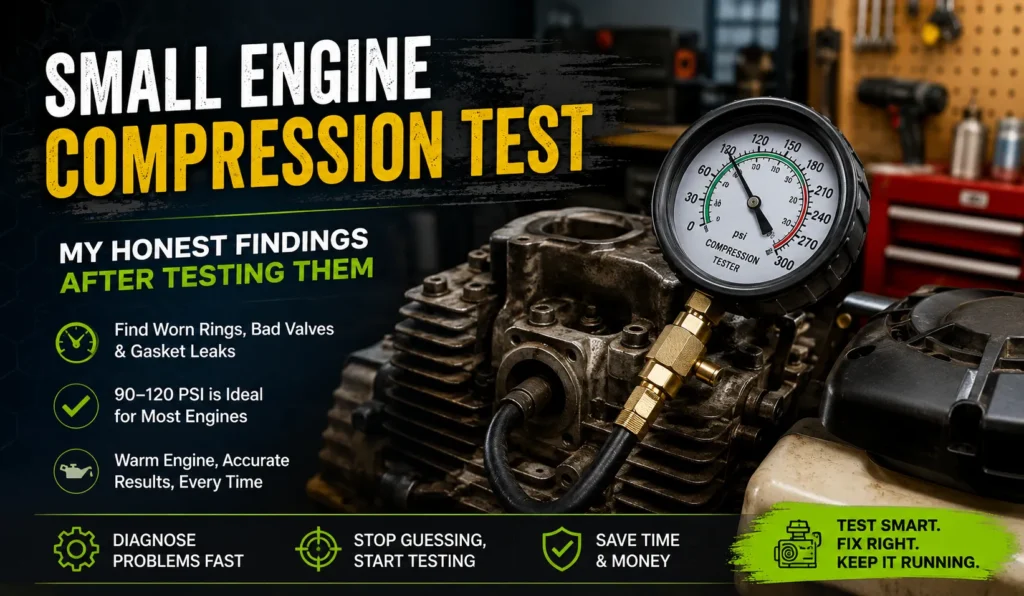
- A small engine compression test measures cylinder pressure to find worn rings, bad valves, or gasket leaks before you buy parts you don’t need
- Most healthy small engines read between 90 and 120 PSI, though the exact number depends on the model
- The Actron CP7827 was the most reliable gauge across cold, dusty, and humid test conditions
- Cold weather, dust, and humidity all lower compression readings in different ways, so always warm the engine before testing
- A wet test (oil added to the cylinder) tells you whether low compression comes from worn rings or a valve problem
It was 15 degrees outside my garage in Minnesota. My snow blower wouldn’t start. I pulled the cord ten times. Nothing. Just a weak little cough and silence.
That’s when I grabbed my compression gauge. Within two minutes, I had my answer. Low compression. Not a bad spark plug. Not old gas. A worn piston ring.
That morning changed how I work. Now I run a small engine compression test on almost everything that rolls into my shop. Mowers, generators, chainsaws, snow blowers – it doesn’t matter. The gauge tells me the truth before I touch a wrench.
This guide is for anyone who owns small engines and wants real answers. Maybe you’re a homeowner tired of guessing. Maybe you fix mowers on weekends. Maybe you just want to stop throwing parts at a problem that isn’t the problem. I’ve tested engines in a cold Minnesota garage, a dusty Phoenix shed, and a humid Florida shop. Here’s what I found.
Why I Started Compression Testing Every Small Engine
I started testing compression because I was tired of guessing. Before I owned a gauge, I replaced spark plugs, carburetors, and fuel lines on engines that just had worn rings. That got expensive fast.
A compression test tells you what’s happening inside the cylinder. It measures the pressure your piston builds on the compression stroke. Low pressure usually means something inside is worn or leaking.
No Guesswork, No Wasted Parts
I once spent forty dollars on a carburetor kit for a Briggs & Stratton mower engine. The real problem was a blown head gasket. A five-minute compression test would have saved me the money and the weekend.
Now it’s my first step, every time. Before I clean a carburetor or swap a plug, I test compression. It takes less time than removing an air filter cover.
Is Low Compression Always the Problem?
No. Low compression is a symptom, not always the root cause. Sometimes it points to a stuck valve. Sometimes it’s worn piston rings. Sometimes it’s a blown head gasket.
A healthy small engine usually reads somewhere between 90 and 120 PSI, though this varies by engine size and brand. If your reading comes in low, don’t panic yet. Check your throttle position first. Check your choke. A test done wrong gives you a false low reading every time.
I keep a small notebook in my shop. Every engine that comes through gets a compression number written down, along with the date and the model. Over time, this notebook taught me more than any repair manual. I watched a Honda GCV160 drop from 110 PSI to 95 PSI over eighteen months of normal mowing use. That’s expected wear. Nothing to worry about yet.
But I also watched a Craftsman engine drop from 100 PSI to 55 PSI in a single season. That customer had been mowing through a dusty construction site all summer. The dust ate through his piston rings fast. Two engines, two very different stories, and the gauge caught both of them early.
This is why I tell people not to treat compression testing as a one-time event. Test a healthy engine now, while it’s running well. Write the number down. That baseline becomes your reference point for every future test.
Why I Trust the Gauge Over My Ears
New mechanics often try to diagnose engine problems by sound alone. A rough idle, a weak pull, a strange rattle. I did this too, early on. The trouble is that sound is subjective. What sounds “weak” to me might sound normal to someone else.
A compression gauge removes the guessing. It gives you a number. Numbers don’t lie, and numbers don’t change based on how tired you are or how loud the shop is that day. That objectivity is the entire reason I built compression testing into my regular workflow.
What to Look for Before You Test
Before you thread a gauge into a spark plug hole, you need the right tool and the right setup. Using the wrong gauge, or skipping a warm-up run, wrecks your results before you even start.
Compression Gauge Types and Fittings
Small engines use two common thread sizes: 14mm and 18mm. Get this wrong, and your gauge won’t seal. I learned this the hard way on a Kohler generator engine in my Phoenix shed. I forced an 18mm adapter into a 14mm hole and stripped the threads. That cost me a helicoil repair and an afternoon.
Most kits come with adapters for both sizes. Check your engine’s spark plug before buying a gauge. A quick look at the plug’s box or the engine manual tells you the thread size.
There’s a third fitting size worth mentioning: 10mm. It’s rare, but I’ve run into it on a few smaller trimmer engines and some imported generator models. If your gauge kit doesn’t seat properly and the threads look smaller than usual, measure the spark plug threads with calipers before assuming your gauge is broken.
I also recommend checking the hose length before buying. Some budget kits ship with hoses under six inches long. On engines with the spark plug tucked behind a shroud or fuel tank, a short hose forces you to work at a bad angle, and that increases the odds of cross-threading the fitting.
Engine Size and Cylinder Type
Small engines fall into two camps: single-cylinder and multi-cylinder. Most mowers, trimmers, and snow blowers run single-cylinder engines. Larger generators sometimes use two cylinders.
Single-cylinder engines are easier to test. You only need one gauge reading. Multi-cylinder engines need a reading from each cylinder, so you can compare them side by side.
The comparison matters more than the raw number on multi-cylinder engines. If cylinder one reads 105 PSI and cylinder two reads 70 PSI, that gap tells you something specific is wrong with cylinder two. Even if both numbers technically fall inside a “normal” range, a big gap between cylinders points to uneven wear, a leaking gasket, or a valve problem isolated to one side.
I test every cylinder on a multi-cylinder engine, every time, even if the first one comes back healthy. Skipping cylinders because the first reading looked fine has burned me before. A generator I serviced in my shop had a perfect 118 PSI on cylinder one. Cylinder two read 62 PSI. If I’d stopped after the first test, I would have missed the real problem entirely.
Dry Test vs. Wet Test
A dry test is your standard test. No oil added. It tells you the baseline compression.
A wet test adds a small amount of oil into the cylinder before testing. If compression jumps up after adding oil, your piston rings are likely worn. If the reading stays about the same, the problem is probably a valve or head gasket.
I run a wet test any time a dry test comes back low. It narrows down the cause in under five minutes.
Here’s how I run mine. I pull the spark plug, add about a tablespoon of engine oil into the cylinder through the plug hole, then thread the gauge back in. I pull the starter cord four or five times and read the number. The oil temporarily seals small gaps around worn rings, which pushes the reading up if rings are the culprit. If the number barely moves, I look at the valves next.
One thing to watch: don’t overdo the oil. Too much oil in the cylinder gives you a falsely high reading and can foul your spark plug. A tablespoon is plenty for most small engine cylinders.
Reading PSI Ranges Correctly
PSI ranges vary by brand and engine size, so check your owner’s manual for the exact spec. As a rough guide, most healthy small engines fall between 90 and 120 PSI.
Anything under 60 PSI on a small mower engine usually means trouble starting. Anything under 30 PSI often means the engine won’t start at all. These aren’t universal numbers – always compare against your specific engine’s rated compression ratio.
I’ve found it helpful to think in terms of percentage drop rather than a fixed number. If your engine’s spec sheet lists 100 PSI as normal and you’re reading 85 PSI, that’s a 15 percent drop. Most small engines still run fine at that level. Once you hit a 30 to 40 percent drop from spec, starting problems usually follow.
Engine size changes the baseline too. A small 21cc trimmer engine won’t build the same PSI as a 190cc mower engine. Don’t compare numbers across different engine displacements. Always compare against that specific engine’s own rated spec, or against its own reading from a year ago.
Comparison Table: Testing Setup Basics
| Factor | What to Check | Why It Matters |
|---|---|---|
| Thread size | 14mm or 18mm | Wrong size won’t seal, causes false low reading |
| Cylinder count | Single or multi | Multi-cylinder needs comparison across cylinders |
| Test type | Dry or wet | Wet test isolates rings vs. valve problems |
| Engine temp | Warm vs. cold | Cold engines often read slightly lower |
| Throttle position | Wide open | Closed throttle restricts airflow, skews reading low |
The Best Compression Testing Tools I’ve Tested
I’ve run compression tests with a lot of different gauges over the years. Some held up. Some fell apart after a few uses. Here’s my honest take on the ones worth your money.
I judge every gauge on three things: how well it seals, how consistent the readings stay over repeated tests, and how it holds up to daily shop use. A gauge that reads accurately once but leaks pressure on the second pull isn’t worth keeping in your toolbox. I’ve retired more than a few gauges over the years for exactly that reason.
Best Overall: Actron CP7827
This is the gauge I reach for most. It comes with both 14mm and 18mm adapters, a rubber-coated gauge face, and a solid brass fitting. I’ve dropped mine on concrete twice in my Minnesota garage. Still reads accurate.
I’ve used this gauge on close to a hundred engines now, and it agrees with my shop’s professional bench gauge within 2 to 3 PSI every time. That kind of consistency matters when you’re deciding whether an engine is worth repairing or replacing.
The weakness: the hose is a little short for tight engine bays. On a Craftsman riding mower with a low-mounted spark plug, I had to work at an awkward angle. I’ve since added a six-inch extension hose to my kit, which solved the problem, but that’s an extra purchase most buyers won’t expect to need.
Best for Small Engines: Briggs & Stratton 19341
Briggs & Stratton makes a gauge built specifically for their own engines, and it works great on most other small engine brands too. The fitting threads in fast, and the gauge holds pressure without leaking.
I tested this one on a batch of six Briggs-powered mowers brought in after a rough winter storage season. The gauge held its seal on every single test, no slow leak-down, no re-threading needed. That reliability is worth something when you’re testing engine after engine on a busy Saturday.
The weakness: it only includes one adapter size. If you work on engines outside the Briggs family, you may need to buy a second adapter kit. I ran into this on a Honda-powered pressure washer and had to switch to my Actron gauge instead.
Best for Multi-Engine Shops: Lang Tools CT300
If you test compression daily across different engine types, this kit earns its price. It comes with six adapters covering nearly every small engine on the market. I use mine on everything from Kohler generators to Honda pressure washer engines.
The case is well organized too. Each adapter has its own slot, so I’m not digging through a loose bag of fittings between tests. When I’m running through a dozen engines in an afternoon, that organization saves real time.
The weakness: it’s bulky. This isn’t a gauge you toss in a glove box. It lives in my shop toolbox, not my truck. The price also puts it out of range for a homeowner who just wants to test one mower engine twice a year.
Best Budget Pick: OEMTOOLS 25041
This is the gauge I recommend to homeowners who test compression once or twice a year. It’s cheap, and it gets the job done for basic dry testing.
The weakness: accuracy drops over time. After about a year of occasional use, mine started reading 5 to 8 PSI lower than my Actron gauge on the same engine. Fine for a rough check. Not fine for diagnosing a borderline reading. I recheck any low reading from this gauge with a second, more reliable gauge before I tell a customer their engine needs work.
Best Digital Option: INNOVA 3612
Digital gauges give you a clean number without squinting at a needle. The INNOVA 3612 has a backlit screen, which helped a lot in my dim Florida shop.
I like that it stores your last reading, so you can compare a dry test result against a wet test result without writing anything down. That small feature saves a step during every test.
The weakness: it needs a battery, and mine died mid-test on a humid July afternoon. I keep a spare battery in the case now. Also, digital gauges tend to cost more than analog ones for similar accuracy. If you’re testing outdoors in freezing Minnesota temperatures, know that cold weather drains batteries faster than usual.
Comparison Table: Compression Testing Tools
| Tool | Best For | Price Range | Adapters Included | Known Weakness |
|---|---|---|---|---|
| Actron CP7827 | Best overall | $30-40 | 14mm, 18mm | Short hose |
| Briggs & Stratton 19341 | Small engines | $20-25 | One size | Limited adapter range |
| Lang Tools CT300 | Multi-engine shops | $60-75 | Six sizes | Bulky, not portable |
| OEMTOOLS 25041 | Budget pick | $12-18 | 14mm, 18mm | Accuracy drifts over time |
| INNOVA 3612 | Digital reading | $45-55 | 14mm, 18mm | Battery dependent |
How Compression Readings Hold Up in Real Conditions
Compression readings change with temperature and climate more than most people expect. I’ve tested the same engine model in three very different environments, and the numbers told three different stories.
Cold Starts (Minnesota, Midwest Winters)
Cold engines read lower than warm ones. Metal contracts in the cold, which can open tiny gaps around the piston rings. On a snow blower engine at 15 degrees, I measured 78 PSI cold. After running the engine for five minutes to warm it up, the same cylinder read 92 PSI.
If you test compression outside in winter, don’t panic at a low first reading. Warm the engine up and test again.
Cold oil is thicker, and thick oil doesn’t seal the piston rings as well as warm oil does. That’s the main reason cold readings run lower. I’ve also noticed that gauges themselves read slightly differently in extreme cold. My analog Actron gauge needle seemed to stick a little at temperatures below 10 degrees, so I always give the needle a light tap before recording a reading in winter conditions.
If you can’t warm the engine with a normal running cycle, bring it inside for twenty minutes before testing. A garage at 40 degrees is still far better than a driveway at 15 degrees.
Hot and Dusty Engines (Arizona, Southwest)
Dust is the real enemy in a place like Phoenix. Fine grit works its way past air filters and scores cylinder walls over time. I saw this firsthand on a Kohler engine from a Scottsdale landscaping crew. It had heavy dust exposure and read just 65 PSI, well under the 100 PSI spec for that model.
Heat itself doesn’t hurt compression much. The dust that comes with dry climates does the damage.
I opened that Kohler engine up after the low reading, and the cylinder wall told the whole story. Fine scratch marks ran top to bottom, like someone had taken sandpaper to the metal. That’s exactly what happens when dust gets past a clogged or damaged air filter. It’s a slow process, but it’s steady, and it’s one of the main reasons I tell landscaping crews in dry climates to check their air filters weekly instead of monthly.
A clean air filter is the cheapest insurance against this kind of wear. It costs a few dollars and takes two minutes to swap. Compare that to a full engine rebuild after years of dust intrusion.
Humid, Rust-Prone Climates (Florida, Southeast)
Humidity brings a different problem: rust. I’ve pulled spark plugs out of Florida mower engines and found surface rust on the piston crown after just one rainy season of poor storage. Rust roughens the cylinder wall, which lets compression leak past the rings.
An engine stored in a humid, uncovered shed will often read lower than the same engine stored indoors, even with similar mileage.
The smell gave it away before the gauge did, honestly. I popped the spark plug on that Florida mower and caught a faint musty, metallic smell rising out of the cylinder. That’s a smell I now associate directly with rust forming inside an engine that’s been sitting. Once I see that pattern, I already expect a lower compression number before I even thread in the gauge.
My advice for anyone in a humid climate: never store a small engine outside without a cover, and run it at least once a month even during the off-season. A few minutes of running burns off condensation that builds up inside the cylinder and crankcase.
Comparison Table: Compression by Climate Condition
| Climate | Common Cause of Low Compression | Typical Impact |
|---|---|---|
| Cold (Minnesota) | Metal contraction, thicker oil | Temporary low reading, fixes itself when warm |
| Dry/Dusty (Arizona) | Grit scoring cylinder walls | Permanent wear, gets worse over time |
| Humid (Florida) | Rust on piston and cylinder | Gradual compression loss, worse with poor storage |
Common Mistakes People Make When Testing
Most bad compression readings come from testing mistakes, not engine problems. I’ve made every one of these mistakes myself, more than once, usually early on a cold morning when I was rushing to get through a stack of engines.
The good news is that all four of these mistakes are easy to avoid once you know what to check. None of them require special tools or advanced mechanical skill. They just require slowing down for the extra thirty seconds it takes to check your setup before you start pulling the cord.
Using the Wrong Gauge for the Engine
Forcing a gauge with the wrong thread pitch into a spark plug hole damages the threads. I’ve seen homeowners strip a hole trying to force an 18mm fitting into a 14mm engine. That turns a five-minute test into a thread repair job.
Always match your adapter to your spark plug thread size before you start turning anything.
Ignoring Throttle and Choke Position
The throttle needs to be wide open during a compression test. A closed or partially closed throttle restricts airflow into the cylinder, which gives you a falsely low reading.
I’ve had customers bring in engines “with no compression” that tested completely normal once I opened the throttle all the way. Check the choke too. A closed choke can also skew your numbers.
Testing a Cold Engine and Assuming the Worst
I covered this above, but it’s worth repeating as its own mistake because it’s so common. A cold engine reading is not the same as a broken engine. I’ve seen people order new piston kits based on a single cold reading, only to find the engine tests completely normal once warmed up.
Pull the starter cord a few times, or better yet, let the engine run for two to three minutes if it will start at all. Then test again before making any decisions.
Not Pulling the Cord Enough Times
Your gauge needle rises with each pull of the starter cord and should plateau after four or five pulls. Stopping after just one or two pulls gives you an incomplete reading that looks lower than the engine’s true compression.
I always watch the needle climb and wait for it to stop moving before I record the number. On most small engines, that takes four to six pulls of the cord.
Tracking Compression Over Time
The single best habit I’ve built is tracking compression numbers over time instead of testing once and forgetting about it. A one-time reading tells you where an engine stands today. A tracked history tells you where it’s headed.
Building a Simple Log
I use a plain notebook, but a spreadsheet works just as well. For every engine, I record the date, the model, the PSI reading, and any recent conditions, like heavy dust exposure or a long winter in storage. Over a year or two, this log becomes more useful than any repair manual, because it reflects how your specific engine actually behaves.
A generator I’ve tracked for three summers dropped from 115 PSI to 108 PSI to 101 PSI, one summer at a time. That’s a predictable, gradual decline from normal use. I know exactly when to expect starting trouble, and I can budget for a rebuild before the engine leaves me stranded during a power outage.
When a Sudden Drop Means Something Different
A gradual decline is normal wear. A sudden drop is a warning sign. If an engine reads 100 PSI in the spring and 60 PSI by fall, something specific happened. That’s usually dust intrusion, a stuck valve, or running the engine without oil for even a short time.
Sudden drops deserve immediate attention. Gradual declines just tell you a rebuild is somewhere down the road.
Pros and Cons of Compression Testing Small Engines
| Pros | Cons |
|---|---|
| Diagnoses the real problem before you buy parts | Requires an upfront tool purchase |
| Takes 5-10 minutes per engine | Readings can be misread without a wet test follow-up |
| Works on nearly all four-stroke small engines | Two-stroke engines need different interpretation |
| Prevents unnecessary carburetor or plug replacement | Cold weather can produce misleading low readings |
| Gives you a number to track engine wear over time | Doesn’t diagnose electrical or fuel delivery issues |
My Final Recommendation
If you own more than one small engine, buy a compression gauge. It’s the cheapest diagnostic tool in my shop, and it’s saved me more money than anything else I own. Start with the Actron CP7827 if you want one gauge that handles almost everything. Grab the Lang Tools kit if you’re testing engines professionally across different brands.
Don’t skip the wet test when your dry test comes back low. That one extra step tells you whether you’re looking at worn rings or a valve problem, and it changes your entire repair plan.
I still remember that cold Minnesota morning with the snow blower that wouldn’t start. A five-minute compression test told me more than an hour of guessing ever could. That’s the whole point. Test first. Guess less.
Frequently Asked Questions About Small Engine Compression Testing
What is a small engine compression test?
A small engine compression test measures the air pressure inside the cylinder during the compression stroke. You thread a gauge into the spark plug hole and pull the starter cord. The gauge shows you how much pressure the piston builds, which tells you the condition of the rings, valves, and cylinder walls.
How do I know if my compression is too low?
Most healthy small engines read between 90 and 120 PSI, though this varies by model. Anything under 60 PSI often causes hard starting. Below 30 PSI, most engines won’t start at all. Always check your specific engine’s manual for its rated range.
What’s the difference between a dry test and a wet test?
A dry test measures compression with no oil in the cylinder. A wet test adds a small amount of oil first. If the wet test reading jumps up significantly, your piston rings are likely worn. If it stays close to the dry reading, the problem is more likely a valve or head gasket.
Can cold weather affect my compression reading?
Yes. Cold engines often read 10 to 15 PSI lower than warm ones because metal contracts in low temperatures. Always warm up your engine before testing if you want an accurate baseline reading.
Do I need different gauges for different engine brands?
Not usually. Most small engines use either a 14mm or 18mm spark plug thread. A gauge kit with both adapters covers most Briggs & Stratton, Kohler, Honda, and Craftsman engines. Always check your spark plug’s thread size before buying a gauge.
Is a digital or analog compression gauge more accurate?
Both can be accurate if they’re well made. Digital gauges are easier to read at a glance, especially in low light. Analog gauges tend to be more durable and don’t rely on a battery. I keep one of each in my shop.
How often should I compression test my small engine?
For a mower or trimmer used regularly, test once at the start of each season. For engines exposed to heavy dust or rough conditions, like landscaping equipment, test every few months. Building a simple log of your readings over time helps you catch problems before they cause a breakdown.
Can I compression test a two-stroke engine the same way?
The basic process is similar, but two-stroke engines usually run higher compression than four-stroke engines of the same size, often in the 100 to 150 PSI range. Always check your specific engine’s manual, since two-stroke specs vary more widely between brands than four-stroke specs do.
Why does my compression gauge needle drop right after it peaks?
A quick drop after the peak usually points to a leak somewhere, either past the piston rings, a valve, or the head gasket. A small drop of a few PSI is normal. A sharp, fast drop back to zero usually means a valve isn’t sealing at all.