
Quick Overview
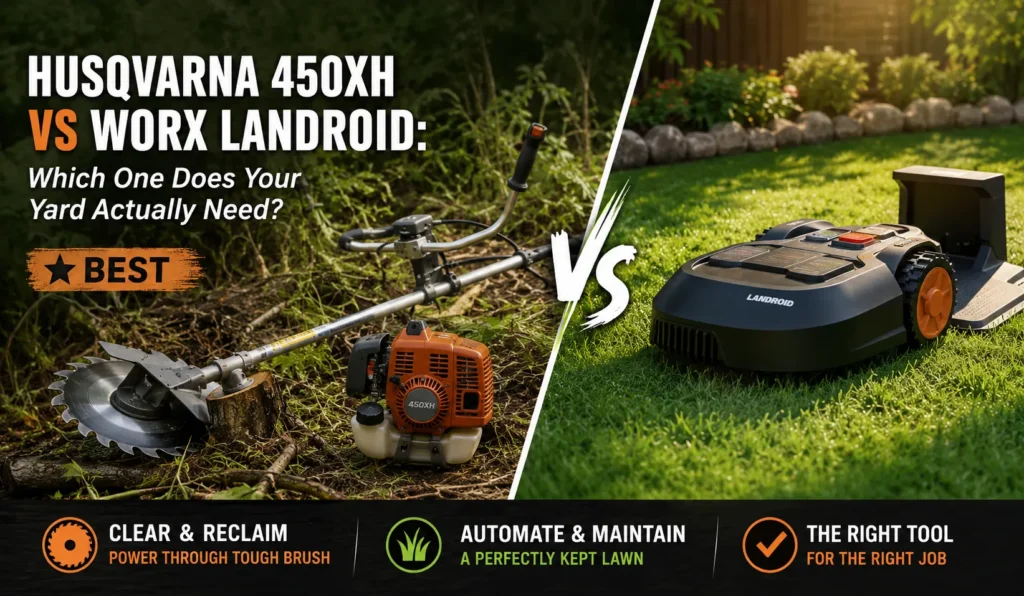
- The Husqvarna 450XH is a gas-powered clearing saw built for cutting brush, saplings, and tall weeds. The Worx Landroid is a robotic mower built for maintaining an already-established lawn.
- They are not direct competitors. Most homeowners who ask “which one should I buy” actually need to ask “what job am I trying to do.”
- The 450XH runs a 50.2cc engine and handles thick, woody growth that a mower (robotic or otherwise) cannot touch.
- The Landroid mows on a schedule using a boundary wire or, on newer models, GPS-assisted mapping, and needs a lawn that’s already clear of brush and debris.
- Some properties genuinely need both: the 450XH to clear and reclaim overgrown ground, then the Landroid to keep the resulting lawn tidy.
What Is the Husqvarna 450XH and What Is the Worx Landroid?
The Husqvarna 450XH is a gas-powered clearing saw. It’s built to cut through brush, saplings, thick weeds, and small woody growth that a regular trimmer or mower can’t handle. It runs on a 50.2cc engine and takes metal blade attachments instead of just trimmer line.
The Worx Landroid is a robotic lawn mower. It mows grass automatically, on a schedule you set, using either a buried boundary wire or, on newer models, GPS mapping. It’s built for lawns that are already established and reasonably clear of obstacles.
If your yard is overgrown with brush, saplings, or thick weeds, you need the 450XH first. If you already have a mowed lawn and just want to stop mowing it yourself, you need the Landroid. Many properties need both, in that order: clear it, then automate the upkeep.
Why People Confuse These Two Products
A lot of homeowners search “450XH vs Landroid” expecting a straight head-to-head, the same way you’d compare two car models. That’s a reasonable instinct. Most buying guides are built that way.
Two Very Different Tools, One Common Search
The confusion usually comes from timing, not features. Someone just moved into a house with a neglected yard. They know they need power equipment, they’ve heard both names mentioned by a neighbor or a YouTube ad, and they assume one purchase will solve the whole problem.
It won’t, because the problem usually has two stages. Stage one is clearing whatever has taken over the property: blackberry brambles, sapling growth along a fence line, weeds gone to seed. Stage two is keeping a clean lawn clean. Different tools, different stages.
What Each One Is Actually Built For
The 450XH belongs in the same category as brush cutters and clearing saws — equipment built for tough, undeveloped, or neglected vegetation. Husqvarna markets it specifically for clearing applications, not routine lawn mowing.
The Landroid belongs in the robotic mower category, alongside brands like Husqvarna’s own Automower line. It’s built for repetitive, scheduled mowing of turfgrass that’s already in reasonably good shape.
What to Look for Before You Choose
Before comparing specs, it helps to know what actually separates these two categories of equipment. The differences below explain why a spec-for-spec comparison table doesn’t really apply here the way it would for two competing mowers.
Power Source and Engine Type
The 450XH runs on a 50.2cc two-stroke gas engine. That means mixed fuel, a pull-start, and the smell and noise of a gas engine — louder than a mower, and it needs fuel and oil mixed at the correct ratio.
The Landroid runs on a rechargeable battery, typically a lithium-ion pack depending on the model. It charges itself at a docking station between mowing sessions. No fuel, no mixing, and dramatically lower noise.
Cutting Method and Terrain Handling
The 450XH uses a metal blade attachment (or heavy-duty trimmer line for lighter jobs) on a rigid shaft. That rigid shaft and blade combination is what lets it cut through woody stems and thick brush that would jam or stall lighter equipment.
The Landroid uses small rotating blades mounted underneath the unit, similar to a robotic vacuum’s brush setup but for grass. It’s designed for fine, repeated trimming of soft turfgrass, not for cutting through anything woody or thick.
Manual Control vs. Automation
You operate the 450XH by hand, the entire time. You’re holding it, walking the terrain, deciding what to cut and where. It demands physical effort and attention from start to finish.
The Landroid runs on its own, on a schedule, within a boundary you set up once. Setup takes real time upfront (laying boundary wire or mapping the yard), but day-to-day operation requires almost no involvement from you.
Maintenance and Setup Time
The 450XH needs the maintenance any gas engine needs: fuel mixed correctly, air filter checks, spark plug care, blade sharpening, and fuel system care if it sits unused for a season. None of this is hard, but it is ongoing.
The Landroid needs boundary wire installed correctly the first time (or GPS zones mapped, on supported models), blade replacement every so often, and occasional cleaning of the underside. After setup, weekly maintenance is minimal.
Quick Comparison Table
| Feature | Husqvarna 450XH | Worx Landroid |
|---|---|---|
| Category | Gas clearing saw | Robotic lawn mower |
| Power source | 50.2cc gas engine | Rechargeable battery |
| Best use | Brush, saplings, thick weeds | Established lawn maintenance |
| Operation | Manual, hands-on | Automated, scheduled |
| Noise level | High (gas engine) | Low (electric motor) |
| Setup time | Minutes (fuel, blade check) | Hours (boundary wire or mapping) |
| Ongoing maintenance | Fuel, filters, blade sharpening | Blade swaps, occasional cleaning |
| Typical terrain | Uneven, overgrown, wooded edges | Flat to moderately sloped, clear lawn |
Husqvarna 450XH: What It’s Good At and Where It Struggles
The 450XH earns its reputation as a clearing tool, not a lawn mower replacement. It’s built for jobs a mower of any kind can’t do.
Where It Performs Best
It excels at reclaiming land that’s gotten away from you. Property lines with sapling growth, fence rows choked with brambles, lots that haven’t been touched in a season or two — that’s its job. The 50.2cc engine has the torque to push through stems and woody growth without bogging down the way smaller electric trimmers often do.
Power and Handling
The engine delivers real cutting power, which matters once you’re past soft grass and into anything with a stem thicker than a pencil. The rigid shaft transmits that power directly to the blade, which is what lets it cut cleanly through brush instead of just bending it over.
It’s also heavier and louder than a string trimmer, which is the trade-off for that power. Extended use means hearing protection and a comfortable harness setup, since you’re carrying real weight on a shoulder strap for the duration of the job.
Where It Falls Short
It’s not a precision tool for finished lawns. Using it for routine grass maintenance on an already-tidy yard is overkill, both in terms of effort and in terms of the finish it leaves behind compared to a mower deck.
Gas engines also mean ongoing fuel costs, mixing ratios to get right, and the maintenance schedule that comes with any small gas engine, including offseason storage prep so the fuel system doesn’t gum up.
Worx Landroid: What It’s Good At and Where It Struggles
The Landroid’s job is repetition. It’s not trying to be powerful. It’s trying to be consistent, quiet, and mostly invisible in your routine.
Where It Performs Best
It shines on established lawns that need regular mowing and nothing more. Set the schedule, let it run in short, frequent sessions, and the lawn stays at a consistent height without you pushing anything. That mowing pattern (frequent, short cuts rather than occasional long ones) also tends to produce a healthier, denser lawn over time, since the clippings are fine enough to mulch back in.
How It Handles Different Lawn Shapes
Boundary-wire models handle irregular shapes well once the wire is laid out correctly, including narrow side yards and curved beds, because the wire defines the exact edge regardless of shape. GPS-mapping models (on supported Landroid lines) can skip the wire-burial step entirely, mapping the yard through an app-guided walk-through instead.
Either setup method takes real time to do right the first time. Skipping steps in boundary placement or mapping is the most common cause of a Landroid mowing unevenly or missing patches.
Where It Falls Short
It can’t clear anything beyond light, soft grass. Brush, saplings, deep weeds, or a lawn that’s been neglected for months are outside its job description entirely — that’s 450XH territory or hand-clearing territory, not robotic-mower territory.
Steep slopes, loose terrain, and obstacles like exposed roots or low branches can also cause problems, since the unit relies on sensors and a defined boundary rather than a person making judgment calls in real time.
How Each One Fits Different Climates and Terrain
Climate and terrain change how each machine performs and how much maintenance it needs, even though the core job each one does stays the same everywhere.
Hot and Humid Climates (Florida, Texas, Southeast)
Humid Southeast lawns grow fast and grow dense. For the Landroid, that often means shorter intervals between mowing sessions to keep up with growth rate, and more frequent blade checks since dense grass dulls blades faster.
For the 450XH, humid climates often mean heavier brush growth along property edges, especially vine-type growth that thrives in heat and moisture. That’s exactly the kind of overgrowth the 450XH is built to clear.
Dry and Rocky Terrain (Southwest, Arizona)
In dry Southwest climates, lawns are often smaller, patchier, or replaced with xeriscaping, so a robotic mower may have less total area to cover, but rocky or uneven ground can interfere with boundary wire placement and with the mower’s sensors.
The 450XH tends to see more use on desert-adjacent properties for clearing dry brush and dead growth, which carries its own wildfire-adjacent maintenance value in dry regions where defensible space matters.
Thick Grass and Cooler-Climate Lawns (Midwest, Northeast)
Midwest lawns with thick, established turfgrass are close to ideal Landroid territory, since the grass type and consistent moisture support frequent, even mowing without the extreme growth spikes seen in hot, humid regions.
The 450XH still earns its place here for spring cleanup, clearing winter-killed brush, overgrown fence lines, and the woody growth that builds up over a dormant season before the lawn itself is ready for regular mowing.
Climate Snapshot
| Climate | Landroid Considerations | 450XH Considerations |
|---|---|---|
| Hot/Humid (FL, TX) | Frequent mowing, faster blade wear | Heavy brush and vine clearing |
| Dry/Rocky (AZ, Southwest) | Smaller lawn areas, sensor interference from rocks | Dry brush clearing, defensible space |
| Cool/Thick Grass (Midwest) | Strong fit for consistent turfgrass | Spring cleanup of winter brush |
Common Mistakes People Make When Choosing Between Them
Most buyer’s remorse with these two products comes down to a handful of repeatable mistakes, not bad luck with the equipment itself.
Picking Based on Price Alone
Comparing sticker prices without comparing job descriptions leads to disappointment either way. A budget robotic mower won’t clear brush no matter how much you paid for it, and a clearing saw won’t give you the hands-off convenience a robotic mower offers.
The right question isn’t “which one costs less” — it’s “which job am I actually trying to solve this year.”
Not Matching the Tool to the Job
The most common mistake is buying a Landroid for a yard that isn’t ready for one yet. If the lawn has brush, saplings, or thick overgrown patches, the Landroid will struggle or fail outright before it even gets to do its actual job.
The fix is sequencing: clear the property first with something built for that (the 450XH, a brush cutter, or hired clearing work), then bring in the robotic mower once the lawn is in a maintainable state.
My Final Recommendation
These two tools solve different problems, and treating them as competitors does readers a disservice. If your property is overgrown, has brush, saplings, or fence lines that have gotten out of hand, that’s a clearing job. A gas clearing saw like the 450XH, with its 50.2cc engine and metal blade option, is built for exactly that kind of work, and a robotic mower would fail at it.
If your lawn is already established and mowed, and you just want to stop mowing it yourself, that’s an automation job. A robotic mower like the Landroid, running on battery power within a boundary wire or mapped zone, is built for that kind of routine, low-effort upkeep.
For a lot of properties, especially ones that have sat neglected for a season or two, the honest answer is both, used in sequence. Clear the land first, then automate the lawn maintenance once there’s an actual lawn to maintain. Buying either one expecting it to do the other’s job is where most of the frustration with both of these tools comes from.
Pros and Cons Table
| Husqvarna 450XH | Worx Landroid | |
|---|---|---|
| Pros | Strong cutting power for brush and saplings; rigid shaft handles woody growth; effective on neglected, overgrown land | Hands-off scheduled mowing; quiet electric operation; promotes healthier turf through frequent mulching cuts |
| Cons | Loud, gas-powered, requires fuel mixing and ongoing engine maintenance; not suited for finished lawns | Cannot clear brush, saplings, or thick weeds; setup (boundary wire or mapping) takes real time to get right |
| Best for | Overgrown lots, brush clearing, fence-line maintenance | Established lawns needing regular, automated mowing |
Frequently Asked Questions
Is the Husqvarna 450XH the same type of product as the Worx Landroid?
No. The 450XH is a gas-powered clearing saw for brush, saplings, and weeds. The Landroid is a robotic mower for maintaining an established lawn. They serve different stages of yard care.
Can a Worx Landroid replace a clearing saw like the 450XH?
No. The Landroid’s blades are built for soft grass, not woody growth. Using it on brush or saplings can damage the unit and won’t actually clear the area.
Can the Husqvarna 450XH be used for routine lawn mowing?
It can cut grass, but it’s not designed for a finished lawn look the way a mower deck is, and it’s far more effort and noise than the job requires once the area is already clear.
Do I need both the 450XH and a Landroid?
If your property has overgrown brush or saplings and you also want automated mowing once it’s clear, yes. Use the 450XH to clear the land first, then the Landroid to maintain it going forward.
How much maintenance does each one need?
The 450XH needs fuel mixed correctly, regular air filter and spark plug checks, and blade sharpening. The Landroid needs occasional blade replacement, cleaning of the underside, and a properly maintained boundary wire or mapped zone.
Which one is better for a neglected, overgrown yard?
The 450XH. Robotic mowers are built for upkeep, not reclamation, and will struggle or fail on heavily overgrown ground.