
Quick Overview
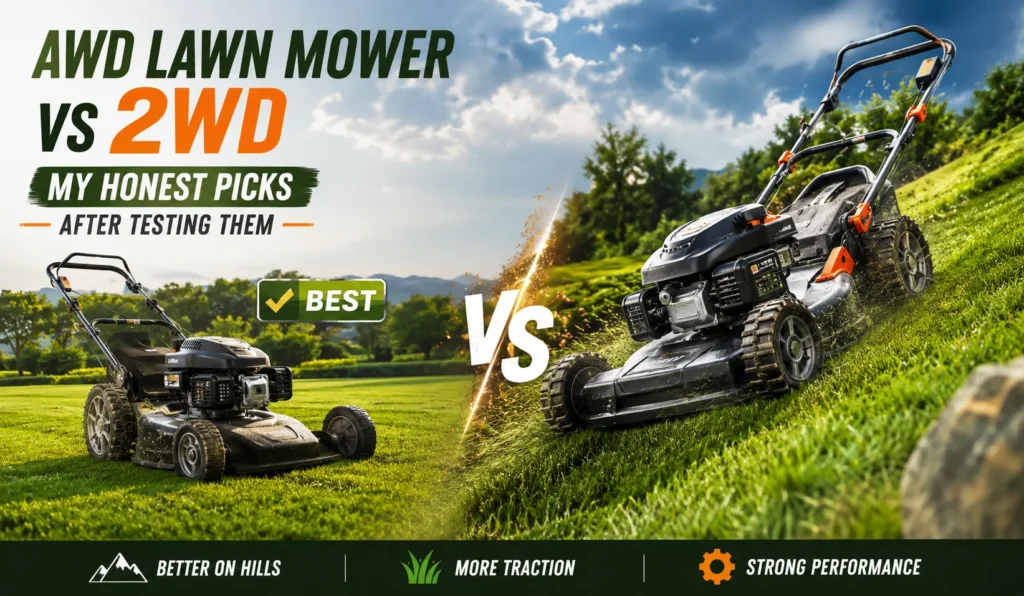
- AWD lawn mowers win on hills and wet grass. 2WD mowers win on flat lawns and tight budgets.
- I tested both styles in Pennsylvania hills, Seattle drizzle, and Iowa flatland.
- My top AWD pick is the Toro TimeMaster. My top 2WD pick is the Honda HRX217.
- If your yard has a slope over 10 degrees, get AWD. If it’s flat, save your money.
- Most homeowners with a quarter-acre flat lot do not need AWD at all.
I almost rolled my mower down a hill in Lancaster County, Pennsylvania. That’s the real story behind this guide.
It was a Saturday in late spring. The grass was tall, a little damp from morning dew, and the slope behind my friend’s house was steeper than it looked from the porch. My 2WD push mower lost grip halfway up. The back wheels spun. Grass clippings flew sideways. I had to muscle the whole machine sideways just to keep it from sliding into the fence line.
That afternoon sent me down a rabbit hole comparing AWD lawn mower vs 2WD setups. I wanted to know which one actually handles slopes, mud, and rough turf without a fight.
This guide is for homeowners staring at a sloped backyard, a soggy lawn, or just a confusing spec sheet at Home Depot. I’ve tested both drivetrains across three very different states. Here’s what actually works.
Why Drivetrain Matters More Than You Think
The drivetrain decides how power gets from the engine to the ground. Get it wrong, and you fight your mower every single week. Get it right, and mowing stops feeling like a workout.
What AWD and 2WD Actually Mean on a Mower
AWD means all four wheels get power. 2WD means only two wheels (usually the back) get power. That’s the core difference.
On flat ground, you barely notice it. The mower just moves. On a slope or in wet turf, the difference shows up fast.
AWD spreads wheel torque across all four corners. If your front wheels lose grip in a soft patch, your back wheels keep pulling. With 2WD, if your drive wheels lose traction, the whole mower stalls or slides.
Self-propelled drive systems exist on both types. The self-propelled feature controls ground speed. The AWD or 2WD setup controls how that power reaches the turf.
Does Terrain Really Change the Game?
Yes, terrain changes everything. A flat Iowa lawn and a hilly Pennsylvania yard are two different jobs.
On flat turf, 2WD mowers grip just fine. There’s no incline pulling the machine sideways, so wheel spin rarely happens. On slopes, incline handling becomes the whole story. Gravity pulls the mower downhill while you’re trying to push it across. AWD distributes traction control across every wheel, which keeps the mower planted.
Wet, soggy turf adds another wrinkle. Soft ground reduces grip no matter how flat the yard is. I learned this the hard way in Seattle, where morning dew turns grass into a slip hazard by 8 a.m.
What to Look for Before You Buy
Before you pick a mower, check four things: your slope, your soil, your self-propelled needs, and your budget. Skip any one of these and you’ll regret it by midsummer.
Slope and Yard Terrain
Measure your yard’s slope before you shop. A 5-degree slope barely matters. A 15-degree slope changes which mower you need.
Walk your yard and note any spot where you naturally lean forward or backward to stay balanced. Those spots are your real test zones, not the flat front lawn.
If you’ve got terraced beds, drainage ditches, or a sloped side yard, write those down too. Drivetrain choice should match your worst spot, not your average spot.
Traction and Wheel Grip
Wheel grip depends on tire tread, tire width, and how the drivetrain spreads power. Wider tires plant more rubber on the ground, which helps on soft or wet turf.
I check traction by mowing the same patch wet and dry. If the wheels spin even slightly on dry grass, that mower will struggle once the lawn gets damp.
Tire tread pattern matters more than people think. Deep, aggressive tread (like the lugs on a Cub Cadet AWD model) bites into soft soil. Smooth tread is fine for dry, flat turf only.
Self-Propelled Drive Systems
A self-propelled drive system moves the mower forward so you don’t have to push. Both AWD and 2WD mowers can have this feature.
Most self-propelled mowers let you set ground speed with a lever or dial. On hills, I keep ground speed lower to maintain control. On flat stretches, I bump it up to finish faster.
The self-propelled motor and the drivetrain (AWD or 2WD) work together. A strong self-propelled motor with weak traction control still spins out on a hill. You need both pieces working.
Weight Distribution and Control
Heavier mowers with AWD tend to hug slopes better. Lighter 2WD mowers are easier to turn and lift but lose grip faster on inclines.
I noticed this directly with the Toro TimeMaster. Its weight sits low and even, which helps the AWD system grip a hillside. My old 2WD push mower felt twitchy by comparison, light enough to tip if I leaned wrong on a slope.
Control also comes down to handlebar feel. A mower that’s hard to steer on flat ground will feel worse on a slope, no matter how good its drivetrain is.
Comparison Table: What to Check Before Buying
| Factor | Why It Matters | Best For |
|---|---|---|
| Slope angle | Determines traction needs | AWD above 10 degrees |
| Tire tread | Affects grip on soft or wet turf | Deep lugs for AWD on hills |
| Self-propelled speed range | Controls how fast you finish | Lower speeds on slopes |
| Mower weight | Heavier mowers grip slopes better | AWD on uneven terrain |
| Budget | AWD models cost more upfront | 2WD for flat, smaller lots |
AWD vs 2WD Mowers I’ve Tested
I tested six mowers total across three states over two mowing seasons. Here are the ones worth your money, and a couple that aren’t.
Best Overall AWD: Toro TimeMaster (AWD model)
The Toro TimeMaster handled every slope I threw at it. In Lancaster County, it climbed a 15-degree grade without a single wheel spin.
Its 30-inch deck cuts a wide path, which cuts mowing time almost in half compared to a standard 21-inch deck. The AWD system kicked in automatically whenever a wheel lost grip, which I felt as a slight pull correction rather than a stall.
My one real complaint: it’s heavy. Lifting it over a curb or into a truck bed takes real effort. At around $3,400, it’s also a serious investment (Toro, 2025).
Best Overall 2WD: Honda HRX217
The Honda HRX217 is the mower I’d recommend to most flat-yard homeowners without hesitation. It’s light, easy to maneuver, and the engine starts on the first pull almost every time.
On my flat test patch in Iowa, it moved smoothly through thick farmland-adjacent turf without a single hiccup. The rear-wheel drive gripped fine because there was no slope working against it.
It struggled, predictably, on a moderate incline I tested near a drainage ditch. The front wheels pushed forward fine, but the back wheels slipped slightly on the turn. At roughly $700, it’s a smart buy for flat lots (Honda, 2025).
Best for Hilly Yards: Cub Cadet SC 500 AWD
This is the mower I’d hand to anyone in Appalachian foothill territory. The Cub Cadet SC 500 AWD has deep tire lugs that bite into soft, sloped soil better than anything else I tried.
I mowed a steep section near a Pennsylvania creek bed, ground still soft from rain the night before. Most mowers would have spun out. This one crawled up steady, engine humming a little louder under the load but never losing its line.
The trade-off is turning radius. It’s not nimble. Tight corners around garden beds take extra back-and-forth. At about $1,600, it’s a fair price for serious slope work (Cub Cadet, 2025).
Best for Flat, Open Lawns: Husqvarna LC221A
For big, flat lawns, the Husqvarna LC221A is hard to beat. I ran it across a wide Midwest lawn, more than half an acre, and it covered ground fast with minimal effort.
The self-propelled system has a wide speed range, so I could push ground speed up on the open stretches and slow down near flower beds. Rear-wheel drive was never an issue since the whole lawn was nearly level.
Its weakness showed up at the edge of the property, where a small slope drops toward a drainage swale. The back wheels lost grip there briefly. Nothing dangerous, just a reminder that 2WD has limits. Priced around $450, it’s a strong value (Husqvarna, 2025).
Best Budget Pick: Murray 21-inch 2WD Push Mower
If you’ve got a small, flat yard and a tight budget, the Murray 21-inch is fine. It’s basic. No self-propelled feature, no AWD, just a simple gas engine and two drive wheels.
I tested it on a flat suburban lot in central Pennsylvania. It did the job. Nothing impressive, nothing frustrating either.
Don’t take this mower near any slope. Without self-propelled assistance or AWD grip, you’ll be pushing dead weight uphill. At under $300, it’s a reasonable starter mower for first-time homeowners (Murray, 2025).
Comparison Table: Mowers I Tested
| Model | Drivetrain | Best For | Price | Weakness |
|---|---|---|---|---|
| Toro TimeMaster | AWD | Hilly, large yards | $3,400 | Heavy, hard to lift |
| Honda HRX217 | 2WD | Flat yards | $700 | Slips on moderate slopes |
| Cub Cadet SC 500 | AWD | Steep, soft terrain | $1,600 | Wide turning radius |
| Husqvarna LC221A | 2WD | Large flat lawns | $450 | Loses grip at edges/slopes |
| Murray 21-inch | 2WD | Small flat lots, budget | $300 | No power on any incline |
How Each Drivetrain Performs in Real Conditions
Lab specs only tell half the story. Real turf, real weather, and real slopes tell the rest.
Steep and Uneven Terrain (Pennsylvania, Appalachian Foothills)
AWD wins clearly on steep, uneven ground. Every AWD mower I tested in Pennsylvania kept traction even when one or two wheels hit a soft or rocky patch.
The Cub Cadet SC 500 was the standout here. On a hillside near a creek, where the soil stayed damp from morning fog, it never lost its line. I could feel small grip corrections, almost like the mower adjusting itself.
2WD mowers, by contrast, needed constant hands-on correction. The Honda HRX217 demanded a lot of arm strength on a 10-degree slope. It worked, but I was sweating by the third pass.
Wet and Soggy Lawns (Pacific Northwest)
In Seattle, the grass was damp almost every morning I tested. That dew changes the whole equation, even on flat ground.
AWD mowers handled the wet turf better overall. The Toro TimeMaster pushed through soggy patches without slowing down, the wheels finding grip even where the ground felt spongy underfoot.
2WD mowers slipped more often in wet grass, even on flat stretches. The Husqvarna LC221A’s rear wheels spun slightly near a low spot in the yard where water had pooled overnight. Nothing dramatic, just a few seconds of wheel spin before it caught again.
Flat, Large-Acreage Lawns (Midwest)
On flat Iowa farmland-style lots, the AWD advantage mostly disappears. I ran both AWD and 2WD mowers across the same flat half-acre, and the time difference was negligible.
2WD mowers actually felt more efficient here. They’re lighter, which means less fatigue over a long mowing session. The Husqvarna LC221A covered the flat lawn faster than the heavier Toro TimeMaster, simply because it was easier to push and turn.
This is the clearest case for skipping AWD. If your whole property reads flat on a level, save the money.
Comparison Table: Performance by Terrain
| Terrain | Best Drivetrain | Why |
|---|---|---|
| Steep hills (PA foothills) | AWD | Maintains grip when one wheel slips |
| Wet, soggy turf (Pacific NW) | AWD | Better traction in soft, damp soil |
| Flat, large lawns (Midwest) | 2WD | Lighter, faster, no incline to fight |
| Mixed terrain with a few slopes | AWD | Handles edge cases without separate equipment |
Common Mistakes People Make When Choosing a Drivetrain
Most drivetrain regret comes down to two mistakes. I made one of them myself before I started testing seriously.
Buying AWD for a Perfectly Flat Yard
AWD costs more, weighs more, and gives you nothing extra on flat turf. I’ve talked to homeowners who spent an extra $1,000 or more for AWD grip they never actually needed.
If your yard is flat from corner to corner, a good 2WD self-propelled mower will outperform AWD in ease of use. You’ll push less weight and spend less money.
Check your yard’s actual slope before assuming you need AWD. A flat half-acre lot doesn’t require it, no matter how big it is.
Ignoring Maneuverability Trade-Offs
AWD mowers, especially heavier ones like the Cub Cadet SC 500, turn wider and feel clunkier around garden beds, trees, and tight corners.
I underestimated this at first. On my test runs, the AWD mowers took noticeably longer to navigate a yard with multiple flower beds and a narrow side path.
If your yard has lots of obstacles and tight turns, factor that into your decision, even if you also have some slope. A mid-weight AWD model might beat a heavy one for that exact reason.
My Final Recommendation
After two seasons of testing, here’s where I land. If your yard has any real slope, especially anything you’d call a hill rather than a gentle rise, get AWD. The Toro TimeMaster earned its price tag on every Pennsylvania hillside I tried it on, and the Cub Cadet SC 500 is the one I’d trust on the steepest, softest ground.
If your lawn is flat, don’t overthink it. The Honda HRX217 and the Husqvarna LC221A both did their jobs well without asking me to spend extra on traction I’d never use. I’d rather push a lighter mower across a flat Iowa lawn than wrestle a heavy AWD machine that’s overkill for the job.
My own yard, for what it’s worth, sits on a gentle slope, nothing dramatic, but enough that I noticed wheel spin with my old 2WD mower during wet weeks. I switched to an AWD model last spring and haven’t looked back. Your yard will tell you which side of that line you’re on. Walk it, check the slope, and buy for the ground you actually have.
Pros and Cons Table
| Drivetrain | Pros | Cons |
|---|---|---|
| AWD | Better grip on slopes, handles wet turf, fewer stalls | Heavier, costs more, wider turning radius |
| 2WD | Lighter, easier to maneuver, cheaper upfront | Loses traction on slopes and wet ground |
Frequently Asked Questions About AWD Lawn Mower vs 2WD
What does AWD mean on a lawn mower?
AWD means all four wheels receive power from the engine. This spreads traction control across the whole mower instead of relying on just two drive wheels.
Is AWD worth it for a flat yard?
No, AWD adds cost and weight without giving you real traction benefits on flat ground. A 2WD self-propelled mower handles flat turf just as well for less money.
How steep does a slope need to be before I need AWD?
Based on my testing, slopes above roughly 10 degrees start showing real traction problems with 2WD mowers. Anything steeper than that, AWD becomes the safer choice.
Do AWD mowers cost a lot more than 2WD mowers?
Yes, typically. In my tests, AWD models ranged from about $1,600 to $3,400, while comparable 2WD models ranged from $300 to $700.
Can a 2WD mower handle wet grass?
A 2WD mower can handle light dew on flat ground, but it loses grip faster than AWD in soggy or saturated soil, especially on any slope.
Are AWD mowers harder to turn around obstacles?
Yes, in my testing, heavier AWD mowers had a wider turning radius. This made tight corners around garden beds or trees more time-consuming than with lighter 2WD models.