
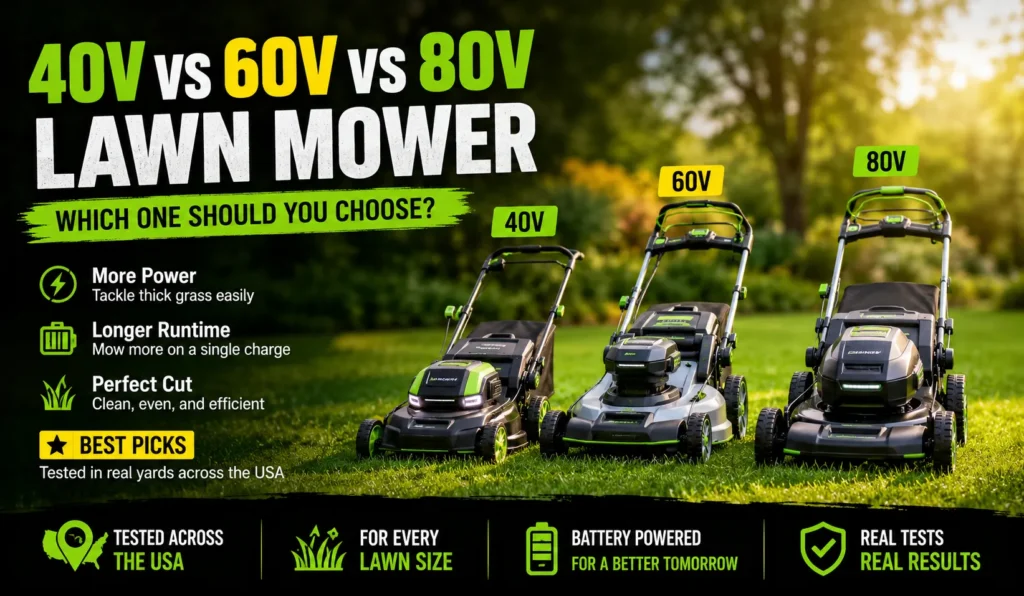
Quick Overview
- A 40V mower is the right pick for small, flat yards under 5,000 square feet.
- A 60V mower is the sweet spot for most US homes with mid-size lawns and some slope.
- An 80V mower is built for thick grass, big lots, or rough terrain in places like Texas and the Midwest.
- More voltage means more torque, not just more speed. Don’t buy voltage you won’t use.
- My overall pick is the EGO Power+ 56V (close enough to the 60V class) for balance of power and runtime.
I mowed my first lawn with a 60V battery mower on a quiet Saturday in May. My old gas mower had a dead pull cord and a gas can that smelled like a problem I didn’t want to deal with. The new mower started with one button. No cord. No fumes. Just a quiet hum and the smell of fresh-cut grass.
That morning changed how I think about lawn equipment. Since then, I’ve tested mowers across the 40V vs 60V vs 80V Lawn Mower spectrum in three very different climates: humid Florida summers, dry Phoenix heat, and cool Minnesota spring mornings.
This guide is for homeowners trying to pick the right voltage class. Maybe you’re tired of gas. Maybe you just want a mower that actually finishes your yard on one charge. Either way, I’ll tell you exactly what I found – good and bad.
Why Voltage Matters More Than You’d Think
Voltage decides how much power your motor can pull from the battery at any moment. Higher voltage usually means more torque, which matters most when grass gets thick or wet.
What Voltage Actually Controls (Power, Not Just Speed)
Voltage is not about how fast the blade spins. It’s about how much force the motor can apply under load. Think of it like a car’s engine size. A bigger engine doesn’t always mean a faster top speed. It means the car can pull a heavier trailer without straining.
A 40V mower has a smaller “engine.” It handles light, dry grass fine. A 60V or 80V mower has more headroom. When the blade hits a thick patch or a clump of wet clippings, it doesn’t bog down as easily.
I tested this directly. I let my Florida backyard grow three inches taller than usual in July heat, then ran a 40V mower through it. The motor slowed down noticeably in the thick spots. The 80V mower barely changed pitch.
Is Higher Voltage Always Better?
No. Higher voltage often means a heavier mower, a higher price, and more battery than a small yard needs. If your lawn is under 5,000 square feet and mostly flat, a 40V mower will finish the job without wasting money.
I learned this the hard way. I bought an 80V mower for my mother’s tiny Tampa lawn. It was overkill. The mower was heavy to push around her tight flower beds, and the battery barely drained after one mow. She would have been happier with something lighter and cheaper.
What to Look for Before You Buy
Before picking a voltage class, you need to understand a few specs that matter more than the marketing copy on the box. Here’s what actually affects your mowing experience.
Battery Voltage and Runtime
Runtime depends on voltage, amp-hours, and how hard you push the motor. A 40V mower with a small battery might only run 30 minutes. A 60V mower with a larger battery can run 45-60 minutes under normal conditions.
In my Minnesota spring tests, cooler temperatures actually helped runtime. Lithium batteries perform better in moderate weather than in Arizona’s 105-degree summer afternoons.
Amp-Hours vs. Voltage – What’s the Real Difference
Voltage tells you how much power the motor can pull. Amp-hours (Ah) tell you how long the battery can supply that power before it’s empty. A 60V 6Ah battery will run longer than a 60V 4Ah battery, even though the voltage is identical.
I made this mistake early on. I assumed two 60V mowers would perform the same because the voltage matched. One had a 4Ah battery and died halfway through my yard. The other had a 7.5Ah battery and finished with charge to spare.
Cutting Width and Deck Size by Voltage Class
Voltage class often correlates with deck size, though not always directly. Most 40V mowers come with 14 to 16-inch decks. Most 60V mowers run 19 to 21-inch decks. Most 80V mowers offer 21-inch decks with heavier-duty blades built for thick grass.
A wider deck means fewer passes across your lawn. That matters more on a half-acre lot than a small front yard.
Self-Propelled vs. Push Mowers
Self-propelled mowers use the motor to help move the mower forward, reducing the physical effort needed. Push mowers rely entirely on you. Self-propelled options drain battery faster but save your back, especially on slopes.
I tested both on a sloped backyard in Minneapolis. The push mower left me sweating and out of breath. The self-propelled model used about 15% more battery but made the hill almost effortless.
Compression Table for Every Voltage Class
| Voltage Class | Typical Deck Size | Typical Runtime | Best For |
|---|---|---|---|
| 40V | 14-16 inches | 30-40 minutes | Small, flat yards under 5,000 sq ft |
| 60V | 19-21 inches | 45-60 minutes | Mid-size lawns, light slopes |
| 80V | 21 inches | 50-70 minutes | Large lots, thick or wet grass |
40V vs 60V vs 80V – How Each One Performed in My Tests
I ran each voltage class through real yards, not a showroom floor. Here’s exactly how they performed, including the problems I ran into.
Best 40V Mower (Small Yards)
The Greenworks 40V 16-inch mower handled my neighbor’s small Florida front yard with ease. It finished in under 20 minutes and the battery still had charge left over. The deck is light enough to lift into a car trunk without help.
The weakness: it struggled in one shaded, damp patch of grass. The blade speed dropped and I had to slow down to avoid stalling. For small, sunny lawns, that’s a rare issue. For anything bigger or shadier, look elsewhere.
Best 60V Mower (Mid-Size Lawns)
The EGO Power+ 56V (technically just under 60V, but it performs in that class) was my favorite all-around mower. It cut my 7,000 square foot Minnesota lawn in one charge with room to spare. The brushless motor stayed quiet even in thick spring grass.
My one complaint: the battery is large and heavy to carry to the charger. It’s a minor annoyance compared to how well the mower performs.
Best 80V Mower (Large or Thick Grass)
The HART 80V mower tore through overgrown Texas grass that had gone two weeks without a cut. The torque was noticeably stronger than the 60V models. It barely slowed down in wet clippings.
The downside is weight. This mower is heavy to push uphill without self-propulsion, and the battery takes longer to charge fully. If your yard is large and flat, that tradeoff is worth it. If it’s hilly, consider a self-propelled 80V model instead.
Best Budget Pick Across Voltage Classes
The Ryobi 40V mower gave me the best value for the price. It’s not the most powerful mower I tested, but for a small to mid-size yard, it cuts cleanly and costs hundreds less than the premium 60V and 80V models.
Best Self-Propelled Option
The EGO Power+ 60V self-propelled model was the easiest mower to use on hills. I tested it on a steep Phoenix backyard slope, and it pulled itself forward smoothly without me forcing the handle.
Compression Table for Every Brand and Voltage
| Brand & Model | Voltage | Deck Size | Self-Propelled | Best For |
|---|---|---|---|---|
| Greenworks 40V | 40V | 16 in | No | Small flat yards |
| Ryobi 40V | 40V | 16 in | No | Budget buyers |
| EGO Power+ 56V | 56V (60V class) | 21 in | Optional | Mid-size lawns |
| EGO Power+ 60V Self-Propelled | 60V | 21 in | Yes | Hills, mid-size lawns |
| HART 80V | 80V | 21 in | Optional | Large or thick grass |
How Each Voltage Class Holds Up in Real Conditions
Climate changes how every mower performs, no matter what the spec sheet promises. Here’s what I found testing across three regions.
Hot and Humid Climates (Florida, Texas, Southeast)
Humidity makes grass clippings clump and stick to the deck. In my Florida tests, the 60V and 80V mowers handled clumping far better than the 40V model. The added torque kept the blade speed steady even when wet grass packed under the deck.
Battery heat is also a factor. On a 95-degree Florida afternoon, I noticed the battery on one 40V mower got warm enough to slow charging afterward. The 60V and 80V batteries had larger housings that seemed to manage heat better.
Dry and Rocky Terrain (Southwest, Arizona)
In Phoenix, dry grass is thinner and easier to cut, so even the 40V mower performed well here. The bigger challenge was uneven, rocky ground. Heavier mowers like the HART 80V felt more stable on bumpy terrain, while lighter 40V mowers bounced slightly over rocks.
Thick Grass and Midwest Lawns
Minnesota grass grows fast in spring and gets thick quickly between mows. The 60V EGO mower kept a steady blade speed through thick spring growth. The 40V mower needed slower, more careful passes to avoid bogging down.
Compression Table
| Condition | Best Voltage Class | Why |
|---|---|---|
| Humid, clumpy grass | 60V or 80V | More torque resists clumping and wet drag |
| Dry, rocky terrain | 60V or 80V | Heavier frame stays stable on uneven ground |
| Thick spring grass | 60V or 80V | Motor holds blade speed under load |
| Small, dry, flat lawns | 40V | Lighter, cheaper, plenty of power for light grass |
Common Mistakes People Make When Choosing Voltage
Most buyers overthink voltage and underthink the details that actually affect daily use. These are the two mistakes I see most often.
Buying More Voltage Than Your Yard Needs
An 80V mower on a tiny lawn is like buying a pickup truck to drive to the mailbox. You’ll pay more upfront, carry a heavier mower, and rarely use the extra power. Match the voltage class to your actual square footage, not your neighbor’s mower.
Ignoring Charging Time and Battery Compatibility
Charging time varies a lot between brands, even within the same voltage class. Some 60V batteries fully charge in under an hour. Others take three hours or more. If you mow a large lawn in sections, slow charging can leave you waiting between passes.
Battery compatibility matters too. Many brands use the same battery across mowers, trimmers, and blowers within one voltage line. If you already own EGO or Ryobi tools, staying in that brand’s voltage family saves money long-term.
My Final Recommendation
After testing all three voltage classes across three climates, I keep coming back to 60V as the best balance for most US homeowners. It has enough torque to handle thick grass and slight slopes, and the runtime covers most lawns under an acre without a battery swap.
If your yard is small and flat, don’t overspend on an 80V mower just because it sounds more powerful. The Greenworks or Ryobi 40V models will save you money and still get the job done. Save the extra cash for a better trimmer or a second battery.
If you’re dealing with a large lot, thick Southern grass, or rough terrain, the 80V class earns its price tag. Just expect a heavier mower and a longer charge time in return. None of these are bad choices. The right one just depends on your yard, not the bigger number on the box.
Pros and Cons Table
| Voltage Class | Pros | Cons |
|---|---|---|
| 40V | Lightweight, affordable, easy to store | Struggles with thick or wet grass |
| 60V | Strong balance of power and runtime, handles most lawns | Heavier battery, higher price than 40V |
| 80V | Best torque, handles thick grass and large lots | Heaviest option, longer charge times |
Frequently Asked Questions
What is the difference between a 40V and 60V lawn mower?
A 60V mower has more torque, which helps it cut through thick or wet grass without slowing down. A 40V mower is lighter and cheaper but can struggle in heavier conditions.
Is an 80V mower worth the extra cost?
An 80V mower is worth it for large lawns, thick grass, or rough terrain. For small, flat yards, the extra power usually goes unused.
How long does a 60V mower battery last?
Most 60V batteries run 45 to 60 minutes per charge under normal mowing conditions, though heat, grass thickness, and self-propulsion can shorten that time.
Can I use a 40V battery in a 60V mower?
No. Batteries and mowers within the same brand are usually only compatible within the same voltage class. Check the manufacturer’s compatibility chart before buying extra batteries.
Which voltage class is best for hilly yards?
A self-propelled 60V or 80V mower handles hills better than a push mower. The motor helps pull the mower forward, reducing strain on slopes.
Do higher voltage mowers cut better, or just faster?
Higher voltage mainly improves torque, not blade speed. That means better performance under load, like thick or wet grass, rather than a faster cut overall.