
Quick Overview
- A robot mower vs riding mower decision comes down to yard size, terrain, and how much you value your weekend mornings.
- Robot mowers cost more upfront ($600-$5,500) but save 3-5 hours a week and need almost no physical effort.
- Riding mowers cost less upfront ($1,900-$6,300) but demand fuel, regular maintenance, and your actual Saturday.
- Slopes above 35-45% (depending on model) rule out most robot mowers entirely – check your steepest section before you buy anything.
- Neither one is the right answer for every yard. Some properties genuinely need both, or neither.
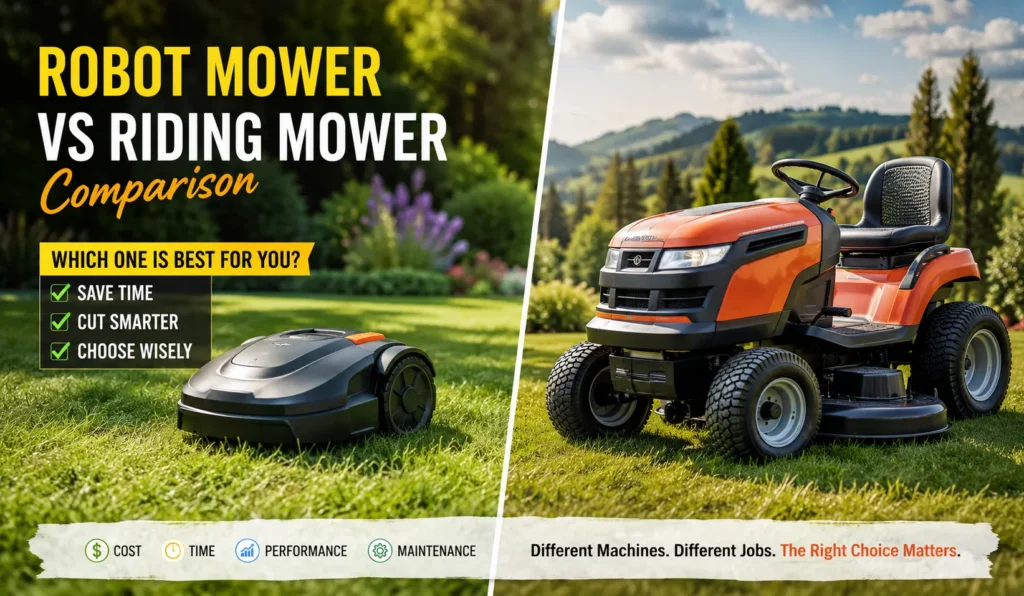
I was sitting on a riding mower in 95-degree Texas heat. Sweat soaked through my shirt. Down the street, my neighbor’s robot mower hummed quietly across his lawn while he sipped coffee on the porch. That contrast stuck with me, and it’s really the whole robot mower vs riding mower question in one image.
This guide is for homeowners with large yards who are tired of spending entire weekends mowing. It’s also for people with small lots who wonder if the robot hype is actually real. And it’s for anyone trying to figure out which machine fits their specific yard, terrain, and budget, instead of just whichever one has the flashier marketing behind it.
How I Ended Up Testing Both Side by Side
I didn’t plan to become the guy who owns a riding mower AND a robot mower. It happened by accident. It happened over about three years. And it happened across three very different yards.
My First Riding Mower Experience (and What I Loved About It)
My first house was outside Austin. The lot was a flat half-acre. The grass was Bermuda, and it grows like it’s mad at you. A push mower would have taken forever. So I bought a basic gas riding mower instead. The lot was too big to walk and too flat to need anything fancy.
I loved it more than I expected to. There’s something satisfying about sitting down. You turn a key. You watch a strip of lawn go from shaggy to sharp in one pass. The smell of fresh-cut Bermuda hit me in 95-degree heat. Sweat soaked through my shirt by the second lap. The seat vibrated under me the whole time. It felt like real work. I liked that feeling.
Why I Even Gave Robot Mowers a Chance
Later, I moved to a townhouse near Atlanta. The front lawn was tiny and oddly shaped. The HOA cared way too much about grass height. A riding mower made zero sense there. It would have been overkill for a yard the size of a parking spot.
A neighbor had a different setup. His Husqvarna Automower worked quietly at 6 a.m. He drank coffee on his porch while it mowed. I watched this happen more than once. I was jealous in a way that surprised me.
So I bought a robot mower, mostly out of curiosity. Two years after that, I moved again. This time it was to a hilly half-acre outside Pittsburgh. I ended up buying a riding mower again. The slope on that property ruled out most robot models. That’s when the whole comparison started to make real sense to me.
Understanding What You’re Actually Comparing
A robot mower and a riding mower solve the same problem. They both cut grass. But they solve it in completely different ways. One replaces your time. The other replaces your effort, while you’re still the one driving.
What a Robot Mower Really Does (and Doesn’t Do)
A robot mower is a small, battery-powered machine. It mows your lawn on a schedule. It works on its own, without you present. It uses either a buried perimeter wire or GPS-based navigation, sometimes called autonomous mowing, to stay inside your yard’s boundaries.
What it doesn’t do is replace edging. It won’t haul leaves or mulch for you. It also won’t bag clippings. Robot mowers mulch as they go. They cut small amounts frequently, rather than making one big weekly pass. If your image of “robot mower” is a Roomba that handles your entire yard maintenance routine, that’s not accurate. It’s a specialist. It’s not a generalist.
What Makes a Riding Mower Still Relevant in 2025
A riding mower is still the better tool for big, open, or sloped properties. You want one machine that can mow, bag, mulch, and sometimes haul a small trailer or spreader. You sit on it. You drive it. You’re done in one session, instead of spreading the job across a whole week.
Riding mowers also win on raw versatility. Attachments exist for snow blades, carts, dethatchers, and aerators on models like the John Deere S140. Most robot mowers simply can’t match that.
The Core Differences at a Glance
The biggest difference isn’t price. It’s your level of involvement. A robot mower runs without you. A riding mower runs because of you. That one fact drives almost every other trade-off you’ll read about below: cost, maintenance, noise, and how much physical work the machine actually removes from your life.
Compression Table – Robot Mower vs Riding Mower Feature Comparison
| Feature | Robot Mower | Riding Mower |
|---|---|---|
| Your time required | Minimal after setup | 30-90+ minutes per session |
| Upfront cost | $600-$5,500 | $1,900-$6,300 |
| Power source | Battery (electric) | Gas or electric |
| Bagging clippings | No – mulches only | Yes, on most models |
| Slope handling | Limited (24-45% max) | Better on hills, especially garden tractors |
| Noise level | 57-75 dB | 75-95+ dB (gas models) |
| Setup complexity | Moderate to high (wire or GPS mapping) | Low – drive it off the trailer |
| Attachments available | Few (anti-collision, GPS module) | Many (blade, cart, spreader, aerator) |
Looking at this table, the pattern is clear. Robot mowers win on convenience. Riding mowers win on raw capability. Neither one is universally “better.” They’re built for different jobs, and a lot of buyers end up disappointed simply because they bought the wrong tool for their actual yard, not a bad tool in general.
What to Look for Before You Choose
Before you fall in love with either option, walk your own yard first. Keep these five factors in mind as you walk it. Skipping this step is how people end up with a $2,000 robot mower stuck on a hillside.
Yard Size and Terrain Type
Robot mowers are rated by acreage. But that number assumes a flat, regular-shaped lawn. Add about 20% more time and effort if your yard has odd angles or tight passages. A half-acre flat suburban lot is the sweet spot for entry and mid-range robot mowers. Anything irregular, heavily wooded, or over an acre starts pushing you toward either a premium robot mower or a riding mower.
Grass Type and Cutting Frequency
Southern grasses like Bermuda and St. Augustine grow fast in summer heat. They benefit from frequent, light cutting. That happens to be exactly what robot mowers do well, since they mow a little every day or two rather than one big weekly chop. Cooler-season grasses common in the mid-Atlantic and Northeast tolerate weekly riding-mower sessions just fine.
Setup Complexity and Learning Curve
A wire-based robot mower like the Worx Landroid L requires installing 600 to 800-plus feet of perimeter wire around your lawn’s edge. That typically takes a full morning or afternoon the first time. GPS and camera-based models like the Husqvarna 410iQ or Worx Landroid Vision skip the wire. But they need careful initial mapping, and tree cover can interfere with signal accuracy. A riding mower has almost no learning curve. You sit down, adjust the deck height, and drive.
Upfront Cost vs Long-Term Cost
Riding mowers cost less to buy but more to run. Gas, oil changes, blade sharpening, and belt replacement add up over a season. Robot mowers cost more to buy but cost very little to run. Mostly it’s electricity, around 15 to 25 kWh per month in season, adding $2 to $4 to your bill. Add occasional blade swaps every one to three months at $10 to $30 a set, and that’s about it.
Compression Table – Decision Factors by Yard Profile
| Yard Profile | Better Fit | Why |
|---|---|---|
| Small, flat, HOA-regulated lot | Robot mower | Quiet, frequent mowing keeps grass within HOA height rules automatically |
| Large flat lawn, 1-3 acres | Riding mower (lawn tractor) | More cutting width per pass, attachments for other yard work |
| Steep or uneven terrain | Riding mower with locking differential | Most robot mowers cap out around 35-45% slope |
| Tight, obstacle-heavy yard with trees and beds | GPS or camera-based robot mower | Narrow-passage navigation beats maneuvering a tractor around obstacles |
| Multiple separate lawn areas | Riding mower, or multiple robot zones via app | Either works, but riding mowers handle disconnected areas more simply |
A quick gut check: if you’re nodding along to two or three rows in the left column above, lean robot. If most of your nods land in the right column, a riding mower is probably the smarter buy. Most yards aren’t pure cases either way, which is exactly why this decision trips people up.
The Best Models I’ve Actually Tested
I’m naming real models here. The prices are accurate as of mid-2026. Every model gets at least one honest weakness. Prices fluctuate, so treat these as a starting point, not gospel. Always check current pricing before you buy.
Best Robot Mower Overall
The Husqvarna Automower 410iQ runs about $1,550 with the RS1 reference station. It uses EPOS satellite positioning instead of a buried wire. It covers up to about 0.5 acres. It handles a 45% slope rating, which is high for its category. It held its accuracy under the tree cover in my Atlanta yard better than camera-based competitors. Camera systems sometimes lose their bearings in shade.
The weakness: at $1,550, it’s a serious investment for half an acre. The EPOS reference station needs a clear sky view of its own to work properly. If your dock location sits under a dense canopy, expect setup headaches.
Best Robot Mower for Complex Yards
The Mammotion LUBA 3 AWD handles roughly 0.75 acres, and it’s wire-free. Its all-wheel drive manages uneven ground and obstacles noticeably better than two-wheel-drive competitors. It uses LiDAR rather than a buried wire, so there’s no installation trench to dig at all.
The weakness: LiDAR-based navigation can still get confused by reflective surfaces like glass tabletops or pool covers. The higher price reflects the AWD hardware. You’re paying a premium for terrain capability that most flat-yard owners simply don’t need.
Best Riding Mower for Large Lawns
The John Deere S140 runs $2,999. It’s a 22 hp V-twin lawn tractor with a 48-inch Accel Deep deck and an 18-inch turning radius. It’s built for half-acre to 3-acre properties. It’s the mower I’d point a new homeowner with a big, fairly flat lot toward first. The dealer network alone makes parts and service easy almost anywhere in the US.
The weakness: owner reviews on Consumer Reports and various forums mention deck height inconsistency right out of the box. Some also report rattling once the mower deck is engaged. That points to a quality-control gap worth checking at the dealer before you drive it home.
Best Budget Riding Mower
The Cub Cadet CC30H keeps things simple. It has a 30-inch deck, a 10.5 hp gas engine, and a hydrostatic transmission, meaning no shifting, just press the pedal. It’s built for yards under an acre. It’s small enough to store in a standard shed. It’s nimble enough for yards with garden beds and trees in awkward spots.
The weakness: the narrower 30-inch deck means more passes to cover the same ground compared to a 48-inch deck. The time savings versus a push mower are real, but they’re modest once your lot gets bigger.
Best Riding Mower for Hilly Terrain
The Husqvarna TS354XD runs $2,999 to $3,500. It’s the one I run on my Pittsburgh hillside. It’s a heavier garden tractor with a 24 hp V-twin engine, a locking rear differential, and a fabricated ClearCut deck. The locking diff genuinely changes how confident you feel cross-cutting a slope. I noticed less wheel slip on wet grass almost immediately after switching to it.
The weakness: owner forums consistently mention it’s loud once the blades engage. Ear protection is a real recommendation here, not overcaution. A handful of early units also had reported frame or wheel bearing issues, so a pre-delivery inspection at the dealer is worth the extra 15 minutes.
Compression Table – All Tested Models Side by Side
| Model | Type | Price (2026) | Coverage | Slope Rating | Best For |
|---|---|---|---|---|---|
| Husqvarna Automower 410iQ | Robot | ~$1,550 | 0.5 acres | 45% | Shaded suburban lots |
| Mammotion LUBA 3 AWD | Robot | ~$2,500+ | 0.75 acres | High (AWD) | Complex, obstacle-heavy yards |
| John Deere S140 | Riding (lawn tractor) | $2,999 | Up to 3 acres | Moderate | Large, mostly flat lawns |
| Cub Cadet CC30H | Riding (lawn tractor) | ~$1,800-$2,200 | Up to 1 acre | Moderate | Budget-conscious, smaller lots |
| Husqvarna TS354XD | Riding (garden tractor) | $2,999-$3,500 | Up to 3+ acres | High (locking diff) | Hills and uneven ground |
Real Maintenance and Running Costs Over a Season
The sticker price is only part of the story. What you spend keeping either machine running tells you more about the real cost of ownership.
Keeping a Riding Mower Running
A gas riding mower needs an oil change roughly every 50 hours of use, which usually works out to once or twice a season for an average yard. Air filters, spark plugs, and the deck belt wear out over a few seasons of regular mowing. Blade sharpening once or twice a year keeps the cut clean instead of shredding grass tips, which can leave your lawn looking brown at the edges.
Fuel cost adds up too. A 24 hp V-twin engine, like the one in the Husqvarna TS354XD, can burn close to a gallon of gas per hour under load. For a yard that takes 90 minutes to mow weekly through a six-month season, that’s a real, recurring cost that a robot mower simply doesn’t have.
Keeping a Robot Mower Running
A robot mower’s maintenance list is much shorter. Blades need replacing every one to three months, depending on grass type and mowing frequency, at $10 to $30 per set. The cutting disc and wheels occasionally need cleaning if grass clippings build up underneath. Electricity costs are modest, generally adding just a few dollars to a monthly utility bill during the growing season.
The boundary wire, if your model uses one, is mostly a set-it-and-forget-it system once installed. The main long-term concern is battery health. Most manufacturers rate their batteries for several years of seasonal use before performance starts to noticeably decline.
Which One Actually Costs Less Over Five Years
Run the numbers over five years, and the gap narrows more than you’d expect. A mid-range riding mower bought for $2,500 might cost another $150 to $300 a year in fuel and upkeep, landing around $3,250 to $4,000 total. A mid-range robot mower bought for $1,500 might cost $40 to $80 a year in electricity and blades, landing closer to $1,700 to $1,900 total. The robot mower often wins on pure dollars, but it doesn’t account for the value of your own time, which is a personal calculation only you can really make.
Specs on a page only tell you so much. Here’s what actually happened when I ran these mowers in three different climates.
Hot and Humid Climates (Georgia, Florida, Gulf Coast)
In Atlanta-area humidity, the Automower’s frequent light cuts actually helped the Bermuda grass stay healthier. Mulching small clippings constantly meant less thatch buildup than my old weekly riding-mower routine produced. The trade-off is heat. Robot mower batteries and electronics work fine in southern summers. But I noticed slightly shorter run times on the hottest days, before the unit auto-docked to cool down.
Large Flat Terrain (Texas, Midwest Plains)
On the flat half-acre in Austin, a riding mower made more sense than a robot ever would have. Wide-open Bermuda grass with no obstacles is exactly the scenario where a 48-inch deck and a comfortable seat let you finish in 30 minutes. A robot would creep across the same ground over several days instead.
Uneven and Hilly Yards (Appalachia, Pacific Northwest, Pennsylvania)
This is where robot mowers mostly lose. My Pittsburgh hillside exceeds the slope rating of every robot mower I tested, except the priciest AWD models. Even those would have struggled with the wet clay soil after rain. A garden tractor with a locking differential, like the TS354XD, handled the same hill without hesitation.
Compression Table – Performance by Climate and Terrain
| Condition | Robot Mower Performance | Riding Mower Performance |
|---|---|---|
| Hot, humid, fast-growing grass | Strong – frequent mowing suits fast growth | Adequate, but needs more frequent sessions |
| Flat, large, open terrain | Adequate, but slower overall coverage | Strong – covers ground fast |
| Steep slopes (35%+) | Weak – most models can’t handle it | Strong, especially with locking differential |
| Heavy tree cover | Mixed – GPS models can lose signal accuracy | Strong – unaffected by canopy |
Common Mistakes People Make When Choosing
Assuming a Robot Mower Can Replace a Riding Mower Entirely
A robot mower cuts grass. That’s it. It doesn’t bag leaves. It doesn’t haul mulch. It doesn’t pull a spreader or clear snow with an attachment. If you bought your riding mower for more than just mowing, a robot mower is an addition to your equipment. It’s not a replacement for it.
Buying a Riding Mower That’s Too Big (or Too Small) for Your Lot
A 54-inch deck on a quarter-acre lot with garden beds just means more time turning around obstacles than actually cutting grass. On the flip side, a 30-inch deck on three open acres turns a 30-minute job into two hours. Match the deck width to your actual lot size and shape. Don’t just buy the biggest mower at the dealership because it looks impressive.
My Final Recommendation
If you’ve read this far hoping I’ll just tell you which one to buy, here’s my honest answer: it depends. It depends on whether your yard is flat. It depends on how big it is. And it depends on how much you actually mind mowing in the first place.
For a small to mid-size flat lot, especially in an HOA community with strict height rules, a robot mower is worth the upfront cost. You get your weekends back. The frequent mulching genuinely helps lawn health in fast-growing southern grasses. For a large, mostly flat property, a riding mower still wins on speed and versatility. You’ll finish in less time than a robot mower needs to even start its second pass across the same lawn.
For hilly or heavily obstacle-filled yards, skip the robot entirely. That’s true unless you’re ready to spend AWD-tier money, and even then, check the actual slope rating against your steepest section before you buy anything. And if your property genuinely needs both, open flat ground plus a separate steep section, owning one of each isn’t overkill. That’s eventually what I did myself. It’s just matching the tool to the terrain you actually have.
Pros and Cons Table
| Robot Mower | Riding Mower | |
|---|---|---|
| Pros | Saves hours of weekly time; quiet; mulches automatically for lawn health; minimal physical effort | Lower learning curve; handles slopes and large areas fast; versatile with attachments; bags clippings |
| Cons | High upfront cost; limited slope handling; needs wire install or careful GPS mapping; can’t bag or haul | Requires your active time every session; ongoing fuel and maintenance costs; louder; more physical effort |
Safety Considerations Worth Knowing About
Both machines carry real risks if you’re not careful, and the risks are different enough that they’re worth covering separately.
Riding Mower Safety
Riding mowers are heavier and faster than most people expect. Rollovers on slopes are the leading cause of serious riding mower injuries, which is exactly why a locking differential and the right slope rating for your terrain matter so much. Always mow up and down slopes rather than across them on a standard riding mower, unless the manufacturer specifically says otherwise for your model. Keep children and pets well clear of the machine while it’s running, since the blades stay dangerous even at idle.
Robot Mower Safety
Robot mowers carry different risks. The spinning blades sit close to the ground and aren’t always visible under the housing, which is a real concern around small children and pets who might approach a quietly moving machine out of curiosity. Most current models include lift sensors that stop the blades the moment the mower is tilted or picked up, and some pause automatically when a person or pet gets close. Still, supervision matters during the first few weeks while everyone in the household, two-legged or four, learns to recognize and avoid it.
Frequently Asked Questions
What is the difference between a robot mower and a riding mower?
A robot mower cuts grass autonomously on a schedule without you present, using a perimeter wire or GPS navigation. A riding mower requires you to sit on it and drive it through each mowing session, but it can bag clippings and pull attachments that robot mowers can’t.
Can a robot mower handle a sloped yard?
Most robot mowers cap out between a 24% and 45% slope rating depending on the model, with premium AWD models like the Mammotion LUBA 3 handling more uneven ground. Steep yards over that threshold need a riding mower, ideally one with a locking differential.
How much does a robot mower cost compared to a riding mower?
Entry-level robot mowers start around $600-$800, with premium GPS models reaching $1,500-$5,500. Riding mowers range from about $1,800 for a basic lawn tractor to $6,300 for a large zero-turn, so the price ranges actually overlap significantly.
Do robot mowers work in humid southern climates with Bermuda or St. Augustine grass?
Yes – robot mowers handle fast-growing southern grasses well because their frequent, light cutting schedule matches how quickly Bermuda and St. Augustine grow, and the constant light mulching reduces thatch buildup compared to weekly riding-mower cuts.
Is a riding mower worth it for a small yard?
Usually not. A riding mower’s main advantage is covering ground fast, which matters less on a small lot. A push mower or robot mower is typically a better fit for yards under a quarter-acre.
How long does it take to install a robot mower’s boundary wire?
Most homeowners report a half-day to a full day for a typical residential lot, depending on yard shape and how many obstacles need to be wired around individually.
What’s the biggest maintenance difference between the two?
Riding mowers need regular oil changes, blade sharpening, and occasional belt or filter replacement, plus ongoing fuel costs for gas models. Robot mowers need periodic blade swaps every one to three months and minimal electricity, with far less mechanical upkeep overall.
Can robot mowers and riding mowers be used together on the same property?
Yes, and it’s more common than people expect on larger properties with mixed terrain. A robot mower can handle a flat front lawn while a riding mower covers a steep back section, which is essentially the setup I run today after testing both extensively.
Are robot mowers safe around pets and children?
Most current models include lift sensors that stop the blades immediately if the mower is tilted or picked up, and many include proximity detection that pauses the machine near people or animals. That said, supervision during the first few weeks is still a smart idea while everyone in the household learns the mower’s patterns.