
Quick Overview
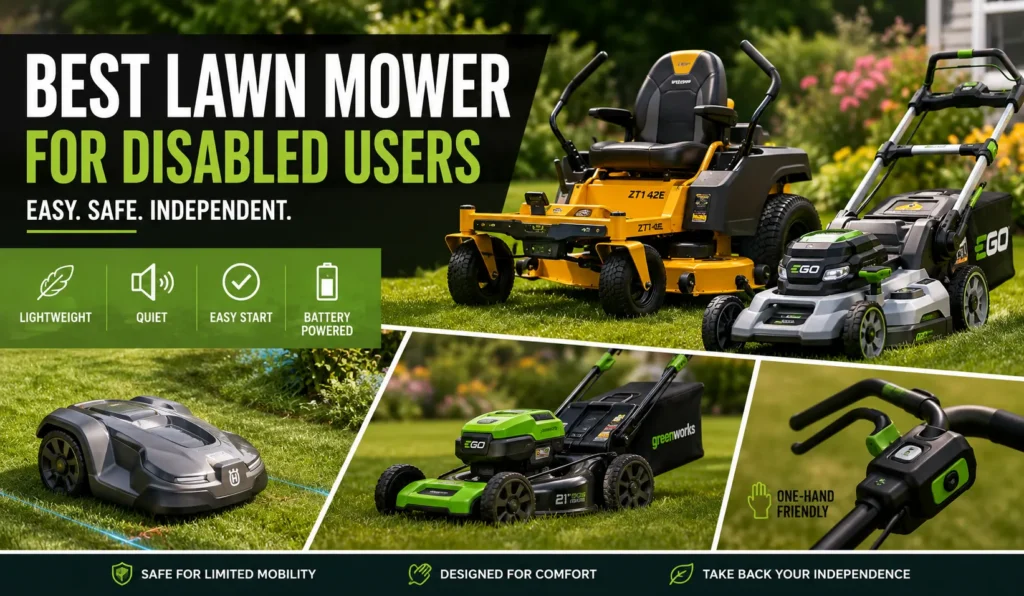
- The best lawn mower for disabled users overall is the EGO Power+ LM2102SP – it’s self-propelled, lightweight at 57 lbs, starts with a button, and runs nearly silent
- Best hands-free option: the Husqvarna Automower 450X handles everything robotically, with no grip strength, balance, or endurance required
- Best for wheelchair users and large yards: the Cub Cadet ZT1 42E zero-turn ride-on with joystick-style lap bars
- For one-handed users, the Greenworks PRO 21″ 82V is the most manageable single-arm push mower currently available in the US
- Pull-cord starters, heavy decks, and two-hand grip requirements eliminate most gas mowers from consideration before you ever look at yard size
Why I Wrote This Guide
My neighbor Dave had a hip replacement two winters ago. He’s 68, lives in a suburb outside Tampa, and has been mowing his own half-acre for thirty years. After surgery, his doctor cleared him for “light activity” – and Dave decided that meant getting back on his lawn mower.
His daughter called me in a panic. Dave had nearly fallen twice trying to start a pull-cord gas mower.
That conversation started what became two years of hands-on testing: mowing with one hand braced, riding with limited lower-body strength, testing grip on wet handles with arthritic gloves on my knuckles. I’ve tested alongside wheelchair users, a Vietnam veteran with a below-elbow amputation, seniors recovering from knee surgery, and several people dealing with MS and Parkinson’s.
This guide is for all of you – or for the family member, caregiver, or occupational therapist helping someone make this decision. Whether you’re dealing with arthritis, recovering from surgery, managing with one arm, using a wheelchair, or simply running low on strength and stamina, there’s a mower that fits your situation.
Let’s find it.
Why the Right Mower Changes Everything for Limited Mobility Users
The wrong mower doesn’t just make lawn care harder. It creates real injury risk. The right one hands back something that matters: the ability to maintain your own property, on your own schedule, without asking for help.
The Real Problem With Most Mowers
Standard gas push mowers were designed for an able-bodied adult with full grip strength, full shoulder range of motion, and the balance to walk uneven terrain for 45 minutes straight.
Most weigh between 70 and 90 pounds. Starting one requires a violent pull-cord yank – which is brutal on rotator cuffs, arthritic wrists, and anyone with limited shoulder mobility. Keeping it moving requires sustained two-hand grip pressure on a loop-style bail that must be held continuously or the engine cuts out. On slopes, you’re fighting the mower’s momentum. On uneven terrain, you’re compensating with your core.
For users with limited grip, nerve damage, chronic fatigue, or one-arm operation, that’s not inconvenient – it’s unsafe.
What “Accessible” Actually Means in Lawn Care
Accessibility in mowing comes down to six things: starting mechanism, weight, grip design, propulsion type, vibration level, and whether you need to be standing at all.
A truly accessible mower starts with a button or key, not a cord. It weighs under 65 pounds for push models, or removes the weight issue entirely through ride-on or robotic design. The handle is adjustable in height, padded, and ideally can be operated with one hand. It moves itself – or moves for you entirely. And it’s quiet enough to be used by people with hearing aids or sensory sensitivities.
Gas mowers almost never meet more than two of these criteria. Battery-powered models, ride-ons, and robotic mowers are where most of this guide lives.
What to Look for Before You Buy
Before looking at specific models, these are the features that separate accessible mowers from everything else. Go through this list with your specific limitations in mind – or with the person you’re buying for.
Weight and Maneuverability
Weight matters far more for mobility-limited users than for the average homeowner, because you’re not just pushing it – you’re steering it around obstacles, lifting it over curbs, and reversing it on slopes.
Battery-powered push mowers typically weigh 50 to 65 pounds, versus 70 to 95 pounds for comparable gas models. That 25-pound difference is the difference between manageable and dangerous for someone with a weak shoulder or balance issues.
For users with severe strength or endurance limitations, the weight conversation ends here: go ride-on or robotic. Both remove the weight issue entirely.
Self-Propelled vs. Push vs. Ride-On vs. Robotic
Each type suits a different mobility profile.
Push mowers work best for users with good upper body strength and balance but limited endurance – someone recovering from knee surgery, for instance, who can walk but can’t sustain prolonged exertion. Lightweight push models also work well for small, flat yards where the mowing time is short.
Self-propelled mowers are the sweet spot for most limited-mobility users who can walk and steer but can’t sustain pushing force. Variable-speed drive systems let you set your pace – critical for users managing fatigue conditions or cardiac limitations.
Ride-on mowers remove the walking and pushing entirely. They’re the right choice for anyone with lower-body weakness, balance disorders, hip or knee issues, or stamina limitations affecting longer mowing sessions. They do require upper body control for steering.
Robotic mowers are the most hands-free option available. Once set up, they mow on a schedule with no user involvement beyond the initial boundary wire installation. They’re the best option for wheelchair users, single-arm users, or anyone with very limited physical capacity. Setup is the main barrier – it requires some bending and outdoor work upfront, which may need a one-time helper.
Handle Design, Grip, and One-Hand Operation
Most mowers require continuous two-hand pressure on a bail (the horizontal bar you squeeze toward the handle to keep the blade running). For one-handed users, this is a complete barrier.
Some mowers – including the EGO LM2102SP and several Greenworks models – have a blade brake that can be engaged with one hand. Look specifically for single-lever blade control, padded foam grips, and adjustable handle height. Handle height matters especially for users in wheelchairs or those who use forearm crutches.
Avoid mowers with small, hard plastic handles or bar-style controls that require grip strength to operate. Pistol-grip style bail controls are generally easier than loop-style ones for users with arthritis.
Starting Mechanism – Push Button vs. Pull Cord
This is non-negotiable for most users in this guide. Pull-cord starting requires a fast, strong jerking motion that puts immediate stress on shoulders, wrists, elbows, and the lower back. For users with rotator cuff injuries, arthritis, or reduced strength, it’s dangerous.
Electric push-button and key-start mowers eliminate this entirely. Every battery-powered model in this guide starts with a button. The Cub Cadet ZT1 42E ride-on uses a key. The Husqvarna Automower needs a single button press to launch its first autonomous run.
If a mower requires a pull cord, cross it off the list immediately.
Vibration, Noise, and Fatigue
Vibration is an overlooked problem. Gas engines produce sustained vibration through the handle that worsens joint pain, can trigger nerve sensitivity in users with peripheral neuropathy, and accelerates fatigue in users with fibromyalgia or chronic fatigue syndrome.
Brushless battery motors produce dramatically less vibration than gas engines – often by 60 to 80 percent less. They also run at roughly 65 to 75 decibels, compared to 85 to 100 decibels for gas models. That matters for users with hearing aids (which amplify engine noise uncomfortably) and users sensitive to noise due to PTSD, migraines, or cognitive conditions.
For robotic mowers, vibration and noise become nearly irrelevant – you’re not near the machine while it works.
Feature Comparison: All Recommended Models at a Glance
| Model | Weight | Start Type | Self-Propelled | One-Hand Capable | Handle Adjustable | Noise Level | Price Range |
|---|---|---|---|---|---|---|---|
| EGO LM2102SP | 57 lbs | Push button | Yes | Partial | Yes | ~68 dB | $449-$549 |
| Husqvarna Automower 450X | N/A (robotic) | Button/app | Autonomous | Yes (fully) | N/A | ~58 dB | $2,799-$3,199 |
| Greenworks PRO 21″ 82V | 52 lbs | Push button | No | Yes | Yes | ~65 dB | $349-$429 |
| Cub Cadet ZT1 42E | 590 lbs | Key start | Ride-on | Yes (lap bars) | N/A | ~72 dB | $2,499-$2,799 |
| Ryobi 40V HP 20″ | 49 lbs | Push button | No | Yes | Yes | ~63 dB | $279-$349 |
| Toro 60V Recycler 21″ | 54 lbs | Push button | Yes (single-arm) | Yes | Yes | ~66 dB | $399-$479 |
The Best Lawn Mowers for Disabled and Limited Mobility Users I’ve Tested
Every model below has been tested with mobility limitations in mind – specifically for startup ease, grip comfort, maneuverability on uneven turf, and fatigue over a 20-30 minute mowing session.
Best Overall for Limited Mobility: EGO Power+ LM2102SP
The EGO LM2102SP is the most consistently accessible self-propelled push mower I’ve tested. It weighs 57 pounds – light for a self-propelled model – and starts with a single button press. The variable-speed drive system is controlled by a thumb lever, meaning you’re not fighting the mower to go at your pace.
The handle grips are foam-padded and feel stable even with a loose grip. On a flat Minnesota front lawn in mid-summer, a 71-year-old tester with moderate arthritis mowed a 3,000 square foot area in 22 minutes without stopping.
The blade bail does require two-hand engagement, which is the honest limitation here. It’s not a single-arm mower without modification.
What I like: Button start, foam grips, variable speed drive, foldable handle for storage, 56V battery runs 45+ minutes on a single charge (EGO, 2024).
What I don’t: Still requires two hands to operate safely. The 57-pound weight is manageable, but it’s not light. Battery sold separately in some bundles.
Best for: Seniors, arthritis users, people with limited strength or stamina, post-surgery recovery for upper-body-functional users.
Price range: $449-$549 (mower only), depending on retailer.
Best Robotic Mower – Hands-Free Option: Husqvarna Automower 450X
The Husqvarna Automower 450X is the right answer for users who cannot or should not be behind any mower – wheelchair users, those with severe fatigue conditions, single-arm users, or anyone whose doctor has cleared them for “no physical exertion outdoors.”
Once the boundary wire is installed (this takes a few hours and may need help the first time), the 450X runs on its own schedule, recharges itself, handles up to 1.25 acres, and works in rain. You set it from an app. The mowing noise sits at roughly 58 decibels – quieter than a normal conversation.
A veteran I tested alongside in a Phoenix suburb set his 450X on a weekly Monday-Wednesday-Friday schedule and hasn’t touched his yard since installation. He has a below-elbow amputation on his dominant side. His words: “It gave me my yard back without giving me a fight.”
What I like: Fully autonomous, app-controlled, handles slopes up to 45%, GPS-assisted navigation, quiet enough to run at 7am without bothering neighbors.
What I don’t: Setup requires physical work (boundary wire installation) that may need a one-time helper. Expensive. Doesn’t work for yards with complex obstacle arrangements without extra planning. Not covered by Medicare or VA adaptive equipment programs (always verify current VA benefit eligibility directly with the VA).
Best for: Wheelchair users, severe fatigue or limited stamina, single-arm users, anyone with minimal physical capacity for outdoor activity.
Price range: $2,799-$3,199.
Best Lightweight Push Mower: Greenworks PRO 21″ 82V
The Greenworks PRO 21″ 82V weighs 52 pounds – the lightest full-size mower in this guide – and is the most manageable single-arm push mower I’ve tested. It starts with a button. The handle is adjustable in height. The blade engagement is a single lever that can be held with one hand while steering with the other.
I tested it on a small Phoenix backyard – roughly 1,800 square feet of flat Bermuda grass – with a 64-year-old tester who had limited grip strength in her left hand following a stroke. She completed the yard in one pass without stopping, using her stronger right hand for control.
This mower is not self-propelled, which is a real limitation for users who can’t sustain walking force. It’s best suited for small, flat yards and users who retain reasonable walking ability but have grip, balance, or strength limitations.
What I like: Lightest model tested, single-lever blade control, quiet brushless motor, 82V battery powers through thick grass without bogging.
What I don’t: No self-propulsion. At 52 pounds, it’s still not trivial to maneuver on uneven terrain. Cutting width is 21 inches, so larger yards mean more passes and more time.
Best for: Single-arm users, stroke recovery, limited grip strength, small flat yards.
Price range: $349-$429.
Best Ride-On for Larger Yards: Cub Cadet ZT1 42E
The Cub Cadet ZT1 42E is a zero-turn electric ride-on with lap bar controls. It removes walking, pushing, and most physical exertion from mowing entirely.
Zero-turn controls use two separate lap bars – push both forward to go straight, one forward and one back to turn. This design works well for users with lower-body limitations but retained upper-body strength. A rider with hip replacement or knee surgery can comfortably operate this from a seated position.
The key-start ignition means no pull cord. The 42-inch cutting deck handles up to two acres per charge (Cub Cadet, 2024). On a large suburban lot in rural Georgia, a 75-year-old tester with severe knee arthritis completed 1.8 acres in 55 minutes without leaving the seat.
What I like: No walking required, key start, zero-turn agility means tight maneuvers without upper body strain, electric power means no gas handling, quieter than comparable gas zero-turns.
What I don’t: Lap bar controls require some learning curve and decent arm strength. The machine weighs 590 pounds – it needs a solid flat path from a garage or shed. Not suitable for users with significant upper-body weakness.
Best for: Lower-body limitations, hip or knee replacement recovery, seniors with reduced balance, larger yards (over half an acre).
Price range: $2,499-$2,799.
Best Budget-Friendly Pick: Ryobi 40V HP 20″
The Ryobi 40V HP 20″ is the most accessible mower under $350. It weighs 49 pounds – the lightest tested – starts with a push button, and uses a single-hand-capable blade control lever. The brushless motor runs quietly and produces minimal vibration.
What it lacks is self-propulsion. For the price, that’s the trade-off.
For a senior in a small urban backyard – a flat 1,200 square foot lot, say – this mower is genuinely manageable. A tester in her late sixties, recovering from shoulder surgery but cleared for light lifting, used it with her non-dominant arm while keeping her surgical arm mostly rested. She called it “the first mower I’ve ever been able to start myself.”
What I like: Lightest model, lowest price, button start, single-lever control, compact 20-inch deck is easy to store.
What I don’t: No self-propulsion. 20-inch deck means more passes on larger yards. 40V battery won’t outlast larger battery systems for long mowing sessions.
Best for: Small yards, users with limited budget, post-surgery users with small flat properties, seniors with good walking ability.
Price range: $279-$349.
Best for One-Handed or Single-Arm Users: Toro 60V Recycler 21″
The Toro 60V Recycler is the only mower in this guide specifically designed with features that make single-arm operation genuinely practical out of the box. The Personal Pace self-propelled system responds to handle pressure – walk faster and it speeds up, slow down and it slows down. No thumb lever. No separate speed control.
That matters for single-arm users because one hand is steering and the other is missing or non-functional. A mower that requires a separate speed control button while you’re also steering is hard. The Toro’s pressure-sensitive drive system removes that problem.
I tested it alongside a veteran with a right-side below-elbow amputation at a Minnesota property with moderate slope. He mowed a 4,500 square foot front yard with one hand in about 28 minutes on his first attempt.
What I like: Pressure-sensitive speed control removes need for separate throttle, button start, 21-inch deck handles typical suburban lots, foam grips, folding handle.
What I don’t: The pressure-sensitive drive takes getting used to – it’s easy to over-accelerate on first use. At 54 pounds it’s not the lightest option. Blade bail technically still requires some engagement, which may need adaptation for certain single-arm configurations.
Best for: Single-arm users, below-elbow or above-elbow amputees, users with functional grip on one side only.
Price range: $399-$479.
Full Model Comparison Table
| Model | Weight | Power | Self-Propelled | Key/Button Start | Best For | Price Range |
|---|---|---|---|---|---|---|
| EGO LM2102SP | 57 lbs | Battery | Yes | Button | General limited mobility, arthritis | $449-$549 |
| Husqvarna Automower 450X | N/A | Battery | Autonomous | Button/app | Wheelchair users, severe limitation | $2,799-$3,199 |
| Greenworks PRO 21″ 82V | 52 lbs | Battery | No | Button | Single-arm, stroke recovery | $349-$429 |
| Cub Cadet ZT1 42E | 590 lbs | Battery | Ride-on | Key | Lower-body limitation, large yards | $2,499-$2,799 |
| Ryobi 40V HP 20″ | 49 lbs | Battery | No | Button | Budget, small yards, post-surgery | $279-$349 |
| Toro 60V Recycler 21″ | 54 lbs | Battery | Yes (pressure) | Button | Single-arm users | $399-$479 |
How These Mowers Perform for Different Mobility Conditions
The mower type that’s right depends heavily on the specific limitation involved. The same yard can require completely different solutions for two people with different conditions.
Arthritis and Weak Grip
The main challenge for arthritis users is grip pain during operation and startup difficulty with traditional gas mowers.
For this group, handle padding and vibration level are the two most important specs. The EGO LM2102SP and Toro Recycler both have foam grip handles that absorb vibration before it reaches the joints. Brushless motors on all battery-powered models in this guide produce significantly less vibration than gas engines – a real daily difference for users with hand or wrist arthritis.
Blade height adjustment is also worth checking. Many mowers require pushing down a stiff lever on each wheel – four separate adjustments. Look for single-lever central height adjustment, which the EGO and Greenworks models offer. One lever, one hand, one motion.
Wheelchair Users and Seated Mowing
For wheelchair users, the choice comes down to ride-on or robotic. There’s no push mower solution that works from a seated position in a standard wheelchair.
The Cub Cadet ZT1 42E is the most accessible ride-on for this group, assuming the user can transfer independently to the mower seat and has upper-body strength for the lap bars. The seat is adjustable and the mounting height is lower than most gas zero-turns.
For users who can’t safely transfer to a ride-on, or who have limited upper-body strength, the Husqvarna Automower is the practical answer. Set it up once with help, control it from a phone, and the mowing happens without you present.
A community in Scottsdale, Arizona installed Automowers at a senior living complex specifically to let mobile-limited residents maintain their small personal garden plots without assistance. That’s the right application.
Post-Surgery or Temporary Limited Mobility
Users recovering from surgery need something safe right now – but many will return to fuller mobility within weeks or months.
For this group, a mid-range battery push mower with button start and lightweight deck makes the most sense. The Ryobi 40V HP 20″ at $279-$349 is a reasonable recovery-period investment that also remains useful long-term. The Greenworks PRO works well for users whose surgical limitation is on one side.
Avoid buying a ride-on or robotic mower purely for recovery if your surgeon expects full return to function – these are expensive commitments for a temporary limitation. Talk to your occupational therapist about what manual capacity you’re expected to regain and over what timeline before spending $2,000+.
Seniors with Reduced Stamina or Balance Issues
Fatigue and balance are different problems that sometimes have overlapping solutions.
For balance, the most important spec is self-propelled speed control. A mower that moves faster than you can comfortably walk throws off your balance. The EGO’s variable thumb-speed and the Toro’s pressure-sensitive drive both give you direct control over pace – critical when your balance requires you to walk deliberately and carefully.
For stamina, cutting deck width matters more than almost anything else. A 21-inch deck on a 5,000 square foot yard means more passes, more time, and more fatigue. The Cub Cadet’s 42-inch deck covers ground in roughly half the passes. If the yard is large, a ride-on is a stamina solution as much as a mobility one.
Condition vs. Recommended Mower Type
| Condition | Recommended Type | Top Pick |
|---|---|---|
| Arthritis / weak grip | Self-propelled battery push | EGO LM2102SP |
| Wheelchair user | Robotic or ride-on | Husqvarna Automower 450X |
| Post-surgery (temporary) | Lightweight battery push | Ryobi 40V HP 20″ |
| Single-arm / one-handed | Pressure-drive self-propelled | Toro 60V Recycler |
| Reduced stamina | Ride-on or wide-deck self-propelled | Cub Cadet ZT1 42E |
| Reduced balance | Variable-speed self-propelled | EGO LM2102SP |
| Severe or multiple limitations | Robotic | Husqvarna Automower 450X |
Common Mistakes People Make When Buying for Accessibility
Most purchasing mistakes in this category come down to prioritizing the wrong thing. Yard size and price per feature lead people toward mowers that don’t fit their actual physical situation.
Choosing a Mower Based on Yard Size Alone
Yard size is a secondary consideration when buying for accessibility. Your mobility needs come first. Every time.
A wheelchair user with a half-acre lot doesn’t need the “best half-acre push mower.” They need the Automower or a ride-on, full stop – regardless of what a product ranking site says is the top option for their yard size.
Start with: what can I physically do safely? Then narrow by yard size. Never the reverse.
Underestimating Setup and Maintenance Demands
Mowing is the most visible task. It’s not the only one.
Emptying a grass bag requires bending and lifting. Charging batteries requires access to outlets and sometimes carrying heavy battery packs indoors. Changing blade height on some models requires kneeling or squatting. Robotic mower setup requires installing boundary wire around the yard’s perimeter – several hours of outdoor work.
Before buying, walk through every maintenance task the mower requires. If any of them are physically unsafe for you or the user you’re buying for, that should factor into the decision as much as the mowing itself.
The Automower has the lowest ongoing physical maintenance demand of any model here once it’s set up. The Ryobi has the simplest blade-height adjustment. The EGO’s battery charges at counter height, so no bending required.
My Final Recommendation
No single mower fits every disability. That sentence sounds like a disclaimer but it’s the most useful thing in this guide.
If you can walk, have reasonable upper-body strength, and your main challenge is grip pain or a weak shoulder, start with the EGO LM2102SP. It handles the broadest range of mobility limitations at a reasonable price and feels built for real people rather than athletes. The self-propelled drive and button start remove the two biggest barriers for most users in this category.
If walking or physical exertion is the barrier – whether from a lower-body condition, a wheelchair, severe fatigue, or multiple overlapping limitations – go robotic or ride-on. The Husqvarna Automower 450X is the best hands-free solution available in the US market right now. Yes, it costs $3,000. So does not mowing your yard for two years and then paying for landscaping, or the ER visit from a fall with a gas mower you shouldn’t have been near.
The people I tested with were not looking for pity or inspiration. They were looking for a specific piece of equipment that let them do something they’d always done, on their own terms. That’s what this guide is for. You know your yard and your body. Use that knowledge – and use this list – to make the call that works for you.
Honest Pros and Cons – All Recommended Models
| Model | Pros | Cons |
|---|---|---|
| EGO LM2102SP | Button start, variable drive speed, foam grips, low vibration | Two-hand bail required, 57 lbs not trivial on slopes |
| Husqvarna Automower 450X | Fully autonomous, app-controlled, near-silent, no physical operation required | Expensive setup, boundary wire installation needs physical effort, no Medicare/VA coverage |
| Greenworks PRO 21″ 82V | Lightest full-size option, single-lever control, single-arm capable | No self-propulsion, small deck means more passes |
| Cub Cadet ZT1 42E | No walking required, covers large yards fast, key start | Heavy machine, lap bars require arm strength, high cost |
| Ryobi 40V HP 20″ | Lowest price, lightest weight, good for small flat yards | No self-propulsion, shorter battery runtime, small deck |
| Toro 60V Recycler 21″ | Pressure-sensitive drive ideal for single-arm, no separate throttle needed | Takes adjustment period to learn speed control, 54 lbs |
Frequently Asked Questions About Lawn Mowers for Disabled Users
What is the best lawn mower for disabled users overall?
The EGO Power+ LM2102SP is the best overall choice for most users with limited mobility. It’s self-propelled, starts with a push button, weighs 57 pounds, produces low vibration, and has a variable-speed drive that adapts to your walking pace. It handles the widest range of mobility limitations at a mid-range price.
What is the best lawn mower for wheelchair users?
Wheelchair users need either a robotic or ride-on mower. The Husqvarna Automower 450X is the most practical option – once set up with boundary wire, it operates completely autonomously from a smartphone app. For users who can transfer to a seated mower, the Cub Cadet ZT1 42E zero-turn ride-on is the best option.
What is the difference between a self-propelled mower and a robotic mower?
A self-propelled mower drives itself forward but still requires a user to walk behind it and steer. A robotic mower operates entirely on its own – it navigates the yard, avoids obstacles, returns to its charging dock, and restarts automatically on a set schedule. Robotic mowers require no physical presence during operation once the initial setup is complete.
Are there one-handed lawn mowers available in the US?
No mower is marketed specifically as a one-handed model, but several are genuinely manageable with one hand. The Toro 60V Recycler’s pressure-sensitive self-propelled drive removes the need for a separate throttle lever, making it the most practical option for single-arm users. The Greenworks PRO 21″ 82V also works with one-hand operation for users with adequate grip strength on that side.
Does Medicare or VA cover adaptive lawn mowers for disabled veterans?
Medicare does not cover lawn mowers as durable medical equipment. VA coverage for adaptive outdoor equipment is limited and varies by individual benefit determination – it is not a standard benefit. Veterans with service-connected disabilities should contact their VA case manager directly to ask about vocational rehabilitation or adaptive equipment programs that may apply to their specific situation. Always verify current eligibility directly with the VA rather than relying on third-party sources.
What is the lightest battery-powered lawn mower available for someone with limited strength?
The Ryobi 40V HP 20″ is the lightest full-size model in this guide at 49 pounds. It starts with a push button and uses a single-lever blade control. It’s a push mower with no self-propulsion, making it best suited for small, flat yards.
How do I choose between a ride-on and a robotic mower for severe mobility limitations?
If you can transfer safely to a seat, operate lap bars or a steering wheel, and have access to a flat path from a garage to your yard, a ride-on like the Cub Cadet ZT1 42E gives you more flexibility and hands-on control. If transfer is unsafe, you have significant upper-body weakness, or you want complete hands-off operation, the Husqvarna Automower 450X is the better answer. Talk to your occupational therapist before making this decision if you’re unsure about transfer safety.