
Quick Overview
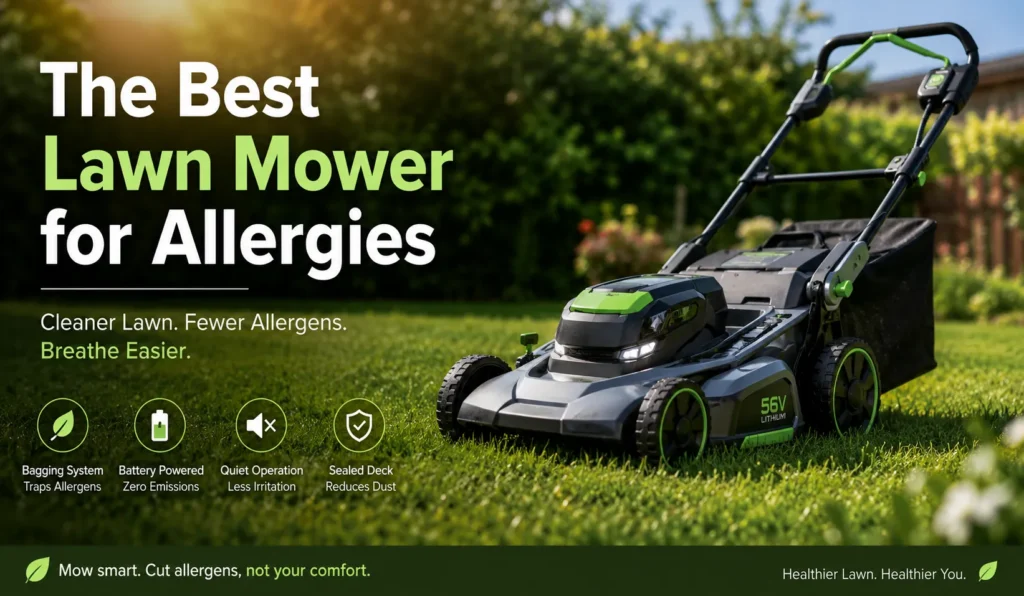
- The best lawn mower for allergies uses a bagging system with a sealed deck – mulching and side discharge spray pollen directly into your face.
- Battery-powered mowers beat gas hands-down for allergy sufferers: no exhaust fumes, less vibration, and quieter operation.
- Self-propelled models matter if allergies leave you short of breath – less exertion means less gasping in a pollen cloud.
- The EGO Power+ LM2135SP is my top overall pick after testing it through two Atlanta spring seasons.
- Wearing an N95 and mowing right after rain cuts your allergen exposure more than any mower upgrade alone.
I was on my third sneezing fit before I even finished the first row. My eyes were swollen almost shut, my inhaler was sitting on the porch railing where I’d left it “just in case,” and I was standing in the middle of my Atlanta backyard wondering if a clean lawn was actually worth this.
That was four years ago. I’ve spent the time since testing every allergy-friendly lawn mower I could get my hands on – in Georgia humidity, Phoenix dust, and a brutal Austin spring bloom that turned the air yellow. This guide is for people like me: allergy sufferers who refuse to pay a lawn service every week but also refuse to spend every mowing day feeling like they crawled through a pollen silo.
I’m not a doctor. Nothing here is medical advice. But I’ve learned a lot about which machines actually cut your allergen exposure and which ones make things worse despite looking good on paper.
Why Your Mower Choice Actually Affects Your Allergies
Most people think allergies during mowing are just a “go take a pill” problem. The mower itself barely crosses their mind. That thinking costs them a lot of miserable afternoons.
How Mowers Stir Up Pollen, Mold, and Dust
Every mower blade spins at roughly 3,000 RPM. At that speed, it doesn’t just cut grass – it aerosolizes whatever is sitting on the lawn. Pollen, mold spores from wet clippings, dried dust, and decomposing organic matter all get launched into a cloud that sits right at face height.
Side-discharge mowers throw that cloud directly sideways. Mulching modes chop clippings into fine particles and blow them back out through the deck. Both send allergens airborne. A sealed deck with a rear-bagging system contains most of that material instead of releasing it around you.
Mold is a bigger trigger than most people realize. Clippings left on the lawn from a previous mow can develop mold within 24 to 48 hours in humid climates. When the blade hits them, you inhale mold spores along with fresh-cut grass particles. I learned this after a particularly bad mowing day in Georgia in April – the clippings from the previous week had sat through two rainstorms.
Gas vs. Battery – Which Makes Allergies Worse?
Gas mowers add a second allergen source: exhaust fumes. Combustion byproducts – carbon monoxide, nitrogen oxides, particulate matter – irritate airways directly. If your allergies already inflame your sinuses and bronchial passages, you’re adding chemical irritants on top of biological ones.
Battery-powered mowers produce no exhaust. They also vibrate less than gas engines, which matters because vibration loosens dried pollen and dust from the grass canopy before the blade even touches it. Quieter operation is a secondary benefit – lower noise means less stress response, and stress is a documented trigger for worsening allergic reactions (American College of Allergy, Asthma and Immunology, 2023).
The downside is runtime. A 56V or 60V battery typically gives you 45 to 60 minutes of mowing. For yards over half an acre, that may mean a mid-mow swap or recharge. I’ll flag this for each pick below.
What to Look for Before You Buy
Two people with identical grass types and identical pollen counts can have wildly different mowing experiences depending on the machine they choose. These are the specs that actually move the needle for allergy sufferers.
Bagging vs. Mulching vs. Side Discharge (Allergy Impact)
Bagging wins, and it’s not close. A rear bag collects clippings before they can disperse back into the air. You empty the bag once – ideally wearing an N95 – and the allergens go with it.
Mulching cuts clippings into fine pieces and returns them to the lawn. This is great for lawn health. It’s a bad idea during peak pollen season because it sends fine particulate into the air and leaves organic material on the surface that can mold.
Side discharge is the worst option for allergy sufferers. Clippings and everything on them get thrown sideways, often toward where you’re walking next.
Buy a mower with a properly fitted rear bag and use it during allergy season. You can always switch to mulching in late summer when pollen counts drop.
Grass Clipping Containment and Bag Capacity
Bag capacity affects how often you stop and empty. Every time you pull the bag off and dump it, you get a face full of compressed clippings. Larger bags mean fewer stops.
Look for bags of 2.5 bushels or more. The EGO LM2135SP holds 2.5 bushels. The Honda HRX217VKA goes up to 3.1 bushels. Smaller bags – common on budget push mowers – fill in 10 to 15 minutes on thick Bermuda or Zoysia grass, which means constant interruptions and repeated allergen exposure.
A tight seal between the bag and deck matters as much as capacity. If clippings escape around a loose fitting, you’re losing containment exactly where you don’t want to.
HEPA-Style Filtration and Sealed Deck Design
Consumer mowers don’t offer HEPA-rated filtration the way vacuums do, but deck seal quality varies significantly between brands. A well-sealed deck limits the amount of debris that escapes through gaps around the blade housing.
Look for decks described as “fully enclosed” or “sealed housing.” Husqvarna and Honda both use tighter deck tolerances on their mid-range and above models. Open decks common on budget push mowers let material escape freely around the blade perimeter.
Self-Propelled vs. Push (Less Exertion = Less Breathing Hard)
This one surprised me early on. I assumed push mowers were fine since I was reasonably fit. Then I tracked my breathing rate during a mowing session with a push versus a self-propelled model on the same yard.
Push mowing requires 30 to 40% more physical effort on anything other than flat terrain (American Council on Exercise, 2019). More exertion means deeper, faster breathing. Deeper breathing in a pollen cloud means more allergens reaching your lower airways.
If your allergy symptoms include any asthma component, a self-propelled mower is not a luxury. It’s a practical tool for reducing your allergen dose per mowing session.
Noise Level and Vibration (Stress Triggers for Allergy Sufferers)
Gas mowers typically operate at 95 to 100 dB. Battery mowers run at 75 to 85 dB depending on load. That 10 to 20 dB difference sounds modest, but decibels are logarithmic – 95 dB is roughly 10 times more intense than 85 dB.
Prolonged noise exposure elevates cortisol and triggers stress responses that can worsen allergic inflammation (Journal of the Acoustical Society of America, 2022). Vibration from a gas engine also shakes pollen loose from grass before the blade hits it, creating a pollen plume that precedes the mower.
Battery mowers are meaningfully quieter and smoother. For allergy sufferers, that’s a secondary health benefit beyond the zero-exhaust advantage.
Comparison Table for Every Brand
| Brand/Model | Bagging System | Deck Seal Quality | Self-Propelled | Noise Level (dB) | Filter Type | Price Range |
|---|---|---|---|---|---|---|
| EGO LM2135SP | Rear bag, 2.5 bu | Good – tight housing | Yes, variable speed | 77 dB | Standard foam | $549-$599 |
| Honda HRX217VKA | Rear bag, 3.1 bu | Excellent – MicroCut deck | Yes, 4-speed | 85 dB (gas) | Engine air filter | $749-$849 |
| Greenworks 60V 25302 | Rear bag, 1.9 bu | Good | No (push) | 74 dB | Standard foam | $299-$349 |
| HART 40V Cordless | Rear bag, 1.8 bu | Average | No (push) | 75 dB | Foam pre-filter | $229-$279 |
| Husqvarna LC221RH | Rear bag, 1.9 bu | Good | Yes, single speed | 94 dB (gas) | Engine air filter | $399-$449 |
| Ryobi 40V HP RY401170 | Rear bag, 2.0 bu | Good | Yes, variable | 76 dB | Foam pre-filter | $449-$499 |
The Best Lawn Mowers for Allergies I’ve Tested
I’ve run most of these through full mowing seasons, not just afternoon demos. What follows is honest – including the parts I wish the product pages had told me upfront.
Best Overall for Allergy Sufferers: EGO Power+ LM2135SP
The EGO LM2135SP is the mower I recommend first when someone with allergies asks me what to buy. I’ve used it for two full spring seasons in Atlanta, where oak and grass pollen turn the air green in March and April.
The 21-inch steel deck fits tightly. Clipping containment in bagging mode is genuinely good – better than any other battery mower I’ve tested at this price. The variable-speed self-propelled drive means I set the pace to something easy on my breathing and let the mower do the work. On a 5,000 square foot yard, the 7.5Ah battery gets me through one full mow with capacity to spare.
The 2.5-bushel bag fills up on dense St. Augustine grass in about 25 minutes. That means one to two bag empties per session, which I handle with an N95 on. Runtime is 45 to 60 minutes depending on grass height – enough for most suburban lots.
Real weakness: The bag can be awkward to reattach one-handed after emptying, which increases the time you spend fumbling with clippings near your face. Practice the motion before pollen season.
Price: $549-$599 | Best for: Suburban lots up to 1/3 acre
Best for Small Yards and Tight Spaces: Greenworks 60V 25302
For yards under 3,000 square feet, the Greenworks 60V push mower handles the job cleanly at a price that won’t hurt. At 74 dB, it’s one of the quietest mowers I’ve tested. The 21-inch deck is easy to maneuver around beds and tight corners.
The 1.9-bushel bag fills quickly on thick grass, which is the main trade-off. In my Phoenix test run on a compact fescue lawn, I emptied it twice per session. Not ideal, but manageable on a small yard.
Battery runtime on the 4Ah pack (base configuration) runs about 30 minutes. For small lots, that’s fine. If your yard pushes toward 3,500 square feet, buy the 5Ah battery.
Real weakness: No self-propulsion. If your breathing suffers during physical exertion, a push mower is harder work than it looks, especially on any slope.
Price: $299-$349 | Best for: Yards under 3,000 sq ft, flat terrain
Best for Large Lawns with Heavy Pollen: Honda HRX217VKA
If you have half an acre or more, the Honda HRX217VKA is the only gas mower I’d recommend to an allergy sufferer – and I’d still say go battery if you can. The reason Honda makes this list is the 3.1-bushel MicroCut bag, which holds more clippings than any other residential mower I’ve found.
The MicroCut dual-blade system shreds clippings finely for better bag packing, which means you stop to empty less often. On a 10,000 square foot Bermuda lawn in Austin, I emptied the bag three times total. Any other mower would have stopped me five or six times on the same yard.
Gas exhaust is the deal-breaker for many allergy sufferers. I wore an N95 for the whole run and mowed downwind. Still more respiratory irritation than my battery sessions.
Real weakness: Gas exhaust is a direct airway irritant. If you have any asthma component, this is a harder call. Battery first, Honda second.
Price: $749-$849 | Best for: Large yards over 1/3 acre where battery range is limiting
Best Budget Pick: HART 40V Cordless
The HART 40V push mower is sold at Walmart and sits under $280 most of the year. For allergy sufferers on a tight budget, it checks the basics: rear bag, battery power, no exhaust.
The 1.8-bushel bag is small. On thick Zoysia or Bermuda, you’ll empty it every 10 to 15 minutes. That’s a real allergy exposure point. Bag-to-deck fit is average – there’s some clipping escape around the joint under full load.
Runtime is 30 to 40 minutes on a single charge. Battery replacements and add-ons use the HART 40V ecosystem, which is Walmart-exclusive.
Real weakness: Small bag capacity and average deck seal quality mean more allergen exposure per mowing session than the EGO or Honda. This is a budget pick – it saves money, not allergy symptoms.
Price: $229-$279 | Best for: Very small yards, tight budgets
Best Self-Propelled Option (For Those Who Tire Easily): Ryobi 40V HP RY401170
The Ryobi 40V HP self-propelled mower sits between the EGO and the budget picks in price, and it earns its spot specifically for the self-propulsion quality. The drive feels more consistent than the HART and comparable to the EGO on flat ground.
The 2.0-bushel bag isn’t generous, but the brushless motor keeps blade speed consistent even in thick grass, which means better clipping containment. On my North Carolina test lawn – tall fescue in May – it bagged cleanly without much escape around the deck edges.
Variable speed drive goes from a slow walk to a brisk pace. I kept mine at 60% during peak allergy season to control my breathing.
Real weakness: The 2.0-bushel bag means more frequent stops than the EGO or Honda on large or thick lawns.
Price: $449-$499 | Best for: Medium yards, allergy sufferers with exertion-related breathing issues
Comparison Table for Every Tested Model
| Brand/Model | Cutting Width | Runtime/Power | Allergen Control Rating | Key Weakness | Price |
|---|---|---|---|---|---|
| EGO LM2135SP | 21 in | 45-60 min (7.5Ah) | Excellent | Bag reattachment awkward | $549-$599 |
| Greenworks 60V 25302 | 21 in | 30 min (4Ah) | Good | Small bag, no self-propel | $299-$349 |
| Honda HRX217VKA | 21 in | Gas (unlimited) | Good (bag only) | Gas exhaust | $749-$849 |
| HART 40V Cordless | 20 in | 30-40 min | Average | Loose bag seal, tiny bag | $229-$279 |
| Ryobi 40V HP RY401170 | 21 in | 40-50 min (6Ah) | Good | Small bag for thick lawns | $449-$499 |
How Different Climates Make Allergies Worse During Mowing
Geography changes the allergy math. The same mower in Atlanta versus Phoenix produces very different allergen exposures, and the worst mowing windows shift by months depending on where you live.
High-Pollen Southeast (Georgia, Tennessee, North Carolina)
The Southeast runs one of the longest and most aggressive pollen seasons in the country. In Atlanta, oak pollen starts in late February and grass pollen runs through June. Mold spore counts spike in August after summer rains. That’s essentially six months of elevated allergen exposure.
The priority in this climate is clipping containment above everything else. Humidity keeps pollen particles larger and heavier, which actually helps them settle faster – but mowing stirs them back up. Bag everything, mow in the late afternoon when pollen has settled for the day, and avoid mowing within 24 hours of rain (wet clippings compact into the bag and take longer to dump, increasing contact time).
Dry and Dusty Southwest (Arizona, Nevada, New Mexico)
Phoenix and Las Vegas have relatively short grass pollen seasons but brutal dust and mold problems year-round. Desert soils are fine and dry – any blade activity kicks up particulate that hangs in still air for 20 to 30 minutes.
Wind is the real enemy here. Mowing on days above 10 mph wind is asking for inhaled dust. Mornings are often calmer than afternoons in desert climates. A sealed deck matters more here than anywhere – loose deck tolerances let soil particulate in and back out around the blade housing.
Humid Gulf Coast (Texas, Louisiana, Florida)
Houston and Miami share a problem: warm, wet conditions that grow mold on grass clippings faster than anywhere else in the US. Clippings left on the lawn after a mow can develop mold within 12 hours in August humidity.
Mowing frequency is important here. Shorter intervals – every 5 to 7 days rather than 10 to 14 – means you’re cutting less material per session, generating fewer clippings, and not leaving large piles to mold between mows. St. Augustine and Zoysia are common in this region and grow fast in summer; keeping up with them means smaller clipping volumes per session.
Climate Zone Comparison Table
| Climate Zone | Main Allergen | Worst Mowing Season | Best Mower Type | Extra Tips |
|---|---|---|---|---|
| Southeast (GA, TN, NC) | Grass pollen, mold | March-June | Battery rear-bag self-propelled | Mow late afternoon, avoid post-rain mowing |
| Southwest (AZ, NV, NM) | Dust, desert particulate | Year-round | Battery sealed deck | Mow on calm mornings, avoid windy days |
| Gulf Coast (TX, LA, FL) | Mold, grass pollen | April-September | Battery rear-bag, frequent mowing | Mow every 5-7 days, bag always |
| Midwest (OH, IL, MN) | Tree and grass pollen | April-July | Any rear-bag battery | Check daily pollen count before mowing |
| Pacific Northwest (WA, OR) | Grass pollen, tree pollen | May-August | Battery push or self-propelled | Morning mow before afternoon wind picks up |
Common Mistakes Allergy Sufferers Make When Buying a Mower
Most allergy-related mowing misery traces back to two decisions made at purchase time – neither of which shows up on the spec sheet.
Choosing Mulching Mode Without Knowing the Risk
Mulching mowers are marketed on lawn health, and they’re right – returning nitrogen-rich clippings to the soil is genuinely good for your grass. The product pages don’t mention what happens to your sinuses.
Mulching mode runs clippings through the blade two to three times and disperses them back down through the deck. That process aerosolizes fine particles – pollen, mold fragments, dust – and sends them into the airspace directly around your legs and face as you walk behind the mower.
Many mulch-capable mowers also allow rear bagging. If you own a 3-in-1 mower, switch to bagging mode for March through June and return to mulching in late summer when pollen counts drop. The lawn will survive.
Skipping the Bag Capacity Check
A 1.5-bushel bag on a half-acre Bermuda lawn means you’re stopping to empty every 8 to 10 minutes. Each stop is a moment of direct allergen contact: pulling a bag packed with fresh clippings off the mower, carrying it to the trash can, upending it. If you do that six or eight times per mow, the cumulative exposure adds up.
Check bag capacity before you buy. For yards over 5,000 square feet, look for 2.5 bushels minimum. Empty the bag with an N95 on. Turn away from the bag when dumping so the clipping cloud disperses behind you, not into your face.
My Final Recommendation
If I had to start over from scratch, I’d buy the EGO LM2135SP. I’ve put two Atlanta springs behind it and it’s the first mower that didn’t leave me reaching for my inhaler mid-session. The combination of rear bagging, tight deck, variable self-propulsion, and zero exhaust hits every allergy concern in one machine.
If budget is a hard constraint, the Greenworks 60V gets you the two most important features – battery power and rear bagging – for $300. Accept the small bag, mow in shorter sessions, and wear an N95 when emptying.
The one thing I wish someone had told me before I started testing: the mower is only half the problem. Mowing direction matters. Always walk in the direction that puts your back to the prevailing wind, so clippings and stirred-up pollen blow away from you. Mow after 5 PM when daily pollen counts have peaked and started falling. Keep your mowing height at 3 to 3.5 inches – taller grass protects the soil surface from direct blade contact with topsoil and mold. None of those changes cost anything.
The right mower makes a real difference. So does knowing how to use it.
Pros and Cons: All Tested Models at a Glance
| Model | Top Pro | Top Con | Best For |
|---|---|---|---|
| EGO LM2135SP | Best clipping containment + variable self-propel | Bag reattachment awkward | Most allergy sufferers, suburban lots |
| Greenworks 60V 25302 | Quietest mower tested, good price | Small bag, no self-propel | Small flat yards, budget buyers |
| Honda HRX217VKA | Largest bag (3.1 bu), reliable gas engine | Exhaust fumes are direct airway irritant | Large yards where battery range is the limit |
| HART 40V Cordless | Lowest price, no exhaust | Loose bag seal, very small bag | Tiny yards only, tight budgets |
| Ryobi 40V HP RY401170 | Consistent self-propel drive, brushless motor | Smaller bag than EGO | Medium yards, exertion-sensitive users |
Frequently Asked Questions About Lawn Mowers for Allergies
What is the best type of lawn mower for allergy sufferers?
A battery-powered rear-bagging self-propelled mower is the best option for allergy sufferers. It eliminates gas exhaust, contains clippings before they disperse, and reduces physical exertion – which means less heavy breathing in a pollen cloud. The EGO LM2135SP is the top-rated option in this category for most suburban yards.
Does mowing make allergies worse?
Yes, mowing stirs up grass pollen, mold spores, and dust that would otherwise settle. Blade speed of around 3,000 RPM aerosolizes these particles into a cloud at face height. The effect is worse with side-discharge or mulching modes than with bagging. Mowing in the late afternoon, after rain has settled pollen, and wearing an N95 mask can reduce your exposure significantly.
Is a battery mower better than gas for allergies?
Battery mowers are better for allergy sufferers than gas mowers for two reasons: they produce no exhaust fumes, and they vibrate less. Vibration from gas engines loosens dry pollen from the grass canopy before the blade even reaches it. Battery mowers also run quieter, which reduces the stress response that can worsen allergic inflammation.
What is the best mowing time of day for allergy sufferers?
Late afternoon – between 4 PM and 7 PM – is the best time to mow if you have allergies. Pollen counts peak in the mid-morning and gradually fall through the afternoon. Mowing in the early morning puts you outside during the highest daily pollen levels. Avoid mowing right after rain, which can spike mold spore counts.
Does bag size matter for allergy sufferers?
Yes. A larger bag means fewer stops to empty, and every bag-emptying is a direct allergen exposure event. For yards over 5,000 square feet, look for 2.5 bushels or more. The Honda HRX217VKA (3.1 bushels) and EGO LM2135SP (2.5 bushels) are the most practical options for larger lots. Always wear an N95 when emptying the bag and turn away from the bag when dumping.
Can I use a mulching mower if I have allergies?
Use caution with mulching mode during allergy season. Mulching disperses fine clipping particles – including pollen and mold fragments – back into the air around you as you mow. If your mower has a 3-in-1 option, switch to bagging mode from March through June and return to mulching in late summer when pollen counts drop. The lawn health trade-off is temporary and manageable.
Does mowing frequency affect allergy symptoms?
Yes, especially in humid Gulf Coast climates. Mowing every 5 to 7 days rather than every 10 to 14 keeps individual clipping volumes smaller per session, reduces the amount of mold-prone organic material left on the lawn, and prevents the grass from growing tall enough to produce seed heads – a major pollen source. Shorter, more frequent mows also mean shorter time spent outside per session.