
Quick Overview
- For yards under half an acre, a walk-behind lawn mower is almost always the right call.
- Lawn tractors make sense for half an acre and up, especially on open, flat terrain.
- The average walk-behind mower costs $300-$600; a basic lawn tractor starts around $1,500.
- Self-propelled gas mowers handle most suburban lots with slopes, trees, and tight spaces.
- If you are physically unable to push a mower for 45-60 minutes, a tractor may be worth it regardless of yard size.
I stood in the outdoor power equipment aisle at a Home Depot in Columbus, Ohio, last spring. I was helping my neighbor Mike pick his first mower after he bought a house with a half-acre lot. He had no idea what he was looking at. Push mower? Self-propelled? Riding tractor? Zero-turn? The tags said $200, $450, $2,400, and $4,100. He turned to me and said, “What’s the actual difference?”
That is exactly the right question. And if you are a first-time homeowner, someone who just inherited a yard, or a person who has never bought a mowing machine in their life, this guide is for you. By the end, you will know which type fits your yard, your budget, and your body.
What Is the Real Difference Between a Lawn Mower and a Lawn Tractor?
The terms get mixed up constantly. Here is the plain-language breakdown.
What a Lawn Mower Actually Is
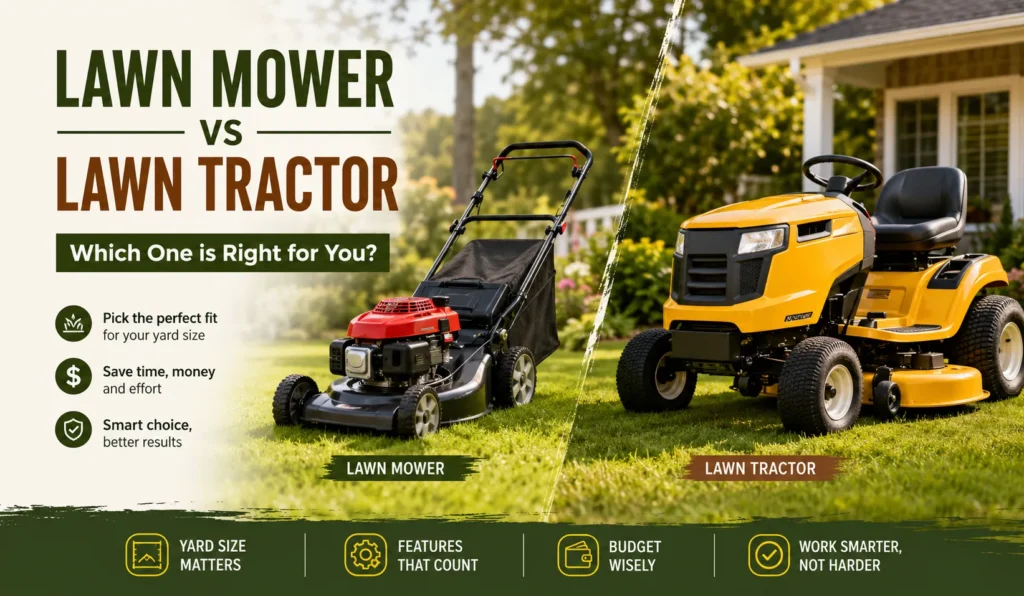
A lawn mower is a walk-behind machine. You stand behind it and either push it or let it pull itself forward. The cutting deck sits underneath, and the blade spins horizontally to cut grass. Most models have a single cutting deck ranging from 21 to 30 inches wide.
Walk-behind mowers come in three drive types: push (you supply all the power), self-propelled (the wheels drive forward on their own), and battery-powered (same as either of the above but running on a lithium-ion battery instead of gas). They are compact, easy to store, and designed for lots under about half an acre.
What a Lawn Tractor Actually Is
A lawn tractor is a riding machine. You sit on it and drive it like a small vehicle, with a steering wheel, foot pedals, and a cutting deck mounted underneath. Engine horsepower typically ranges from 18 to 25 HP, and cutting deck widths run from 42 to 54 inches.
A lawn tractor is not a zero-turn mower. Zero-turn mowers have two steering levers instead of a wheel and can spin in place. Tractors have a traditional front-wheel steering setup and a wider turning radius. For beginners, the tractor is the easier starting point.
Why Beginners Get Confused Between the Two
The confusion comes from the word “riding.” People see a riding mower in a neighbor’s garage and do not know if it is a lawn tractor, a zero-turn, or something else entirely. Marketing does not help either – retailers often label small tractors as “riding mowers” and larger riding mowers as “tractors” with no consistent logic.
The simplest rule: if you walk behind it, it is a lawn mower. If you sit on it and steer with a wheel, it is a lawn tractor.
When a Lawn Mower Is the Right Choice
For most beginners with a typical suburban yard, a walk-behind lawn mower is the correct starting point. Here is why.
Yard Size Is the Deciding Factor
If your yard is under half an acre, a walk-behind mower will do the job in under an hour. The average suburban lot in the US is around a quarter acre (about 10,000 square feet). A 21-inch self-propelled gas mower covers that in roughly 40-50 minutes at a comfortable walking pace.
The National Association of Realtors reported in 2023 that the median US lot size for new single-family homes is 8,600 square feet. That is squarely in push-mower territory.
Buying a $2,000 tractor for a 8,000-square-foot yard is like buying a pickup truck to commute two miles to work. It costs more to buy, more to store, and more to maintain.
Tight Spaces, Slopes, and Obstacles
Walk-behind mowers handle tight spaces that a tractor simply cannot reach. A tractor has a turning radius of 18-24 inches on most models. A walk-behind mower can turn on a dime.
If your yard has flower beds, trees, a fence line, a swing set, or a narrow gate, a walk-behind mower will get into those spots cleanly. A tractor will leave strips of uncut grass that you then have to trim by hand.
Slopes are another factor. On slopes under 15 degrees, a self-propelled mower handles well. On slopes steeper than 15 degrees, a walk-behind can actually be safer than a tractor, which can tip sideways on steep inclines if driven across the slope.
Budget and Storage Reality
A quality self-propelled gas mower from a brand like Honda, Toro, or EGO costs $350-$600. A comparable entry-level lawn tractor from Cub Cadet or Husqvarna starts at $1,500 and can easily reach $2,500.
Storage matters too. A walk-behind mower fits in a small corner of a one-car garage or a modest shed. A lawn tractor needs at least a 7×10-foot footprint and cannot share tight space with a car.
If you rent storage, budget for that. Outdoor tractor covers run $40-$80, and they are not optional if you do not have a shed.
When a Lawn Tractor Makes More Sense
There are clear situations where a lawn tractor earns its price. If you fall into one of these categories, the extra investment makes sense.
Large, Open Yards (Half an Acre and Up)
On a half-acre lot with open terrain, a walk-behind mower takes 90 minutes to two hours. Your legs ache. Your back aches. The following Saturday it needs to happen again.
A 42-inch cutting deck on a Cub Cadet XT1 or John Deere E100 cuts a half-acre in about 30-35 minutes. That time savings compounds over 20-30 mowing sessions per year.
On open, flat properties in places like rural North Carolina or central Texas, a lawn tractor also saves real physical wear. A friend of mine in Waco mows 1.5 acres. He bought a Troy-Bilt pony tractor and said it changed his Saturday mornings entirely.
Physical Limitations and Comfort
If you have knee problems, a bad hip, chronic back pain, or limited cardiovascular endurance, pushing a mower for 60 minutes is not just tiring – it can be genuinely painful.
A lawn tractor lets you sit and drive. No pushing. No sustained physical effort beyond steering and operating the blade engagement. For older homeowners or anyone with mobility limits, this alone justifies the cost even on a smaller property.
When You Need More Than Just Mowing
Lawn tractors accept attachments. A snow blower attachment turns your tractor into a winter machine. A bagger collects clippings automatically. A dethatching attachment handles lawn renovation. A lawn roller or spreader attachment is also an option on most mid-range tractors.
If your property needs seasonal work beyond mowing, a tractor becomes a multi-purpose tool instead of a single-use purchase.
Side-by-Side Comparison: Lawn Mower vs Lawn Tractor
Here is where the two types of machines actually differ in day-to-day use.
Cost to Buy and Maintain
Walk-behind mowers cost less upfront and less over time. A gas self-propelled model runs $350-$600 new. Annual maintenance (oil, spark plugs, blade sharpening, air filter) typically runs $40-$80 per year.
Lawn tractors cost $1,500-$3,500 for a beginner-level model. Annual maintenance runs $100-$200, and a single drive belt or deck belt replacement costs $25-$60 in parts plus labor if you do not do it yourself. Transmission repairs on older tractors can run $200-$400.
Battery-powered walk-behind mowers (EGO, Greenworks, Ryobi) cost $400-$700 for the mower plus battery. They have lower maintenance costs since there is no oil to change and no carburetor to clean – but battery replacement runs $150-$300 after 5-7 years.
Ease of Use for a Total Beginner
Both are easier to use than most people expect. A self-propelled mower takes about 10 minutes to learn. A lawn tractor takes slightly longer – you need to get comfortable with blade engagement, the parking brake, and the transmission type (more on that below).
The bigger learning curve with tractors is safety. You need to know not to mow across steep slopes, not to back up without checking behind you, and how to disengage the blades before hitting an obstacle. These are simple habits, but they take a few sessions to build.
Maneuverability and Cutting Width
Walk-behind mowers win on maneuverability every time. They turn sharply, fit through gates, and navigate obstacles a tractor cannot. The trade-off is cutting width: most walk-behind mowers cut 21-22 inches per pass.
A lawn tractor cuts 42-54 inches per pass. That wider cutting deck covers ground fast on open terrain. On a yard with lots of trees and beds, though, a tractor’s wide deck leaves strips that require trimming.
Storage Space Requirements
| Feature | Walk-Behind Mower | Lawn Tractor |
|---|---|---|
| Floor space needed | 2×4 ft (about 8 sq ft) | 5×7 ft (about 35 sq ft) |
| Fits in 1-car garage? | Yes, easily | Only with careful planning |
| Can be stored vertically? | Some models, yes | No |
| Cover needed outdoors? | Recommended | Required |
Comparison Table: Lawn Mower vs Lawn Tractor
| Factor | Walk-Behind Mower | Lawn Tractor |
|---|---|---|
| Best yard size | Under 0.5 acre | 0.5 acre and up |
| Purchase price | $300-$700 | $1,500-$3,500 |
| Annual maintenance cost | $40-$80 | $100-$200 |
| Cutting width | 21-30 inches | 42-54 inches |
| Turning radius | Very tight | 18-24 inches |
| Storage footprint | Small | Large |
| Handles slopes? | Yes, up to 15 degrees | Better on flat terrain |
| Accepts attachments? | No | Yes |
| Physical effort required | Moderate | Minimal |
What to Look for If You Choose a Lawn Mower
Once you decide on a walk-behind mower, you still have a few choices to make. These are the ones that actually matter for a beginner.
Push vs. Self-Propelled
A push mower has no drive system in the wheels – you supply all the forward motion. On flat, open lawns under 6,000 square feet, a push mower works fine and costs less.
A self-propelled mower has a drive system in the front or rear wheels. You squeeze a lever and it pulls itself forward. On slopes, larger yards, or for anyone who finds pushing tiring, self-propelled is the better choice. The price difference is usually $80-$150.
Rear-wheel drive self-propelled models handle slopes better. Front-wheel drive models turn more easily. For most beginners, front-wheel drive is enough.
Gas, Electric, or Battery-Powered
Gas mowers are loud, require oil changes, and need fresh fuel at the start of each season. But they run indefinitely as long as you have fuel, and they have plenty of power for thick or wet grass. A Honda HRX217 or Toro Personal Pace are good beginner gas options.
Battery-powered mowers (especially EGO’s 56V platform) have caught up with gas performance on typical lawns. They are quieter, need no oil, and start with a button press. For yards under 8,000 square feet, a 5Ah or 7.5Ah battery handles one full mow on a charge. For larger lawns, you may need two batteries.
Corded electric mowers are an option for very small yards. The cord limits range to about 100 feet from an outlet and is a hazard to mow around. Most beginners find battery-powered more practical.
Cutting Width and Cutting Height Adjustment
For most suburban lots, a 21-inch cutting deck is standard and sufficient. Wider decks (24-30 inches) cover more ground per pass but are harder to maneuver in tight spaces.
Cutting height adjustment is the setting that determines how long your grass is after mowing. Most beginners set it and forget it at the middle position (about 3 inches). This is correct for most lawn grass types in the US. Avoid cutting below 2.5 inches – it stresses the grass and invites weeds.
Look for a mower with a single-point height adjustment (one lever changes all four wheels at once) rather than individual wheel adjustments. It saves time every time you change the height.
Top Walk-Behind Mowers for Beginners
| Model | Type | Cutting Width | Best For | Price (approx.) |
|---|---|---|---|---|
| EGO Power+ LM2135SP | Battery, self-propelled | 21 inches | Most suburban lots | $599 |
| Honda HRX217VKA | Gas, self-propelled | 21 inches | Thick grass, slopes | $579 |
| Toro Personal Pace 21472 | Gas, self-propelled | 22 inches | Larger flat yards | $429 |
| Ryobi 40V HP 20″ | Battery, self-propelled | 20 inches | Small to mid yards | $349 |
| Greenworks 48V 21″ | Battery, push/self-prop | 21 inches | Budget-conscious buyers | $299 |
What to Look for If You Choose a Lawn Tractor
Lawn tractors come with more variables than walk-behind mowers. Here are the three that matter most for a beginner.
Engine Size and Cutting Deck Width
For a half-acre lot, an 18-20 HP engine is enough. For one acre or more, 20-24 HP gives you enough power to handle thick grass without bogging down.
Cutting deck width determines how fast you cover ground. A 42-inch deck cuts about 50% more per pass than a 28-inch walk-behind. A 54-inch deck cuts faster still, but it is harder to maneuver around obstacles. For most beginners with a half to one-acre lot, a 42 or 46-inch deck is the right size.
Transmission Type (Manual vs. Automatic)
Lawn tractors come with three main transmission types. Manual transmissions have a clutch pedal and gear shifter. Automatic transmissions (also called hydrostatic) change speed smoothly as you press the foot pedal. CVT (continuously variable transmission) is similar to automatic but smoother.
For beginners, hydrostatic automatic transmission is the right choice. It removes the learning curve of clutching and shifting and feels closer to driving a car with an automatic transmission. Manual tractors are cheaper but frustrating if you are not used to them.
Attachments and Versatility
Not all tractors accept all attachments. Before buying, confirm that the model you are looking at has a standard 3-point hitch or attachment system, and that your desired attachments (snow blower, bagger, dethatching kit) are listed as compatible.
John Deere’s 100 series, Husqvarna’s TS series, and Cub Cadet’s XT series all have strong attachment ecosystems. Troy-Bilt and Craftsman offer fewer official attachments but are widely compatible with third-party options.
Top Lawn Tractors for Beginners
| Model | Engine | Deck Width | Best For | Price (approx.) |
|---|---|---|---|---|
| John Deere E110 | 17.5 HP | 42 inches | First-time riders, half-acre lots | $1,699 |
| Cub Cadet XT1 Enduro LT42 | 18 HP | 42 inches | Mid-sized yards, solid value | $1,699 |
| Husqvarna TS 142 | 19 HP | 42 inches | Beginners, good maneuverability | $1,699 |
| Troy-Bilt Bronco 42 | 17.5 HP | 42 inches | Budget-first buyers | $1,499 |
| John Deere E130 | 22 HP | 42 inches | Larger lots, heavier use | $2,099 |
Common Beginner Mistakes When Choosing
Most people regret their first mower purchase for one of three reasons.
Buying a Tractor for a Tiny Yard
I have seen this more than once. A new homeowner buys a $2,000 Husqvarna riding tractor for a 6,000-square-foot lot because it feels like the “serious” choice. Six months later, they realize the tractor barely fits through the side gate, cannot turn around near the fence, and takes longer to set up than it does to mow.
A yard under 10,000 square feet does not need a tractor. A self-propelled walk-behind mower will outperform a tractor on small properties in every way except seating comfort.
Underestimating Lawn Mower Effort on a Large Property
The flip side happens too. Someone buys a push mower for a three-quarter-acre lot because they want to save money. After two mowing seasons of 90-minute pushing sessions in August heat, they sell the mower and buy a tractor anyway – spending more total than if they had bought the tractor first.
If your yard is over half an acre and mostly flat and open, buy the tractor the first time.
Ignoring Long-Term Maintenance Costs
A cheap tractor can become an expensive headache. A $1,200 no-name riding mower with a disposable engine may need a full carburetor rebuild by year three. Parts availability for off-brand tractors is poor.
Stick with brands that have a US dealer network: John Deere, Husqvarna, Cub Cadet, Troy-Bilt, and Craftsman are all safe choices with widely available parts and service centers.
For walk-behind mowers, Honda and Toro engines have the best reputation for longevity. EGO batteries are covered by a 3-year warranty and are widely available for replacement.
My Final Recommendation
Here is what I would tell Mike – or any beginner – standing in that home improvement store aisle.
If your yard is under half an acre and has any obstacles (trees, beds, gates, slopes), start with a self-propelled gas or battery mower. Spend $400-$600 on something from Honda, Toro, or EGO, and you will have a machine that handles your yard well, stores easily, and lasts 8-12 years with basic maintenance. You will not regret it.
If your yard is over half an acre, mostly flat, and open, buy a hydrostatic lawn tractor with a 42-inch deck from John Deere, Cub Cadet, or Husqvarna. Budget $1,500-$2,000. Your Saturday mornings will be shorter and your back will thank you.
If you are physically unable to push a mower for 45-60 minutes regardless of yard size, go with the tractor. The comfort difference is real, and no yard size rule outweighs that.
The wrong choice is almost always the one made because it felt more impressive in the store. Buy for your yard size, your storage space, and your body – not for the machine that looks the best parked in the driveway.
Pros and Cons: Lawn Mower vs Lawn Tractor
| Walk-Behind Lawn Mower | Lawn Tractor | |
|---|---|---|
| Pros | Lower cost ($300-$700) | Covers large areas fast |
| Easy to store | Minimal physical effort | |
| Better in tight spaces | Accepts attachments | |
| Handles slopes well | Cuts 42-54 inch swaths | |
| Simple to maintain | Comfortable for long sessions | |
| Cons | Physical effort required | Expensive ($1,500-$3,500) |
| Slow on large lots | Needs large storage space | |
| No attachment support | Poor in tight spaces | |
| 21-inch cut width only | High maintenance cost | |
| Tiring in heat/humidity | Can tip on steep slopes |
Frequently Asked Questions About Lawn Mowers and Lawn Tractors
What is the difference between a lawn mower and a lawn tractor for beginners?
A lawn mower is a walk-behind machine you push or guide on foot. A lawn tractor is a riding machine you sit on and drive with a steering wheel and pedals. Lawn mowers are designed for smaller yards (under half an acre), while lawn tractors are better suited for half an acre and up. The price difference is significant: walk-behind mowers start around $300, while entry-level lawn tractors start around $1,500.
How big does my yard need to be to need a lawn tractor?
Most lawn care experts recommend a lawn tractor for properties of half an acre (about 21,780 square feet) or larger, especially if the terrain is flat and open. Below that threshold, a self-propelled walk-behind mower is more practical, easier to store, and less expensive to maintain.
Is a self-propelled mower worth the extra cost over a push mower?
For most beginners, yes. A self-propelled mower typically costs $80-$150 more than a comparable push model, but it reduces physical effort significantly on slopes, larger lawns, and during hot weather. The time savings over a full mowing season usually justifies the price difference on any yard over 5,000 square feet.
What lawn tractor brands are best for beginners?
John Deere, Cub Cadet, and Husqvarna are the most reliable choices for beginners because of their dealer networks, parts availability, and clear owner documentation. Troy-Bilt is a good budget option. Avoid off-brand or store-label tractors with no dealer support – parts availability becomes a problem within a few years.
Can a lawn tractor handle slopes?
Lawn tractors are best on slopes under 10-15 degrees. On steeper grades, especially across the slope rather than up and down, a tractor can become unstable. Most manufacturers include a maximum slope rating in the owner’s manual. For steep properties, a walk-behind self-propelled mower with good wheel traction is actually safer than a tractor.
How long does it take to mow half an acre with each type?
A 21-inch walk-behind self-propelled mower takes about 60-75 minutes to mow half an acre. A lawn tractor with a 42-inch cutting deck covers the same area in roughly 30-35 minutes. The tractor is roughly twice as fast on open ground, but that gap narrows on properties with lots of obstacles to navigate around.
What is the best battery-powered lawn mower for beginners?
The EGO Power+ LM2135SP is widely considered the top battery-powered option for beginners. It uses a 56V lithium-ion battery system, covers a quarter to half acre on a single charge with the 7.5Ah battery, and matches gas mower performance on most grass types. The battery platform is compatible with other EGO tools, which adds long-term value.