
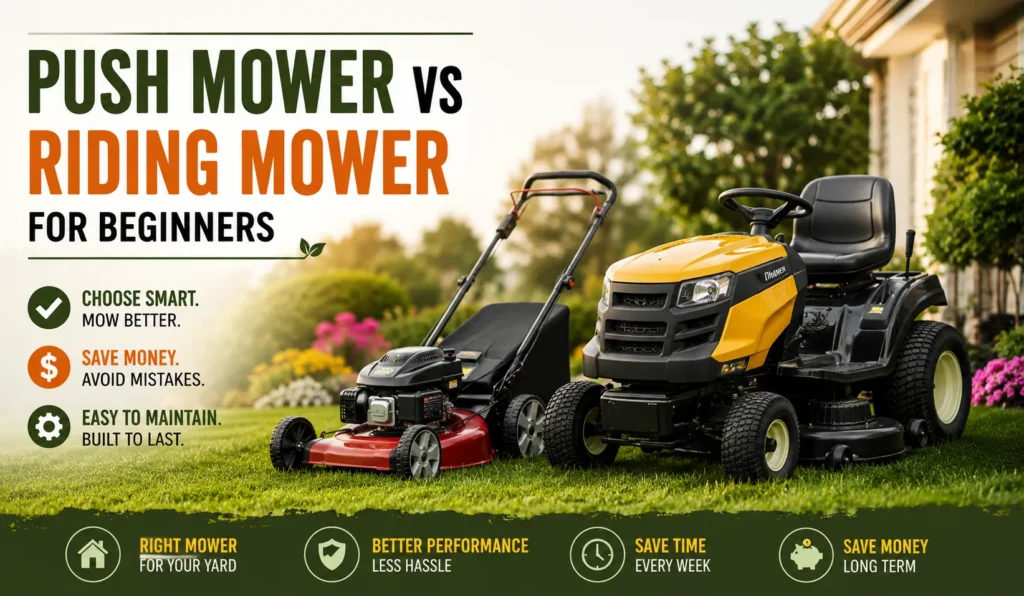
Quick Overview
- Push mowers work best for yards under half an acre – they cost less and store easily
- Riding mowers make sense for yards over half an acre, hilly terrain, or anyone with joint pain
- A decent self-propelled push mower runs $300-$600; a riding mower starts around $1,500-$2,000
- Most beginners buy more mower than they need – match the machine to your actual yard, not the neighbor’s
- Maintenance costs are real on both types – riding mowers cost more to service every year
I still remember standing in a Home Depot aisle in Columbus, Ohio, surrounded by mowers, and having zero idea what I was looking at. I’d just bought my first house. The lawn was about a third of an acre – nothing huge. But my neighbor had a riding mower that roared past my fence every Saturday like he was harvesting wheat.
Was I supposed to have one of those?
This guide is for anyone in that same spot. If you’re a first-time homeowner trying to figure out the push mower vs riding mower decision, I’m going to give you the honest breakdown – no fluff, no brand sponsorships. Just what I learned from mowing everything from a small city lot in Chicago to a sloped half-acre in Tennessee.
Why This Decision Trips Up So Many Beginners
Most beginners get this wrong for the same reason: they buy with their ego, not their yard.
It’s Not Just About Yard Size
Yard size matters a lot. But it’s not the only factor.
Terrain is just as important. A flat quarter-acre is easy with any push mower. But a quarter-acre with a 15-degree slope and wet clay soil? That’s a different story entirely. I’ve had a push mower slip out of my hands on a wet hill in Nashville – that was a wake-up call.
Think about these questions before you buy:
- How many square feet is your lawn, realistically?
- Does your yard have slopes, ditches, or tight corners?
- Do you have any physical limitations – bad knees, a bad back, low stamina?
- How much dry, secure storage space do you have?
Answer those first. Then look at machines.
The Real Cost Difference Nobody Mentions
The sticker price is just the start.
A basic gas push mower might cost $250. A self-propelled model with a Honda engine runs $400-$600. A riding mower from Cub Cadet or Husqvarna starts around $1,500 and can hit $4,000+ for a zero-turn.
But here’s what people skip: ongoing costs.
Riding mowers need belt replacements, blade sharpening, oil changes, battery maintenance, and sometimes transmission work. A typical annual service bill for a riding mower runs $150-$300 (Consumer Reports, 2023). Push mowers are far cheaper to maintain – usually under $75 a year if you do basic care yourself.
Storage costs money too. A riding mower needs a real shed or garage bay. If you don’t have one, you’re renting space or buying a storage unit. That adds up fast.
Push Mowers – What Beginners Should Know
A push mower is the right starting point for most beginners. Here’s why, and where it starts to fall short.
Best For: Small to Medium Yards
Push mowers handle yards up to half an acre well. Anything under a quarter-acre, a basic push mower is all you need.
I mowed a 4,000 sq ft city lot in Lincoln Park, Chicago for three years with a Toro Recycler 22. It took about 30 minutes, fit in a corner of my garage, and never cost me more than $60 a year to maintain. Simple, done.
If your yard is in that range – flat, no major obstacles – a self-propelled push mower is the smarter buy. It saves money, it’s easy to store, and it gives you a real workout if you want it.
Learning Curve and Ease of Use
Push mowers have almost no learning curve.
You pull the cord (or press a button on electric models), squeeze the handle, and walk. That’s it. Most beginners feel confident after one mow.
Self-propelled models do the walking for you – they pull themselves forward while you steer. That’s worth the extra $100-$150 for anyone mowing more than 3,000 sq ft or dealing with slight slopes.
The main skill to learn is mowing in straight, overlapping rows so you don’t miss strips. Takes one or two sessions to get it right.
One honest downside: push mowers are physical work. On a hot August day in a large yard, you’ll feel it in your legs and lower back. If you have knee or hip issues, 45 minutes behind a push mower gets uncomfortable fast.
Maintenance You’ll Actually Deal With
Push mowers are easy to maintain. Here’s what comes up every season:
- Oil change: Once a year, about 10 minutes, costs around $5
- Blade sharpening or replacement: Once a year, $20-$40 for a new blade
- Air filter: Check yearly, replace if dirty, about $8
- Spark plug: Replace every 1-2 years, about $5
- Fuel: Use fresh gas – old gas is the number one reason push mowers won’t start in spring
The most common beginner mistake: leaving gas in the tank over winter. It gums up the carburetor. Either drain it in fall or add fuel stabilizer. A $10 bottle of Sta-Bil saves you a $90 carburetor cleaning.
Comparison Table for Popular Push Mower Types
| Type | Best For | Avg. Price | Pros | Cons |
|---|---|---|---|---|
| Basic push (gas) | Flat yards under 4,000 sq ft | $220-$320 | Cheap, simple | Physical effort, slower |
| Self-propelled (gas) | Yards up to half acre, mild slopes | $350-$600 | Less work, faster | Heavier, pricier |
| Battery-electric | Small yards, noise restrictions | $300-$550 | Quiet, low maintenance | Limited run time |
| Corded electric | Very small yards | $150-$220 | Cheapest option | Cord is annoying |
Top brands I’ve personally used: Honda (GCV160 engine is excellent), Toro (Recycler line is reliable for beginners), EGO (best battery option on the market right now).
Riding Mowers – What Beginners Should Know
A riding mower feels like a major purchase – because it is. Get it right and you’ll use it for 10-15 years. Get it wrong and you’ll regret it every time you pay for maintenance.
Best For: Large or Hilly Lawns
Riding mowers are the right call when:
- Your lawn is over half an acre
- Your yard has significant slopes (over 10 degrees)
- You have physical limitations that make walking with a mower painful
- Mowing time matters – you want to cut a large yard in 30 minutes, not 90
I tested a John Deere E120 on a 1.2-acre property in Franklin, Tennessee. What would’ve been a 2-hour push mow turned into a 45-minute ride. On that sloped terrain, a push mower would’ve been dangerous and exhausting. The riding mower was the right tool.
Cutting deck width is the key spec here. Wider decks (42″-54″) cover more ground per pass and cut total mowing time significantly. Most homeowner riding mowers run a 42″ or 46″ deck.
Learning Curve and Ease of Use
Riding mowers have a short learning curve, but it’s steeper than a push mower.
You need to get comfortable with:
- Steering with a steering wheel or lap bars (depending on the type)
- Operating the blade engagement lever
- Adjusting cutting height
- Turning in tight spaces without scalping the grass
Zero-turn mowers are the fastest option but are harder to learn. They have dual lap bars instead of a steering wheel – you push forward on both to go straight, and slow one side to turn. Most beginners find them awkward for the first hour.
For beginners, I’d recommend a standard riding mower with a steering wheel before jumping to a zero-turn. The Husqvarna YTH18542 or Cub Cadet XT1 LT46 are good starting points. They’re predictable, have solid turning radius, and are forgiving for new riders.
One honest drawback: riding mowers do not handle tight spaces well. Trees, flower beds, and obstacles mean extra trimming with a separate tool afterward. Budget time (and money for a string trimmer) for that.
Maintenance You’ll Actually Deal With
Riding mowers need more regular attention than push mowers. Here’s what the first year usually looks like:
- Oil change: Every 50 hours of use, or once a season
- Blade sharpening: 2-3 times a season depending on use
- Air filter: Check monthly during mowing season
- Battery: Riding mowers have a 12V battery that dies over winter if not kept on a trickle charger
- Belt replacements: Drive belts and deck belts wear out over 2-4 years – budget $40-$80 per belt
- Tire pressure: Check each spring – low pressure affects cut quality
Annual service at a dealer or equipment shop runs $150-$300 (Consumer Reports, 2023). If you skip it, smaller problems turn into bigger ones fast.
The biggest beginner mistake with riding mowers: not checking tire pressure and blade balance. Uneven cutting almost always traces back to one of those two things.
Comparison Table for Popular Riding Mower Types
| Type | Best For | Avg. Price | Pros | Cons |
|---|---|---|---|---|
| Standard riding (steering wheel) | Half to 2-acre flat yards | $1,500-$2,500 | Easy to learn, reliable | Slower than zero-turn |
| Zero-turn mower | 1+ acre, open yards | $2,500-$4,500 | Fastest option, tight turns | Higher learning curve, costs more |
| Lawn tractor | Large yards with attachments | $1,800-$3,500 | Can pull carts, snow blades | Bulky, takes space |
| Rear-engine rider | Half-acre, simple terrain | $1,200-$1,800 | More compact | Less power, smaller deck |
Top brands worth trusting: John Deere (E-series is reliable for beginners), Husqvarna (good value for the price), Cub Cadet (strong build quality), Toro (excellent for zero-turns).
Push Mower vs. Riding Mower: Side-by-Side for Beginners
Here’s how the two options line up on the things that actually matter when you’re buying your first mower.
Yard Size and Terrain
Under 1/4 acre, flat terrain: push mower wins, no contest.
1/4 to 1/2 acre, flat: self-propelled push mower is fine for most people.
Over 1/2 acre: riding mower saves time and energy.
Any yard with steep slopes: riding mower is safer (push mowing steep slopes is a real injury risk).
Tight spaces with lots of trees or beds: push mower is actually easier to maneuver around obstacles.
Budget and Long-Term Cost
The gap is bigger than the sticker price suggests.
A self-propelled gas push mower at $450 plus $60/year in maintenance costs about $750 over five years.
A basic riding mower at $2,000 plus $200/year in maintenance runs closer to $3,000 over the same period.
If your yard is under half an acre, the riding mower doesn’t save enough time to justify that cost difference. If your yard is over an acre, the time savings are real – and the cost math starts to favor the rider.
Storage Space
This one surprises first-time buyers.
A push mower fits in a corner of a garage or a small shed. A riding mower needs a dedicated bay – roughly 6 feet wide and 6-8 feet deep. It also needs to be dry and protected from extreme cold (which kills the battery).
If you’re renting storage or live in a townhouse with a shared garage, a riding mower might not be practical even if your yard is large enough for one.
Comparison Table
| Factor | Push Mower | Riding Mower |
|---|---|---|
| Best yard size | Under 1/2 acre | Over 1/2 acre |
| Starting price | $220-$600 | $1,500-$4,500 |
| Annual maintenance | $40-$75 | $150-$300 |
| Storage needed | Small corner/shed | Full garage bay |
| Learning curve | Very low | Low to moderate |
| Physical effort | High | Very low |
| Slope safety | Moderate (avoid steep) | Better on slopes |
| Obstacle handling | Better around trees/beds | Needs extra trimming |
| Mowing speed (1 acre) | 90-120 min | 30-45 min |
Common Mistakes Beginners Make
Most regrets I’ve seen come down to two things. Both are avoidable.
Buying a Riding Mower for a Small Yard
I’ve talked to a lot of new homeowners who bought riding mowers for yards under 6,000 sq ft. Every single one of them admitted it within a year.
The riding mower is slower in tight spaces. It can’t get close to fences, flower beds, or trees without running over something. They still need a push mower or trimmer to finish the edges. And they paid $2,000+ for the privilege.
If your yard is under half an acre and mostly flat, a good self-propelled push mower is faster, easier, and costs a fraction of the price.
The one exception: if you have real physical limitations – chronic back pain, bad knees, limited mobility – a riding mower on a smaller yard can genuinely be the right call.
Underestimating Storage and Transport Needs
Riding mowers don’t just need space to park. They need space to work on, space to winterize, and a way to transport them if they need service.
Most lawn equipment dealers won’t come to your house for basic service. You need a trailer or a pickup truck to haul a riding mower to a shop. If you don’t own one, that’s a rental cost on top of your repair bill.
Push mowers fit in a car trunk or a friend’s SUV. That difference matters when something goes wrong.
Also worth knowing: riding mowers are a theft target. If you’re storing one in an unlocked shed or an open carport, get a chain lock. (Consumer Reports, 2022 reported riding mowers as one of the most stolen outdoor power tools in suburban areas.)
My Final Recommendation
Here’s what I’d tell a friend buying their first mower today.
If your yard is under half an acre and mostly flat, buy a self-propelled gas push mower. Something like the Toro Recycler 22 or Honda HRX217 will last 10+ years with basic care. It will handle your yard in under an hour, store in a corner, and cost less to fix when something goes wrong. You’ll thank yourself every time you skip the maintenance bill.
If your yard is over half an acre, has serious slopes, or mowing it with a push mower would take 90 minutes in the heat – get a riding mower. Don’t overspend on zero-turn features you won’t use as a beginner. A basic steering-wheel riding mower like the Cub Cadet XT1 LT46 or John Deere E130 gives you everything you need for a large yard without the learning curve of a zero-turn.
The honest truth is: most people in the US with a standard suburban yard don’t need a riding mower. They want one. There’s nothing wrong with that – mowing on a rider is more fun. But if budget or storage is a concern, start with a good self-propelled push mower. You can always upgrade later. You can’t un-spend $2,500.
Pros and Cons Table
| Push Mower | Riding Mower | |
|---|---|---|
| Pros | Cheap to buy | Handles large areas fast |
| Low maintenance cost | Easy on your body | |
| Easy to store | Better on slopes | |
| Works in tight spaces | Covers ground quickly | |
| Simple to use from day one | Great for 1+ acre yards | |
| Cons | Physical effort needed | Expensive to buy |
| Slow on large yards | High annual service cost | |
| Hard on slopes | Needs major storage space | |
| Can’t handle 1+ acres well | Poor in tight spaces | |
| Time-consuming for big lawns | Harder to transport for repairs |
Frequently Asked Questions About Push Mowers vs. Riding Mowers
What is the best mower for a beginner with half an acre?
A self-propelled gas push mower works for most half-acre yards. Look for at least a 149cc engine and a 21″-22″ cutting deck. If your terrain is hilly or you have joint issues, a basic riding mower with a 42″ deck is a better fit.
How much does a riding mower cost to maintain each year?
Expect to spend $150-$300 per year on a riding mower (Consumer Reports, 2023). That covers oil changes, blade sharpening, belt replacements, and occasional battery service. Push mowers run $40-$75 a year for the same basic care.
What is the difference between a self-propelled and a push mower?
A push mower requires you to push it forward by walking. A self-propelled mower uses its engine to drive the rear wheels, pulling itself forward while you steer. Self-propelled models cost $100-$200 more but cut the physical effort on slopes and larger yards.
Can a riding mower handle a sloped yard?
Most riding mowers handle slopes up to 15 degrees safely. Steeper than that, and you risk tipping – especially on wet grass. Zero-turn mowers are not recommended for slopes above 10 degrees. Always check your mower’s slope rating in the owner’s manual before using it on a hill.
How long does it take to mow one acre with each type?
A push mower with a 22″ deck takes 90-120 minutes to mow one acre at a walking pace. A riding mower with a 42″ deck covers the same area in 30-45 minutes. For any yard over half an acre, that time difference adds up significantly over a full mowing season.
Is a battery-powered push mower good for beginners?
Yes – battery-electric push mowers like the EGO Power+ are excellent for beginners with small yards. They start instantly with a button, require almost no maintenance, and run quietly. The trade-off is run time: most battery mowers last 45-60 minutes per charge, which limits them to yards under 8,000 sq ft.
What yard size makes a riding mower worth it?
Most lawn care professionals and equipment dealers use half an acre as the cutoff (Briggs & Stratton, 2022). Under that, a self-propelled push mower is faster and more maneuverable in tight spaces. Over half an acre, a riding mower saves real time and physical effort every single week.