
Quick Overview
- A healthy lawn starts with knowing your grass type and soil – not buying expensive products
- Cool-season grasses (Kentucky bluegrass, tall fescue) grow best in northern states; warm-season grasses (Bermuda, St. Augustine) suit the South and Southwest
- The four tasks every beginner must master are mowing, watering, fertilizing, and edging
- Most beginners damage their lawn by mowing too short and watering too often – not too little
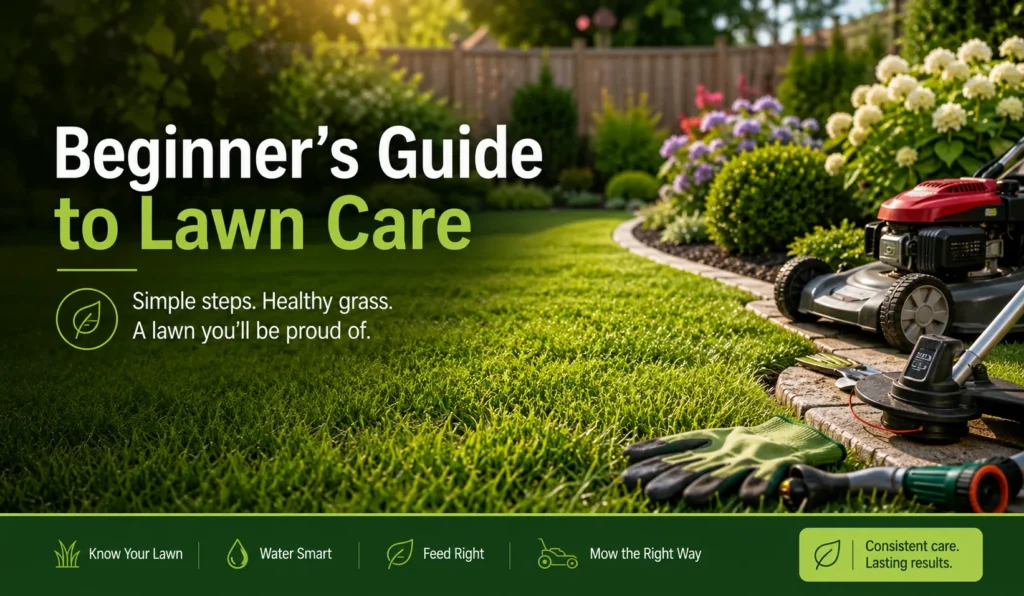
- You can get started with five tools: a mower, string trimmer, edger, broadcast spreader, and a hose with a timer
I remember the first time I stood in my backyard after buying my house. The grass was patchy. Weeds ran the fence line. My neighbor’s lawn looked like a golf course. Mine looked like something behind an abandoned strip mall.
That’s where most people start with a beginner guide to lawn care. Confused. A little defeated. Convinced the neighbor must know some secret they don’t.
He did know something – but it wasn’t a special product or a magic formula. It was just the basics, done consistently.
This guide is for anyone who just bought a home, just killed their lawn, or just realized the yard they’ve been ignoring needs real attention. You don’t need experience. You need a place to start.
Why Lawn Care Feels Overwhelming at First (And Why It Doesn’t Have To)
Most beginners feel overwhelmed because there’s too much information – and most of it contradicts itself. One source says water every day. Another says once a week. One person on YouTube swears by one product. Another has a completely different answer.
Here’s what I’ve learned after working with lawns in Florida, Minnesota, and Arizona: most of the confusion comes from one root problem. People apply advice meant for one grass type to a completely different one.
The Biggest Myth About Having a Green Lawn
The biggest myth is that a green lawn requires a lot of money or specialized knowledge.
It doesn’t. It requires doing a few simple things at the right time of year. Most lawns fail not from neglect but from doing too much – too much water, too much fertilizer, cutting the grass too short.
I’ve seen people spend $800 on fertilizer programs for a lawn that just needed the right mowing height. Save your money until you understand what your specific lawn actually needs.
What Beginners Actually Need to Know First
Before you buy anything, learn two things: what grass type you have, and what your soil looks like.
Everything else – watering schedules, fertilizer types, mowing frequency – depends on those two answers. Get them wrong and every other step becomes guesswork. I’ll walk you through both in the next section.
Understanding Your Lawn Before You Do Anything
The first step in lawn care is observation, not action. Spend ten minutes walking your yard before you touch a single tool. Look at the grass blades. Check the soil. Notice where the sun hits and where it doesn’t.
This ten-minute check saves months of wasted effort.
Grass Types Across the US
Your grass type determines almost every decision you’ll make. There are two main categories: cool-season grasses and warm-season grasses.
Cool-season grasses grow actively in spring and fall. They go dormant in summer heat. They’re common in the northern half of the US – the Midwest, the Northeast, and the Pacific Northwest.
Common cool-season types include:
- Kentucky bluegrass – dark green, fine texture, needs full sun
- Tall fescue – drought-tolerant, handles shade better than bluegrass
- Perennial ryegrass – germinates fast, good for overseeding thin areas
Warm-season grasses grow hard in summer and go dormant in winter. They’re the right choice for the South and Southwest.
Common warm-season types include:
- Bermudagrass – aggressive, handles heat and foot traffic well
- St. Augustinegrass – thick, shade-tolerant, common in Florida and along the Gulf Coast
- Zoysiagrass – slow-growing but forms a dense, durable turf
If you don’t know what you have, take a close-up photo of a blade and run it through Google Lens. Most county extension offices – run by land-grant universities – also offer free or low-cost grass identification. That’s the first resource I’d use before spending anything.
Soil Health and Why It Matters
Grass doesn’t grow in isolation. It grows in soil. If your soil is off, nothing you apply on top will fix it.
Two soil factors matter most for a beginner: pH and compaction.
Soil pH measures acidity on a scale from 0 to 14. Most grasses want a pH between 6.0 and 7.0. Below that, nutrients can’t absorb even if you fertilize correctly. Above 7.0, the same problem occurs.
A basic soil pH test kit costs $10-15 at any hardware store. Or send a sample to your local cooperative extension service – they test pH and give you specific amendment recommendations for your state. The University of Minnesota Extension and the University of Florida’s IFAS program are two good examples of free, reliable state resources.
Compaction is the second issue. When soil is too dense, grass roots can’t grow deep. The lawn looks thin and struggles the moment heat or drought hits. Aeration – punching small holes in the soil – fixes this. More on that in the seasonal section.
Reading Your Yard – Sun, Shade, and Drainage
Walk your yard at a few different times of day and note where the sun actually reaches.
Most grasses need at least 6 hours of direct sunlight per day. Areas under trees or in building shadow will always struggle with sun-loving grass types. In those spots, a shade-tolerant variety like tall fescue or St. Augustinegrass is a better fit than trying to force Kentucky bluegrass where it won’t grow.
Drainage matters too. After rain, check for spots where water pools for more than 30 minutes. Those areas have drainage problems. Grass planted there will suffocate. You’ll need to either regrade, add drainage, or plant a water-tolerant species in those spots.
Grass Types by US Region
| Region | Climate | Best Grass Types | Dormant Season |
|---|---|---|---|
| Pacific Northwest | Cool, wet | Tall fescue, perennial ryegrass | Summer (partial) |
| Upper Midwest | Cold winters, warm summers | Kentucky bluegrass, tall fescue | Winter |
| Southeast | Hot, humid | St. Augustinegrass, Bermuda, Zoysia | Winter |
| Southwest / Desert | Hot, dry | Bermudagrass, buffalo grass | Winter |
| Mid-Atlantic | Mixed | Tall fescue, Kentucky bluegrass | Winter |
| Texas / Gulf Coast | Hot, humid to semi-arid | Bermuda, St. Augustine, Zoysia | Winter |
The Basic Lawn Care Tasks Every Beginner Must Learn
There are four tasks at the center of all lawn care: mowing, watering, fertilizing, and edging. Master these and your lawn will look noticeably better within one season.
Each task has a right way and several wrong ways. I’ll flag the most common beginner errors as I go.
Mowing – Height, Frequency, and Common Mistakes
The single most important mowing rule: never cut more than one-third of the grass blade in a single session.
If your grass is 4.5 inches tall, cut it to 3 inches – not shorter. Cutting too low stresses the plant, exposes soil to direct sunlight (which feeds weeds), and burns the turf during summer heat.
The right mowing height depends on your grass type:
| Grass Type | Ideal Mowing Height |
|---|---|
| Kentucky bluegrass | 2.5 – 3.5 inches |
| Tall fescue | 3 – 4 inches |
| Bermudagrass | 1 – 2 inches |
| St. Augustinegrass | 3.5 – 4 inches |
| Zoysiagrass | 1.5 – 2.5 inches |
Mow based on how fast the grass grows, not the calendar. In spring, when growth is fast, you may mow every 5 days. In summer heat, once every 10-14 days. Let the one-third rule guide your timing.
Keep your mower blade sharp. A dull blade tears grass instead of cutting it. Torn blades turn yellow at the tips and invite disease. Sharpen or replace blades once per season.
Watering – How Much Is Actually Enough
Most lawns need 1 to 1.5 inches of water per week – from rain, irrigation, or both.
That sounds simple. The part beginners get wrong is how they deliver it. Shallow, daily watering keeps roots near the surface. Those roots can’t handle heat or drought. Deep, infrequent watering – soaking 6 to 8 inches into the soil – trains roots to grow down where it’s cooler and moisture lasts longer.
Water in the early morning, between 5 and 10 AM. This gives the grass time to dry before evening. Wet grass at night is a fast path to fungal disease. I learned that the hard way with a St. Augustine lawn in Tampa – a week of evening irrigation gave me a brown patch problem that took two months to clear.
A simple test: after watering, push a screwdriver 6 inches into the soil. If it goes in with little resistance, you’ve reached the right depth. If it’s hard to push, water longer next time.
Fertilizing – What, When, and How Often
Fertilizer gives your grass nutrients it can’t get in large enough quantities from soil alone. The three main ones are nitrogen (N), phosphorus (P), and potassium (K) – listed on every bag as three numbers like 10-10-10. This is the NPK ratio.
For most lawns, nitrogen matters most. It drives green growth. Phosphorus supports root development. Potassium improves the lawn’s ability to handle heat, cold, and stress.
When to fertilize depends on your grass type:
- Cool-season grasses: The most important application is in early fall (September-October). Add a lighter feeding in spring.
- Warm-season grasses: Fertilize in late spring through summer, when growth is active.
Never fertilize dormant grass. Nutrients won’t absorb. They’ll wash off into nearby groundwater instead.
Run a soil test before your first fertilizer application. It tells you exactly what your lawn is missing, so you don’t over-apply. Slow-release fertilizers are a better starting point for beginners than fast-release – they feed the lawn gradually and reduce the risk of burning it.
Edging and Trimming for a Clean Finish
Edging is what separates a maintained lawn from a neglected one.
Even an average lawn looks intentional with clean edges along walkways, driveways, and garden beds. Edge along all hard surfaces. It takes 15 minutes and makes a larger visual difference than an hour of extra mowing.
Use a string trimmer along fences and structures where the mower can’t reach. Trim after mowing so you can see what the mower left behind.
Don’t edge more than once every one to two weeks. Going at it too often cuts too deep into the turf border and creates bare strips along your edges.
Seasonal Task Schedule
| Season | Cool-Season Grass | Warm-Season Grass |
|---|---|---|
| Spring | Light fertilize, overseed bare spots, start mowing | Wait for green-up, apply pre-emergent weed control, begin mowing |
| Summer | Water deeply, mow at full height, no fertilizer in heat | Fertilize, mow consistently, water through heat |
| Fall | Core aerate, heavy fertilize, overseed thin areas | Reduce fertilizer, prepare for dormancy |
| Winter | Minimal care; avoid traffic on frozen turf | Dormant – no fertilizer, minimal watering |
The Tools You Actually Need (And What to Skip)
You don’t need $2,000 of equipment to start. Five tools cover 90% of what a beginner will ever need.
Before you buy, rent or borrow first. One season of actual use tells you more about what you need than any review article will.
Must-Have Tools for a Beginner
These five tools are enough to maintain any standard residential lawn:
- Walk-behind mower – For yards under a quarter acre, a push or self-propelled mower is all you need
- String trimmer – Handles edges and tight spots the mower can’t reach
- Edger – Dedicated edgers give cleaner lines than a trimmer, especially along concrete
- Broadcast spreader – For fertilizer and grass seed; far more even than hand-spreading
- Hose with an adjustable timer – Takes the guesswork out of watering frequency
Start there. Add more tools only when a specific task calls for one.
Tools That Look Useful But Aren’t (Yet)
These are tools you’ll see recommended everywhere. Most beginners don’t need them in year one:
- Riding mower – Worth it for yards over half an acre. Overkill for most suburban lots
- Core aerator – You’ll want this eventually, but rent it once a year rather than buy
- Leaf blower – Nice to have, but a rake works fine when you’re just starting
- Soil moisture sensor – Good technology, but the screwdriver test is free and just as reliable
Gas vs. Battery vs. Electric – Which Is Right for You
Most beginners today are better off starting with battery-powered tools.
Gas equipment is powerful and lasts a long time. But it also needs maintenance – oil changes, fuel stabilizer in winter, spark plug checks. That’s an extra layer of knowledge you don’t need while you’re still learning the lawn basics.
Battery tools from brands like EGO, Greenworks, or RYOBI are powerful enough for most residential lawns under a quarter acre. They start with a button and need almost no upkeep.
Corded electric tools are the cheapest option. The cord is annoying, but the tools are reliable and require almost no maintenance. A solid choice for small yards with accessible outlets.
Tool Comparison
| Tool Type | Cost Range | Best For | Downside |
|---|---|---|---|
| Gas mower | $250-$600+ | Large yards, heavy use | Requires regular maintenance |
| Battery mower | $200-$700 | Yards under 1/4 acre | Higher upfront cost; battery limits |
| Corded electric mower | $100-$250 | Small yards | Cord limits range |
| Gas string trimmer | $80-$250 | Heavy weeds, frequent use | Maintenance required |
| Battery string trimmer | $60-$200 | Most residential yards | Battery life per charge |
How Lawn Care Changes by Season
Lawn care is not the same task repeated each month. Each season asks something different from your grass – and from you.
The biggest mistake I see beginners make is treating lawn care as a single summer chore. Fall is the most important season for northern lawns. Miss it and you’re starting over in spring.
Spring – Wake-Up Tasks That Set the Tone
Spring is about preparation, not perfection.
For cool-season grasses, wait until soil temperature reaches 50°F before doing much of anything. Fertilizing on partially frozen ground accomplishes nothing. A soil thermometer costs about $10 at any garden center and is worth every cent.
Once the ground warms up, rake out any dead grass and thatch left over from winter. This is dethatching – it gives new growth room to breathe and lets sunlight reach the soil.
If bare patches survived winter, this is the time to overseed. Scratch the soil lightly, spread grass seed at the recommended rate, and keep it moist until germination. Most cool-season seeds germinate in 7-21 days at 50-65°F.
Apply a pre-emergent weed control product before the soil hits 55°F. Once crabgrass seeds sprout, the window is closed. Timing here matters more than the product you choose.
Summer – Protecting Your Lawn from Heat Stress
Summer is survival mode for cool-season grasses.
In Phoenix in July or Atlanta in August, your lawn fights heat stress, drought, and pest pressure at the same time. The biggest thing you can do is raise your mowing height. Taller grass shades the soil, keeps it cooler, and reduces moisture loss.
Water deeply and early. In extreme heat above 90°F, aim for 1.5 to 2 inches per week.
For warm-season grasses like Bermuda or St. Augustine, summer is peak growth season. This is when they want regular fertilizer and consistent mowing. Stay on top of growth or the lawn becomes hard to manage by mid-July.
Watch for heat stress signals: grass that doesn’t spring back when you walk on it, or a blue-gray tinge instead of green. Both mean the lawn needs water right away.
Fall – The Most Important Season Most Beginners Ignore
For cool-season lawns in the Midwest, Northeast, and Pacific Northwest, fall is the most important season of the year.
Grass builds root mass in fall before going dormant for winter. A fall fertilizer application – the biggest one of the year – goes straight into that root development. Jonathan Green, a New Jersey-based grass seed company, recommends applying fall fertilizer when daytime temperatures drop below 70°F but before the first frost.
Core aeration in fall is also worth doing every one to two years. A core aerator pulls small plugs of soil from the lawn, reducing compaction and letting water, air, and fertilizer reach the roots. Renting one runs about $60-$80 for a day. It makes a larger real-world difference than most products sold at garden centers.
Overseed thin or bare areas in early fall. Soil temperatures are still warm enough for germination, but cooler air means new seedlings won’t cook in the heat.
Mow until the grass stops growing, then lower your mowing height by half an inch for the last two cuts. This reduces the risk of snow mold forming under matted grass over winter.
Winter – What to Do (and What to Leave Alone)
Most lawns don’t need much in winter. The discipline is knowing what not to do.
Don’t walk on frozen turf. Grass blades are brittle when frozen. Foot traffic breaks them and leaves visible brown paths that take weeks to recover once spring arrives.
Don’t fertilize dormant grass. Nutrients won’t absorb. They’ll wash off and end up in nearby water.
In the South, Bermuda and Zoysia go dormant and turn brown. That’s normal – not dead. Some Florida and Texas homeowners overseed dormant warm-season lawns with perennial ryegrass to keep color through winter. It works, but it adds cost and requires spring cleanup once the ryegrass dies back.
Use winter to service equipment. Clean and store your mower, change the oil on gas tools, and store batteries away from freezing temperatures.
Seasonal Task Quick Reference
| Task | Spring | Summer | Fall | Winter |
|---|---|---|---|---|
| Mowing | Begin at normal height | Raise height | Continue; lower for last 2 cuts | Stop when dormant |
| Watering | As needed | Deep, 2-3x per week | Reduce | Minimal or none |
| Fertilizing | Light (cool-season) | Full application (warm-season) | Heavy (cool-season) | None |
| Aeration | Optional (warm-season) | No | Best time (cool-season) | No |
| Overseeding | Yes, if needed (cool-season) | No | Best time (cool-season) | No |
| Weed control | Pre-emergent | Spot treat as needed | Optional | No |
Common Beginner Mistakes and How to Avoid Them
Most lawn problems I’ve seen trace back to two mistakes. Both are easy to fix once you know what to look for.
Mowing Too Short or Too Often
Scalping the lawn is the most common beginner error.
People assume short grass looks neater and means less frequent mowing. The opposite is true. Short grass stresses faster, browns in heat, and creates open space for weeds to fill in. A Minnesota lawn cut to one inch in June will look terrible by July 4th.
Set your mower deck to the correct height for your grass type and leave it there. When in doubt, most grass types do better slightly tall than slightly short.
Mowing too often – say, every three days when the grass hasn’t grown enough to justify it – causes stress too. Follow the one-third rule. Mow only when the grass has grown enough to warrant it.
Overwatering (Yes, It’s a Real Problem)
Overwatering does more damage to lawns than drought does, in my experience.
Constantly wet soil suffocates grass roots and creates conditions for fungal disease. In Florida, I’ve seen homeowners run irrigation every single day through summer and wonder why brown patch and dollar spot were spreading across the yard. The irrigation was the cause, not the cure.
Signs of overwatering: consistently soggy soil, moss or algae growth, mushrooms popping up, and grass pulling up from the soil easily with no visible roots attached.
If you have an irrigation system, audit it once a month. Heads get knocked out of alignment. Zones run longer than programmed. A single stuck zone can destroy a turf section within a week.
Water less than you think you need to. Then observe. Most established lawns handle dry spells better than their owners expect.
My Final Recommendation
If I had to start over as a complete beginner, I’d do three things before anything else.
First, get a soil test. About $15 from your county extension office or a lab like SoilKit tells you your pH and any specific nutrient gaps. No guessing, no wasted product. This single step shapes every decision that follows.
Second, identify my grass type and look up the specific care calendar for that grass in my region. The University of Florida IFAS program, the University of Minnesota Extension, and Texas A&M AgriLife Extension all publish free, state-specific guides. These are more reliable than generic YouTube advice because they’re calibrated to your actual climate and soil.
Third, I’d focus entirely on mowing correctly before touching fertilizer or weed control. A lawn mowed at the right height and frequency resists weeds better, recovers from stress faster, and looks healthier than any amount of product can compensate for.
The first season, you’ll make mistakes. That’s expected. The grass is more forgiving than it looks – and so is the process. Most problems are fixable with a small adjustment and some patience.
Give it one full year. You’ll be surprised how much you figure out just by paying attention to your own yard.
DIY Lawn Care vs. Hiring a Service
| Factor | DIY | Lawn Care Service |
|---|---|---|
| Annual cost (avg. suburban lot) | $200-$600 in materials | $1,000-$2,500+ depending on services |
| Time required | 1-3 hours per week in season | Near zero |
| Learning curve | Moderate in the first season | None |
| Control over products and timing | Full control | Limited by service schedule |
| Equipment cost upfront | $300-$800 | Included in service |
| Results in year one | Variable while learning | More consistent |
| Knowledge gained long-term | Builds significantly | None |
DIY is worth it if you enjoy being outside and want to understand what’s happening in your yard. A service makes sense if your time is limited or your lawn has serious problems that need professional diagnosis.
You can also split the difference: hire out high-effort tasks like core aeration and overseeding, and handle mowing and watering yourself.
Frequently Asked Questions About Lawn Care for Beginners
What is the first thing a beginner should do before any lawn care?
Get a soil test before spending money on any product. A basic test from your county extension service costs around $15 and returns your pH level and specific nutrient gaps. This one step shapes every other decision – what fertilizer to buy, whether your soil needs lime, and what grass types will actually do well in your yard.
How often should I water my lawn?
Most lawns need 1 to 1.5 inches of water per week. Water deeply two to three times per week rather than lightly every day. Deep watering encourages roots to grow down where moisture lasts longer. Water between 5 and 10 AM so the grass dries before evening – wet grass at night invites fungal disease.
What is the difference between cool-season and warm-season grass?
Cool-season grasses – Kentucky bluegrass, tall fescue, perennial ryegrass – grow best in spring and fall and go dormant in summer heat. They’re common in the northern US. Warm-season grasses – Bermuda, St. Augustine, Zoysia – grow actively in summer and go dormant in winter. They’re the right choice for the South and Southwest. Their fertilizing and overseeding schedules differ significantly.
What does NPK mean on a fertilizer bag?
NPK stands for nitrogen (N), phosphorus (P), and potassium (K) – the three main nutrients in lawn fertilizer. The three numbers on a bag (like 10-10-10 or 30-0-4) show the percentage of each nutrient by weight. Nitrogen drives green growth. Phosphorus supports root development. Potassium helps the lawn handle heat, cold, and drought stress.
When should I fertilize my lawn?
It depends on your grass type. Cool-season grasses get their most important fertilizer application in early fall (September-October), with a lighter feeding in spring. Warm-season grasses are fertilized from late spring through summer when they’re actively growing. Never fertilize dormant or drought-stressed grass – the nutrients won’t absorb.
Do I need to aerate my lawn as a beginner?
Aeration helps most lawns but isn’t urgent in year one. If your soil is compacted – a screwdriver is hard to push 6 inches into the ground – or your lawn sees heavy foot traffic, renting a core aerator once a year makes a real difference. Renting runs $60-$80 for a day. For cool-season lawns, fall is the best time.
What causes yellow or patchy areas in a lawn?
Yellow patches have several common causes: soil pH below 6.0 blocking nutrient absorption, nitrogen deficiency, fungal disease from overwatering, or grub damage below the surface. A soil test rules out pH and nutrient issues. If the grass in yellow patches pulls up with no roots attached, grubs feeding underground are the likely cause.