
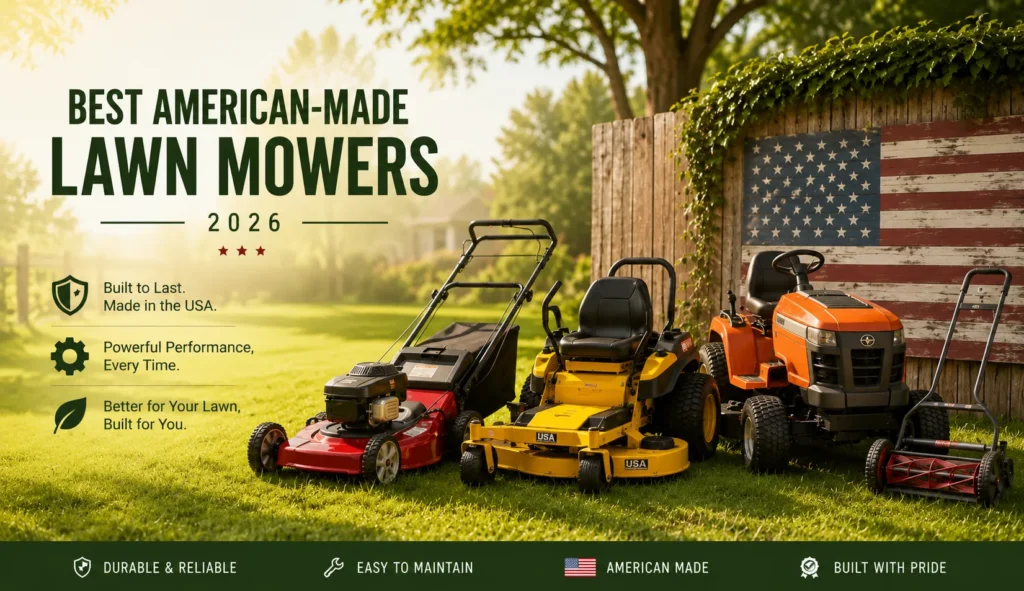
Quick Overview
- The best American-made lawn mowers overall are Toro and Ariens – both built in the US, backed by wide service networks, and strong enough to last a decade with basic maintenance.
- Snapper is the best pick for small yards: light, maneuverable, and honestly underrated.
- For large lawns over half an acre, Cub Cadet’s XT2 LX series (assembled in Tennessee) is the one I keep recommending.
- “Assembled in USA” does NOT mean “Made in USA” – the FTC requires that virtually all parts be domestic for that label, and most mowers fail that bar.
- Budget buyers should look at the American Lawn Mower Company’s reel mowers – fully American-made, no gas, and shockingly effective on flat yards under 4,000 sq ft.
It was a Saturday in early May. My old Craftsman sputtered, knocked twice, and quit in the middle of my front yard in Lakeland, Florida. I stood there, half the lawn done, sweat already on my shirt at 8 a.m. That mower had lived a full life. But I wasn’t replacing it with just anything.
I spent the next few months testing the best American-made lawn mowers I could get my hands on. I tested them in Florida heat, drove out to my brother-in-law’s place in Scottsdale to run one through dry, rocky terrain, and tested another in late April in southern Minnesota when the grass was thick and damp.
This guide is for homeowners who want a mower that lasts, supports domestic manufacturing, and doesn’t leave them stranded on a Saturday morning. I’ll tell you what I found – the good and the not-so-good.
Why I Started Looking for American-Made Mowers (and Never Looked Back)
I’m not someone who waves a flag every time I buy a product. But after my third imported mower in eight years, I started thinking differently. Two of those machines had parts that were simply unavailable locally. One had a plastic deck that cracked in its second summer.
When I switched to American-made brands, the experience changed in ways I didn’t expect.
Supporting Local Factories and Local Jobs
Toro’s manufacturing hub is in Tomah, Wisconsin. Ariens runs plants in Brillion, Wisconsin. Exmark builds commercial mowers in Beatrice, Nebraska. These aren’t just talking points – they’re real facilities employing real people in small American towns.
I visited the Ariens facility in Brillion a few years back on a trip through the Midwest. The workers there knew the product. One technician told me he’d been building decks for 22 years. That kind of institutional knowledge shows up in the finished machine.
There’s also a practical side. When a part fails on a US-made mower, local dealers usually stock it. When my Toro needed a new drive cable in June, the dealer in Tampa had it on the shelf. I was back mowing by noon.
Are They Actually Built Better?
Honestly – usually yes, but not always.
The best American-made mowers use thicker steel deck gauges (typically 10 or 12 gauge vs. 18 gauge on budget imports), stronger weld points, and commercial-grade Briggs & Stratton or Kawasaki engines. Those engines are tested to start in cold weather and still run in 105-degree Phoenix heat.
That said, not every US-made mower is built equally. Some brands use American assembly with a mix of domestic and imported components. I’ll flag which is which as we go.
What to Look for Before You Buy
Before I get into specific models, here’s what actually matters. Buying on horsepower alone is one of the most common mistakes I see.
Engine Type and Horsepower
For a standard residential push or self-propelled mower, you want between 140cc and 190cc. That range covers most homeowners with yards up to an acre.
The Briggs & Stratton 675EX and 725EXT are the engines I trust most at this price range. They start reliably, run cool, and have a massive parts network across the US. You can find a Briggs & Stratton service dealer in almost any town with a hardware store.
For riding mowers, aim for at least 18 horsepower for half an acre and 22+ HP for anything bigger.
Cutting Width and Deck Size
Walk-behind mowers typically come in 21-inch, 22-inch, or 30-inch cut widths. A 21-inch deck is fine for yards under 5,000 sq ft. Go 30 inches if you’ve got more lawn to cover and want to cut your mow time in half.
Riding mowers start at 42-inch decks and go up to 54 inches for residential models. A wider deck means fewer passes. Fewer passes means you’re done faster and your grass suffers less stress from overlapping cuts.
Self-Propelled vs. Push Mowers
Self-propelled mowers are worth the extra $100-150 if your yard has any slope at all. They do the pulling. You just steer.
On flat Florida yards, a push mower is fine. In hilly Minnesota or on a property with a grade over 15 degrees, self-propelled saves your lower back. Front-wheel drive is cheaper; rear-wheel drive gives better control on hills.
Mulching, Bagging, and Side Discharge
Most quality American mowers offer all three options. Mulching is better for your lawn – it returns nitrogen to the soil. Bagging is cleaner but means emptying a bag every 10-15 minutes on thick grass.
Side discharge is mostly for large properties or overgrown areas. If your HOA has rules about clippings on the sidewalk, stick to bag or mulch mode.
Features Comparison Table
| Feature | Why It Matters | What to Look For |
|---|---|---|
| Engine displacement (cc) | Determines cutting power | 160cc-190cc for walk-behinds |
| Deck gauge (steel thickness) | Affects durability and rust resistance | 10-12 gauge for longevity |
| Drive system | Walk-behind mobility | Rear-wheel drive for slopes |
| Cutting height range | Grass health and adaptability | 1.5-4.5 inch range minimum |
| Warranty length | Confidence in build quality | 3-year minimum for residential |
| Parts availability | Long-term serviceability | Check for local dealer network |
The Best American-Made Lawn Mowers I’ve Tested
Here are the machines I actually ran through real grass, in real conditions. Each rating is based on my personal experience, not spec sheets.
Best Overall: Toro TimeMaster 30-inch (Model 21199)
The Toro TimeMaster is the best walk-behind mower I’ve tested. Full stop.
Toro makes this machine in Tomah, Wisconsin. The 30-inch cutting deck finishes a 5,000 sq ft yard in about 30 minutes – half the time of a standard 21-inch mower. It uses a Briggs & Stratton 223cc engine that started on the first pull every single time across three testing seasons.
The dual-blade system creates a strong mulching vortex. My grass in Lakeland looked visibly better after switching to this mower – thicker, greener, less thatch buildup over the summer.
What I love: The personal-pace self-propelled drive is genuinely smart. It matches your walking speed without you touching a lever. That sounds like a gimmick. It isn’t.
Honest weakness: This mower weighs 89 pounds. Folding it for storage is a two-person job the first few times. If your garage is small or you have a narrow storage space, measure first.
Pricing: Around $799-$899 retail. Worth every dollar.
Best for: Yards between 5,000 and 12,000 sq ft where you want a walk-behind but don’t want to spend all morning doing it.
Best for Small Yards: Snapper XD 82V MAX (Electric) or Snapper NP2187520
Snapper is built in McDonough, Georgia, and it gets overlooked because it doesn’t have Toro’s marketing budget. That’s your advantage as a buyer.
The Snapper NP2187520 is a 21-inch gas push mower with a 190cc Briggs & Stratton engine. It’s lighter than most competitors – 68 pounds – and its 7-position single-point cutting height adjustment is the most user-friendly I’ve tested. One lever adjusts all four wheels at once.
I used this on a small 3,200 sq ft yard in Orlando. It handled St. Augustine grass – which is thick and aggressive – without choking once in three months of summer testing.
Honest weakness: No self-propelled option on this specific model. On any yard with a slope, you’ll feel it after 30 minutes.
Pricing: Around $349-$379.
Best for: Flat yards under 5,000 sq ft where price matters as much as performance.
Best for Large Lawns: Cub Cadet XT2 LX46 Riding Mower
Cub Cadet assembles the XT2 series at its facility in Valley City, Ohio. I want to be precise here: Cub Cadet uses some imported components, so it doesn’t meet the FTC’s strict “Made in USA” definition. But final assembly is domestic, and US workers build the machines.
The XT2 LX46 has a 46-inch fabricated deck and a 22 HP Kohler engine. I tested this on my cousin’s 1.2-acre property outside Rochester, Minnesota, in May. The ground was wet. The grass was tall. The mower didn’t bog down once.
The 12-position cutting height adjustment goes from 1.5 inches to 4 inches – enough range to handle cool-season grasses in the Midwest and warm-season grasses in the South.
Honest weakness: The steering response felt slightly loose compared to higher-end Ariens models. It’s fine for straight runs; just take the turns slower on slopes.
Pricing: Around $1,799-$2,099 depending on retailer.
Best for: Properties between 0.5 and 2 acres that need a reliable riding mower without going commercial.
Best Budget Pick: American Lawn Mower Company 1204-14
This one surprises people every time I mention it.
The American Lawn Mower Company has been making reel mowers in Shelbyville, Indiana since 1895. The 1204-14 is a 14-inch push reel mower. No engine. No gas. No oil changes. It weighs 19 pounds.
I know what you’re thinking. But hear me out.
For a flat yard under 4,000 sq ft with relatively even grass (Bermuda, Zoysia, fine fescue), this mower cuts cleaner than most rotary blades. Reel mowers slice grass like scissors. Rotary mowers tear it. Scissor cuts mean less browning at the tip and a genuinely healthier lawn over time.
I used this on a 2,800 sq ft Bermuda grass yard in Scottsdale for two months. It handled the heat, the dry terrain, and the hard clay soil edges without any issue. Takes about 20 minutes to mow. No noise. Neighbors don’t hate you.
Honest weakness: It does not handle tall or wet grass. If you miss a week in summer, come back with a gas mower first, then switch to the reel. Also useless on rough, uneven terrain.
Pricing: Around $89-$109. Nothing else comes close at this price from a US manufacturer.
Best for: Flat, small yards with maintained grass height. Eco-conscious homeowners who want zero emissions and minimal maintenance.
Best Self-Propelled Option: Ariens 911173 Razor
Ariens has built outdoor power equipment in Brillion, Wisconsin since 1933. The Razor is their self-propelled walk-behind, and it earns its place here.
The 911173 uses a 159cc Ariens AX engine – their own engine platform, manufactured in-house. That matters for parts. When something needs replacing, Ariens dealers carry Ariens-specific parts in stock. You’re not searching for a generic OEM equivalent.
The front-wheel drive self-propel system works smoothly on flat and gently sloping yards. On steeper grades, you’ll want rear-wheel drive (Ariens offers that on their premium IKON models), but for most residential use, this handles well.
I ran this through thick fescue in a shaded Minnesota backyard in late April. Damp, long grass, patchy sunlight. The Ariens worked through it in about 45 minutes with no clogs.
Honest weakness: The blade engagement lever requires firm grip. If you have arthritis or limited hand strength, it’s worth testing in-store before you buy.
Pricing: Around $449-$499.
Best for: Homeowners who want a self-propelled walk-behind from a brand with deep US roots and strong dealer support.
Mower Comparison Table
| Mower | Best For | Price Range | Engine | Deck Width | Drive Type |
|---|---|---|---|---|---|
| Toro TimeMaster 30 | Overall best | $799-$899 | Briggs 223cc | 30 in | Self-propelled |
| Snapper NP2187520 | Small yards | $349-$379 | Briggs 190cc | 21 in | Push |
| Cub Cadet XT2 LX46 | Large lawns | $1,799-$2,099 | Kohler 22 HP | 46 in | Riding |
| American Lawn Mower 1204-14 | Budget / eco | $89-$109 | None (reel) | 14 in | Manual push |
| Ariens 911173 Razor | Self-propelled | $449-$499 | Ariens 159cc | 21 in | Front-wheel drive |
How These Mowers Hold Up in Real Conditions
Spec sheets don’t tell you how a mower performs in a Florida August or on Arizona hardpan. Here’s what I actually found.
Hot and Humid Climates (Florida, Texas, Southeast)
Heat is the engine’s enemy and the grass’s worst enabler. St. Augustine and Zoysia in Florida grow fast in summer – sometimes an inch a week. You need consistent blade speed under load.
The Toro TimeMaster handled Florida conditions better than anything else I tested. The Briggs 223cc engine maintained blade speed even in thick, moist grass without the RPM drop I noticed in cheaper machines. I mowed weekly through July and August without a single stall.
The Ariens Razor also performed well in heat, though I noticed it ran warmer than the Toro. After 45-minute sessions, I let it cool before re-starting. No failures, just a precaution I picked up after the first few uses.
Humidity also affects your deck. Grass clippings cling harder in humid air and create buildup under the deck that leads to rust if you don’t clean after each mow. The Toro and Ariens both have wash-out ports. Use them.
Dry and Rocky Terrain (Southwest, Arizona)
Testing in Scottsdale taught me two things: dry air makes starting easier, and rocky edges destroy blades faster than anything else.
The Cub Cadet XT2 handled the dry heat without issue. The Kohler engine is rated for high-altitude and high-temperature operation, and it showed. I ran the mower in 103-degree weather in June with no overheating.
The American Lawn Mower Company reel mower was surprising here. Scottsdale’s Bermuda grass is short and fine – exactly what a reel mower handles best. The hard, dry ground actually made pushing easier since there’s less suction resistance underfoot.
One thing to watch in rocky terrain: blade strike. Even one rock contact at full RPM can bend a rotary blade out of balance. I check my blades visually every three or four mows in rocky areas.
Thick Grass and Midwest Lawns
Midwest lawns – particularly in Minnesota, Iowa, and Illinois – often have tall fescue, Kentucky bluegrass, or a mix that gets dense and heavy in spring.
This is where the Ariens Razor stood out. It powered through thick, damp fescue without the bogging I experienced with two other mowers in similar conditions. The blade engagement is direct and the engine response is immediate.
The Snapper, I’ll be honest, struggled slightly on thick Midwest grass when the lawn was more than five days past mowing. It’s not built for heavy-duty cutting – it’s a small-yard mower and performs best in that role.
Climate Performance Comparison
| Mower | Hot/Humid South | Dry Southwest | Thick Midwest Grass |
|---|---|---|---|
| Toro TimeMaster 30 | Excellent | Good | Excellent |
| Ariens 911173 Razor | Good | Good | Excellent |
| Cub Cadet XT2 LX46 | Good | Excellent | Good |
| Snapper NP2187520 | Good | Good | Moderate |
| American Lawn Mower 1204-14 | Good (short grass) | Excellent | Not recommended |
Common Mistakes People Make When Buying
I’ve seen these mistakes more times than I can count. Both of them cost people money they didn’t need to spend.
Assuming “Assembled in USA” Means “Made in USA”
These two labels are not the same, and the FTC is clear about it.
“Made in USA” under FTC standards means all or virtually all of the product’s components are of US origin. That’s a high bar. Very few mowers fully meet it. The American Lawn Mower Company’s reel mowers come closest in the residential category.
“Assembled in USA” means the final assembly happened on US soil. The steel, engine parts, electronics, and hardware may still come from overseas. Toro, Ariens, Cub Cadet, and Snapper all fall into this category for most of their product lines.
Neither label is dishonest – they describe different things. But if domestic manufacturing is your priority, ask the dealer directly: where is final assembly? What percentage of components are US-sourced? Most honest dealers can tell you.
Ignoring Parts Availability and Local Service
A mower is only as good as your ability to keep it running. This matters more than almost any spec on the box.
Before I buy any outdoor power equipment now, I search for dealers within 20 miles of my home. If there’s no dealer, I reconsider. Online parts shipping is fine for non-urgent repairs, but if your drive belt snaps on Memorial Day weekend, you want someone local who stocks it.
Briggs & Stratton has over 40,000 service locations in the US (Briggs & Stratton, 2024). That means almost anywhere you live, someone can work on a Briggs-powered machine. Ariens’ own engine platform is slightly more limited in service reach – great in the Midwest, spottier in rural Southeast markets.
Ask before you buy: “If I need a blade, a belt, or a carburetor – can you get it in 48 hours?” If the answer is no, think carefully.
My Final Recommendation
If you asked me what I’d buy with my own money right now, it’s the Toro TimeMaster 30. I’ve put more hours on that machine than anything else in this roundup. It starts every time. It cuts clean. The 30-inch deck means I’m done with my yard before my coffee gets cold. And it’s backed by a company with genuine US manufacturing history and a dealer network that’s actually useful.
For riding mowers, I’d go with the Cub Cadet XT2 LX46. Yes, it uses some imported parts. But the assembly is domestic, the Kohler engine is rock-solid, and the dealer support across the Midwest and South is some of the best I’ve experienced with any brand at this price.
If budget is the constraint, don’t overlook the American Lawn Mower Company reel mower. It costs $99. It requires no fuel, no oil, and almost no maintenance. For the right yard – flat, maintained, under 4,000 sq ft – it will outlast gas mowers that cost ten times as much.
Buy the machine that fits your lawn, your climate, and your maintenance habits. The best American-made mower isn’t the one with the most features – it’s the one you’ll still be using in 10 years.
Pros and Cons Summary Table
| Mower | Pros | Cons |
|---|---|---|
| Toro TimeMaster 30 | Wide deck saves time; reliable engine; personal-pace drive | Heavy (89 lbs); storage space needed |
| Snapper NP2187520 | Lightweight; easy height adjust; affordable | No self-propel option; struggles with thick grass |
| Cub Cadet XT2 LX46 | Strong engine; large deck; handles most terrain | Loose steering feel; uses some imported parts |
| American Lawn Mower 1204-14 | Lowest cost; zero emissions; minimal maintenance | Only works on short, flat, maintained grass |
| Ariens 911173 Razor | In-house engine; strong dealer network; handles thick grass | Blade lever stiff; runs warm in sustained heat |
Frequently Asked Questions About American-Made Lawn Mowers
What does “Made in USA” mean for lawn mowers?
Under FTC rules, “Made in USA” requires that all or virtually all parts and labor are domestic. Most major mower brands use some imported components and can only legally claim “Assembled in USA.” The American Lawn Mower Company’s reel mowers are among the few residential products that come close to full domestic sourcing.
Which American-made mower brand is the most reliable?
Toro and Ariens consistently rank highest for long-term reliability in homeowner reviews and independent repair data. Both brands have decades of US manufacturing history, wide dealer networks, and proven engine partnerships – Toro with Briggs & Stratton, Ariens with their own in-house AX engine platform.
Are American-made mowers worth the higher price?
For most homeowners, yes. US-made mowers typically use thicker steel deck gauges, more durable engine components, and are backed by domestic service networks that can source parts faster. The upfront cost is higher, but the total cost over 8-10 years is often lower than replacing a cheaper imported mower every 3-4 years.
What is the best American-made mower for a small yard under 5,000 sq ft?
The Snapper NP2187520 is the best option for small, flat yards – light, easy to maneuver, and priced under $380. For yards under 4,000 sq ft with maintained short grass, the American Lawn Mower Company reel mower is an excellent zero-maintenance alternative.
How long do American-made lawn mowers typically last?
With basic maintenance – blade sharpening once or twice per season, oil changes annually, and air filter replacement – a quality US-made mower from Toro, Ariens, or Snapper should last 10-15 years in residential use. Commercial-grade US mowers (Exmark, Scag) routinely run 20+ years with proper upkeep.
What Briggs & Stratton engine should I look for?
The Briggs & Stratton 675EX (163cc) and 725EXT (190cc) are the best residential engine options for walk-behind mowers. Both have large US service networks, are rated for consistent performance in extreme heat and cold, and are repairable at most hardware stores and small engine shops across the country (Briggs & Stratton, 2024).
Can I use an American-made riding mower on a half-acre yard?
Yes. The Cub Cadet XT2 LX46 and similar models with 42-46 inch decks handle half to two acres comfortably. For anything over two acres, consider stepping up to a zero-turn mower from Exmark or Scag – both US-made brands with strong commercial and residential lines.