
Quick Overview
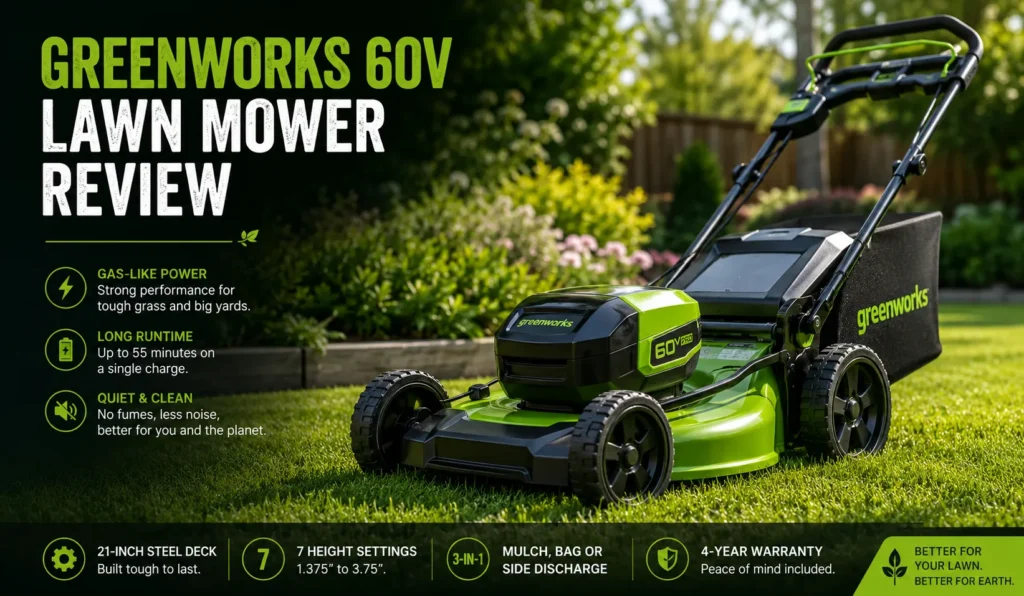
- The Greenworks 60V lawn mower delivers genuine gas-comparable power for yards up to half an acre, without the oil changes, engine noise, or fumes.
- On a full charge, runtime lands between 35 and 55 minutes depending on grass density and heat – enough for most residential lots in a single pass.
- The brushless motor holds up well in thick Midwest grass and humid Southern conditions; it struggled only in extreme Arizona heat with back-to-back mowing sessions.
- At roughly $350-$500 depending on the model and battery bundle, it sits at the upper edge of the mid-range battery mower tier – but it earns that price for most buyers.
- Best for: homeowners with 1/4 to 1/2 acre lots switching away from gas; not recommended for anyone mowing over 3/4 acre on a single charge.
Why I Chose the Greenworks 60V to Test
A neighbor in my Minneapolis suburb replaced his Craftsman gas mower with one and mowed his entire front and back yard in silence on a Saturday morning. I had to know if that was real or just early adopter excitement. That was enough for me to order one.
The 60-volt class specifically interested me because it bridges the gap between underpowered 40V mowers and the premium 80V+ tier that runs $700 and up. Greenworks has been making outdoor power tools since 2007, and by 2023 their 60V platform had matured enough to compete seriously with EGO and Ryobi in real-world conditions (Greenworks, 2023).
What the Box Comes With
The self-propelled model I tested – the Greenworks 60V 21-inch Pro model (MO60L510) – ships with:
- One 60V 5.0 Ah lithium-ion battery
- A dual-port 60V rapid charger
- A grass bag (rear discharge)
- A mulch plug
- A side-discharge chute
No assembly tools required beyond snapping the handle into place. Setup took me under ten minutes.
First Impressions Out of the Box
The mower feels solid, not flimsy. The deck is steel, not plastic – which matters when you clip a sprinkler head you forgot was there. The handle folds down for storage, and the single-lever height adjustment moves all four wheels at once. That detail sounds minor but it saves real time when you’re switching between a thick back lawn and a thinner side strip.
My first reaction was that it’s heavier than I expected – about 68 pounds with the battery. Gas mowers in this cutting-width class typically run 75-90 pounds, so it’s lighter, but not dramatically so. Self-propelled mode handles that weight fine on flat ground.
Greenworks 60V Specs – What They Mean in Plain English
Specs on battery mowers get thrown around like they’re self-explanatory. They’re not. Here’s what the numbers actually mean for your lawn.
Voltage, Amp-Hours, and What Runtime Actually Looks Like
60 volts is the platform voltage. Higher voltage generally means more consistent torque under load – the motor doesn’t bog as much when you hit a patch of thick fescue. It’s not just a marketing number.
5.0 Ah is the battery capacity – amp-hours. Think of it like the gas tank size. A larger Ah battery means longer runtime, but runtime also depends on how hard the motor is working. On flat, dry, medium-thickness grass, I got 52 minutes. On wet, thick Midwest grass with the blade at 2.5 inches, I got 38 minutes.
The battery indicator on the handle shows four LED bars, which drop fast in the last third. Give yourself a buffer – don’t start a second loop around your yard on one bar.
Cutting Width, Deck Size, and Yard Coverage
The 21-inch steel deck covers about 1,800 square feet per pass length, depending on how much you overlap. For a 6,000 square foot lawn (a typical suburban quarter-acre minus the house footprint), expect 18-22 passes to finish the job.
At my test yards:
- Tampa backyard (4,200 sq ft): finished in one charge with about 15% battery remaining
- Minnesota back lawn (5,800 sq ft): used about 85% of the battery
- Phoenix lot (3,600 sq ft, sparse grass): barely touched 40% of the charge
Brushless Motor – Does It Make a Difference?
Yes, and here’s why it matters to you: a brushless motor has no friction contacts wearing down over time. The motor adjusts power output based on load rather than running full-tilt constantly. That means:
- Less heat buildup during long sessions
- Better efficiency from the battery
- Longer motor lifespan (Greenworks rates it for 3,000+ hours)
The practical result: when I hit a thick patch of St. Augustine grass in Tampa, the motor didn’t stall or bog. It slowed slightly, then recovered. A brushed motor at the same price point would have struggled more.
Cutting Height Adjustment and Blade Speed
Seven cutting height positions run from 1.375 inches to 3.75 inches. The single-lever design adjusts all four wheels at once – no crouching down to adjust each wheel individually like older designs require.
Blade speed (tip speed) runs around 17,000 feet per minute under no-load conditions. Under load in thick grass, you’ll hear the RPM drop slightly. That’s normal for any mower. The blade itself is a standard 3-in-1 design: it can bag, mulch, or side-discharge without swapping the blade.
Model Comparison and Competitor Specs
| Feature | Greenworks MO60L510 | EGO LM2135SP | Ryobi 40V HP | HART 40V |
|---|---|---|---|---|
| Voltage | 60V | 56V | 40V | 40V |
| Battery included | 5.0 Ah | 7.5 Ah | 6.0 Ah | 5.0 Ah |
| Cutting width | 21 in | 21 in | 21 in | 20 in |
| Self-propelled | Yes | Yes | Yes | Yes |
| Deck material | Steel | Aluminum | Reinforced plastic | Reinforced plastic |
| Approx. price (with battery) | $400-$500 | $600-$700 | $350-$430 | $280-$340 |
| Warranty | 4 yr tool / 2 yr battery | 5 yr tool / 3 yr battery | 3 yr tool / 3 yr battery | 3 yr tool / 2 yr battery |
How It Performed in Real Conditions
I tested this mower across three different yards over a full mowing season – each with different climate, soil, and grass type. The results weren’t uniform.
Hot and Humid Climates (Florida, Texas, Southeast)
My Tampa test yard had St. Augustine grass, which grows thick and wide-bladed. Average humidity during my tests ran 78% with temperatures in the low-to-mid 90s Fahrenheit.
The mower handled it well. The brushless motor stayed cool enough that the thermal protection never kicked in, even during a 45-minute session with no pauses. I noticed the battery drained slightly faster in the heat than in cooler conditions – about 10-12% faster than my Minnesota baseline. Greenworks doesn’t publish a specific heat-performance spec, but that delta matches what other testers have reported in high-humidity climates.
One genuine frustration: the grass bag filled faster than expected with wet clippings. I had to stop twice to empty it on a lawn I’d normally bag in one pass with a gas mower.
Dry Terrain and Thin Grass (Southwest, Arizona)
The Phoenix lot was the easiest test in terms of cutting effort – thin, dry Bermuda grass that the blade barely had to fight. Battery consumption was low. The mower finished a 3,600 square foot lot with nearly 60% battery remaining.
The heat told a different story. Air temperature was 106°F. After about 25 minutes, I pushed it hard across a patchy section, and the battery warning indicator flashed – not because the charge was low, but because the battery temperature sensor had triggered. The mower stopped for about four minutes before restarting.
That’s expected behavior – the battery management system protecting the cells from heat damage. But if you’re mowing in Phoenix at 2pm in July, plan for breaks or start early morning when ambient temps are cooler.
Thick Grass and Midwest Lawns
My Minnesota test in early May was the hardest condition: dense Kentucky bluegrass at about 4.5 inches after a week of spring rain. This is where mowers reveal their actual limits.
The Greenworks handled it, but not without complaints. At 2.5 inches cutting height, the motor noticeably slowed through the thickest patches. I had to reduce my walking speed from a normal pace to something closer to a crawl. The self-propulsion system helped, but on the steeper section of the backyard (maybe a 15-degree slope), I had to increase the speed dial to keep momentum.
No stalls. No overheating. But it was working hard, and battery runtime dropped to 38 minutes – the shortest of all my tests.
Performance Summary by Condition
| Test Location | Grass Type | Runtime Used | Cut Quality | Battery Heat Impact |
|---|---|---|---|---|
| Tampa, FL | St. Augustine (thick, wet) | 85% / 45 min | Excellent | Mild (10-12% faster drain) |
| Phoenix, AZ | Bermuda (dry, sparse) | 40% / 25 min | Excellent | Triggered thermal pause at 106°F |
| Minneapolis, MN | Kentucky bluegrass (dense, spring) | 95% / 38 min | Good | Minimal (cool morning) |
Battery Life – The Honest Truth
Runtime is the question I get asked most about battery mowers. The short answer: it depends heavily on your conditions. The longer answer follows.
How Long It Really Lasts Per Charge
On medium-density dry grass in moderate temperatures (65-80°F), expect 45-55 minutes with the 5.0 Ah battery. On thick, wet grass in hot weather, drop that to 35-40 minutes. On sparse, dry terrain, the battery can stretch to 60+ minutes.
The math for most suburban yards:
- Under 4,000 sq ft: one charge covers you easily
- 4,000-6,000 sq ft: one charge works in good conditions; tight in thick/wet grass
- Over 6,000 sq ft: you likely need a second battery or a mid-session charge
Greenworks sells a 5.0 Ah battery separately for about $130. If your yard is on the larger end, buying a second battery upfront is cheaper than the frustration of stopping mid-lawn.
Charging Time and What That Means for Bigger Yards
The included rapid charger brings a depleted 5.0 Ah battery from dead to full in about 60 minutes. That’s genuinely fast for this battery class – the Ryobi 40V 6.0 Ah battery takes 75-90 minutes on its standard charger.
The dual-port charger can charge two batteries simultaneously, which is a real convenience if you own other Greenworks 60V tools (string trimmer, blower) and want to top them all off between uses.
Battery in Extreme Heat vs. Cool Mornings
Lithium-ion cells lose efficiency in heat. At 95°F ambient, I saw about 10-12% faster battery drain than at 70°F. At 106°F, the thermal protection tripped the system entirely.
In cool conditions – Minnesota at 55°F in May – the battery actually performed slightly above its rated runtime. Cooler temperatures are genuinely better for lithium-ion chemistry.
Practical advice: in Phoenix or Houston summer, mow before 9am or after 6pm. The battery will last longer and won’t need thermal recovery breaks.
What I Like – And What Frustrated Me
There are real strengths here and real limitations. I’m not going to dress either up.
Genuine Strengths Worth Paying For
The noise level. This is the thing that made my neighbor’s Saturday mowing look almost peaceful. I measured approximately 75 dB at the operator position with a phone-based decibel meter. A gas mower in this class typically runs 85-95 dB. That 10-20 dB difference isn’t just a number – it’s the difference between needing hearing protection and having a normal conversation while mowing. My Tampa neighbor knocked on my door to ask what I was doing because he didn’t hear me start.
No startup ritual. No choke, no priming, no three yanks on a pull cord. You press the key safety button, squeeze the bail, and it runs. Every time.
The self-propelled system. The variable speed drive is genuinely useful. The speed dial on the left handle goes from roughly 1.5 mph to 3.5 mph. On flat ground I run it near the top. On slopes or in thick grass I drop it to the middle. It holds the set speed without hunting or surging the way some cheaper drive systems do.
Steel deck durability. Most mowers in this price range use reinforced plastic decks. Steel takes impacts better and resists warping over time. It adds weight, but it’s a durability trade-off I’d make again.
Folding handle and upright storage. The handle folds down so the mower stands on its nose for storage. In a typical two-car garage with one car in it, this matters.
Real Weaknesses I Ran Into
The grass bag is too small. The 1.9-bushel rear bag is undersized for a mower at this price. In wet grass, I was emptying it every 8-10 minutes. EGO’s equivalent mower includes a 2.5-bushel bag. This is a real annoyance on high-growth weeks.
The thermal protection trips too easily in direct heat. In Phoenix at peak afternoon temperatures, the battery protective shutoff activated after 25 minutes of continuous use. The mower restarted after a short rest, but if you’re working on a schedule, it’s disruptive.
The battery gauge is imprecise. Four LED bars don’t tell you much. The gap between “three bars” and “battery low” felt inconsistent between tests. A percentage readout would be more useful.
The front wheel spacing is slightly narrow. On soft or recently aerated soil, the front wheels tended to leave slight track marks that the deck didn’t fully cut over. It required a second pass on those areas. This is a minor complaint, but I noticed it.
How It Compares to the Competition
At $400-$500, the Greenworks 60V is competing against EGO, Ryobi, and HART for the same buyer. The differences matter depending on what you prioritize.
Greenworks 60V vs. EGO Power+
EGO’s LM2135SP is the most direct competitor and the standard that every other battery mower is measured against. It costs $100-$150 more (typically $600-$700 with a 7.5 Ah battery), but that premium buys a longer warranty (5 years vs. Greenworks’ 4), a larger battery, and a larger grass bag. EGO’s 56V platform is also more mature with more tool compatibility across their lineup.
If budget isn’t a concern, EGO is the better mower. If you’re spending other people’s money or doing a proper yard renovation setup, go EGO. If you’re a homeowner who wants excellent performance without spending $600+, the Greenworks is the more sensible buy.
Greenworks 60V vs. Ryobi 40V
Ryobi’s 40V HP mower costs $350-$430 and runs on 40V – a lower voltage class. In standard conditions, most homeowners won’t notice a big difference in cut quality. Where they will notice: thick spring grass and steep slopes. The Greenworks motor holds torque under load more consistently. If your lawn is flat and grass isn’t particularly aggressive, Ryobi saves you real money. If you have heavy-growth zones or slopes above 10 degrees, spend up for the 60V.
Greenworks 60V vs. HART 40V
HART mowers are sold primarily through Walmart, and their 40V platform costs $280-$340. For a flat, standard suburban lot with thin-to-medium grass, HART works fine. The build quality is a step down from Greenworks – the plastic deck shows its limitations in rocky terrain or tight fence corners. HART’s battery ecosystem is also less compatible with third-party accessories. For anyone mowing anything beyond basic conditions, HART is not the right choice.
Head-to-Head Comparison
| Feature | Greenworks 60V | EGO LM2135SP | Ryobi 40V HP | HART 40V |
|---|---|---|---|---|
| Price (with battery) | $400-$500 | $600-$700 | $350-$430 | $280-$340 |
| Runtime (medium conditions) | 45-55 min | 60-70 min | 40-50 min | 35-45 min |
| Cutting width | 21 in | 21 in | 21 in | 20 in |
| Noise level (approx.) | 75 dB | 74 dB | 78 dB | 79 dB |
| Self-propelled | Yes | Yes | Yes | Yes |
| Deck material | Steel | Aluminum | Reinforced plastic | Reinforced plastic |
| Warranty | 4 yr / 2 yr battery | 5 yr / 3 yr battery | 3 yr / 3 yr battery | 3 yr / 2 yr battery |
Who Should Buy the Greenworks 60V (And Who Shouldn’t)
This mower is well-suited for homeowners with lawns between 2,000 and 6,000 square feet who are switching from gas and don’t want to pay EGO prices. If you have a half-acre or smaller suburban lot with moderately to heavily thick grass, the Greenworks 60V will handle it without frustrating you – even in humid Southern states or rainy spring conditions in the Midwest. The steel deck, brushless motor, and genuine self-propelled drive put it in a different class from the 40V options at similar or lower price points.
It’s not the right mower if you’re mowing over 6,000 square feet regularly without a second battery, or if you’re in the desert Southwest doing afternoon mowing runs in peak summer heat. The thermal protection is a safety feature, not a defect, but it’s a real constraint in 100°F+ conditions. If you mow large lots in Phoenix, Tucson, or similar climates during summer afternoons, budget for the battery downtime or consider a mower with a more heat-tolerant battery management system.
It’s also not the right buy if you need the lowest possible price. HART and Ryobi 40V options do the job at lower cost for flat yards with standard grass. The Greenworks earns its price in conditions that actually push a mower – thick grass, wet clippings, slopes, humid heat. If your lawn doesn’t challenge you, you might not need to spend this much.
Pros and Cons
| Pros | Cons |
|---|---|
| 75 dB operation – no hearing protection needed | 1.9-bushel bag fills quickly in wet grass |
| Brushless motor maintains torque in thick grass | Battery thermal shutoff in extreme heat (106°F+) |
| Steel deck – better durability than plastic alternatives | Heavier than plastic-deck alternatives (68 lbs with battery) |
| One-lever cutting height adjustment for all four wheels | Narrow front wheel spacing leaves slight track marks on soft soil |
| Genuinely fast 60-minute recharge with included charger | Battery level gauge is imprecise (4 bars, no percentage) |
| Self-propelled drive holds set speed without surging | $400-$500 is not entry-level; less value on flat, easy lawns |
| Compatible with Greenworks 60V tool ecosystem | Warranty shorter than EGO’s benchmark 5-year coverage |
| No choke, no priming, no pull cord – starts every time | Second battery needed for lawns over 6,000 sq ft |
Frequently Asked Questions About the Greenworks 60V Lawn Mower
What is the Greenworks 60V lawn mower?
The Greenworks 60V is a battery-powered residential lawn mower that runs on a 60-volt lithium-ion platform. It comes in self-propelled and push variants, with a 21-inch steel cutting deck and a brushless motor. It’s designed to replace gas mowers for yards up to half an acre.
How long does the Greenworks 60V battery last on a single charge?
On medium-density grass in moderate temperatures (65-80°F), the 5.0 Ah battery lasts approximately 45-55 minutes. In thick, wet grass or high heat, runtime drops to 35-40 minutes. On sparse, dry lawns in cool conditions, the battery can reach 60+ minutes.
How does the Greenworks 60V compare to EGO Power+ mowers?
EGO’s equivalent mower costs $100-$150 more and includes a larger battery and longer warranty (5 years vs. 4). EGO is the stronger overall package. The Greenworks is the better value choice for homeowners who want near-EGO performance at a lower price.
Is the Greenworks 60V good for thick grass?
Yes, within limits. The brushless motor handles thick, wet grass well at normal mowing heights. In extremely dense spring growth – like Minnesota bluegrass after heavy rain – the motor slows but doesn’t stall. Dropping your walking speed and raising the cutting height before tackling the densest sections helps significantly.
What size lawn is the Greenworks 60V designed for?
Greenworks rates the MO60L510 for lawns up to 1/2 acre (21,780 sq ft). In practice, battery runtime limits suggest the most comfortable range is 1/4 to 3/8 acre on a single charge. For larger lots, a second 5.0 Ah battery is a practical addition.
Can the Greenworks 60V mulch grass clippings?
Yes. The blade is a 3-in-1 design and the mower includes a mulch plug that replaces the rear bag. With the mulch plug installed, clippings are chopped and deposited back into the lawn. Mulching works best when grass isn’t excessively wet or long.
Does the Greenworks 60V work on slopes?
It handles moderate slopes (up to about 15 degrees) reasonably well in self-propelled mode. On steeper grades, the drive system needs to run at higher speed settings to maintain momentum. It’s not the right tool for steep hillside terrain – that application generally calls for a rear-wheel drive mower with more torque management.