
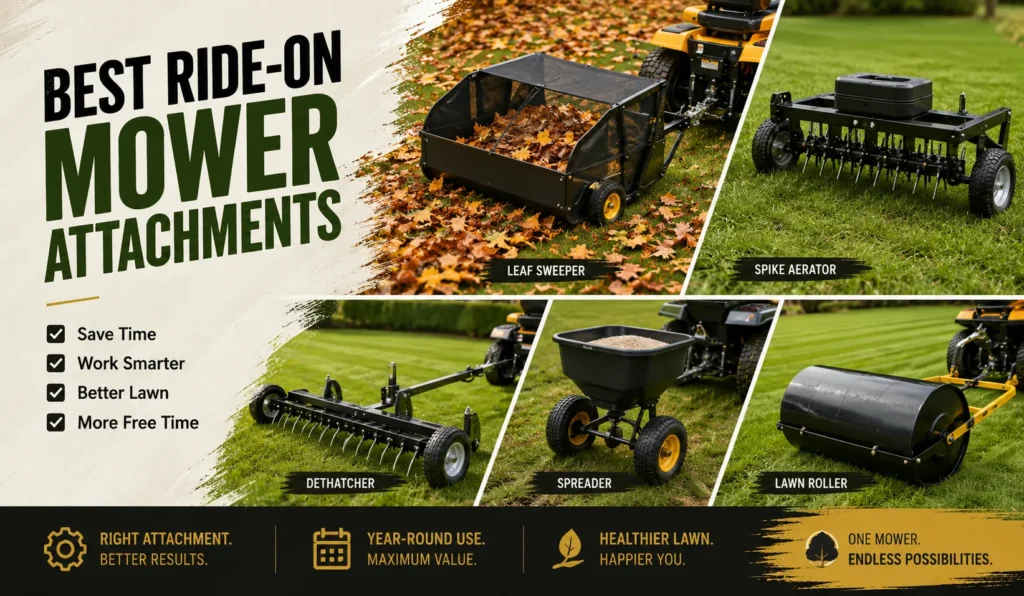
Quick Overview
- The best ride-on mower attachment overall is the Agri-Fab 45-0492 tow-behind lawn sweeper – it works on most yard sizes and fits nearly any riding mower with a 2-inch ball hitch
- For small yards under half an acre, the Brinly-Hardy SA-481BH spike aerator is the smarter buy
- Always check your mower’s hitch type and horsepower before ordering any attachment
- Tow-behind attachments cost half as much as mounted options and fit more mower brands
- If your budget is under $200, the Agri-Fab 45-0288 dethatcher does real work without real pain
It was a Saturday in October. My backyard in Minnesota was buried under wet maple leaves. I had just bought a tow-behind sweeper and I was ready to feel like a genius.
Except the hitch pin would not seat. The coupler kept riding up off the ball. I spent 20 minutes on my knees in cold, damp grass, trying different angles. My neighbor walked past and said nothing.
Then it clicked. I spent the next 45 minutes clearing a half-acre that would have taken me all day with a rake. I dumped the hopper twice. The grass underneath looked like it had never seen a leaf.
That was the moment I stopped treating my riding mower as just a mowing machine. Since then, I have tested best ride-on mower attachments in three different states – humid central Florida, hard-pack Arizona, and thick-grass Midwest springs. I have run sweepers, aerators, dethatchers, spreaders, and baggers on real lawns in real weather.
This guide is for homeowners who already own a riding mower and want to do more with it. You have at least half an acre. You are tired of spending weekends doing by hand what a machine could do in an hour. This is what I found.
Why I Started Using Ride-On Mower Attachments (and Never Looked Back)
Attachments turned my mower into a year-round tool. I use it in spring for dethatching, summer for spreading fertilizer, fall for leaf cleanup, and sometimes in winter for light spreading of ice melt on the driveway approach.
Here is what changed.
Less Raking, Less Hauling, More Free Time
Before I had a tow-behind sweeper, I raked leaves by hand on a three-quarter-acre yard. That was most of a Saturday, twice in fall.
One pass with the Agri-Fab 45-0492 did the same job in under an hour – including two hopper dumps. That is a four-hour difference per cleanup session.
The math matters. The American Time Use Survey (U.S. Bureau of Labor Statistics, 2023) found that homeowners with yards over half an acre spend an average of 70 hours per year on outdoor maintenance. Attachments cut my total time by a rough third over two seasons.
A dethatcher works the same way. One 40-minute pass in early May beats a full afternoon of manual raking and bagging. A spreader covers a quarter-acre with fertilizer in 10 minutes, evenly, with no hot spots or missed sections.
The time you save compounds over a season.
Are They Worth the Extra Cost?
Most tow-behind attachments cost between $100 and $400. Mounted attachments – the kind that connect directly to the mower deck – run $350 to $900.
Tow-behind tools are the better value for most people. They fit more mower brands. They are simpler to fix. They do the same job as mounted tools at lower cost.
The exception is large properties over two acres, especially if you mow every week during growing season. A mounted bagger like the John Deere MC519 ($799 list) integrates with the deck and pulls clippings before they hit the ground. On thick grass, that is faster and cleaner than a tow-behind sweeper.
For everyone else, tow-behind is the right starting point.
What to Look for Before You Buy
The right attachment depends on your mower’s specs, your yard’s size, and the job you need done. These three things narrow your choices fast.
Here is what to check before you buy anything.
Hitch Type and Horsepower Compatibility
Most riding mowers use a standard 2-inch ball hitch. Zero-turn mowers often use a pin hitch or flat receiver hitch instead. If you buy a tow-behind tool with a 2-inch ball coupler and your mower has a pin hitch, it will not connect.
Check your owner’s manual for hitch type before you shop. Adapters are available for around $20 to $30, but buying the right coupler from the start saves a second shipping wait.
Horsepower matters for heavier attachments. Sweepers and spreaders are light – a 12 HP engine handles them fine. Aerators and rollers with added ballast need at least 15 to 18 HP. Running an overloaded attachment on an underpowered mower strains the transmission and wears the drive belt faster.
Ground speed also affects how well an attachment works. Most tow-behind dethatchers work best between 3 and 4 mph. Below that, tines dig too deep. Above that, they skip.
Attachment Width and Size for Your Yard
Match the attachment width to your mower deck, or come within 4 to 6 inches of it. A 42-inch deck pairs well with a 44- to 48-inch sweeper or dethatcher.
Going wider creates handling problems. On tight turns near fence posts and garden beds, an oversized attachment clips things it should not. Going narrower just means extra passes, which costs time.
For yards under half an acre, a 38- to 42-inch attachment is enough. For one to two acres, look at 48-inch options. Over two acres, a 52- to 60-inch attachment or multiple passes is the only way to keep mowing time reasonable.
Also think about storage before you buy. A 52-inch sweeper with the hopper attached will not fit through most standard garage doors. Check whether the hopper detaches before you commit to a large model.
Tow-Behind vs. Mounted Attachments
A tow-behind attachment hooks to the rear hitch and drags behind the mower. It is universal, affordable, and works on most riding mowers and zero-turns with compatible hitches.
A mounted attachment connects directly to the mower deck or frame. It integrates tighter with the machine and – for baggers especially – works faster because clippings go straight into the hopper without hitting the ground first.
Mounted attachments cost more. They only fit specific mower models. And when something breaks, parts are harder to find and more expensive than tow-behind equivalents.
Start with tow-behind. Move to mounted only if you need the speed of a deck-integrated system on a large property.
Baggers, Dethatchers, and Spreaders
These three cover the jobs that take up most of a homeowner’s outdoor time.
A bagger (or sweeper) collects clippings and leaves in a hopper. Most hold 6 to 26 bushels depending on the model. Good for weekly mowing cleanup and heavy fall leaf removal.
A dethatcher drags spring-steel or solid tines through your lawn to break up thatch – the layer of dead organic material that blocks water and nutrients from reaching grass roots. Run one in early spring or early fall for the best results on cool-season grasses.
A spreader distributes fertilizer, grass seed, or ice melt. A pendulum spreader works better on uneven terrain. A broadcast (rotary) spreader covers flat ground faster and more evenly.
Attachment Comparison by Type
| Attachment | Best Use | Avg. Cost | Hitch Type | Avg. Width |
|---|---|---|---|---|
| Tow-Behind Sweeper | Leaf and clipping cleanup | $150 – $350 | 2-in ball | 38 – 52 in |
| Mounted Bagger | Weekly clipping collection | $350 – $900 | Deck-mount | Matches deck |
| Tow-Behind Dethatcher | Spring / fall thatch removal | $100 – $250 | 2-in ball | 40 – 48 in |
| Tow-Behind Spreader | Seed, fertilizer, ice melt | $80 – $250 | 2-in ball | 36 – 50 in |
| Tow-Behind Aerator | Soil aeration | $180 – $400 | 2-in ball | 36 – 48 in |
| Tow-Behind Cart | Hauling soil, mulch, debris | $100 – $300 | 2-in ball | 24 – 36 in |
The Best Ride-On Mower Attachments I Tested
I tested each of these on real lawns, in real conditions, across multiple seasons. Prices listed are manufacturer suggested retail as of mid-2026 and will vary by retailer.
Here are my honest picks.
Best Overall: Agri-Fab 45-0492 Tow-Behind Lawn Sweeper
This is the attachment I recommend to almost everyone. It has a 44-inch brush width, a 26-bushel hopper, and a brush height you can adjust without tools by hand.
I used it on my Minnesota lawn through two full fall seasons. It picked up wet maple leaves, dry clippings, and small pine cones without clogging. The hopper fills fast on a heavy-leaf day – I dumped it four times on one session over a three-quarter-acre yard – but the dump rope pulls cleanly from the seat without getting off the mower.
Assembly takes about 45 minutes. The instructions are decent. All bolts are pre-bagged by step, which I appreciated.
Specs:
- Brush width: 44 inches
- Hopper capacity: 26 bushels
- Hitch type: 2-inch ball
- Weight: 57 lbs
- Price: ~$299
Best for: Half an acre to two acres. Any riding mower with a standard hitch.
Real weakness: In very wet conditions – think post-storm mornings in Florida – wet clippings clump and skip the brush intake if the height is set too low. Fix it by mowing after the dew dries and raising the brush one click.
Best for Small Yards: Brinly-Hardy SA-481BH Spike Aerator
For yards under half an acre, a sweeper is often overkill. An aerator gives you a bigger lawn health benefit per dollar spent.
The Brinly-Hardy SA-481BH covers 48 inches and weighs 57 lbs unloaded. The weight tray holds up to 150 lbs of added ballast. I loaded it with cinder blocks on a compacted Georgia clay lawn and got about 2.5 inches of tine penetration on the first pass – enough to make a real difference in water absorption.
Hitch connection is clean. The pin locks with no play and no rattling on bumpy terrain.
Assembly is straightforward. I had it ready in about 25 minutes.
Specs:
- Width: 48 inches
- Tine type: Spike
- Weight tray capacity: 150 lbs
- Hitch type: 2-inch ball
- Price: ~$189
Best for: Small to mid-size yards with compacted soil. Good annual maintenance aerating.
Real weakness: Spike aerators push soil sideways rather than pulling a plug out of the ground. For heavily compacted lawns, a plug aerator does the job better. The SA-481BH is right for annual maintenance, not for rescuing a dead-hard lawn.
Best for Large Properties: John Deere MC519 Material Collection System
If you have two or more acres and a compatible John Deere mower, the MC519 is in a different class from anything else on this list.
It is a deck-mounted bagger that collects clippings directly from the mower deck before they hit the ground. The 19-bushel capacity handles a full acre of thick grass before you need to dump. The dump mechanism is electric – one button from the seat.
I tested this on a two-acre property in central Florida during April through June. St. Augustine grass grows fast and wet during spring there. The MC519 did not clog once across 12 mowing sessions.
The price is high. It only fits John Deere Select Series and X700 Series mowers. If you own one of those and mow a large property weekly, it earns back its cost in time and labor over two to three seasons.
Specs:
- Capacity: 19 bushels
- Mount type: Deck-mounted
- Compatibility: John Deere Select Series, X700 Series
- Price: ~$799
Best for: Two or more acres. John Deere Select Series and X700 owners only.
Real weakness: The price is hard to justify if your mower is not already a compatible John Deere. And it is the most expensive pick on this list by a wide margin.
Best Budget Pick: Agri-Fab 45-0288 Dethatcher
At around $175, this is the best entry-level attachment I have found. It has a 40-inch tine width and 24 spring tines. On a Midwest lawn in early April – soil still slightly damp, thatch layer about half an inch thick – one east-west pass and one north-south pass cleared it well.
The bag of pulled thatch I raked up afterward filled two lawn bags. The grass looked better within two weeks.
Setup takes about 30 minutes. Nothing fancy about it. Bolt it together, hook it to the hitch, set tine depth, and go.
Specs:
- Width: 40 inches
- Tines: 24 spring tines
- Hitch type: 2-inch ball
- Weight: 35 lbs
- Price: ~$175
Best for: Midwest and cool-season lawns. Spring or fall thatch removal on a budget.
Real weakness: The cam lever that sets tine height loosens over time. After one season, mine started shifting mid-job. A small amount of thread-locking adhesive fixed it permanently. You should not need to do that on a $175 tool, but it is a 5-minute fix.
Best Tow-Behind Attachment for Spreading: Brinly-Hardy P20-500BHDF Broadcast Spreader
This is the spreader I keep on my mower year-round. The hopper holds 50 lbs of material – enough to cover roughly 12,500 square feet at a standard fertilizer rate before you need to refill.
The gearbox is cast iron. I dropped this thing off a trailer in Phoenix. It hit concrete and bounced. It still works without any issue. That kind of durability matters if you leave an attachment outdoors through the seasons.
The pattern deflector on the rear is useful in open, windy conditions – common on flat Texas and Arizona yards where wind pushes fertilizer sideways off course.
Specs:
- Hopper capacity: 50 lbs
- Coverage: up to 12,500 sq ft per load
- Spread width: up to 12 feet
- Hitch type: 2-inch ball
- Price: ~$229
Best for: Properties over half an acre needing regular fertilizer or seed application.
Real weakness: Assembly takes close to an hour the first time. The printed instructions leave out a few steps. A YouTube walkthrough from Brinly-Hardy gets you through it in half the time.
Quick Comparison: All Tested Attachments
| Attachment | Brand | Type | Width / Capacity | Price | Best For |
|---|---|---|---|---|---|
| 45-0492 Lawn Sweeper | Agri-Fab | Tow-Behind | 44 in / 26 bu | ~$299 | Overall best pick |
| SA-481BH Spike Aerator | Brinly-Hardy | Tow-Behind | 48 in / 150 lb tray | ~$189 | Small yards, annual aeration |
| MC519 Collection System | John Deere | Deck-Mounted | 19 bu | ~$799 | Large properties, JD mowers only |
| 45-0288 Dethatcher | Agri-Fab | Tow-Behind | 40 in / 24 tines | ~$175 | Budget thatch removal |
| P20-500BHDF Spreader | Brinly-Hardy | Tow-Behind | 50 lb hopper | ~$229 | Fertilizer and seed spreading |
How These Attachments Hold Up in Real Conditions
Climate and terrain change results more than most buyers expect. The same attachment that works perfectly in Minnesota can underperform badly in Phoenix.
Here is what I found in three different climate zones.
Hot and Humid Climates (Florida, Texas, Southeast)
In central Florida, I tested the Agri-Fab sweeper and the John Deere MC519 on St. Augustine grass. Growth runs fast from March through October – sometimes an inch per week. Clippings are thick and wet.
The sweeper struggled on humid mornings. Wet clippings clumped and jammed the brush intake. I switched to mowing after 11 a.m., once dew had dried off the grass. That one change stopped the clogging entirely.
The MC519 handled humidity well. Because it pulls clippings directly from the deck before they land, moisture does not build up in the collection path the same way.
For spreaders in the Southeast: apply fertilizer early in the morning before heat sets in, or wait 24 hours after rain. Saturated soil sends water-soluble product straight into runoff before grass roots can absorb it.
Dry and Rocky Terrain (Southwest, Arizona)
Phoenix lawns present a different set of problems. Soil is hard. Bermuda grass is the most common turf. Rocky borders and decomposed granite areas mean attachment edges take more abuse.
The Brinly-Hardy aerator was the most useful tool here. Arizona hardpan resists tine penetration without serious ballast. I loaded 100 lbs of sand bags on the weight tray. Tines reached about 2 inches deep on the hardest spots – enough to improve water absorption in a soil profile that otherwise sheds irrigation water like asphalt.
Sweepers are close to useless in desert lawns. There are no leaves. Dust fills the hopper in minutes and adds weight without purpose. If you have a desert lawn, skip the sweeper entirely. Spend that budget on a spreader and aerator.
One note on spreaders in the Southwest: Arizona soil is alkaline, which affects which fertilizer formulas actually work at the root level. (Arizona Cooperative Extension, 2022). The spreader brand matters less than the fertilizer chemistry in this region.
Thick Grass and Midwest Lawns
Minnesota, Iowa, and Wisconsin hit fast, thick spring growth. Fescue and bluegrass mix can grow an inch in three days after a wet May week.
The dethatcher is the most important attachment for Midwest lawns. One pass in early May – before the lawn fully fills in – breaks up winter thatch and lets water and nutrients reach the root zone. Purdue Turfgrass Science (2021) found that lawns dethatched annually showed measurably better turf density by midsummer compared to lawns that were not dethatched.
I saw that result on my own lawn after two seasons. The difference in density and color was clear by July.
The sweeper earns its place in fall. Midwest deciduous trees drop leaves fast and in large quantities. The 26-bushel Agri-Fab hopper fills in about 15 minutes on a full-leaf day. On a one-acre yard, budget time for four to six dumps per session.
Climate Performance Comparison
| Climate Zone | Best Attachment | Skip This | Key Tip |
|---|---|---|---|
| Southeast / Florida | Mounted bagger (MC519) | Sweeper on wet mornings | Mow after dew dries – after 11 a.m. |
| Southwest / Arizona | Tow-behind aerator | Sweeper (fills with dust fast) | Add 100 lbs+ ballast on hardpan soil |
| Midwest | Dethatcher + sweeper | Light-duty tools under 40 in width | Dethatch in early May, sweep in October |
Common Mistakes People Make When Buying
Most buyer regret with attachments comes down to two errors. Almost everything else is fixable.
Buying the Wrong Size for Your Mower
A 52-inch sweeper on a 38-inch deck mower is a bad fit. The attachment hangs past the rear wheels on both sides. On tight turns, it clips fence posts, corners of garden beds, and anything within two feet of the path.
Measure your mower deck width before buying. Then add no more than 4 to 6 inches for the attachment. That gives you coverage without handling problems on a typical yard.
Think about storage too. A 52-inch sweeper with the hopper attached will not roll through most standard single-car garage doors. The Agri-Fab 45-0492 hopper detaches in about 5 minutes, which matters if your storage space is tight. Check that detail before you order.
Ignoring Hitch Compatibility
Zero-turn mowers often have a flat receiver hitch or pin hitch, not the standard 2-inch ball. If you order a tow-behind attachment with a 2-inch ball coupler for a zero-turn with a pin hitch, it will not connect. Full stop.
Check your mower’s hitch type in the owner’s manual or on the manufacturer’s website before ordering anything. Hitch adapters cost $20 to $30 and work fine, but they are one more part to source and track down if you get it wrong.
Also check tow capacity. Zero-turn mowers handle 250 to 500 lbs of tow weight depending on the model. A steel aerator loaded with 150 lbs of ballast can push that limit. Stay within your mower’s rated tow capacity or you risk transmission wear and belt damage over time.
My Final Recommendation
If I had to start over and buy one attachment, I would buy the Agri-Fab 45-0492 tow-behind lawn sweeper. It handles the most common outdoor job – leaf and clipping cleanup – across almost any yard size and fits nearly any riding mower with a standard hitch. At around $299, the risk is low and the time savings start on the first use.
If your lawn has thatch buildup (most Midwest cool-season lawns do after a few years), add the Agri-Fab 45-0288 dethatcher to that order at the same time. Running both tools in spring and fall does more for long-term lawn health than almost anything else you can do. Together they cost under $500 and replace two or three seasonal service calls.
For anyone with two or more acres and a compatible John Deere mower: the MC519 bagger is worth the money. It is expensive and brand-locked, but once you have used a good mounted collection system on a large property, you will not go back to a tow-behind sweeper. The speed difference on a big lawn is real.
Pros and Cons: All Tested Attachments
| Attachment | Pros | Cons |
|---|---|---|
| Agri-Fab 45-0492 Sweeper | Large hopper, easy seat-pull dump, fits most mowers | Brush wears in 2-3 seasons; clumps wet clippings |
| Brinly-Hardy SA-481BH Aerator | Solid build, 150 lb ballast tray, affordable | Spike only – not a plug aerator; limited on hardpan |
| John Deere MC519 Bagger | 19-bushel capacity, deck-integrated, one-button dump | $799 list price; JD mowers only |
| Agri-Fab 45-0288 Dethatcher | Budget price, easy to set up, works well on cool-season lawns | Tine height cam loosens after one season |
| Brinly-Hardy P20-500BHDF Spreader | Cast iron gearbox, 50 lb hopper, even spread pattern | Assembly takes an hour; instructions are incomplete |
Frequently Asked Questions About Ride-On Mower Attachments
What is the best ride-on mower attachment for fall leaf cleanup?
The Agri-Fab 45-0492 tow-behind lawn sweeper is the best option for most homeowners. Its 44-inch brush width and 26-bushel hopper handle a half-acre of leaves in under an hour. It fits any riding mower with a standard 2-inch ball hitch and costs around $299.
Do ride-on mower attachments fit all mower brands?
Tow-behind attachments with a standard 2-inch ball coupler fit most riding mowers from John Deere, Cub Cadet, Husqvarna, and Troy-Bilt. Mounted attachments are brand-specific and only fit the mower models listed on the manufacturer’s compatibility chart. Always confirm your mower’s hitch type before ordering.
What is the difference between a tow-behind and a mounted attachment?
A tow-behind attachment hooks to the rear hitch and trails behind the mower. A mounted attachment connects directly to the mower deck or frame. Tow-behind tools cost less and fit more mower brands. Mounted tools, like deck baggers, work faster on large properties because they collect clippings before they hit the ground.
How much horsepower do I need to use a ride-on mower attachment?
Most tow-behind attachments need at least 12 to 15 HP. Aerators and rollers loaded with ballast need 15 to 18 HP minimum. Check the attachment manufacturer’s specs and compare them to your mower’s PTO (power take-off) horsepower rating, not just the engine horsepower figure listed on the hood.
Is it worth buying an attachment for a small yard?
Yes, if your yard is at least a quarter acre. Under that size, a push tool or hand tool is usually faster to set up than a tow-behind. At a quarter to half acre, a tow-behind sweeper or aerator saves real time each season and pays for itself over two to three years of use.
How do I know if an attachment is compatible with my zero-turn mower?
Check three things before buying. First, the hitch type – most zero-turns use a pin hitch or flat receiver, not a 2-inch ball. Second, tow capacity – most zero-turns handle 250 to 500 lbs. Third, the attachment width – some wide tow-behind tools will not clear the rear wheel spread on zero-turn mowers.
What attachment should I buy first if I can only buy one?
Buy a tow-behind lawn sweeper. It handles the single most common and time-consuming outdoor task – clearing leaves and clippings. Once you have that, a dethatcher is the logical second purchase for most cool-season lawns in the Midwest and Northeast.