
Quick Overview
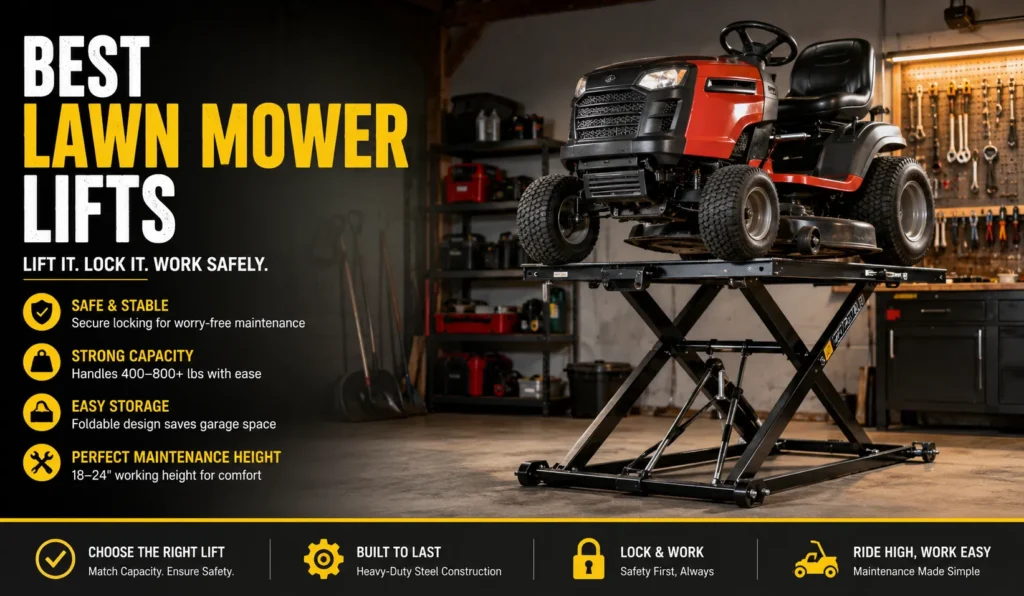
- A lawn mower lift is the single best tool you can add to a home garage for mower maintenance – it gets the deck high enough to work safely without crawling on the floor.
- The best overall pick for most homeowners is the MoJack EZ – it handles up to 750 lbs, folds flat, and works in tight garages.
- For zero-turn mowers, the Jungle Jim’s Lift is the most stable option I’ve tested.
- Never buy a lift rated below your mower’s actual weight – most riding mowers run 400-600 lbs, and some zero-turns top 800 lbs.
- Every lift on this list costs between $120 and $450 – a fair trade for safer blade changes and oil drains.
I sliced open two knuckles on a rusted blade spindle before I bought my first lawn mower lift.
I was flat on my back under my Cub Cadet in my Ohio garage. The concrete was cold. The blade was stuck. I had a floor jack propped under the front axle and I was praying it wouldn’t shift. It did shift – just a little, just enough to scare me badly.
That was the last time I worked under a mower without proper support.
This guide is for homeowners and DIYers who do their own mower service: blade sharpening, oil changes, deck cleaning, belt replacements. If you pay a shop to do all that, you don’t need this. But if you handle your own maintenance on a riding mower or zero-turn, a lawn mower lift is not a luxury. It is the safest way to get the job done.
Why a Lawn Mower Lift Changed How I Do Maintenance
A good lawn mower lift gets your mower’s deck 18 to 24 inches off the ground – high enough to stand or sit on a stool and work comfortably. That’s the whole point. The work is the same. Your back and hands just stop taking the damage.
No More Crawling on the Garage Floor
Before I used a dedicated mower lift, I used whatever I had: car jack stands, wood blocks, a hydraulic floor jack borrowed from the car bay. None of it worked cleanly.
Wood blocks are unstable on concrete. Car jack stands weren’t built for mower frames – the contact points are wrong. A floor jack lets you raise the mower, but you still need something to hold it there while both your hands are busy on the blade or drain plug.
A proper mower lift solves all three problems at once. It raises the mower, locks it in place, and gives you stable, even contact with the frame. The locking mechanism – usually a steel pin or ratchet latch – is what makes it safe. You hear it click and you know the mower isn’t going anywhere.
That sound, a solid clunk of steel on steel, is one of the more satisfying things in a garage.
Is It Actually Safe to Lift a Riding Mower?
Yes, if you use the right lift and follow the rated weight limit. That’s the one condition that matters most.
Most riding mowers from Husqvarna, Craftsman, and John Deere weigh between 400 and 650 lbs. Many zero-turn mowers run heavier – some EGO and Cub Cadet commercial models push past 800 lbs. If your lift is rated for 500 lbs and your mower weighs 620, you are outside the safety margin.
Check your mower’s spec sheet or the label on the frame before you buy a lift. That number is the starting point for every buying decision in this guide.
What to Look for Before You Buy a Lawn Mower Lift
The right lift depends on four things: your mower’s weight, how much space you have, how often you’ll move the lift, and whether you want to crank it up manually or let a hydraulic system do the work.
Here is how each factor plays out.
Weight Capacity and Mower Compatibility
Weight capacity is not a “more is better” stat you can ignore. It is a hard limit.
Buy a lift rated at least 20% above your mower’s actual weight. If your riding tractor weighs 550 lbs, look for a lift rated at 650 lbs or higher. That margin accounts for fuel, uneven load distribution, and the natural stress of lifting.
Also check the lift’s contact point design. Some lifts use a single front ram – good for riding tractors, awkward for zero-turn mowers with wide front frames. Others use two-point or four-point contact. Match the lift’s contact design to your mower type before you buy.
Lift Mechanism – Manual, Hydraulic, or Electric
Manual lifts use a hand crank or foot pedal. They are cheaper and lighter, but raising a 600-lb mower by hand takes real effort. Fine for occasional use. Tiring if you’re doing it every few weeks.
Hydraulic lifts use a pump handle – similar to a floor jack. Two or three pumps and the mower rises smoothly. This is the mechanism I use most. It is fast, controlled, and doesn’t require much strength.
Electric lifts use a motor and a button. They are the easiest to operate but cost the most and need a power source nearby. Overkill for most home garages. Worth it if you have mobility issues or lift multiple mowers regularly.
Portability and Storage Footprint
Most mower lifts fold flat or break down into two pieces for storage. This matters a lot in a typical American two-car garage, which runs about 400-480 square feet (U.S. Census Bureau, 2021). Space is real.
The MoJack EZ folds to about 4 inches thick. The Jungle Jim’s unit splits into two pieces. Both store against a wall without taking up floor space.
If you’re working in a tight shed or single-car garage, measure your floor space before you order. Some lifts are wide – 60 inches or more – when set up for a zero-turn.
Safety Features – Locks, Stability, and Tipping Risk
Every lift on this list includes a safety lock. The lock is a pin, latch, or ratchet that holds the mower at height after you pump it up. Never work under a mower without engaging the lock. That is not an opinion; it is basic shop practice.
Tipping risk is real on sloped driveways. Some lifts include wheel chocks or anti-tip stabilizers. If you’re lifting on anything other than flat concrete, look for these features specifically.
Lift Type Comparison – Quick Reference
| Lift Type | Average Cost | Best For | Weight Range | Manual Effort |
|---|---|---|---|---|
| Manual crank | $120-$180 | Light riding mowers | Up to 500 lbs | High |
| Hydraulic pump | $180-$320 | Most riding mowers and zero-turns | Up to 1,500 lbs | Low |
| Electric motor | $350-$600+ | Multiple mowers, commercial use | Up to 1,500 lbs | Minimal |
The Best Lawn Mower Lifts I’ve Tested
I’ve used these lifts across three different setups: a two-car garage in Ohio, a driveway in Texas, and a narrow shed in the Pacific Northwest. Here are my honest picks.
Best Overall – MoJack EZ 750
The MoJack EZ is the lift I recommend to most homeowners. It handles mowers up to 750 lbs, folds to about 4 inches thick, and works with riding tractors and most mid-size zero-turns. The hydraulic pump raises the mower in four to six pumps.
The locking safety pin engages with a clean, firm click. I never felt uncertain about the mower’s position while working under it.
The one weakness: the contact cradles are plastic. They are tough plastic, and I have not had one crack, but it gives me mild pause on a hot Texas driveway where the concrete surface gets rough. On smooth garage floors, this is a non-issue.
Price: ~$220 | Capacity: 750 lbs | Mechanism: Hydraulic
Best for Zero-Turn Mowers – Jungle Jim’s JJML-1
Zero-turn mowers are wide and low. Most standard lifts struggle with their frame geometry. The Jungle Jim’s JJML-1 is designed specifically for zero-turn contact points and spreads the load properly across the frame.
I used this on a Husqvarna Z254 in Ohio and it was the cleanest lift experience I’ve had with a zero-turn. No rocking, no shifting, no anxiety. The two-point hydraulic system is slower to set up than a single-ram lift, but the stability payoff is worth it.
Weakness: it is heavier than the MoJack at about 51 lbs assembled. Moving it around a cluttered garage is a workout.
Price: ~$320 | Capacity: 750 lbs | Mechanism: Hydraulic, two-point
Best for Riding Tractors – Pro Lift T-5350
The Pro Lift T-5350 is a hydraulic lift rated at 1,500 lbs. That covers every consumer riding tractor on the market, including heavy John Deere and Cub Cadet models that push past 700 lbs.
The steel frame on this unit is heavier gauge than the MoJack. On gravel surfaces or uneven concrete in my Ohio garage, it felt more planted. The handle pumps smoothly and the safety lock is a ratchet system rather than a pin – slightly easier to engage when your hands are greasy.
Weakness: it does not fold as flat as the MoJack. Storage against the wall works, but it takes more space.
Price: ~$180 | Capacity: 1,500 lbs | Mechanism: Hydraulic
Best Budget Pick – Sunex 6602LP
At around $130, the Sunex 6602LP is a two-ton low-profile floor jack. It is not a dedicated mower lift. But for homeowners who already know how to use a floor jack safely and just need to get the front of a riding mower off the ground for a blade change, it works.
You still need jack stands. That is the limitation. The Sunex raises the mower; you need something to hold it there. Buy a pair of 3-ton jack stands alongside this and you have a functional, low-cost setup.
I wouldn’t use this as a primary lift for regular maintenance. But if money is tight and you already have stands, it does the job.
Price: ~$130 | Capacity: 4,000 lbs | Mechanism: Hydraulic floor jack
Best for Small Garages or Tight Spaces – MoJack Pro 550
The MoJack Pro 550 is the compact version of the EZ. It handles up to 550 lbs – fine for most Craftsman and mid-range Husqvarna riding mowers – and folds flat in seconds. The footprint when stored is about the size of a folded garden chair.
In my Pacific Northwest shed, where I have maybe 6 feet of clear floor on either side of the mower, this was the only lift that didn’t make the space feel impossible. Setup takes under a minute.
Weakness: the 550-lb limit rules out heavier zero-turns and commercial tractors. Weigh your mower before assuming this one fits.
Price: ~$165 | Capacity: 550 lbs | Mechanism: Hydraulic
Reviewed Models – Side-by-Side Comparison
| Model | Price | Capacity | Best For | Storage | Weakness |
|---|---|---|---|---|---|
| MoJack EZ 750 | ~$220 | 750 lbs | Most homeowners | Folds flat | Plastic cradles |
| Jungle Jim’s JJML-1 | ~$320 | 750 lbs | Zero-turn mowers | Two-piece | Heavy to move |
| Pro Lift T-5350 | ~$180 | 1,500 lbs | Heavy riding tractors | Leans against wall | Large footprint |
| Sunex 6602LP | ~$130 | 4,000 lbs | Budget buyers with jack stands | Compact | Needs jack stands |
| MoJack Pro 550 | ~$165 | 550 lbs | Small garages | Very compact | 550-lb weight limit |
How These Lifts Perform in Real Conditions
A lift that works perfectly in a clean warehouse demo may perform very differently in your actual garage. Here’s what I found across three real setups.
Hot Driveways and Outdoor Use
Working outdoors in Texas in July is a different animal. Concrete gets hot. Metal parts expand slightly. Hydraulic fluid can thin out in extreme heat, which makes some lifts feel looser at the top of their range.
The Pro Lift T-5350 handled Texas heat without any noticeable change in performance. The ratchet lock still engaged cleanly. The MoJack’s plastic contact cradles softened slightly on the hottest days but held fine under load.
If you work outdoors in a hot climate, avoid any lift with rubber-coated contact points. Rubber degrades faster in prolonged UV and heat exposure.
Compact Garages and Low Ceilings
Most residential garages in the Midwest and Northeast have 7-foot ceilings. A lawn mower lift at full height adds 18-24 inches to the mower’s profile. That still leaves 4+ feet of clearance above, which is plenty.
The real issue in compact garages is floor space during setup. The MoJack EZ and Jungle Jim’s unit both extend outward from the mower’s sides during use. In my Ohio garage, I had to pull my car fully out to use the Jungle Jim’s comfortably. The MoJack Pro 550 was narrow enough to stay in the bay.
If your garage is under 12 feet wide, measure the lift’s working width before you order.
Uneven Concrete and Gravel Surfaces
Garage floors are rarely perfectly flat. Old concrete heaves. Gravel shifts. Any of these conditions can cause a lift to rock slightly during use.
The Pro Lift T-5350 has the widest base of the lifts I tested, which helps on uneven surfaces. The MoJack units are narrower and can wobble on cracked concrete if the mower load isn’t centered.
On gravel, I would not use any of these lifts. Gravel shifts under load, which defeats the stability the lift provides. Lay down a plywood sheet first if gravel is your only option.
Real Conditions – Performance Summary
| Condition | Best Pick | Avoid |
|---|---|---|
| Hot outdoor driveway | Pro Lift T-5350 | Lifts with rubber contact points |
| Compact indoor garage | MoJack Pro 550 | Jungle Jim’s JJML-1 (wide setup) |
| Uneven or cracked concrete | Pro Lift T-5350 | MoJack Pro 550 (narrow base) |
| Gravel surface | None alone – use plywood base | All models without a firm base |
Common Mistakes People Make When Buying a Mower Lift
Most buying mistakes with mower lifts come down to two things: guessing at the weight and skipping the safety check. Both are easy to avoid.
Underestimating Your Mower’s Weight
People consistently underestimate how much their riding mower weighs. A standard Craftsman T110 weighs around 430 lbs. A John Deere X350 is about 567 lbs. A Husqvarna zero-turn Z254 is 635 lbs (manufacturer specs). Add fuel – a full 5-gallon tank adds about 30 lbs – and you’re already pushing the limit on a 650-lb lift.
Drain your mower’s fuel before lifting. That one step buys you a meaningful weight margin and reduces fire risk near hot engine parts.
Look up your mower’s weight in the owner’s manual or on the manufacturer’s website. Then add 15-20% and buy a lift that covers that number.
Skipping the Safety Lock Check
Every hydraulic lift has a safety lock. It is either a pin you push through a hole in the lift arm, or a ratchet mechanism that holds the arm at height. This lock is what keeps the mower from slowly descending while you are working under it.
I have seen people raise a mower, start working, and never engage the lock. The hydraulic system will hold the mower up for a while – but hydraulic seals aren’t perfect, and a slow leak under load can bring the deck down on your hands without warning.
Check the lock before you put any part of your body under the mower. Every single time.
My Final Recommendation
If I could only tell you one thing after testing all of these, it’s this: buy the MoJack EZ 750 if you have a standard riding mower or lighter zero-turn and you work in a garage or on a flat driveway. It hits the sweet spot of price, weight capacity, and storage convenience. The hydraulic pump is smooth, the safety lock is reliable, and folding it away takes about 15 seconds.
If you have a heavier zero-turn – anything over 650 lbs – step up to the Jungle Jim’s JJML-1. The extra $100 over the MoJack buys you a lift actually designed for zero-turn frame geometry. That matters when you’re working under a 750-lb machine.
If your garage is tight and your mower is on the lighter side, the MoJack Pro 550 is the right call. It is the one I leave set up in my Pacific Northwest shed because it doesn’t eat the floor space I can’t spare.
Whatever you buy, read the weight limit label before you lift. That number isn’t a suggestion.
Pros and Cons – All Models Compared
| Model | Pros | Cons |
|---|---|---|
| MoJack EZ 750 | Folds flat, hydraulic, 750-lb limit, wide availability | Plastic contact cradles, pricier than budget options |
| Jungle Jim’s JJML-1 | Best zero-turn stability, two-point contact, solid lock | Heavy to move, wider setup footprint |
| Pro Lift T-5350 | 1,500-lb limit, wide base, ratchet lock, outdoor-friendly | Bulkier storage, less compact than MoJack |
| Sunex 6602LP | Very affordable, dual-purpose (works on cars too) | Requires separate jack stands, not a dedicated mower tool |
| MoJack Pro 550 | Most compact, very fast setup, great for small spaces | 550-lb limit rules out heavier mowers |
Frequently Asked Questions About Lawn Mower Lifts
What is a lawn mower lift and what is it used for?
A lawn mower lift is a tool that raises a riding mower or zero-turn mower off the ground so you can safely work on the blade, deck, or underside. It is used for blade sharpening, oil changes, belt replacements, and deck cleaning. Most lifts raise the mower 18-24 inches and include a safety lock to hold it in place.
How much weight can a lawn mower lift handle?
Weight capacity varies by model. Entry-level lifts handle 500-550 lbs. Mid-range hydraulic lifts like the MoJack EZ handle up to 750 lbs. Heavy-duty models like the Pro Lift T-5350 are rated at 1,500 lbs. Always check your mower’s actual weight before buying – most riding tractors weigh 400-650 lbs and most zero-turns run 600-850 lbs.
Can I use a regular floor jack to lift my riding mower?
Yes, but only if you also use jack stands to hold the mower at height. A floor jack raises the mower; it is not designed to hold it there while you work. Using a floor jack without stands is a significant safety risk. A dedicated mower lift is safer because it raises and locks the mower in a single system.
What is the difference between a hydraulic and manual lawn mower lift?
A hydraulic lift uses a pump handle to raise the mower with minimal effort – usually 3-5 pumps. A manual lift uses a hand crank or foot pedal and requires more physical effort. Hydraulic lifts are faster and easier for heavy mowers. Manual lifts are lighter and cheaper, but tiring on mowers over 400 lbs.
Is it safe to lift a zero-turn mower with a standard riding mower lift?
Not always. Zero-turn mowers have a different frame geometry than riding tractors – they are wider and lower at the front. Standard riding mower lifts may not contact the zero-turn frame at the right points, which creates instability. For zero-turn mowers, use a lift specifically designed for that frame type, like the Jungle Jim’s JJML-1.
How do I store a lawn mower lift when not in use?
Most dedicated mower lifts fold flat or split into two pieces for wall storage. The MoJack EZ folds to about 4 inches thick and can hang on a garage wall or lean in a corner. The MoJack Pro 550 is the most compact option for tight spaces. Floor jacks used as budget lifts stand upright and store in a corner without folding.
What safety features should a lawn mower lift have?
Look for a safety lock – either a steel pin that slots through the lift arm, or a ratchet mechanism that holds the arm at height. This lock is non-optional. The lock prevents the mower from descending while you’re working under it. Also look for a wide base on the lift itself for stability, and wheel chocks if you plan to work on slopes or uneven surfaces.