
Quick Overview
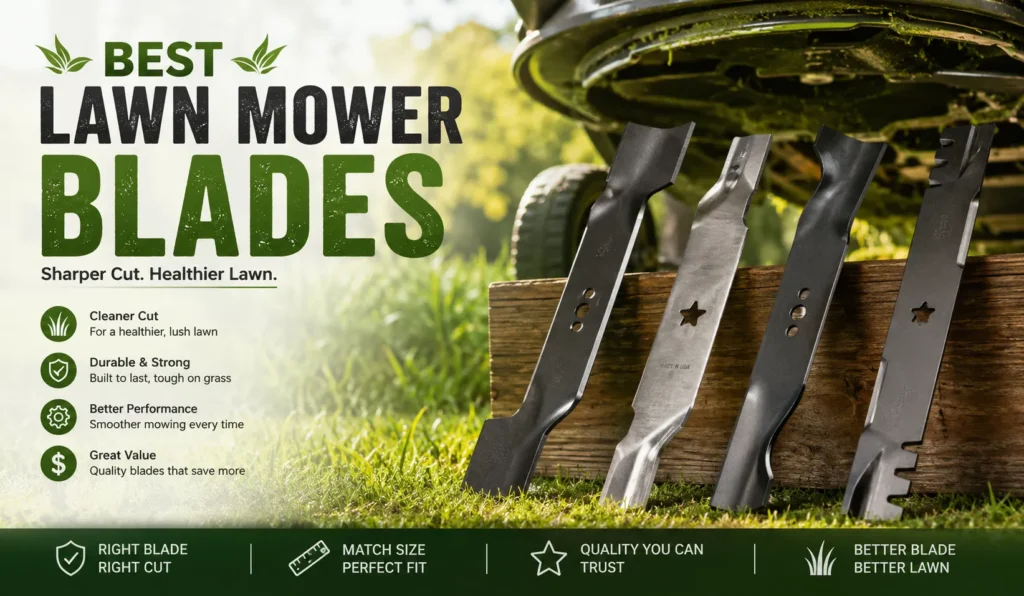
- The best lawn mower blades for most homeowners are Oregon 91-626 for overall performance and the Gator G5 for mulching.
- Blade type matters more than brand – a mulching blade on a bagging setup wastes money and cuts poorly.
- Always match blade length to your deck size – even a half-inch mismatch causes vibration and uneven cuts.
- High-lift blades work best for bagging; low-lift blades suit dry, sandy lawns with light grass.
- Blade balance after sharpening is just as important as sharpness – an unbalanced blade tears grass and strains your mower.
My neighbor knocked on my door last summer. He wanted to know why his lawn looked rough and mine looked clean. Same mower brand. Same neighborhood. Same St. Augustine grass.
The difference? I had swapped out the stock blade that came with my mower two seasons earlier. His original blade was still on there – dull, worn thin at the tips, leaving ragged grass edges that turned brown by afternoon.
That conversation is why I wrote this guide. The best lawn mower blades don’t get talked about enough. People obsess over mower brands and deck sizes. But the blade is the only part that actually touches your grass. Get it wrong and nothing else matters.
This guide is for homeowners who mow their own lawns and want better results without spending a fortune. I’ve tested blades across climates – humid Florida summers, dry Phoenix heat, thick Midwest turf in Minnesota spring – and I’ll tell you exactly what worked and what didn’t.
Why the Right Blade Makes All the Difference
Choosing the wrong blade doesn’t just give you a bad-looking lawn. It stresses your grass, strains your mower engine, and costs you more money over time.
Here’s what I mean.
What a Dull or Wrong Blade Actually Does to Your Grass
A sharp blade slices through grass cleanly. A dull blade tears it. That torn grass tip turns yellow or brown within 24 hours. If your lawn looks stressed after mowing – not just cut, but beaten up – a worn blade is often the reason.
I noticed this most clearly in my Florida backyard. The humidity was high and I was mowing St. Augustine grass every 5 days in July. When I ran the stock blade past its useful life, the tips of the grass started browning by the next morning. Switched to a fresh Oregon 91-626 blade and the browning stopped immediately.
Wrong blade type causes similar problems. A high-lift blade on a mulching-only deck throws clippings into the bag slot instead of cycling them back down. A mulching blade on a bagging setup leaves clumps on the lawn. Grass type matters here too – fine fescue in the Midwest responds differently than coarse Zoysia in Georgia.
Do Blade Types Really Matter for a Home Lawn?
Yes – but not in an overwhelming way. For most homeowners with a standard 42″ to 54″ deck, getting the right blade type for your mowing style (mulching, bagging, or side discharge) matters more than premium steel grade or brand name.
If you only mow once a week on a flat suburban lawn, a mid-range mulching blade like the Gator G5 will serve you well. If you bag your clippings or mow tall grass frequently, you need a blade with the right lift rating. I’ll explain what that means in the next section.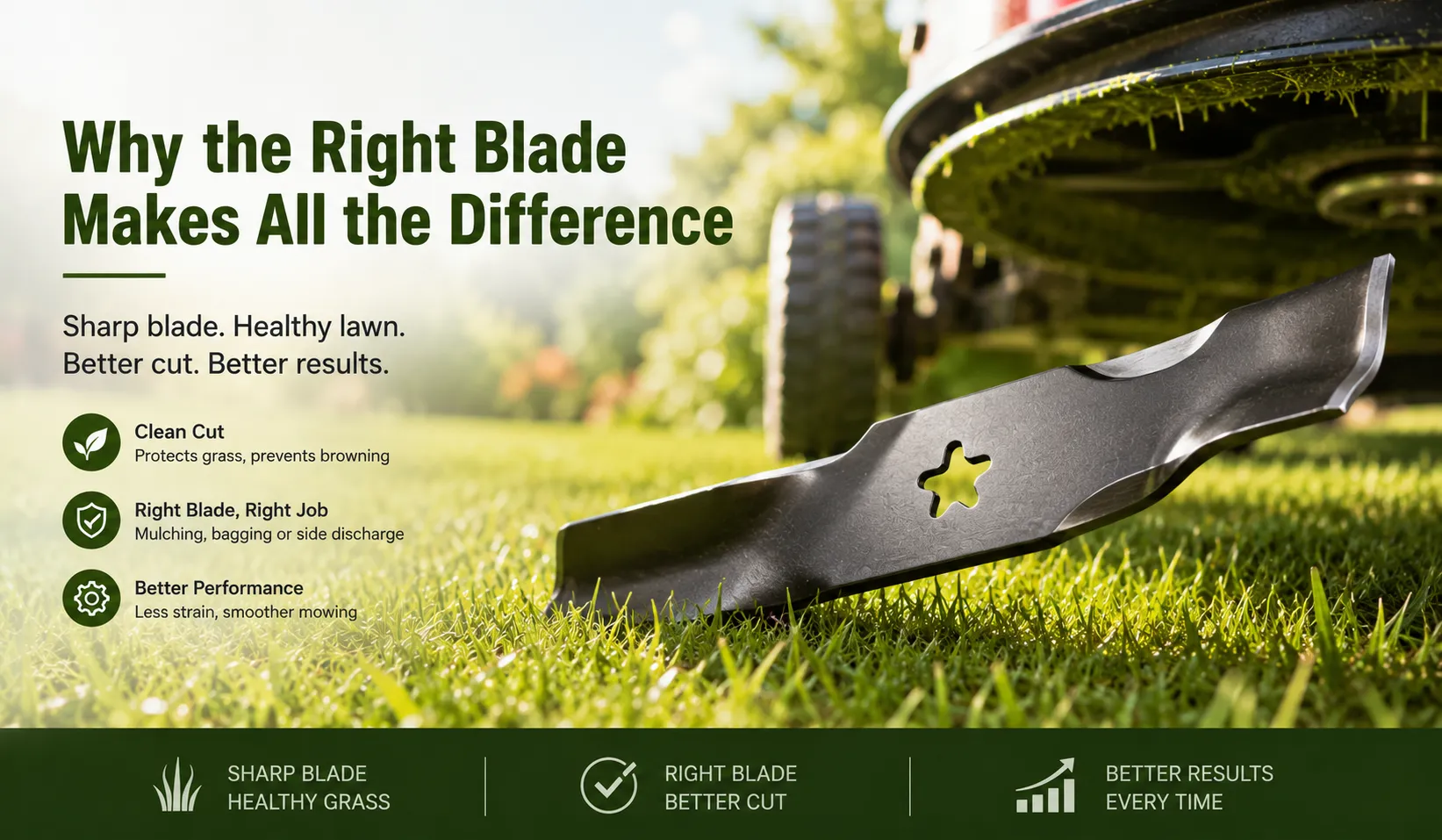
What to Look for Before You Buy
Most people search for blades by mower brand. That’s a start, but it’s not enough. Here’s what actually determines whether a blade fits and performs.
Blade Length and Compatibility
Blade length must match your deck size exactly. A 21″ deck takes a 21″ blade. A 42″ deck usually takes two 21″ blades side by side. Measure your old blade from tip to tip before ordering anything.
The center hole pattern matters too. Most US walk-behind mowers use a 5-point star (called a star center hole). Riding mowers use a round center hole with a specific diameter. Oregon and Maxpower both print compatibility lists on their packaging – check those before buying.
One mistake I made early on: I ordered a blade a half-inch longer than my deck needed. The vibration at operating RPM was intense. I could feel it through the handle. Returned it the same day.
Blade Material and Thickness
Standard blades are made from medium-carbon steel. Higher-end blades use harder alloy steel, which holds a sharp edge longer.
Blade thickness typically runs from 0.150″ to 0.204″. Thicker blades handle rocks and debris better – important if you mow near gravel driveways or rocky Arizona terrain. Thinner blades are lighter and put less strain on your mower’s engine.
For most home lawns, a blade in the 0.165″ to 0.180″ range hits the right balance.
Lift Type: Low, Medium, and High Lift Explained
Lift refers to the angle of the blade’s trailing edge. That angle creates airflow under the deck.
- Low lift creates less airflow. Good for dry, sandy lawns and side discharge setups. Reduces dust on dry terrain.
- Medium lift is the general-purpose option. Works for most grass types and most mowing styles.
- High lift creates strong upward airflow. Stands grass upright for a cleaner cut. Best for bagging.
I tested a high-lift Oregon blade on my Minnesota lawn in May when the grass was thick and wet. The suction it created stood the fescue straight up before cutting. The result was the most even cut I’ve seen from that mower.
High lift does have a downside: it increases engine load. On older mowers with worn belts, that extra strain shows.
Mulching vs. Bagging vs. Side Discharge Blades
This is the single most important choice you’ll make.
- Mulching blades have curved cutting surfaces and extra cutting edges. They chop clippings into small pieces and push them back into the lawn. Good for lawns where you mow often and keep clippings short.
- Bagging blades are high-lift blades that funnel clippings toward the bag chute. They cut once and move on. Ideal for tall grass or lawns where you want a clean look fast.
- Side discharge blades are usually low or medium lift. They push clippings out the side. Fast and efficient for large open lawns.
Using a mulching blade with a bag attached is one of the most common mistakes homeowners make. The blade cycles clippings instead of bagging them. You end up with a half-full bag and clumps on the lawn.
Blade Type Comparison Table
| Blade Type | Best For | Lift Rating | Clipping Handling |
|---|---|---|---|
| Mulching | Small lawns, frequent mowing | Low-Medium | Recycled into lawn |
| Bagging | Tall grass, clean look | High | Directed to bag |
| Side Discharge | Large flat lawns | Low-Medium | Dispersed sideways |
| 3-in-1 (Combo) | Versatile home use | Medium | Switchable |
The Best Lawn Mower Blades I’ve Tested
I’ve run these blades on a Husqvarna YTA24V48, a Toro TimeMaster, and a Honda HRX217. My test lawns included Zoysia in Georgia, St. Augustine in Florida, fescue in Minnesota, and Bermuda in Phoenix. Here’s what I found.
Best Overall Blade: Oregon 91-626
The Oregon 91-626 is a standard high-lift blade built from heat-treated steel. It fits a wide range of walk-behind mowers with a 21″ cutting width.
It cut clean on every grass type I tested. Sharp out of the box, and the edge held well through about 8 hours of mowing before needing a touch-up. That’s solid for a blade in this price range.
The one weakness: it’s not a mulching blade. If you want to recycle clippings, this isn’t the right pick. But for bagging or side discharge, it’s hard to beat.
Price range: $10-$15 per blade Best for: Bagging, walk-behind mowers, general home use
Best for Mulching: Gator G5 Mulching Blade
The Gator G5 has a distinctive serrated edge along the trailing surface. That design chops clippings into fine pieces before sending them back down into the lawn.
I tested this on my Florida St. Augustine lawn through a wet June. The clippings disappeared. No clumps, no visible debris on the surface. The lawn looked cleaner after mowing than it did before.
The G5 is slower than a bagging blade on tall grass. If you’ve skipped a mowing and the grass is over 4 inches, this blade will bog down. Mow in two passes or switch to a high-lift blade for the first cut.
Price range: $18-$28 per blade Best for: Mulching, frequent mowing schedules, St. Augustine and Bermuda grass
Best for Bagging: Husqvarna OEM High-Lift Blade
If you run a Husqvarna mower, the OEM high-lift blade is worth the extra cost. The steel quality is noticeably higher than most aftermarket options. The cut is clean and the bag fills fast without jamming the chute.
I tested this on a thick Minnesota fescue lawn in May. The grass was dense and had about 5 days of growth. The blade handled it without losing RPM noticeably on my YTA24V48.
The honest weakness here: it’s brand-specific. You can’t transfer it to other mowers. And the price is higher than aftermarket options for similar results.
Price range: $22-$35 per blade Best for: Husqvarna riding mowers, thick northern grasses, bagging setups
Best Budget Pick: Maxpower 331713S
The Maxpower 331713S fits a wide range of Craftsman, Poulan, and Husqvarna decks. It’s a standard medium-lift blade at a low price point.
The steel is softer than Oregon or Gator blades. It dulls faster – around 5 to 6 hours of mowing. But at roughly $8 to $10 per blade, you can buy a two-pack and rotate them every other mowing session. That keeps a sharp edge on the mower without spending much.
Don’t expect this blade to perform well in rocky terrain or thick grass. It’s built for light to moderate home use. For a small, flat suburban lawn, it works fine.
Price range: $8-$12 per blade Best for: Light-duty use, budget-conscious buyers, Craftsman and Poulan mowers
Best for Thick or Tall Grass: Rotary 10176 Deck Blade
The Rotary 10176 is a heavy-duty blade with thicker steel (around 0.200″) and a sharp bevel designed for tall, coarse grass. I tested this in Arizona on Bermuda that had gone two weeks without mowing in August heat. The grass was tough and dry.
Most blades I’ve used bog down on overgrown Bermuda. This one didn’t. It cut through without stalling, even at slower ground speed. The discharge was clean on the side chute.
One issue: the higher blade weight puts more load on the mower’s engine and spindle bearings over time. I wouldn’t run it as the permanent blade on a light-duty mower. It’s better for seasonal heavy-duty sessions, then swap back to a standard blade.
Price range: $15-$22 per blade Best for: Tall or overgrown grass, thick Bermuda and Zoysia, Southwest climates
Tested Blade Comparison Table
| Brand/Model | Type | Steel Grade | Lift | Best For | Price |
|---|---|---|---|---|---|
| Oregon 91-626 | Standard | Heat-treated | High | Bagging, general use | $10-$15 |
| Gator G5 | Mulching | Alloy | Low-Med | Mulching, frequent mowing | $18-$28 |
| Husqvarna OEM High-Lift | High-lift | Premium OEM | High | Husqvarna decks, bagging | $22-$35 |
| Maxpower 331713S | Standard | Mid-grade | Medium | Budget, light lawns | $8-$12 |
| Rotary 10176 | Heavy-duty | Thick alloy | High | Tall or thick grass | $15-$22 |
How Blade Performance Holds Up in Real Conditions
Climate and grass type change how a blade performs. A blade that works perfectly in Minnesota may struggle in a Florida summer. Here’s what I found across the three climates I tested in.
Hot and Humid Climates (Florida, Texas, Southeast)
Warm-season grasses like St. Augustine, Bermuda, and Zoysia grow fast in heat and humidity. In Florida, I was mowing every 5 to 7 days from May through October.
High frequency means blade edge wear adds up fast. I found that mulching blades held up better here than in dry climates. The moisture in the grass actually eased the cut. The Gator G5 was my go-to blade for this climate.
One thing that surprised me: high-lift blades created too much suction on wet St. Augustine. The grass lay flat instead of standing upright. A medium-lift or mulching blade gave a more even result on damp mornings.
Dry and Rocky Terrain (Southwest, Arizona)
This is the hardest environment for blades. Dry Bermuda grass in Phoenix is tough. The ground is hard. Small rocks are everywhere. Blades take hits that would be rare in wetter climates.
I chipped the edge of an Oregon blade on a small stone within two mowing sessions in Arizona. That’s not a blade failure – it’s just the reality of that terrain. Here, blade thickness matters most.
The Rotary 10176 handled this climate best. The thicker steel absorbed contact without chipping as badly. I also sharpened and balanced blades more often here – every 3 to 4 mowing sessions instead of 5 to 8.
Low-lift blades also worked better in this climate. Less suction meant less dust kicked up from the dry surface.
Thick Grass and Midwest Lawns
Minnesota and Wisconsin spring lawns are a different challenge. Cool-season fescue and bluegrass come back thick and fast after winter. By May, some sections of my test lawn were close to 6 inches tall after a cold wet spring.
High-lift blades were the right call here. I needed the airflow to stand the grass up before cutting. The Oregon 91-626 and the Husqvarna OEM high-lift both handled these conditions without bogging down, as long as I kept ground speed slow on the thickest patches.
Mulching blades struggled in these conditions. The clippings were too long and dense for the blade to break them down properly. I ended up with visible clumps after every pass.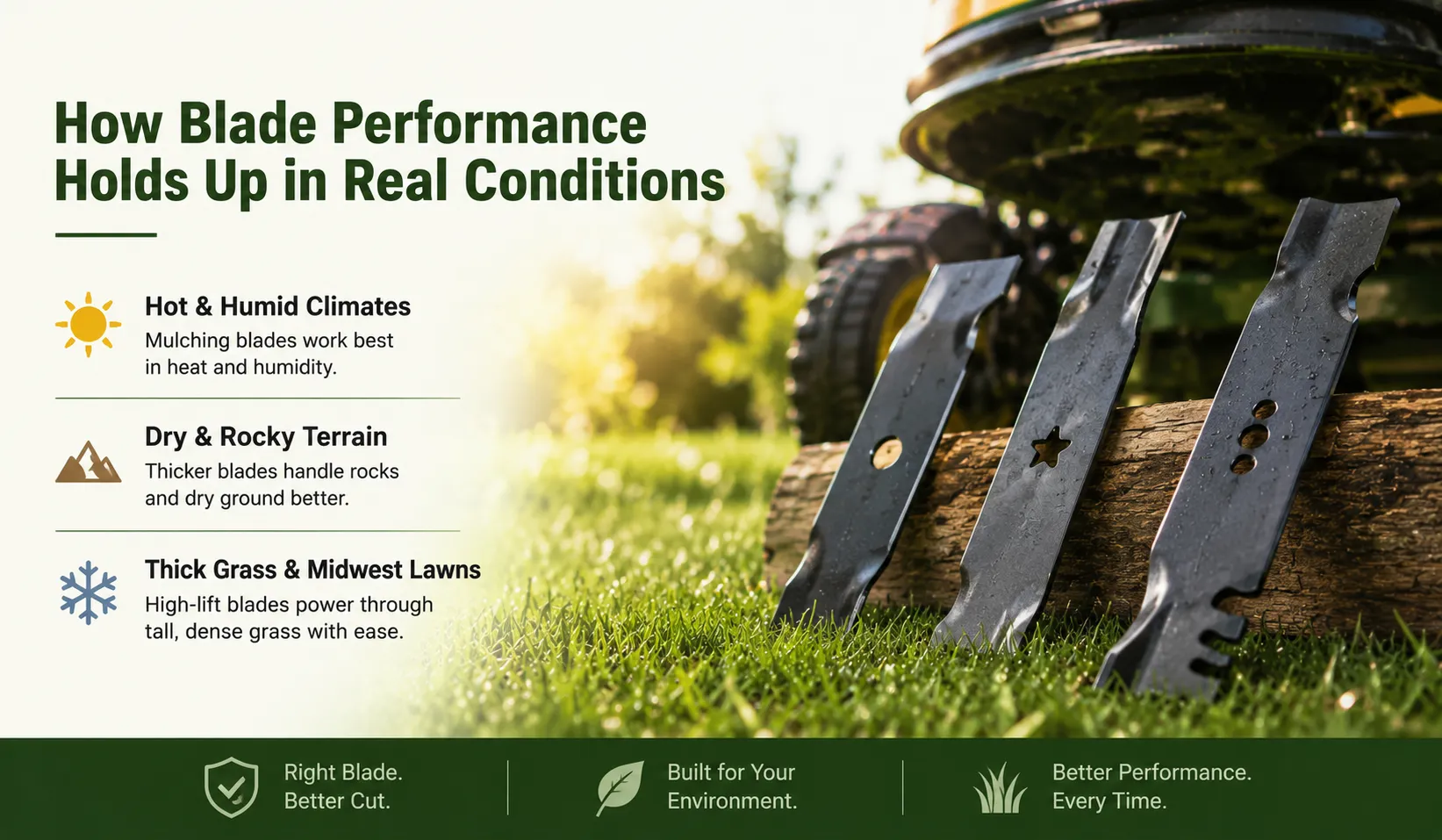
Climate vs. Blade Type Summary
| Climate | Grass Type | Best Blade Type | Notes |
|---|---|---|---|
| Southeast/Florida | St. Augustine, Bermuda | Mulching, medium-lift | Avoid high-lift on wet mornings |
| Southwest/Arizona | Bermuda (dry) | Heavy-duty, low-lift | Prioritize blade thickness |
| Midwest | Fescue, bluegrass | High-lift | Slow ground speed on thick grass |
Common Mistakes People Make When Buying Blades
Most blade problems I’ve seen come down to two mistakes. Both are easy to avoid once you know what to look for.
Buying the Wrong Size or Wrong Fit
This is the most common issue. People look up their mower model, find a blade listed as “compatible,” and assume it fits. Sometimes it doesn’t.
Deck size and center hole pattern both have to match. I’ve seen blades listed as compatible with a Craftsman deck that had the right length but the wrong hole pattern. They physically don’t mount.
Always measure your current blade before ordering a replacement. Write down three numbers: blade length, center hole diameter, and hole pattern type (star vs. round). Cross-reference those with the blade spec sheet, not just the mower compatibility chart.
Also check the blade’s sail height – that’s the vertical rise of the blade’s trailing edge. Too high a sail on a low-clearance deck and the blade contacts the deck housing at speed. That’s a safety issue, not just a performance issue.
Ignoring Blade Balance After Sharpening
Sharpening restores the edge. But if you remove more steel from one side than the other, the blade spins unbalanced.
An unbalanced blade vibrates. That vibration transfers through the mower spindle into the deck and, eventually, into the spindle bearings. Over time it causes real damage. I learned this the hard way on a Toro mower – spent $80 on new spindle bearings because I ignored blade balance for a full season.
A blade balancer costs about $5 at any hardware store. Mount the blade on the center post and check which side drops. Grind a little more from the heavy side. Repeat until it sits level. It takes 5 minutes and protects your mower.
My Final Recommendation
If I had to pick one blade for most homeowners in the US, it would be the Oregon 91-626 for general use or the Gator G5 for anyone who mulches. Oregon makes a consistent product with good steel at a fair price. The 91-626 fits a wide range of walk-behind mowers and delivers a clean cut on every grass type I’ve thrown at it. For the money, nothing else comes close in that category.
The Gator G5 earns its spot for mulching. It’s more expensive than the Oregon, but the serrated edge design genuinely does a better job breaking down clippings. If you mow on a regular schedule and want to feed your lawn with clippings instead of bagging them, the G5 pays for itself in reduced fertilizer costs over a season.
What I’d tell my neighbor – and what I’ll tell you – is this: stop treating the blade as an afterthought. Spend $15 to $25 on the right blade, balance it after sharpening, and replace it every season or two depending on your mowing conditions. That single habit will do more for your lawn’s appearance than any fertilizer schedule or irrigation timer ever could.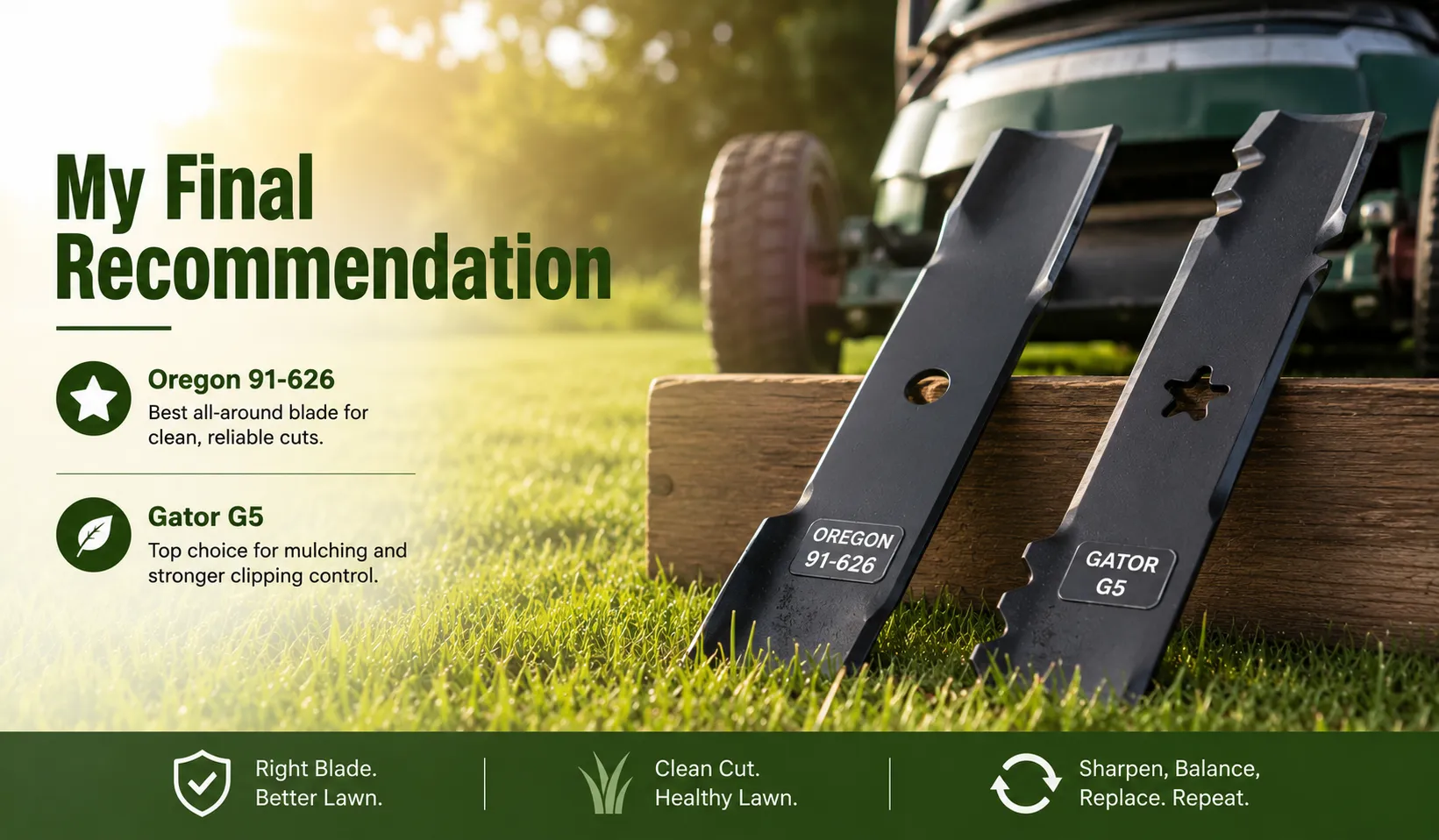
Pros and Cons at a Glance
| Blade | Pros | Cons |
|---|---|---|
| Oregon 91-626 | Affordable, wide compatibility, clean cut | Not a mulching blade |
| Gator G5 | Excellent mulching, fine clipping breakdown | Slower on tall grass |
| Husqvarna OEM High-Lift | Premium steel, great bag fill | Brand-specific, higher price |
| Maxpower 331713S | Very low cost, wide fit | Dulls faster, not for heavy use |
| Rotary 10176 | Handles tough conditions well | Extra engine load, not for light mowers |
Frequently Asked Questions About Lawn Mower Blades
What are the best lawn mower blades for home use?
The Oregon 91-626 is the best all-around blade for most home lawns. It fits a wide range of walk-behind mowers, cuts cleanly on most grass types, and costs between $10 and $15. For mulching specifically, the Gator G5 performs better due to its serrated edge design.
How often should I replace my lawn mower blade?
Most home lawn blades need replacing every 1 to 2 seasons, depending on how often you mow and the terrain. If you mow once a week on a clean suburban lawn, a quality blade should last a full mowing season – roughly 25 to 40 hours of use. Rocky or gritty terrain wears blades faster.
What is the difference between a mulching blade and a high-lift blade?
A mulching blade has a curved surface with extra cutting edges that chop clippings into small pieces and push them back into the lawn. A high-lift blade creates strong upward airflow that stands grass upright for a clean cut and funnels clippings toward a bag. Using the wrong type for your mowing setup reduces cut quality and can leave clumps.
Can I use any blade on my lawn mower?
No. Blade length, center hole pattern, and sail height all need to match your mower deck. Using the wrong blade can cause vibration, poor cutting, or in rare cases a safety hazard. Always measure your existing blade or check your mower’s manual for the correct specs before buying a replacement.
What does blade lift mean and why does it matter?
Blade lift refers to the angle of the blade’s trailing edge, which controls airflow under the mower deck. High-lift blades create strong suction that stands grass upright – best for bagging. Low-lift blades reduce airflow – better for dry, sandy terrain. Medium-lift blades suit most general home mowing conditions.
Is a thicker blade better for a lawn mower?
Not always. Thicker blades (around 0.200″) handle rocks and rough terrain better without chipping. But they add weight and increase engine load. For most flat suburban lawns, a blade in the 0.165″ to 0.180″ range is the right balance between durability and mower strain.
How do I know if my lawn mower blade is dull?
The easiest sign is how your grass looks after mowing. A dull blade tears grass instead of cutting it, leaving ragged tips that turn brown or yellow within 24 hours. You may also notice the mower has to work harder – slower engine speed, more vibration, or higher fuel use on a gas mower.