
Quick Overview
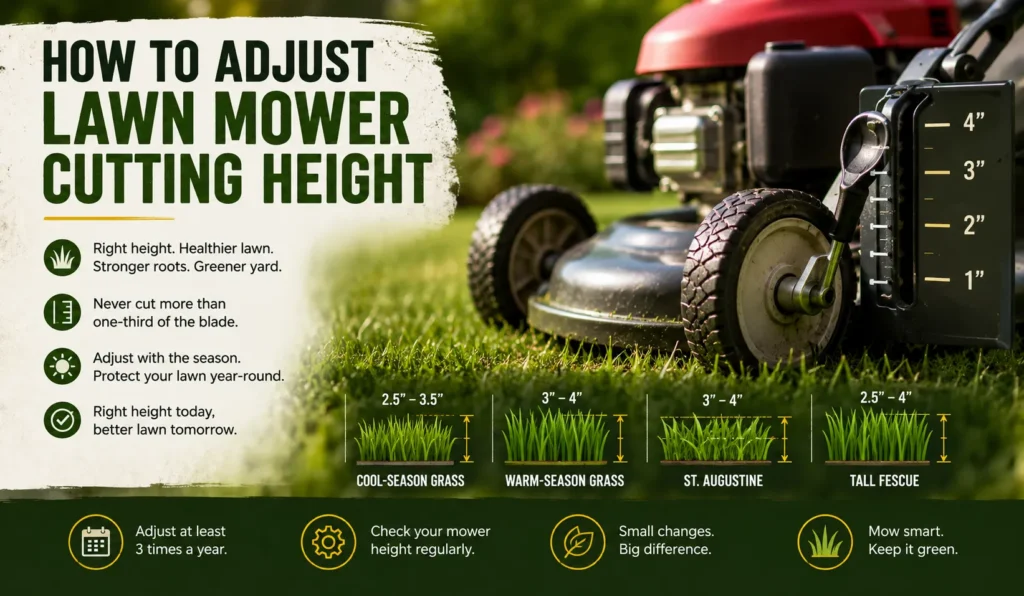
- Adjusting lawn mower cutting height correctly stops scalping, stress, and patchy regrowth.
- Most grass types do best between 2.5 and 4 inches – but the right number depends on grass variety, season, and your region.
- Walk-behind mowers use either a single lever or individual wheel clips; riding mowers use a lift lever or dial; robotic mowers use a knob or app setting.
- Never remove more than one-third of the blade in a single mow – this is the single most important rule in lawn care.
- Adjust your cutting height at least three times a year: spring, peak summer, and fall.
A few summers ago, my neighbor called me over to look at his lawn. He had just mowed it for the first time after a hot Georgia July. The yard looked like someone had taken a belt sander to it. Yellow. Dry. Patchy in the worst spots. He had left the deck at the lowest setting from the previous fall – and just never changed it.
That moment is why I care so much about how to adjust lawn mower cutting height. It is not a complicated task. But most people either skip it entirely or set it once and never touch it again. This guide is for homeowners who want to stop guessing and start mowing with a plan.
Why Cutting Height Matters More Than Most People Think
Cutting height affects how your lawn handles heat, drought, weeds, and pests. It is not just about looks. A few millimeters in the wrong direction can mean the difference between a lawn that bounces back and one that turns brown by August.
What Happens When You Cut Too Short
Short cutting – also called scalping – removes the green leaf blade and exposes the pale stem underneath. That stem cannot photosynthesize. The grass stops producing energy, root growth slows, and the lawn becomes thin and patchy.
In full sun, scalped grass burns fast. I have seen it happen in Phoenix in June: one bad cut, and the yard looked like straw within three days. Shallow roots from repeated low cutting also make your lawn more vulnerable to soil compaction and drought stress.
Short cutting also opens the door to weeds. When grass is thin, crabgrass and broadleaf weeds move in quickly. Sunlight reaches the soil surface, weed seeds germinate, and you end up fighting a new problem every season.
What Happens When You Let It Grow Too Long
The opposite extreme is just as bad. When grass grows too tall before you cut it, the lower blades have been living in shade. They turn yellow and weak. Then you mow, expose them to full sun, and they burn.
Tall grass also holds moisture. That is good for drought, but bad for fungal disease. Lawns in the Pacific Northwest and humid Southeast are especially prone to dollar spot and brown patch when the grass is too dense and wet.
There is a sweet spot for every grass type. The goal is to stay in that range all season long.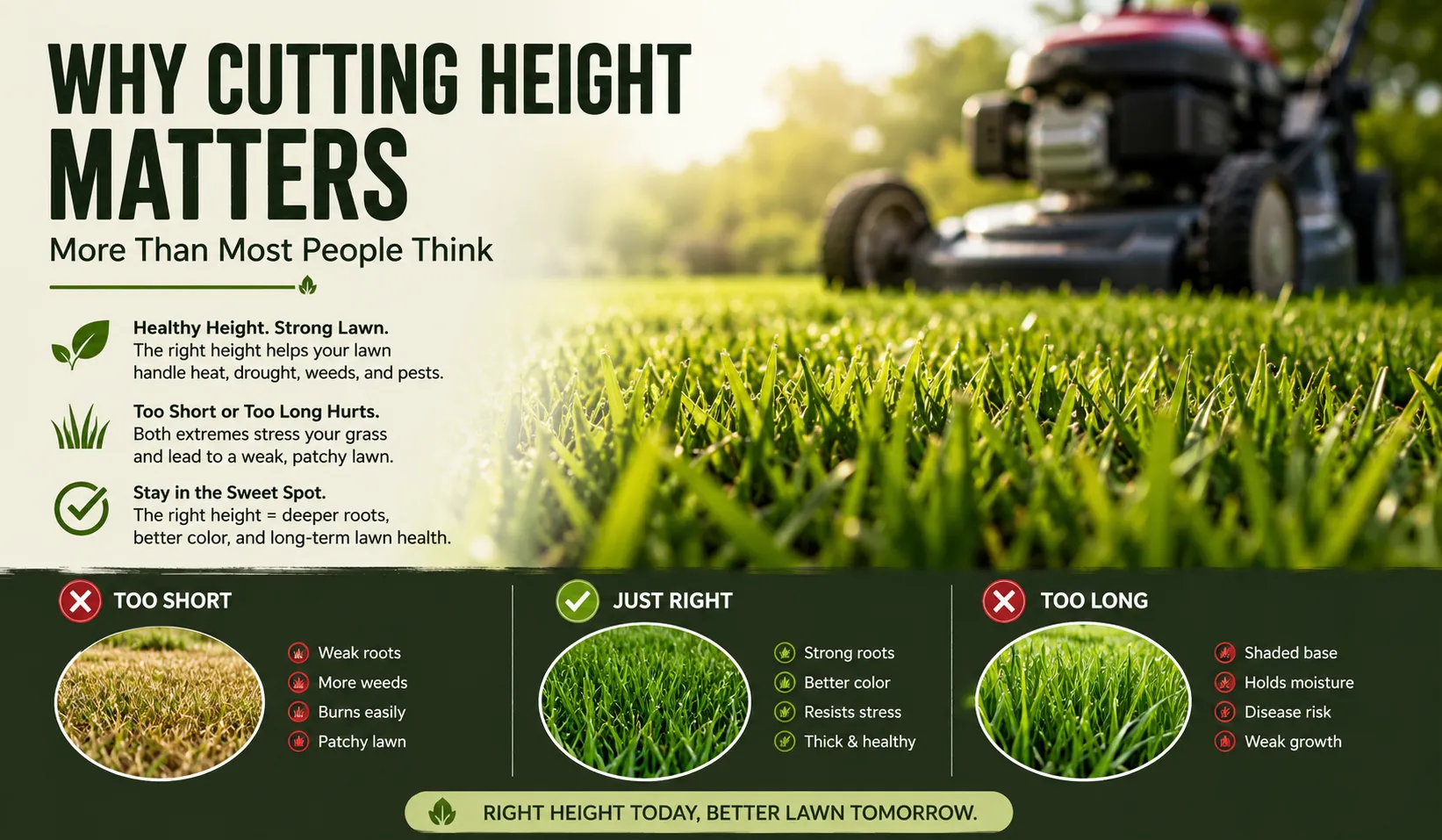
Understanding Cutting Height Settings
Your mower has numbered positions on the deck adjustment – but those numbers do not mean the same thing on every machine. Here is how to read them correctly.
What the Numbers on Your Mower Actually Mean
On most walk-behind mowers, the height settings run from 1 to 5 or 1 to 7. These are relative positions, not exact measurements in inches. Position 3 on a Toro Recycler does not equal position 3 on a Ryobi self-propelled.
The only way to know your actual cutting height is to measure it. Here is how:
- Park the mower on a hard, flat surface (driveway or garage floor)
- Lower the deck to your chosen position
- Use a tape measure or ruler from the ground to the lowest edge of the blade
Do this once per mower. Write the measurement on a piece of tape and stick it to the mower handle. You will thank yourself later.
Deck Height vs. Blade Height – What Is the Difference?
Deck height is the distance from the ground to the bottom of the mower deck. Blade height is the actual cut height – the distance from the ground to the tip of the spinning blade.
On most consumer mowers, blade height is slightly lower than deck height because the blade sits a small distance above the deck bottom. The difference is usually about a quarter inch. For practical mowing purposes, the measurement from ground to blade tip is what matters.
Compression Table: Common Mower Types and Their Height Ranges
| Mower Type | Typical Height Range | Adjustment Increments |
|---|---|---|
| Walk-behind push | 1 – 4 inches | 0.25 – 0.5 inch steps |
| Self-propelled | 1 – 4 inches | 0.25 – 0.5 inch steps |
| Riding / zero-turn | 1 – 5 inches | 0.25 inch steps |
| Robotic mower | 1 – 3.5 inches | 0.1 – 0.25 inch steps |
How to Adjust Cutting Height on Different Mower Types
Every mower type has its own adjustment system. Some take ten seconds. Others take two minutes per wheel. Knowing which system you have makes the process straightforward.
Walk-Behind Push Mowers (Single Lever vs. Individual Wheel Adjusters)
Most modern walk-behind mowers use one of two systems.
Single lever: One handle on the side of the deck moves all four wheels at once. This is the easiest system by far. You squeeze a tab, push the lever, and the whole deck lifts or drops in one motion. Honda HRX models and the EGO 56V self-propelled both use this design. It takes about five seconds.
Individual wheel clips: Each wheel has its own clip that slots into a notched bracket. You squeeze the clip, lift the wheel, and snap it into the new notch. Repeat for all four wheels. This system is more common on older mowers and some budget models. It is slower – but it also lets you set the front and rear wheels at slightly different heights, which some people do to get a cleaner cut on uneven ground. Ryobi 40V push mowers often use this system.
To adjust:
- Park the mower on a flat surface with the engine off
- For single lever: squeeze the tab and move to the new height position
- For wheel clips: press the release tab, lift each wheel, snap it into the correct notch
- Check the actual height with a tape measure before mowing
Self-Propelled Mowers
Self-propelled mowers use the same deck adjustment systems as push mowers – single lever or individual wheel clips. The self-propulsion drive is separate from the height mechanism.
One thing to watch: on self-propelled mowers with rear-wheel drive (like the Toro TimeMaster), dropping to the lowest height settings can create drag. The rear wheels sometimes dig into soft spring soil. If you notice the mower pulling hard or tracking unevenly after an adjustment, raise the deck by one position.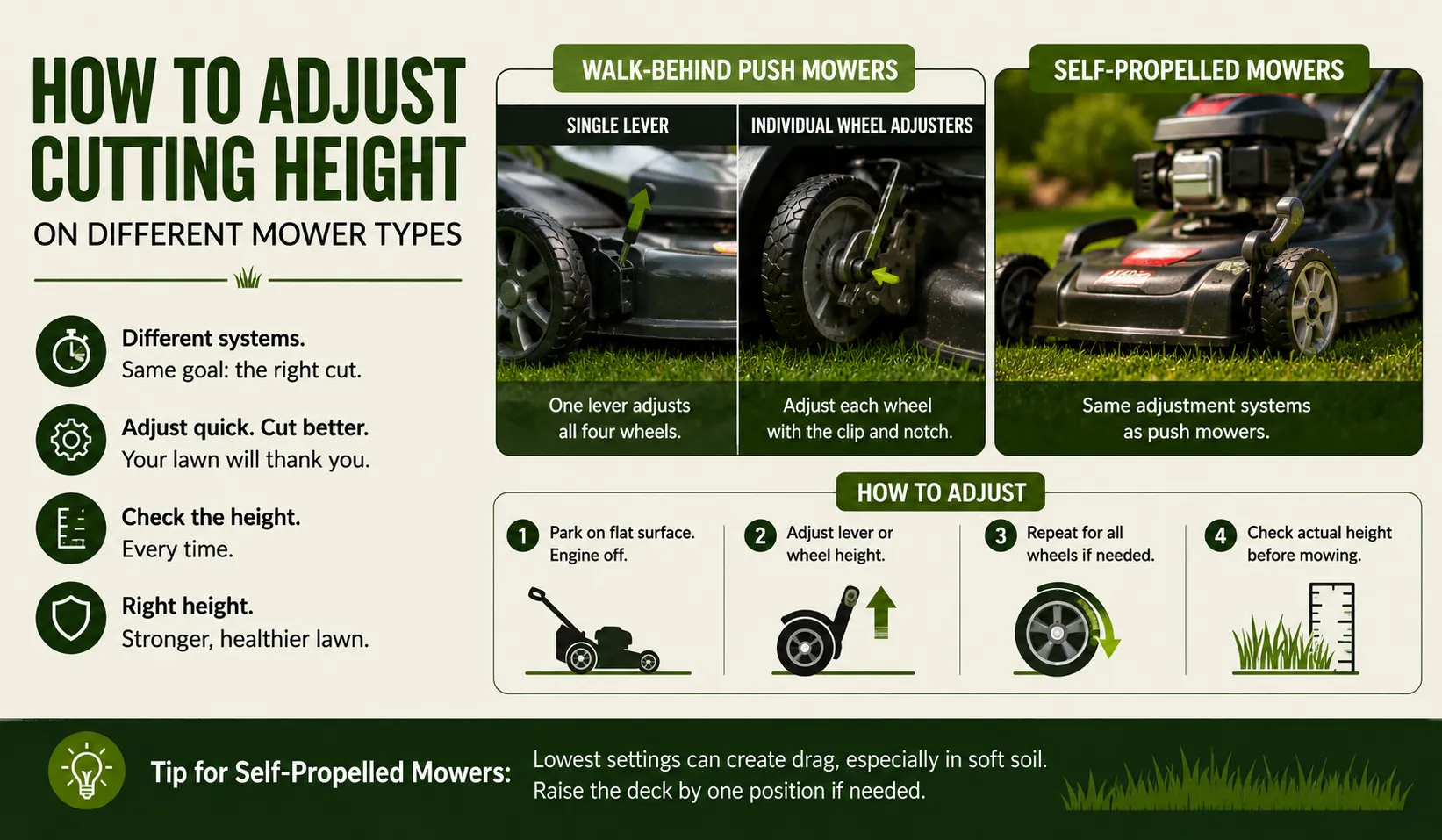
Riding Mowers and Zero-Turn Mowers
Riding mowers use a lift lever or a dial near the seat to adjust the deck height. The lever typically moves the entire cutting deck up or down through a cable or linkage system.
On Husqvarna riding mowers, the height lever is on the right side of the seat and clicks into numbered positions. On John Deere entry models, it is a similar side-mount lever with half-inch increments. Most zero-turns (Husqvarna Z254, Ariens IKON) use a spring-assisted foot pedal combined with a pin that locks the deck at the chosen height.
To adjust a riding mower deck:
- Set the mower on flat ground
- Disengage the blades (PTO off)
- Move the height lever or turn the dial to the new position
- Verify the actual height by measuring from the ground to the blade tip under the deck
One common mistake: people adjust the deck height while the mower is on uneven ground. Even a small slope throws the measurement off. Always adjust on a flat surface.
Robotic Mowers
Robotic mowers adjust height differently depending on the brand. Most models – including Husqvarna Automower and the Worx Landroid – have a height dial directly on the chassis. You turn it clockwise or counterclockwise while the mower is stationary.
Some newer models, like the EcoFlow Blade and Segway Navimow, allow height adjustment through an app. You set the target height in centimeters, and the machine adjusts its cutting mechanism automatically.
Robotic mowers cut more frequently than traditional mowers – often every day or two. Because of this, they work at lower heights than you might expect. Most are set between 1.5 and 2.5 inches, relying on frequent light cuts rather than infrequent deep cuts.
Compression Table: Adjustment Method by Mower Type
| Mower Type | Adjustment System | Time to Adjust | Ease |
|---|---|---|---|
| Walk-behind (single lever) | One lever, all four wheels | 5 seconds | Very easy |
| Walk-behind (wheel clips) | Individual clips per wheel | 2 – 3 minutes | Moderate |
| Self-propelled | Same as walk-behind | 5 sec – 3 min | Easy to moderate |
| Riding mower | Side lever or foot pedal + pin | 30 seconds | Easy |
| Zero-turn | Foot pedal + deck pin | 30 – 60 seconds | Easy |
| Robotic mower | Dial or app setting | 10 – 30 seconds | Very easy |
The Right Cutting Height for Every Grass Type
Grass type is the single most important factor when choosing a cutting height. Cutting Bermuda the way you cut tall fescue will wreck one of them.
Warm-Season Grasses (Bermuda, St. Augustine, Zoysia)
Warm-season grasses grow aggressively in heat and go dormant in winter. They generally prefer lower cutting heights than cool-season types.
Bermuda grass does best at 0.75 to 1.5 inches for hybrid varieties and 1.5 to 2.5 inches for common Bermuda. I cut the common Bermuda in my Georgia backyard at 1.75 inches from May through September. Go lower than that and you risk scalping the runners.
St. Augustine grass is coarser and wants more height – 2.5 to 4 inches. In Florida and coastal Texas, most lawn care professionals keep St. Augustine at 3 to 3.5 inches during the growing season. Lower than 2.5 inches and chinch bugs find it much easier to damage.
Zoysia falls in between at 1 to 2.5 inches, depending on the variety. Fine-blade Zoysia (like Emerald) prefers 0.75 to 1.5 inches. Coarser Zoysia (like El Toro) handles 1.5 to 2.5 inches well.
Cool-Season Grasses (Kentucky Bluegrass, Tall Fescue, Ryegrass)
Cool-season grasses thrive in spring and fall, slow down in summer heat, and stay green through mild winters.
Kentucky Bluegrass grows best at 2.5 to 3.5 inches. In Minnesota and the upper Midwest, I have seen bluegrass lawns look their best around 3 inches through the summer. Below 2 inches in July, they thin out and go patchy fast.
Tall fescue is one of the most forgiving grass types in terms of height. It performs well at 3 to 4 inches. In the transition zone (Kentucky, Virginia, Kansas), tall fescue lawns mowed at 3.5 to 4 inches during summer stress hold up noticeably better than those kept shorter.
Perennial ryegrass does well at 1.5 to 2.5 inches. It is a common overseeding grass in the Pacific Northwest and is often mixed into bluegrass lawns across the country.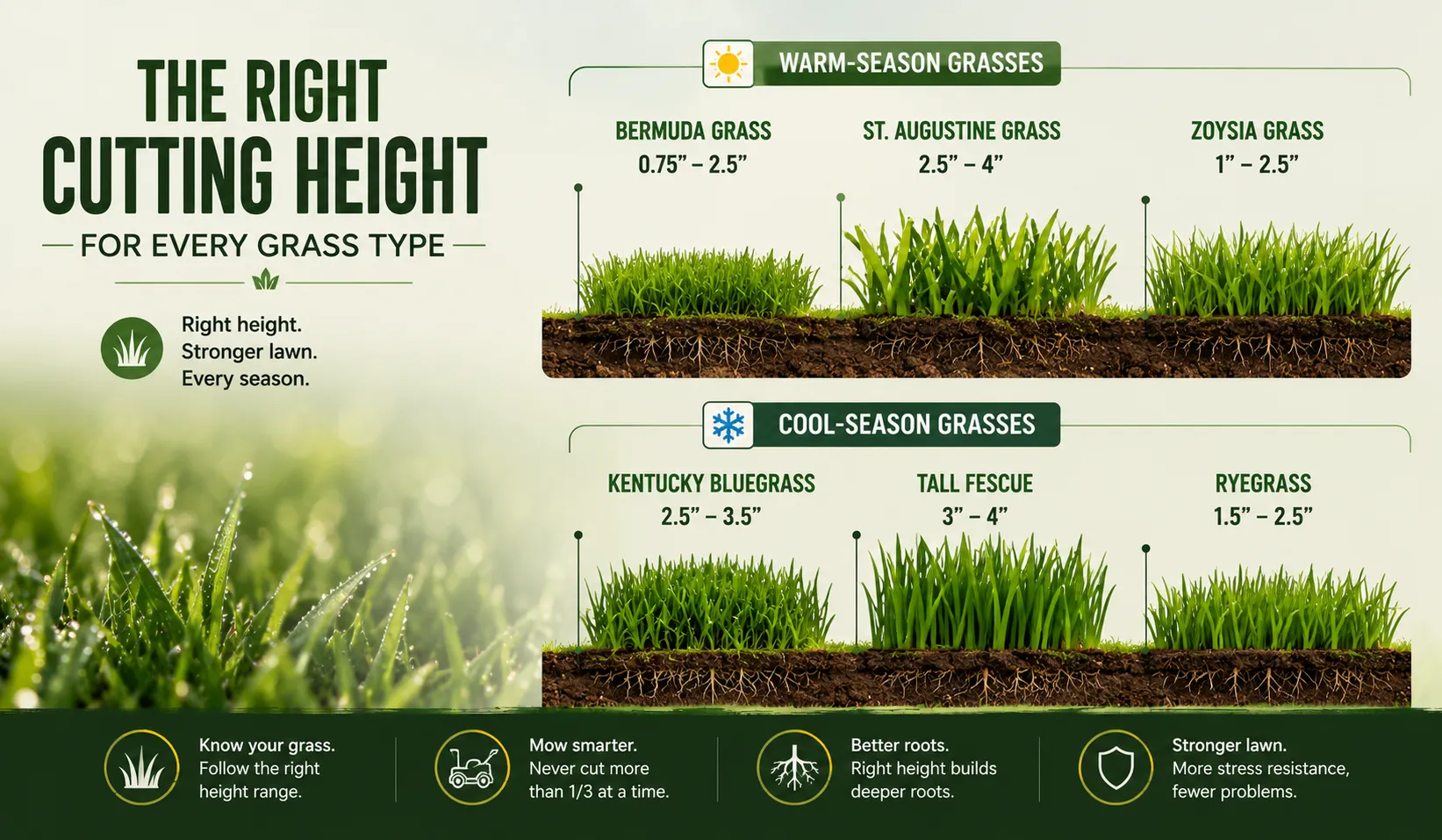
Mixed or Unknown Grass Types
If you do not know what type of grass you have, start at 3 inches. That height is safe for most common grass varieties. Then watch how the lawn responds over two to three mowing cycles.
If the lawn looks good and grows evenly, stay there. If you see yellowing or thinning, raise to 3.5 inches. If it looks too shaggy between cuts and grows very fast, try 2.5 inches.
Your local cooperative extension office can usually identify your grass type from a small sample or even a photo. University of Georgia Extension, Texas A&M AgriLife, and Purdue Extension all offer free or low-cost identification services online.
Compression Table: Grass Type, Ideal Height, and Season
| Grass Type | Ideal Cutting Height | Season to Apply |
|---|---|---|
| Common Bermuda | 1.5 – 2.5 in | Late spring through early fall |
| Hybrid Bermuda | 0.75 – 1.5 in | Late spring through early fall |
| St. Augustine | 2.5 – 4 in | Spring through fall |
| Zoysia (fine) | 0.75 – 1.5 in | Growing season |
| Zoysia (coarse) | 1.5 – 2.5 in | Growing season |
| Kentucky Bluegrass | 2.5 – 3.5 in | Year-round (raise in summer) |
| Tall Fescue | 3 – 4 in | Year-round (raise in summer) |
| Perennial Ryegrass | 1.5 – 2.5 in | Year-round |
How Season and Climate Change the Right Height
The same grass needs different heights at different times of year. Most people miss this. They set the deck in April and never touch it again.
Spring – Coming Out of Dormancy
In early spring, grass is coming out of dormancy and just starting to build energy reserves. This is the one time I recommend cutting slightly lower than your usual summer height.
For tall fescue and bluegrass in the mid-Atlantic and Midwest, start at 2 to 2.5 inches for the first one or two cuts of the season. This removes dead winter blade tips and lets light reach the new growth underneath. After those first cuts, raise back to your summer height.
For warm-season grasses in the South, wait until the lawn is at least 50 percent green before mowing. Cutting dormant Bermuda or Zoysia just tears the dead blades and spreads them around without helping anything.
Summer Heat Stress (South, Southwest, and Humid Southeast)
Summer is when cutting height matters most. In heat stress – anything above 90 degrees Fahrenheit for multiple days – grass needs more blade to shade the soil and reduce moisture loss.
In Phoenix and Las Vegas, Bermuda lawns mowed at 1.5 to 2 inches in summer brown faster and require more water than those kept at 2.5 inches. The taller blade shades the soil. That keeps the root zone a few degrees cooler.
In the humid Southeast (Georgia, Alabama, Louisiana), St. Augustine lawns should stay at 3.5 to 4 inches through July and August. This height also reduces chinch bug pressure, which spikes in heat and drought (University of Florida IFAS, 2023).
For cool-season grasses in the transition zone, raise to your maximum recommended height in July and August. Kentucky Bluegrass at 3.5 inches during a heat wave will survive. The same lawn at 2 inches may go dormant and struggle to recover.
Fall Prep and the Final Cut Before Winter
In fall, lawns need to prepare for dormancy or slow growth. For warm-season grasses in USDA zones 7 through 9, gradually lower the cutting height through September and October. This helps the crown of the plant harden off before the first frost.
For cool-season grasses in zones 5 through 7, fall is the growing season. Keep the height at your normal summer setting through October, then drop about a half inch for the last one or two cuts before the ground freezes. Shorter grass heading into winter reduces the risk of snow mold.
The final cut should never scalp the lawn. Leave at least 2 inches on cool-season grasses and 1 inch on warm-season grasses going into dormancy.
Compression Table: Seasonal Height Guide by Region
| Region | Grass Type | Spring | Summer | Fall | Final Winter Cut |
|---|---|---|---|---|---|
| Southeast (GA, FL, AL) | Bermuda / St. Augustine | 1.5 – 2 in | 2.5 – 4 in | 2 – 3 in | 1.5 – 2 in |
| Southwest (AZ, NV, TX) | Bermuda / Zoysia | 1.5 – 2 in | 2 – 2.5 in | 1.5 – 2 in | 1 – 1.5 in |
| Midwest (MN, OH, IL) | Kentucky Bluegrass | 2 – 2.5 in | 3 – 3.5 in | 2.5 – 3 in | 2 – 2.5 in |
| Transition Zone (KY, VA, KS) | Tall Fescue | 2.5 – 3 in | 3.5 – 4 in | 3 – 3.5 in | 2.5 in |
| Pacific Northwest (OR, WA) | Ryegrass / Bluegrass | 2 – 2.5 in | 2.5 – 3 in | 2.5 – 3 in | 2 in |
Common Mistakes People Make with Cutting Height
Most cutting height problems come from two habits. Both are easy to fix once you know about them.
The One-Third Rule – and Why People Ignore It
The one-third rule says: never remove more than one-third of the grass blade in a single mowing. If your target height is 3 inches, mow when the grass reaches 4.5 inches. If your target is 2 inches, mow when it hits 3 inches.
Most people know this rule. Almost nobody follows it.
The reason it matters is energy. Grass stores carbohydrates in its blade. Remove too much at once and the plant cannot produce enough energy to regrow quickly. Root depth drops. The lawn weakens. In summer heat, this can mean a dead or dormant patch within two weeks.
I ignored this rule on a Bermuda lawn in Atlanta one June. I was behind on mowing, the grass was around 4 inches, and I dropped the deck to 1.5 inches in one pass. Two weeks later I had yellow runners and a lawn that looked like it had a disease. It did not. I just removed too much at once.
If you have fallen behind and the grass is too long, mow at a higher setting, wait a few days, then mow again at your target height. Two passes are always better than one aggressive cut.
Setting It Once and Forgetting It All Season
This is the most common mistake I see. Homeowners set the deck height in spring and then leave it there through October.
The problem is that grass needs change with temperature, rainfall, and growth rate. A height that works in May can stress your lawn in August. And the height that is right for August can leave your lawn too tall going into winter.
Check your cutting height at least three times a year:
- Spring (March – April): adjust for dormancy recovery
- Peak summer (June – July): raise for heat protection
- Fall (September – October): prepare for dormancy or the final cut
The adjustment takes thirty seconds on most mowers. There is no good reason to skip it.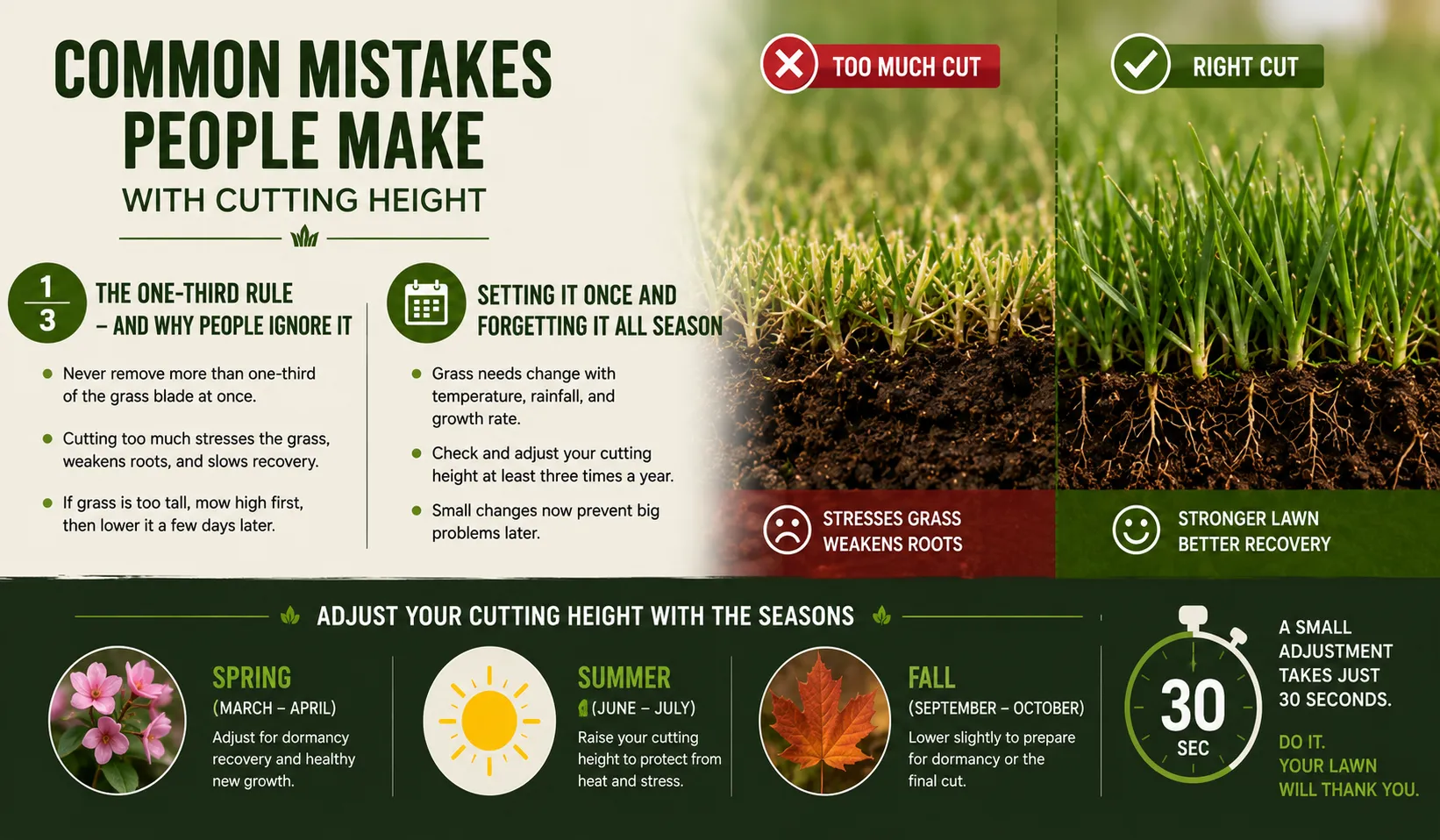
My Final Recommendation
If I had to give one piece of advice about cutting height, it is this: measure your actual cut height at least once, then adjust it with the season. Most people have never measured it. They think they are at 3 inches and they are actually at 1.75 inches. That gap explains a lot of struggling lawns.
Start at 3 inches if you are unsure. Watch your lawn over three to four mow cycles. If it looks dense and green and grows evenly, you are in the right range. If you see stress, thin spots, or fast yellowing in summer, raise by half an inch and watch what happens.
The tools you already have are enough to do this right. You do not need a new mower or a special blade. You just need to move the lever, check the height, and adjust with the season. That is all it takes.
Pros and Cons: Cutting High vs. Cutting Low
| Factor | Cutting High (3 – 4 inches) | Cutting Low (1 – 2 inches) |
|---|---|---|
| Heat stress protection | Better – blade shades the soil | Worse – soil exposed to direct sun |
| Drought resistance | Better – deeper root system | Worse – shallow roots dry out faster |
| Weed pressure | Lower – grass crowds out weeds | Higher – bare soil invites weed seeds |
| Mowing frequency | Less frequent – slower growth rate | More frequent – fast growth in season |
| Appearance | Lush, carpet-like look | Tight, manicured look |
| Scalping risk | Low | High on uneven ground |
| Fungal disease risk | Slightly higher in humid climates | Lower in humid climates |
| Best for | Most home lawns, summer months | Sports turf, Bermuda in season, robotic mowers |
Frequently Asked Questions About Lawn Mower Cutting Height
What is the best cutting height for most home lawns?
For most cool-season grass lawns (bluegrass, fescue, ryegrass), 3 to 3.5 inches is the best year-round starting point. For warm-season grasses like Bermuda and Zoysia, 1.5 to 2.5 inches works for most homeowners. Adjust up in summer heat and down slightly in fall.
How do I know what height my mower is actually set to?
Park on a hard, flat surface. Use a tape measure from the ground to the tip of the blade under the deck. The number on your mower dial is a relative position, not an exact measurement in inches. Measuring once per mower tells you exactly where you stand.
What is the one-third rule in mowing?
The one-third rule says to never remove more than one-third of the grass blade in a single cut. If your target is 3 inches, mow when the grass reaches 4.5 inches. Removing more than one-third at once slows root growth and stresses the lawn.
Should I change cutting height in summer?
Yes. During peak summer heat – especially in the South and Southwest – raise your cutting height by 0.5 to 1 inch above your spring setting. Taller grass shades the soil, reduces water evaporation, and keeps roots cooler. This is the single most effective thing you can do for a lawn in a hot summer.
How do I adjust cutting height on a riding mower?
Most riding mowers have a height lever or dial near the seat. Move the lever to the new position while the blades are disengaged and the mower is on flat ground. After adjusting, measure from the ground to the blade tip to verify the actual height. Check your specific model’s manual for the lever location if you are not sure.
What is the difference between deck height and blade height?
Deck height is the distance from the ground to the bottom of the mower housing. Blade height is the actual cutting height – the distance from the ground to the spinning blade tip. On most consumer mowers, blade height is about a quarter inch lower than the deck measurement. Blade height is the number that matters for lawn care.
How often should I adjust my cutting height during the year?
At minimum, adjust three times per year: once in spring coming out of dormancy, once at the start of peak summer heat, and once in fall before the last cut of the season. If you have a warm-season grass in the deep South, you may want to adjust four or five times as conditions shift.