

Quick Overview
- Lawn mower overheating is most often caused by a clogged air filter, low oil, or packed grass clippings blocking airflow around the deck
- When your mower shuts down mid-mow, turn it off immediately and let it cool for at least 30 minutes before inspecting
- Clean the air filter every 25 hours of use and check oil before each mowing season – these two habits prevent most overheating issues
- Gas mowers overheat mainly from engine problems; battery mowers shut down from built-in thermal protection triggered by sustained heat
- If your mower has a blown head gasket or seized engine, repair costs often exceed the machine’s value – replacement is sometimes the smarter call
It was a mid-July afternoon in Phoenix. The temperature hit 108°F. I was halfway through my backyard when my Toro self-propel sputtered and died. There was a sharp burning smell – like hot rubber mixed with scorched grass. I knew right away: lawn mower overheating had stopped me cold.
That moment of panic is real. You stand there in the heat, sweating, wondering if you just broke your machine. The good news is that most overheating problems are fixable. Many are preventable.
This guide covers why lawn mower overheating happens, how to fix it right now, and what to do to stop it from coming back. It’s written for homeowners with gas or battery mowers – whether your engine shut off mid-mow, you spotted smoke rising from the deck, or you noticed your blade slowing down in thick grass.
I’ve dealt with overheating mowers in Florida humidity, Arizona summer heat, and Minnesota’s thick spring grass. I’ll walk you through what to check, what to fix, and when to put the wrench down and call a repair shop.
Why Lawn Mowers Overheat in the First Place
Most overheating problems come down to one of four things: airflow, oil, clippings, or temperature. Each one builds on the others.
Clogged Air Filters and Blocked Vents
A dirty air filter is the most common cause of lawn mower overheating. The engine needs a steady flow of clean air to stay cool. When the filter gets clogged, the engine works harder and engine temperature climbs fast.
The cooling fins on most small engines – Briggs & Stratton and Honda units especially – sit near the air intake. Block that airflow and the engine can’t shed heat. It’s the only cooling system the engine has.
Check your filter every season, or every 25 hours of use. On a foam filter, look for gray or brown buildup. On a paper filter, tap it against your hand – if dust pours out, it’s done. A new filter costs $5–10 at any hardware store.
Blocked vents cause the same problem. Grass clippings, dirt, and debris pack into the cooling fins over time. I’ve pulled out solid plugs of compressed grass from around the fins on a Husqvarna walk-behind. Five minutes with a stiff brush cleared them.
Low or Dirty Engine Oil
Engine oil does two jobs. It lubricates moving parts and pulls heat away from the engine block. When oil is low, the engine runs hotter than it should. When oil is old and broken down, it stops doing either job properly.
Crankcase oil breaks down faster in high-heat conditions. If you’re mowing in Phoenix in July with oil that’s been sitting in the engine since last fall, you’re asking for trouble.
Check oil before every mow. The dipstick takes ten seconds. If the oil looks black and gritty instead of amber or light brown, change it before you start. Most small engines need SAE 30 or 10W-30 – check your manual.
Low oil is also a fire risk. A hot engine with no lubrication can cause permanent damage in minutes.
Grass Clippings Packed Around the Deck
Deck clogging is one of the sneakier causes of overheating. Wet grass sticks to the underside of the mowing deck and builds into a thick mat. That mat traps heat and blocks airflow around the blade and engine.
I’ve seen this happen in Florida during the rainy season. Bahia grass and St. Augustine grass get heavy when wet. After 30 minutes of mowing, the deck can look like it’s been wallpapered in green paste.
Clogged decks also force the engine to work harder. The blade struggles to spin through the buildup. That raises RPM load and engine temperature at the same time.
Clean the deck after every use. Tilt the mower on its side – air filter facing up – and scrape the deck clean with a putty knife or deck scraper.
Mowing in Extreme Heat or Direct Sun
The ambient temperature matters more than most people think. Your mower’s engine is already hot during operation. Add 100°F air and direct sun, and the cooling system runs near its limit the whole session.
I mowed in Phoenix in July at midday – once. The Husqvarna walked fine for 20 minutes, then the thermal overload switch kicked in and it stopped cold. The engine wasn’t broken. It was just too hot to continue safely.
That thermal overload switch is a safety feature. It cuts power when engine temperature crosses a set limit. It’s doing exactly what it’s supposed to do.
Mow before 9 AM or after 6 PM on hot days. That single change prevents most heat-related shutdowns.
Warning Signs Your Mower Is Overheating
Your mower gives you warning signals before it stops working. Catch them early and you’ll avoid the bigger problems down the line.
Engine Shuts Off Mid-Mow
A sudden shutdown mid-mow is almost always the thermal overload switch doing its job. The engine got too hot, the switch cut power, and now you’re standing in the yard holding a silent machine.
This is a safety feature, not a failure. But it means something is wrong – either the conditions are too extreme (too hot, too long) or maintenance is overdue (clogged filter, low oil).
Don’t try to restart right away. Let the engine cool for at least 30 minutes. Then investigate before starting again.
Burning Smell or Smoke from the Deck
A burning rubber or oil smell is a serious sign. It usually means oil is getting onto hot engine parts, or grass clippings are resting against a hot surface.
Smoke from under the deck often means clippings are burning. Smoke from the engine area points to oil leaking onto the block – possibly from a blown gasket.
Stop immediately if you see smoke. Turn off the engine and step back. Let everything cool before you touch anything.
Loss of Power or Blade Slowdown
Before a full shutdown, most mowers give you a warning. The engine loses power and the blade slows. You’ll hear the RPMs drop. The mower might struggle through grass it handled fine ten minutes earlier.
This RPM drop is the engine laboring under thermal stress. The carburetor can also run lean as the engine heats up, which cuts the fuel mix and reduces power further.
If you notice this happening, stop mowing. Don’t push through it.
Compression Table – Symptom vs. Likely Cause
| Symptom | Likely Cause |
|---|---|
| Engine shuts off mid-mow | Thermal overload switch triggered |
| Burning smell, no smoke | Grass clippings on hot deck or exhaust |
| Smoke from engine area | Oil leak onto hot block |
| Blade slows, RPMs drop | Low oil or clogged air filter |
| Hard to restart after shutdown | Thermal cutoff still active or vapor lock |
| Power loss in thick grass | Deck clogging or high RPM load from clippings |
How to Cool Down an Overheated Mower (Step-by-Step)
When your mower shuts down from heat, the right steps in the right order prevent further damage. Here’s what I do every time it happens.
Immediate Steps to Take When It Shuts Down
First, disengage the blade. If the mower stopped itself, the blade may already be off – but confirm it.
Move the mower to shade if possible. This sounds minor. It actually matters – direct sun keeps surface temperatures high and slows the cooldown.
Don’t open the oil cap or air filter cover right away. Hot engines pressurize internally. Let things settle for a few minutes first.
Step back and look around the mower. Check that nothing is smoking or showing signs of fire. Dry grass clippings sitting near a hot exhaust pipe can ignite. This is not common, but it happens.
How Long to Let It Rest Before Restarting
Wait 30 minutes minimum. I know that feels like forever when you have half a lawn left to mow. But restarting too soon risks pushing an already stressed engine past its limit.
On a very hot day in direct sun, I’d wait 45 minutes. After 20 minutes, touch the engine housing lightly with the back of your hand. If it’s still hot, wait longer.
You’ll hear the engine contracting as it cools – a click-tick sound as the metal settles. That’s your signal things are moving in the right direction.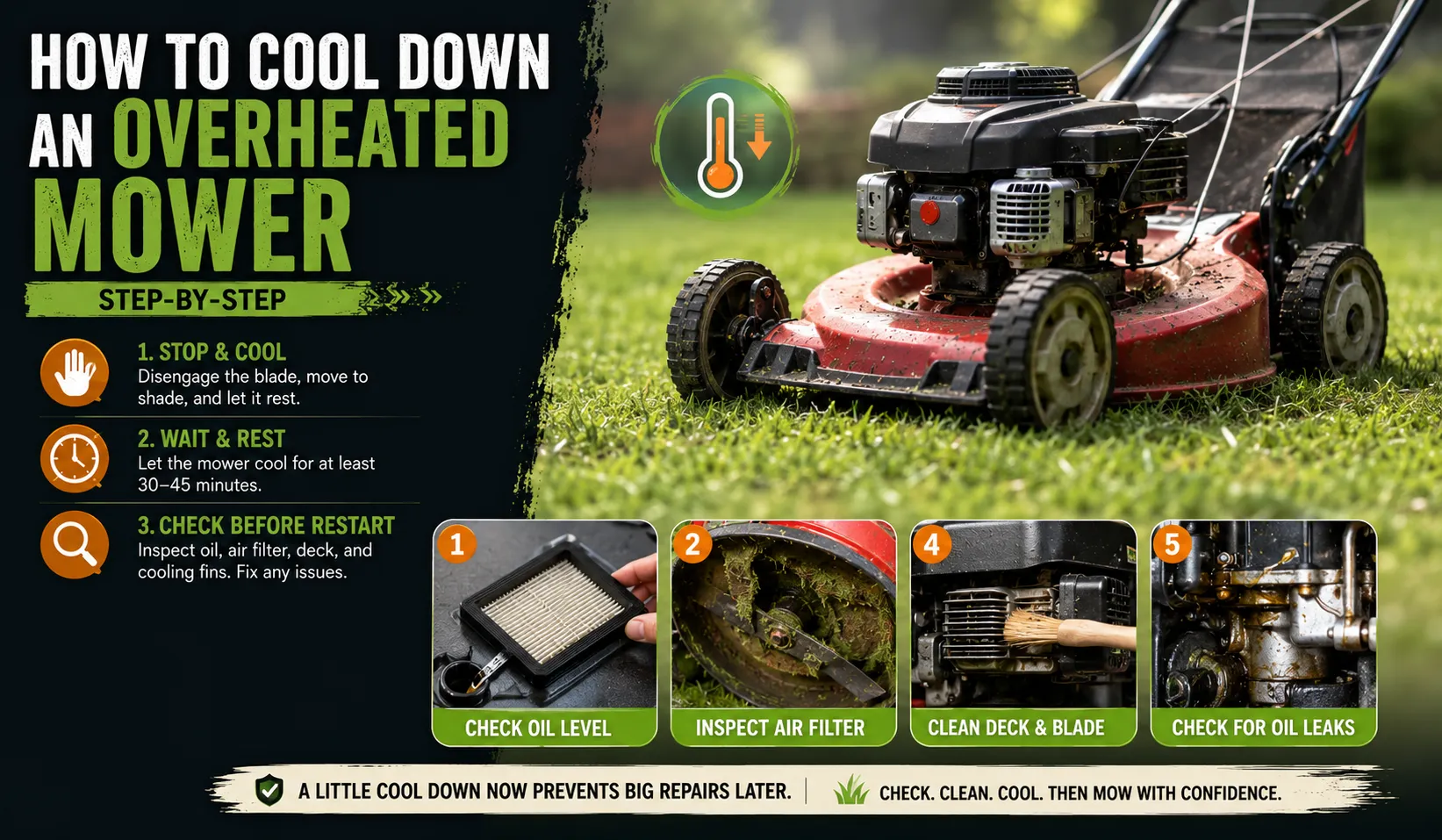
What to Check Before You Start It Again
Before restarting, run through this list:
- Check oil level with the dipstick – add SAE 30 or 10W-30 if it’s low
- Pull out the air filter and look at it – clean or replace if it’s dirty
- Look under the deck for packed clippings – scrape them out
- Check the cooling fins for debris – clear them with a stiff brush
- Look for oil on the engine block – this could point to a gasket leak
If everything checks out, try a restart. If the mower shuts down again quickly, stop. There’s a deeper problem.
Compression Table – Fix vs. Tool Needed
| Problem Found | Fix | Tool Needed |
|---|---|---|
| Dirty air filter | Clean or replace filter | Brush or none |
| Low oil | Add correct grade oil | Oil, funnel |
| Clogged deck | Scrape clippings off | Putty knife or scraper |
| Blocked cooling fins | Clear with brush | Stiff brush |
| Oil on engine block | Inspect for gasket leak | Flashlight |
| Still shutting down after all fixes | Take to repair shop | – |
How to Prevent Lawn Mower Overheating
Most overheating is preventable. These habits take almost no time and save you from repairs and downtime later. Stay consistent with them and overheating becomes rare.
Clean the Air Filter Every 25 Hours
Twenty-five hours of use is roughly one mowing season for a typical suburban yard. Mark it on a calendar or tape a note inside your shed.
Foam filters: wash with warm soapy water, let dry fully, re-oil lightly, and reinstall.
Paper filters: tap out loose dust and inspect for tears or heavy fouling. If it’s dark gray or torn, replace it. A new paper filter costs $5–10 at any hardware store.
Don’t skip this step. A clogged air filter is the fastest path to engine overheating.
Check and Change Oil Before Each Season
I change oil every spring, before the first mow of the season. It takes 10 minutes and protects the engine for another year.
Old oil loses viscosity and stops pulling heat from the engine properly. It also holds carbon deposits from combustion – and you don’t want that circulating through the engine.
Use the oil grade listed in your manual. Most Briggs & Stratton and Honda small engines call for SAE 30 or 10W-30. Check before using full synthetic in older engines – it can affect seals in some models.
Clear Clippings from the Deck After Every Use
Every use. Not every other use. Every time.
Wet grass clippings stuck to the deck harden overnight. By the next session they’re nearly impossible to remove, and they trap heat against the deck the whole time you mow.
A plastic deck scraper takes two minutes after each session. Tilt the mower, scrape the deck, done.
If you bag your clippings, the deck stays cleaner by default. Side-discharge and mulching mowers pack clippings much faster.
Mow in the Morning or Evening, Not Midday
Mow before 9 AM or after 6 PM on days above 90°F. This is the simplest advice I can give, and the most ignored.
Morning mowing has a bonus: dew has usually dried off the grass by 7–8 AM in most US climates, but air temperature is still cool. The grass cuts cleanly and the engine runs well within its limits the whole session.
Midday in Arizona or Florida, you’re mowing in conditions that stress both the engine and yourself. It’s not worth it.
Compression Table – Prevention Task vs. Frequency
| Task | How Often |
|---|---|
| Check oil level | Before every mow |
| Change engine oil | Once per season (spring) |
| Clean air filter | Every 25 hours of use |
| Clear deck of clippings | After every use |
| Check and clear cooling fins | Every 10 hours or once per season |
| Inspect spark plug | Once per season |
| Sharpen blade | Every 20–25 hours |
Overheating by Mower Type – Gas vs. Battery vs. Riding
Different mowers overheat for different reasons. Gas, battery, and riding mowers each have their own failure patterns. Knowing which type you have changes how you troubleshoot.
Gas Mowers (Most Common Cause of Overheating)
Gas mowers overheat more often than any other type. The causes covered above – dirty filters, low oil, clogged decks – apply mainly to them.
The engine temperature in a typical walk-behind gas mower can reach 300–400°F during normal operation. Add a blocked air filter or low oil and that climbs well past safe limits.
Brands like Toro, Husqvarna, and Honda use Briggs & Stratton or Honda GCV engines in most residential models. All of them rely on forced-air cooling through fins around the cylinder head. Block those fins and you’ve blocked the only cooling the engine has.
Battery-Powered Mowers (Heat Affects Battery Life)
Battery mowers don’t have an engine in the traditional sense, but they still overheat – just differently.
The lithium-ion battery packs in EGO, Ryobi, and Greenworks mowers have battery thermal management systems built in. When battery temperature rises too high, the system cuts power to protect the cells.
This usually happens after sustained mowing in high heat – mowing for 40 minutes in Florida in August with a partially discharged battery, for example.
Lithium-ion batteries lose capacity faster when regularly exposed to high heat. Store batteries indoors or in the shade when not in use. Don’t charge a hot battery right after mowing – wait 30 minutes for it to cool down first. Most battery mower manufacturers recommend keeping batteries below 80°F during storage.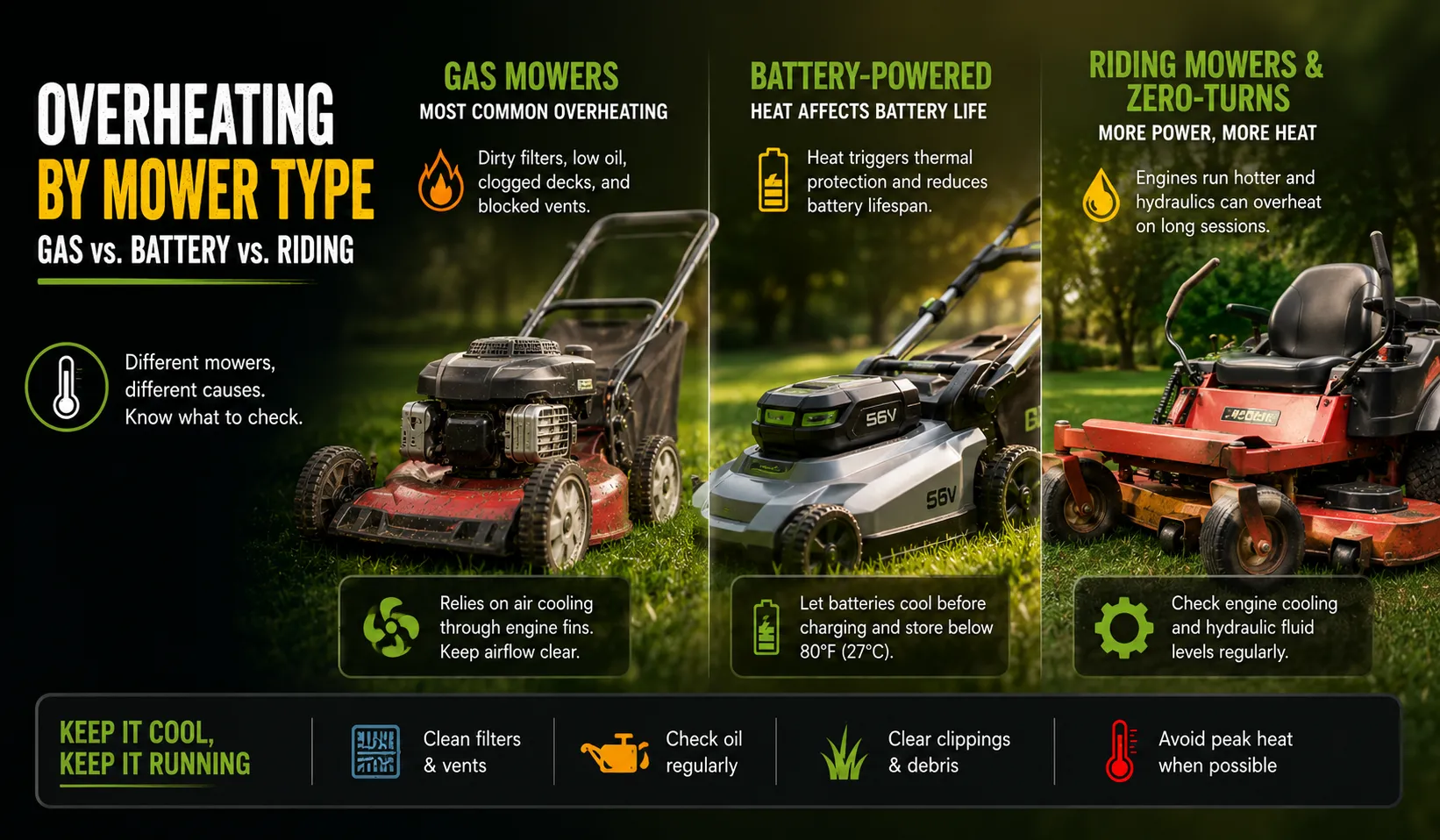
Riding Mowers and Zero-Turns (Engine Cooling Differences)
Riding mowers use larger engines – often Kawasaki, Kohler, or Briggs & Stratton V-twins. These engines have more cooling capacity than walk-behind units, but they also generate more heat.
Riding mowers add one more variable: the operator sits right above the engine. You’ll feel heat rising through the hood much sooner when overheating starts.
Zero-turn mowers can overheat their hydraulic systems in addition to the engine. On long mowing sessions, hydraulic fluid can get hot enough to affect steering response. I’ve felt this on a Husqvarna Z254 after an extended pass – the steering got noticeably stiffer near the end of the session.
Check hydraulic fluid levels each season on riding mowers. This isn’t optional if you’re running a zero-turn.
Compression Table – Mower Type vs. Overheating Risk
| Mower Type | Primary Overheating Risk | Warning Sign |
|---|---|---|
| Gas walk-behind | Clogged air filter, low oil | Shutdown, burning smell |
| Battery walk-behind | Battery thermal cutoff | Sudden stop, battery indicator light |
| Gas riding mower | Engine heat buildup | Power loss, stalling |
| Zero-turn riding | Hydraulic system overheating | Stiff or sluggish steering |
When Overheating Means a Bigger Problem
Sometimes overheating is a symptom, not the cause. If basic fixes don’t solve it, the engine may have deeper damage that maintenance won’t fix.
Blown Head Gasket Signs
A blown head gasket is a serious problem. The head gasket seals the combustion chamber. When it fails, you’ll often see white or blue-gray smoke from the exhaust – even after the mower has been sitting.
You might also see oil loss without any visible external leak. The oil is burning inside the combustion chamber.
On a small walk-behind mower engine, head gasket repair typically costs $80–150 at a shop. If the mower is more than 8–10 years old and the repair costs half the machine’s value, it’s worth pausing before agreeing to it.
Seized Engine – What It Feels Like and What to Do
A seized engine is what happens when a motor runs with no oil until the metal parts weld themselves together from heat and friction. Pull the starter cord and it won’t move at all – not a little stiff, just solid, like pulling against concrete.
I’ve seen this once, on a Craftsman mower that had been running nearly dry on oil for most of a season. The shop estimate was $250. The mower was worth $180 used. The math pointed clearly to replacement.
If your engine is seized, take it to a shop for a diagnosis first. Sometimes a seized engine can be freed with penetrating oil and patience. More often, the repair cost makes replacement the better call.
When to Call a Repair Shop vs. DIY
Call a shop when:
- The starter cord won’t pull at all (seized engine)
- You see white or blue smoke from the exhaust after addressing basic fixes
- The mower still shuts down after you’ve cleaned the filter, changed the oil, and cleared the deck
- You hear knocking or grinding from inside the engine
- The mower is under warranty and opening it yourself could void coverage
Do it yourself when:
- The problem is a dirty air filter, low oil, or clogged deck
- The spark plug needs replacement ($5–8 at any hardware store)
- The cooling fins are packed with debris
- The mower is shutting down on hot days but runs fine when it’s cooler
My Final Recommendation
I’ve fixed a lot of overheating mowers over the years. The honest truth is that 90% of the problems I’ve seen came down to three things: a neglected air filter, old oil, or a deck full of packed clippings. Those aren’t repair problems. They’re maintenance problems. Fix them and most overheating issues disappear.
The other 10% – seized engines, blown gaskets, hydraulic failures – those are the ones where you need to stop and do the math. If a repair costs more than half what the mower would cost to replace, and the mower is already several years old, buying new is usually the smarter move. A new Toro or Honda walk-behind runs $350–500. A major engine repair runs $150–350. That math isn’t always obvious in the moment, but it’s worth thinking through before you hand it over to a shop.
The single best thing you can do right now: check your oil and pull out your air filter before your next mow. If the oil is dark and the filter is gray, fix both before you start the engine. That 10-minute check will prevent more problems than anything else in this article.
Quick-Fix vs. Deeper Repair – What’s Worth Doing Yourself and What Isn’t
| Repair | DIY or Shop? | Estimated Cost | Worth Doing? |
|---|---|---|---|
| Clean or replace air filter | DIY | $0–$10 | Always |
| Change engine oil | DIY | $5–$15 | Always |
| Scrape deck clippings | DIY | $0 | Always |
| Replace spark plug | DIY | $5–$8 | Yes |
| Clear cooling fins | DIY | $0 | Yes |
| Head gasket replacement | Shop | $80–$150 | Depends on mower age |
| Seized engine repair | Shop | $200–$350+ | Rarely – often replace instead |
| Hydraulic fluid service (riding mower) | Shop or DIY | $20–$80 | Yes, don’t skip |
Frequently Asked Questions About Lawn Mower Overheating
Why does my lawn mower keep shutting off in hot weather?
Your mower has a thermal overload switch that cuts power when engine temperature gets too high. This is a safety feature, not a breakdown. It usually means the air filter is dirty, oil is low, or you’re mowing in extreme heat without enough breaks. Let the mower cool for 30 minutes, check both the filter and oil, then restart.
How long should I let an overheated mower cool down?
Wait at least 30 minutes before touching or restarting an overheated mower. On days above 95°F, wait 45 minutes. Touch the engine housing lightly with the back of your hand – if it’s still hot, give it more time. Restarting too soon can push a stressed engine past its limit.
Can a lawn mower catch fire from overheating?
Yes, under certain conditions. Dry grass clippings packed near a hot exhaust pipe can ignite. Oil leaking onto a hot engine block is also a fire risk. If you smell burning and see smoke, shut off the mower immediately, step back, and let everything cool before you inspect anything.
What oil should I use to prevent my lawn mower from overheating?
Most residential gas mowers with small engines use SAE 30 or 10W-30 motor oil. Check your owner’s manual for the correct grade. Always use fresh oil – old, degraded oil loses its ability to pull heat from the engine. Change oil once per season or every 50 hours, whichever comes first.
How do I know if my lawn mower engine is seized from overheating?
Pull the starter cord. If it won’t move at all – not stiff, just fully locked – the engine is likely seized. This happens when a motor runs with no oil and the internal metal parts fuse together. Take it to a repair shop for a diagnosis before deciding whether to repair or replace.
Does mowing wet grass cause lawn mower overheating?
Wet grass doesn’t directly cause the engine to overheat, but it makes deck clogging much worse. Wet clippings stick to the underside of the deck and build up fast, forcing the blade to work harder and raising engine load and temperature. Mow when the grass is dry if possible. If you must mow wet grass, stop and check the deck more often during the session.
Why does my battery mower shut down faster in summer than my old gas mower did?
Battery mowers have thermal protection systems built into their battery packs. When the battery gets hot from heavy use or high ambient temperature, the system cuts power to protect the cells. Store your battery in a cool, shaded place between sessions. Let it rest for 30 minutes after heavy mowing before charging, and avoid leaving it in a hot car or garage.