
Key Takeaways
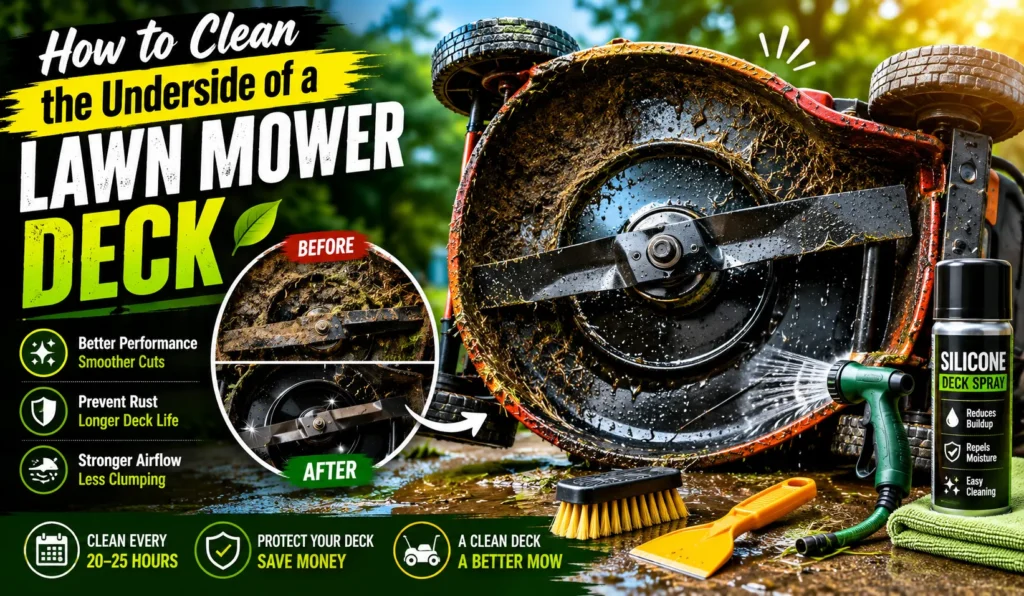
- Cleaning the underside of a lawn mower deck every 20-25 hours of use prevents clumping, blade drag, and early deck rust
- You need a plastic scraper, stiff brush, garden hose, and silicone deck spray – total cost under $20
- Always disconnect the spark plug wire or remove the battery before tilting the mower – no exceptions
- Wet-grass climates like Florida and the Pacific Northwest need a deck cleaning every 5-8 mows
- One coat of silicone spray after cleaning cuts your next scraping session roughly in half
My Husqvarna started bogging down halfway through the backyard last July. Thick clumps of wet grass were flying out sideways. I thought something was wrong with the blade. Then I flipped the deck over.
It was a mud pie. A solid inch of black, rotting clippings packed so tight I had to chip it off in chunks. The smell was somewhere between a compost pile and wet dog. Not pleasant.
That moment is how most people discover they need to clean the underside of a lawn mower deck. You wait until something breaks down before you figure out why it matters. I’ve been there.
This guide is for homeowners who want to do the job right – before it becomes a problem. Whether you run a Honda gas mower or an EGO battery unit, the process is the same. I’ve cleaned decks in Florida heat, Oregon spring mud, and Phoenix summer dust. The details shift a little. The core steps don’t.
Here’s exactly how to do it.
Why Cleaning the Deck Actually Matters
Grass buildup under the deck hurts mower performance fast, and most people don’t connect the symptoms to the cause until real damage is done.
What Happens When You Ignore It
A caked deck blocks airflow. When airflow drops, the blade can’t lift grass upright before cutting. The result: uneven cuts, clumping, and patches the blade skips entirely.
I had a neighbor in Tampa whose Toro was cutting in a wavy pattern. He blamed a bent blade. We checked the deck first. Under there was so much packed St. Augustine grass that the blade had maybe two inches of clearance instead of four. We cleaned it out and the problem was gone in 20 minutes.
Beyond cut quality, buildup holds moisture against the deck metal. That’s how deck rust starts. I’ve seen decks with pinhole corrosion forming under packed clippings that looked fine from the top. Once rust takes hold in a steel deck, it’s expensive to repair.
Mulching performance is the other thing that suffers. A mulching mower relies on the blade recirculating clippings in tight, controlled airflow. When that space is blocked, clippings stop getting cut fine and start dropping in piles instead.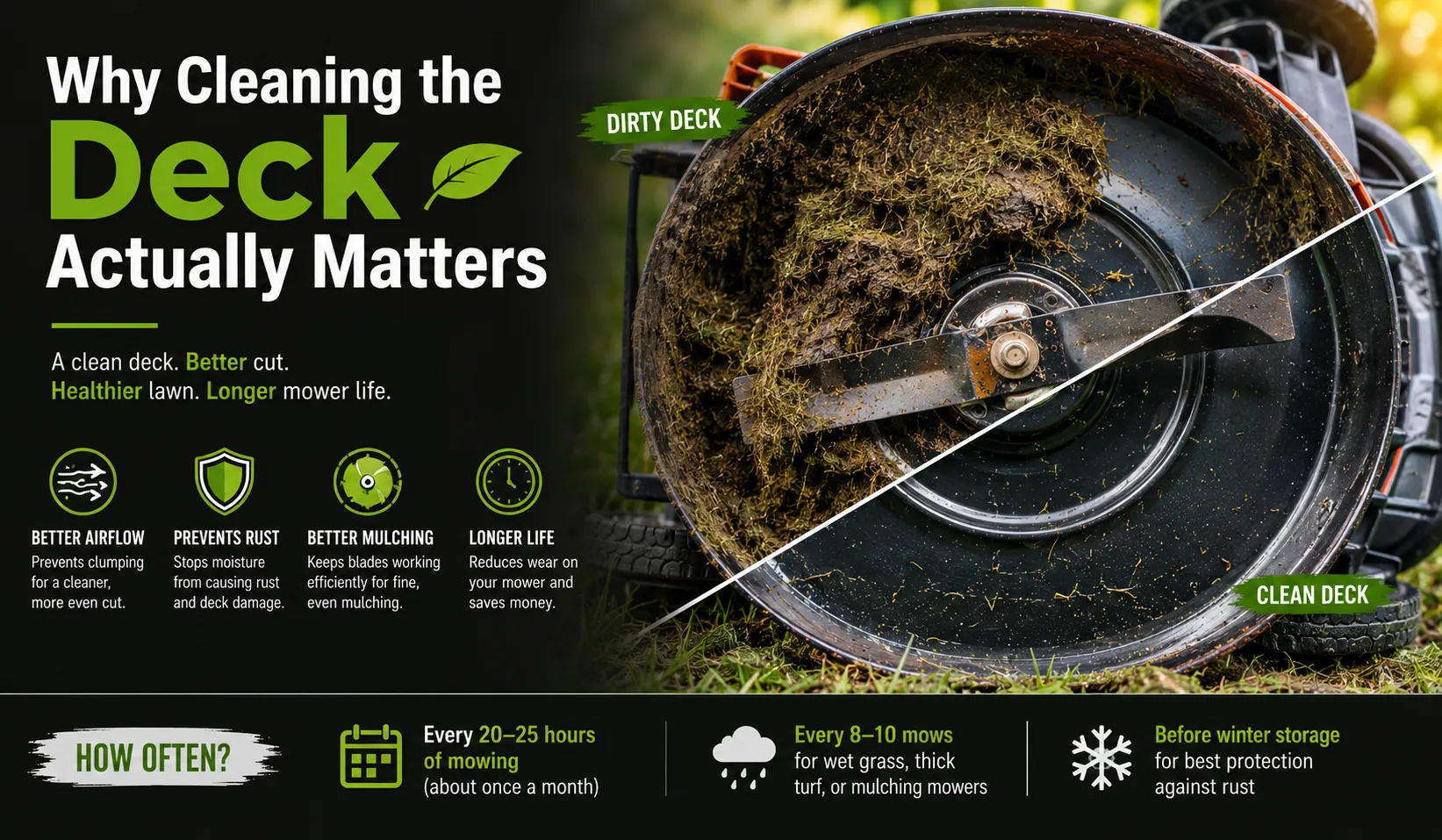
How Often Should You Clean It?
For most homeowners mowing once a week, clean the deck every 20-25 hours of run time. That’s roughly once a month during peak mowing season.
If you’re mowing wet grass, thick turf, or running a mulching mower, clean every 8-10 mows. Mulching mowers recirculate clippings, so buildup happens faster than with a side-discharge setup.
Before winter storage, always do a full cleaning. Wet clippings left packed in the deck over several cold months corrode steel faster than a whole season of normal use.
What You’ll Need Before You Start
The good news: you probably already have most of this at home. Nothing on the list is expensive or hard to find.
Tools and Supplies List
- Plastic or wood scraper (avoid metal on aluminum decks – it scratches and creates spots where rust starts)
- Stiff-bristle brush or old paintbrush
- Garden hose with spray nozzle
- Bucket with warm soapy water (dish soap works fine)
- Silicone deck spray – Husqvarna Deck Spray, Fluid Film, or WD-40 Specialist Silicone all work well
- Work gloves
- Safety glasses
- Two wood blocks or a mower lift to hold the mower tilted safely
Total cost if you need to buy everything new: around $15-20.
Safety First – What to Do Before You Flip the Mower
This part matters more than any step in the actual cleaning process. A blade that moves while your hand is near it is a serious injury, not a general caution.
For gas mowers: pull the spark plug wire off the plug. You’ll see it – a black rubber cap on the side of the engine. Pull it off and set it somewhere visible, away from the plug.
For battery mowers (EGO, Greenworks, Ryobi): remove the battery pack entirely. Don’t just power the mower off. Take the battery out and set it aside.
Also let the mower sit for five minutes after shutting it off before touching anything near the blade. Hot surfaces and fuel need time to settle.
How to Clean the Underside of a Lawn Mower Deck (Step-by-Step)
These are the five steps I follow every time. A moderately dirty deck takes 20-30 minutes from start to finish. A badly caked one can take an hour – which is a good reason not to skip cleanings.
Step 1 – Disconnect the Spark Plug or Battery
Do this first. Every single time. Before you tilt the mower, before you grab the scraper.
Pull the rubber spark plug wire cap off on gas mowers, or pop the battery pack out on electric models. Set them somewhere you’ll see them when you’re done. The goal is making sure there’s no possible way that blade moves while you’re working.
Step 2 – Tilt or Raise the Mower Safely
For push mowers, tilt the mower back on two rear wheels so the deck faces you. Slide wood blocks under the frame to hold it steady. Don’t rely on balance alone – a wobble when your hand is near the blade is a dangerous situation.
One thing that trips people up: the carburetor side. On most gas push mowers, you want to tilt so the air filter and carburetor face up, not down. If they face down, oil can drain into the air filter and cause a rough start at best, damage at worst. Check your mower manual if you’re not sure which side is which.
For riding mowers, use a purpose-built mower lift or drive the front wheels up onto ramps. Never slide under a riding mower held up by a floor jack alone.
Step 3 – Scrape Off the Buildup
Start at the center of the deck and work outward toward the discharge chute. The clippings come off in layers. The outer layer is dry and flaky. The layer near the deck surface is wet, dark, and smells like a compost bin.
For badly caked decks, this takes real time. I spent 15 minutes on one deck in Gainesville that hadn’t been cleaned in two full seasons. The buildup had its own texture by then – almost like dried clay.
Use a plastic scraper on aluminum decks, not metal. A metal scraper scratches through the surface coating and creates spots that corrode faster than the rest of the deck.
Step 4 – Rinse and Wash the Deck
Once the bulk of the buildup is off, rinse with your garden hose. Medium pressure works – strong enough to push loose material out of the corners, but not so hard that water gets into the engine area or bearings.
Then scrub with a stiff brush and soapy water. Pay attention to the corners around the blade mount. That area is where clippings pack in tightest, and it’s where most decks start rusting first because nobody thinks to clean it.
Rinse again until the water runs clear.
One honest warning: don’t let water sit inside the deck after rinsing. Tilt the mower to drain it, then wipe the deck surface with an old rag. Standing water – especially in the center of a steel deck – starts surface corrosion within a day or two.
Step 5 – Dry It and Apply a Protective Coating
Wipe the deck dry as well as you can. Then let it air out for 10-15 minutes before applying any spray.
Once it’s dry, apply a light coat of silicone spray across the entire underside, including around the blade mount. The coating creates a slightly slick surface that grass clippings can’t grip as easily. It won’t stop buildup entirely, but it cuts the amount down by a lot and makes the next cleaning much faster.
I use Husqvarna Deck Spray on my own mower. One can lasts a full mowing season if you apply it after every other cleaning.
Gas vs. Battery Mower Cleaning Differences
| Factor | Gas Mower | Battery Mower |
|---|---|---|
| Safety step | Remove spark plug wire | Remove battery pack |
| Water caution | Avoid carburetor and air filter | Avoid motor housing and battery port |
| Tilt direction | Carburetor side faces up | Either side (check manual) |
| Deck material | Often steel – rust-prone | Often aluminum or plastic – rust-resistant |
| Coating after cleaning | Apply every cleaning on steel decks | Every 1-2 cleanings on aluminum |
Cleaning Tips for Different Grass Types and Climates
Where you live and what you’re cutting changes how fast buildup forms, how hard it packs, and how often you need to deal with it.
Wet, Thick Grass (Pacific Northwest, Midwest, Florida)
This is the worst-case scenario for deck buildup. High-moisture grass – St. Augustine in Florida, bluegrass after an Oregon spring rain – packs into a deck like wet cement and dries hard.
During Florida’s rainy season (May through September), I cleaned decks every 6-7 mows. Any longer and the cut quality dropped noticeably. The discharge chute would start clogging mid-mow, which is a reliable sign the deck is overdue.
A fast habit that saves a lot of scraping: rinse the underside with a garden hose after every mow when you’ve been cutting in wet conditions. It takes three minutes. It prevents a 40-minute scraping session three weeks later.
Dry and Sandy Turf (Arizona, Southwest, Southern California)
Dry climates are much easier on decks. Clippings in Phoenix or Tucson are light and dry, and most of them fall out on their own between mows. Buildup is thin, flaky, and scrapes off fast.
The main issue in sandy areas is abrasion. Sand gets thrown up by the blade at high speed and wears the leading edge of the deck over time. Check that edge carefully when you clean. Also clean out the blade mounting area thoroughly – sand works into the bolt threads and can make blade removal difficult later.
Bermuda and Zoysia Grass (Southeast, Texas)
Bermuda and Zoysia produce fine, dense clippings that compact tightly. They’re not as wet as St. Augustine, but they pack into the corners and discharge area of the deck in a way that’s hard to break up with a wide scraper alone.
I keep a narrow putty knife specifically for the side discharge area and the front lip when I’m cleaning a deck that’s had Bermuda in it. Those are the two spots where the clippings pack hardest. A regular scraper won’t reach them properly.
Cleaning Frequency by Grass and Climate
| Grass Type / Region | Cleaning Frequency |
|---|---|
| St. Augustine (Florida, Gulf Coast) | Every 5-7 mows |
| Bluegrass (Midwest, Pacific Northwest) | Every 8-10 mows |
| Bermuda / Zoysia (Southeast, Texas) | Every 10-12 mows |
| Tall Fescue (Mid-Atlantic, Pacific NW) | Every 8-10 mows |
| Desert grasses (Arizona, Southwest) | Every 15-20 mows |
| All types – end of season | Always, before storage |
Common Mistakes People Make When Cleaning
Most cleaning mistakes aren’t about missing a step. They come down to rushing three specific things.
Using Too Much Water Near the Engine
Blasting the engine block with a pressure washer is the most common mistake I see. Water gets into the air filter, the carburetor, or the electrical connections on battery-powered mowers. On a gas mower, a wet air filter causes a rough start. On a battery mower, water in the motor housing can damage electronics.
Use a regular garden hose, not a pressure washer. Keep the nozzle pointed at the deck surface. If the top of the mower needs cleaning, wipe it down with a damp rag instead of spraying it directly.
Forgetting to Reattach the Spark Plug Wire
This one is embarrassing when it happens – and I’ve done it twice. You clean the deck, lower the mower back down, and then pull the start cord for five minutes wondering why it won’t fire. The wire is still sitting on the engine cover where you left it after step one.
Build the reattachment into your sequence: tilt up, clean, lower down, then reattach the wire or reinstall the battery before you move the mower at all. Same order every single time.
Skipping the Protective Spray
Cleaning without a protective coat afterward means the next session will take longer, not shorter. The bare deck surface is now clean metal, and clippings bond to it faster than they did before you scraped it.
Two minutes with a can of silicone spray changes this. The mower looks finished once the deck is clean, so this step gets skipped constantly. Don’t skip it – it’s what makes the next cleaning a 15-minute job instead of a 45-minute one.
How to Keep the Deck Cleaner Between Mows
A few simple habits between cleanings reduce how hard each full cleaning needs to be.
Deck Spray – Does It Actually Work?
Yes, within reason. Deck spray doesn’t stop clippings from landing inside the deck. It stops them from bonding to the metal as hard.
Products like Fluid Film and Husqvarna Deck Spray leave a thin, slick film on the surface. Clippings still land, but they don’t stick the same way. When you rinse after a mow, most of the loose material washes off easily. Without the coating, it starts drying into the surface within hours.
Apply after every cleaning. If you’re mowing in wet conditions more than twice a week, reapply mid-season even without a full cleaning.
Mowing Habits That Reduce Buildup
Small changes to how you mow make a real difference in how fast the deck cakes up:
- Avoid mowing wet grass when you can help it. Damp clippings stick to the deck surface three times faster than dry ones.
- Never cut more than one-third of the blade height in one pass. Removing too much at once creates long, wet clippings that clump and pack fast.
- Run the mower at full throttle. Lower engine RPM reduces blade tip speed, which reduces the airflow that normally clears clippings from the deck area.
- After mowing, run the mower on bare concrete for 30 seconds. The blade spinning without grass throws off most of the loose clippings left inside.

My Final Thoughts
I’ve cleaned a lot of decks over the years. Some by choice, most because I waited too long. The honest result every time is the same: the mower cuts better right after, the blade lasts longer between sharpenings, and you avoid the deck corrosion that costs $200-plus to fix or forces an early replacement.
The biggest mistake is treating this as a breakdown repair instead of regular maintenance. A 20-minute cleaning once a month during peak season beats a 90-minute rescue operation once a year – and the 90-minute version still leaves you wondering how much rust has already formed underneath the packed clippings.
One real warning before you go: if you find rust patches during a cleaning, don’t put the mower away and forget about them. Light surface rust can be treated with a wire brush and rust-inhibitor paint. But if you see soft spots in the metal, or holes forming, that deck is compromised. A cracked mower deck can throw shrapnel during operation. Get it assessed by a repair shop before running the mower again.
Quick Reference Table – Full Cleaning Checklist
Use this table as a fast reference before each cleaning session. Every row should be checked off before you put the mower back in service.
| Step | Action | Notes |
|---|---|---|
| Before anything | Remove spark plug wire or battery pack | Do this before tilting – no exceptions |
| Tilt safely | Wood blocks under frame or use a mower lift | Carburetor-side up on gas push mowers |
| Scrape | Plastic scraper, center outward | Metal tools will scratch aluminum decks |
| Rinse | Garden hose, medium pressure | Keep water away from engine and motor housing |
| Scrub | Stiff brush and dish soap | Focus on blade mount corners and discharge area |
| Dry | Rag wipe, then 10-15 min air dry | Don’t let water pool inside the deck |
| Coat | Silicone spray across entire underside | Reapply mid-season in wet climates |
| Final check | Reattach spark plug wire or reinstall battery | Confirm before first test start |
Frequently Asked Questions About Cleaning Your Lawn Mower Deck
These are the questions I hear most often from neighbors and new mower owners getting into regular maintenance for the first time.
How often should I clean the underside of my lawn mower deck?
Every 20-25 hours of run time for most homeowners, which works out to roughly once a month during peak season. If you’re mowing wet or thick grass – St. Augustine in Florida, bluegrass in the Pacific Northwest – bump that up to every 5-8 mows. End-of-season cleaning before storage is non-negotiable regardless of how often you cleaned during the year.
Can I use a pressure washer to clean my mower deck?
A light-duty pressure washer can work on the deck surface itself, but keep the spray well away from the engine, carburetor, air filter, and motor housing on battery mowers. A regular garden hose handles normal buildup just as well with less risk. Save the pressure washer for a deck that’s genuinely caked after multiple missed cleanings.
What is the best product to prevent grass from sticking to the mower deck?
Silicone-based sprays are the most reliable option. Husqvarna Deck Spray, Fluid Film, and WD-40 Specialist Silicone are all good choices available at most hardware stores. Apply a light, even coat across the full underside after each cleaning session.
What’s the difference between cleaning a gas mower deck versus a battery mower deck?
The safety step is the main difference: pull the spark plug wire on gas mowers, remove the battery pack on electric models. Battery mower decks are often aluminum or durable plastic, so they’re much less likely to rust than steel gas mower decks. Steel decks need protective coating after every cleaning. Aluminum decks benefit from it too, but are more forgiving if you miss an application.
Can I clean my mower deck without tilting the mower?
Not for a proper cleaning. You need access to the full underside to scrape and rinse correctly. A quick rinse from a garden hose while the mower sits flat can wash out loose clippings after a mow, but it won’t remove packed buildup or let you inspect the blade, mounting hardware, and deck surface for rust or wear.
Is it safe to rinse a lawn mower with water?
Yes, with care. Use a garden hose and keep the spray away from the engine block, air filter, carburetor, and any electrical connections. Dry the deck surface with a rag before applying protective spray, and don’t put the mower into storage with water still sitting inside the deck cavity.
What happens if I never clean my mower deck?
Airflow drops inside the deck, which reduces the lift that pulls grass upright before the blade cuts it. The result is uneven cuts, heavy clumping, and visible stripes in the lawn. Moisture trapped in the packed clippings corrodes the deck metal from the inside. Over time, mulching performance drops sharply because the blade is fighting through buildup instead of spinning in clean air. Most homeowners notice the cut quality problems first. The rust usually shows up later – often too late to treat cheaply.