
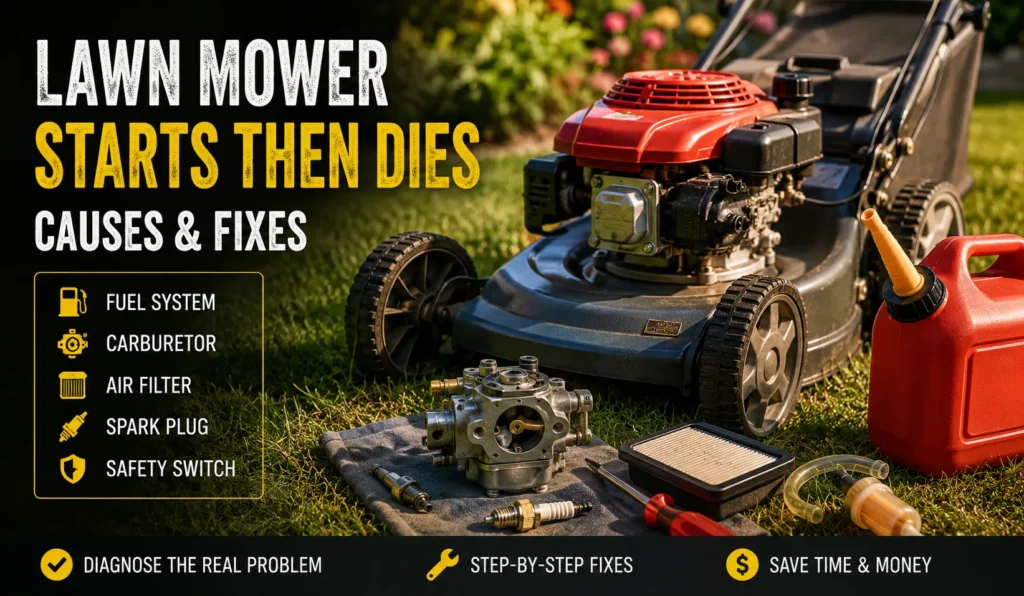
Quick Overview
- A lawn mower that starts then dies almost always has a fuel delivery or carburetor problem — solve those first before replacing anything.
- Stale fuel with ethanol is the most overlooked cause; gas older than 30 days can gum up a carburetor in humid climates.
- A vented gas cap, dirty air filter, or faulty safety switch can each mimic a carburetor problem — use the symptom checklists in this guide to tell them apart.
- Most fixes cost under $20 and take under an hour with basic hand tools.
- If the engine has low compression or a blown head gasket, repair costs often exceed the mower’s value — buy a new one.
You know how this goes. Saturday morning, grass is getting embarrassing, you pull the cord — and it fires right up. Relief washes over you. Then, three seconds later, it sputters and quits.
You pull again. Same thing. Fires, idles for a moment, dies.
That cycle of hope and frustration is one of the most common lawn mower problems homeowners face, and it almost always has a fixable cause. I’ve personally tracked down this exact issue on a Briggs & Stratton 550EX on a humid Georgia July morning, a Honda GCV160 that refused to run after sitting through a Minnesota winter, and more Craftsman riders than I care to count. Every single time, the fix came down to a handful of components.
This guide is for homeowners who want to diagnose and fix the problem themselves without paying a shop $80 to clean a carburetor that costs $12 to replace. We’ll go system by system, starting with the most likely cause.
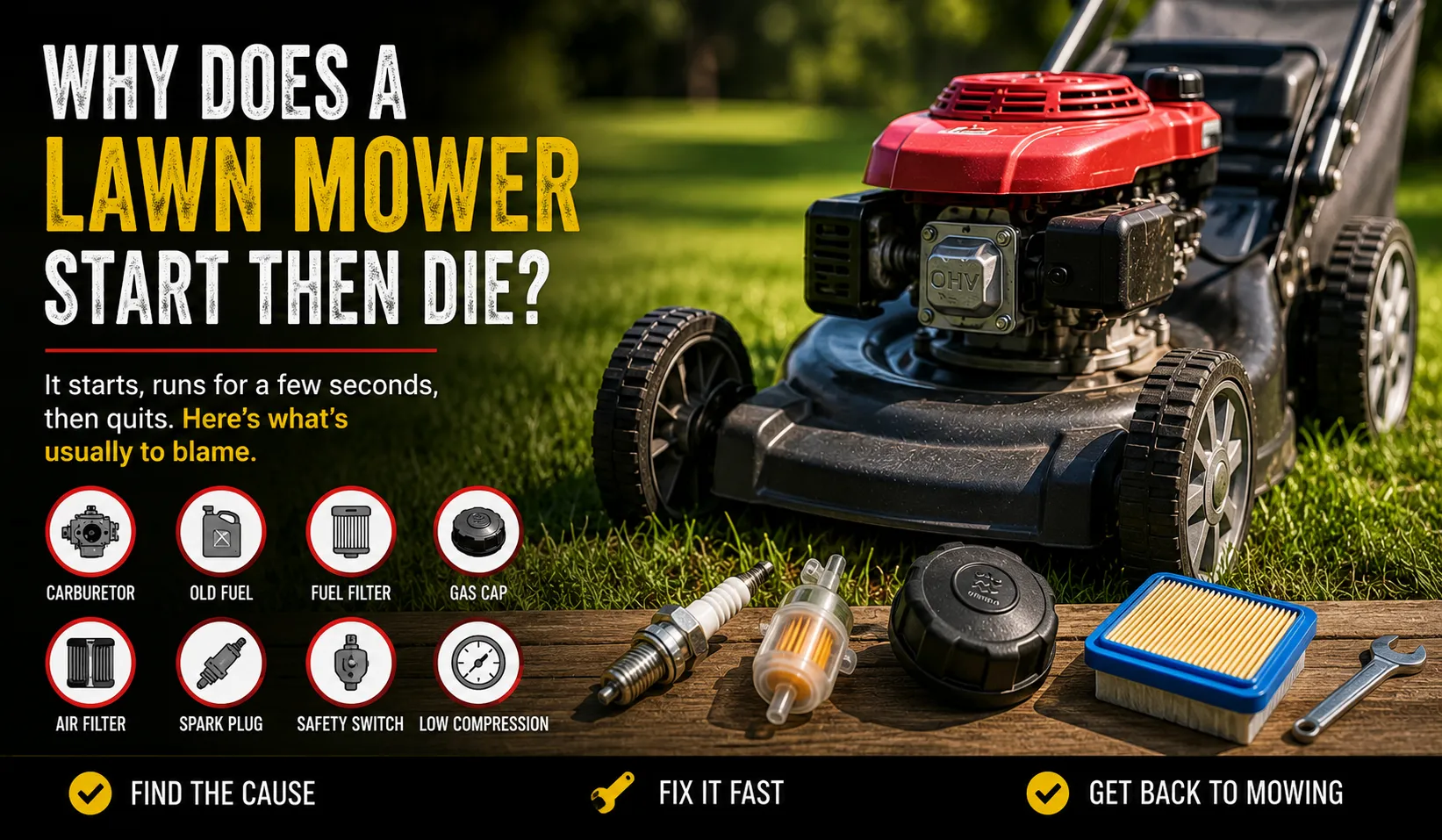
Why Does a Lawn Mower Start Then Die?
When a mower fires up and then quits, the engine is getting just enough fuel or air to ignite — but not enough to sustain combustion. Something is cutting the supply off within seconds.
The good news: that brief moment when it does run tells you a lot. A cold engine that fires immediately but dies when the choke opens points to fuel starvation. An engine that runs for 30 seconds then quits after warming up points somewhere different. The behavior narrows the diagnosis before you touch a single tool.
The Most Common Culprits at a Glance
- Dirty or clogged carburetor – by far the most frequent cause on mowers older than two seasons
- Stale or ethanol-degraded fuel – especially common after winter storage or on mowers that sit unused for more than a month
- Clogged fuel filter or kinked fuel line – fuel can’t reach the carburetor at the flow rate the engine needs
- Faulty vented gas cap – causes vapor lock that starves the engine within seconds
- Dirty air filter – engine gets fuel but can’t breathe enough to sustain combustion
- Fouled or failing spark plug – engine misfires and stalls, especially under load
- Faulty safety switch – cuts ignition to the engine even when all conditions look correct
- Low compression – engine can’t sustain combustion regardless of fuel or spark quality
How to Tell Which Problem You Have
Start with the simplest tests and work toward the more mechanical ones. Before touching anything, answer these:
- Has the mower been sitting for more than 30 days without Sta-Bil or a similar fuel stabilizer?
- Does it die immediately when you release the choke, or does it run for a bit and then quit?
- Does it die under load (when you engage the blade) but idle okay in neutral?
If yes to question one, start with fuel. If yes to question two, the carburetor’s idle circuit is almost certainly clogged. If yes to question three, look at the carburetor main jet and the air filter before anything else.
Carburetor Problems – The #1 Cause
The carburetor is where fuel and air mix before entering the engine. When it’s partially blocked, the engine gets enough mixture to start but not enough to sustain idle or handle any load.
This is by far the most common reason a lawn mower starts then dies, and on older machines — any Briggs & Stratton or Tecumseh engine that’s seen a few seasons — it’s almost always the first place to look.
Dirty or Clogged Carburetor
When gasoline sits for 30 days or more, the lighter hydrocarbons evaporate and leave behind a sticky, varnish-like residue. That residue clogs the tiny passages inside the carburetor — particularly the main jet and the idle jet, which are often just 0.5mm in diameter.
The idle jet is the first to clog. That’s why the engine starts (because the choke circuit can pull fuel) but dies the moment the choke opens and the idle circuit takes over.
The smell is a dead giveaway. Old gasoline smells noticeably sour or like nail polish remover rather than fresh fuel.
The Float and Needle Valve Issue
Inside the carburetor’s float bowl, a small float rides on the fuel level. When fuel rises to the correct level, the float pushes a needle valve closed to stop more fuel coming in — like the float in a toilet tank.
If that needle valve sticks open, the float bowl floods and the engine runs rich, then drowns. If it sticks closed, the bowl doesn’t fill and the engine starves within seconds of starting. Both symptoms look identical from the outside: mower fires, runs briefly, dies.
You can confirm a stuck needle valve by checking the float bowl after the mower dies. Remove the bowl (one bolt on most Briggs & Stratton carbs). If the bowl is bone dry, the valve is stuck closed. If fuel pours out or the engine smelled like raw gas, it’s stuck open.
How to Clean It Without Removing It (and When You Must)
Without removing the carburetor:
Spray carburetor cleaner directly into the air intake while the engine is running. This works as a temporary fix about 30% of the time on mild clogs and tells you the carburetor is the problem if the engine runs longer while you’re spraying.
You can also remove the float bowl (leave the carb on the engine), spray cleaner through every visible passage, let it soak for 10 minutes, and blow it out with compressed air.
When you must remove and disassemble:
If the above doesn’t work, or if you can see varnish buildup when you look inside, pull the carburetor. Soak the metal body in carburetor cleaner for 30–60 minutes. Use a thin wire or needle to clear each jet passage, then blow everything out with compressed air. Never use wire on the soft needle valve seat.
On a Briggs & Stratton 500 series engine, the carburetor removes with two bolts and takes about 20 minutes to pull. Replacement carburetors run $12–$18 on Amazon for most common Briggs, Tecumseh, and Toro engines. Honestly? Replacing is often faster than cleaning at that price.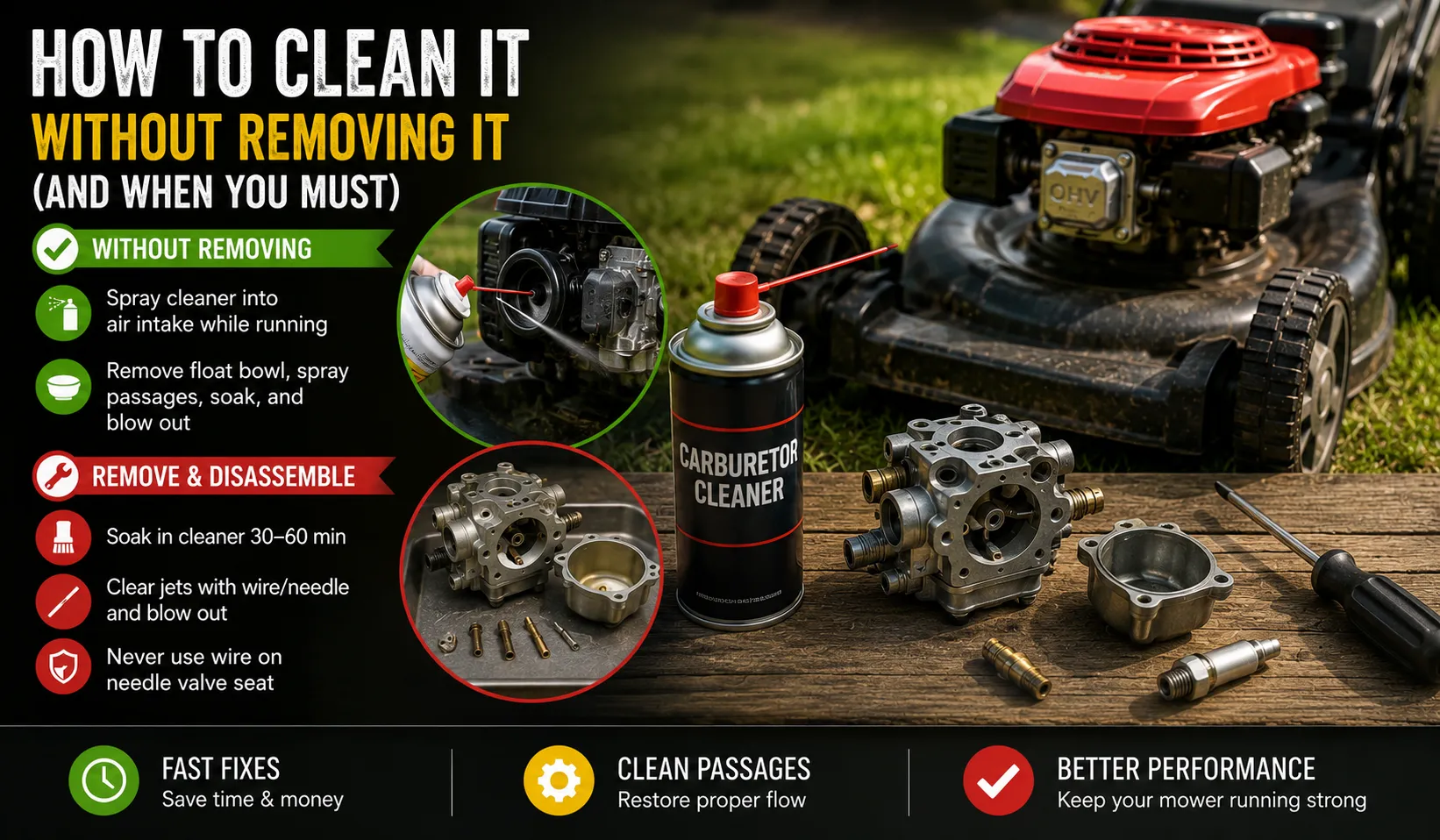
Carburetor Symptoms vs. Likely Fix
| Symptom | Most Likely Cause | Fix |
|---|---|---|
| Dies when choke opens | Idle jet clogged | Clean or replace carb |
| Runs rich, black smoke, then dies | Needle valve stuck open | Clean needle seat or replace float valve |
| Runs 30 sec, dies, restarts after cooling | Vapor lock or heat soak | Check gas cap vent, carb heat shield |
| Runs with choke half-closed only | Main jet partially blocked | Clean or replace carb |
| Fuel in oil (smells gassy) | Float valve flooding | Replace needle valve and seat |
Fuel System Issues That Mimic Carburetor Problems
A clogged fuel filter or a failed gas cap can produce symptoms that look exactly like a carburetor problem. Test these before tearing into the carb — they’re easier to fix and often cheaper.
Old or Stale Fuel (Ethanol Is Usually the Villain)
US pump gasoline is E10 or E15 — 10% to 15% ethanol. Ethanol attracts water from humidity, and that water separates from the gasoline over time. The water settles to the bottom of the tank and enters the carburetor first.
Water doesn’t combust. The engine fires on gasoline, then hits a slug of water-contaminated fuel and dies.
In a humid climate like coastal Georgia or Florida, this can happen in as little as 30 days without a fuel stabilizer. In Minnesota, fuel from last October stored in an unheated garage can be completely unusable by spring. The fix: drain the tank fully, run the carb dry by letting the engine run until it stops, and refill with fresh fuel.
Clogged Fuel Filter or Pinched Fuel Line
Most walk-behind mowers have a small inline fuel filter — a clear plastic cylinder roughly the size of your thumb, sitting in the fuel line between the tank and carburetor. It traps debris before it reaches the carb.
When that filter clogs, the engine gets enough fuel to start but starves under any demand.
To check it: with the engine off, disconnect the fuel line at the carburetor and let gravity pull fuel into a cup. If flow is a weak trickle or stops quickly, the filter is blocked. Replacement filters cost $3–$6 at any hardware store.
Also inspect the fuel line itself. On older Craftsman and Troy-Bilt mowers, rubber fuel lines crack and collapse internally — they look fine on the outside but restrict flow. Squeeze the line along its length. Any section that feels stiff or crinkled should be replaced.
Vented Gas Cap Causing Vapor Lock
The gas cap on your mower has a tiny vent hole that lets air into the tank as fuel is consumed. If that vent clogs, the tank creates a partial vacuum as fuel drains out. Eventually the vacuum is strong enough to stop fuel flow to the carburetor — the engine dies.
Here’s how to test it in 30 seconds: when the mower dies, loosen the gas cap a half-turn and try to restart. If it fires right up and runs normally, the cap vent is the problem. Replacement caps cost $5–$8 for most Husqvarna, Toro, and Briggs-powered mowers.
Fuel Symptom Checklist
| Symptom | Check First | Then Check |
|---|---|---|
| Starts fine, dies after 30-60 seconds | Gas cap vent | Fuel filter |
| Smells like sour or old gasoline | Drain and replace fuel | Clean carb float bowl |
| Won’t restart for 15+ minutes after dying | Vapor lock from cap | Fuel line restriction |
| Fine on flat ground, dies on slopes | Fuel pickup angle | Tank baffle or fuel cap |
| Runs poorly in heat, fine when cool | Fuel boiling in line | Heat shield or fuel line routing |
Air Filter, Spark Plug, and Ignition Issues
These components are easier to inspect and replace than anything in the fuel system. They’re worth checking early in your diagnosis — especially if the mower hasn’t had basic maintenance in two or more seasons.
A Dirty Air Filter Starves the Engine
The engine needs a precise ratio of air to fuel to run. If the air filter is so clogged that it restricts airflow, the mixture goes too rich — too much fuel, not enough air — and the engine runs rough and dies under load.
A paper air filter on a walk-behind mower should be replaced every season or every 25 hours of use (Briggs & Stratton, 2024). On a foam filter, washing and re-oiling annually is usually enough.
Hold the filter up to a light. If you can’t see light through the paper, it’s done. The fix takes two minutes and a $4 filter.
Spark Plug Fouling – What It Looks Like and What It Means
Pull the plug and look at the tip. A healthy plug tip is light tan or grayish. Here’s what different colors tell you:
- Black and sooty – running too rich (usually a carburetor or air filter issue)
- Black and oily – oil is getting into the combustion chamber (worn rings or valve seals)
- White or blistered – running too lean or the engine is overheating
- Carbon deposits building the gap shut – the plug misfires and the engine quits
On any push mower spark plug that’s more than two seasons old, replace it regardless of how it looks. A new NGK or Champion plug costs $3–$5. Gapping should be 0.030″ on most Briggs & Stratton engines — check your manual.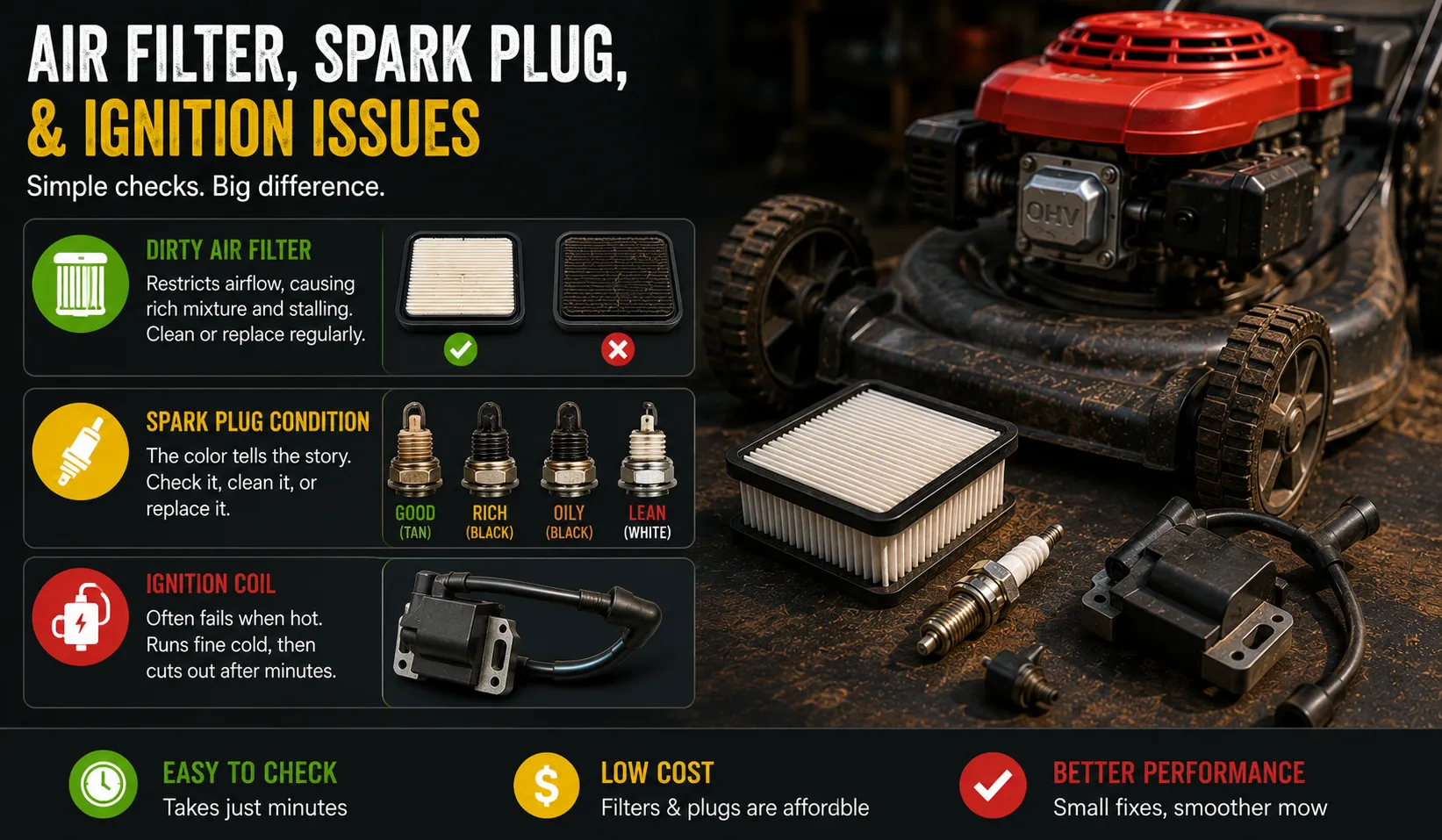
Ignition Coil Failure (Less Common, But It Happens)
The ignition coil turns battery or flywheel energy into the high-voltage spark that fires the plug. When a coil fails, it usually fails hot — it works fine when the engine is cold but shorts out after a few minutes of running.
That pattern — mower runs okay for 5–10 minutes then dies, starts again after cooling — is the ignition coil’s signature. It’s more common on older Tecumseh and Kawasaki engines than on modern Briggs engines.
Testing requires a coil tester or swapping a known-good coil. Replacement runs $20–$45, and the repair is moderate difficulty — you need to set the air gap precisely (typically 0.010″) between the coil and the flywheel magnets.
Part Condition vs. Action Needed
| Part | Condition | Action |
|---|---|---|
| Air filter | Gray/tan, light passes through | Clean or replace if seasonal |
| Air filter | Black, stiff, solid | Replace immediately |
| Spark plug | Tan/gray tip, 0.030″ gap | Leave it, good condition |
| Spark plug | Black soot, carbon bridge | Replace, check carb mixture |
| Spark plug | Oil-fouled tip | Replace, investigate valve/ring wear |
| Ignition coil | Fails only when hot | Test under load, replace if confirmed |
Safety Switch and Sensor Problems
Modern mowers have multiple safety switches that cut the engine if something goes wrong. When one of those switches fails internally, it can kill the engine randomly — which looks identical to a fuel or ignition problem.
This is especially common on riding mowers with high hours, where connectors corrode and switches wear out.
Seat Safety Switch (Riding Mowers)
On every riding mower built since the late 1980s, there’s a switch under the seat. The engine won’t run if the operator isn’t seated. If that switch fails or develops a loose connection, the mower can cut power mid-operation — or prevent startup entirely.
Try pressing down firmly on the seat while starting. If that changes anything, you’ve found your problem.
Blade Engagement and Bail Bar Switches
Walk-behind mowers have a bail bar — the handlebar lever you squeeze to keep the engine running. Release it and the engine dies. If the switch that reads the bail bar position fails, the mower may die even while the bail is held.
On riding mowers, the blade engagement switch (PTO switch) serves a similar function. A worn PTO switch often allows the mower to start in neutral but kills the engine the moment you engage the blades.
How to Test a Safety Switch Without a Multimeter
Disconnect the wire connector on the suspect switch and use a short piece of wire to bridge the two terminals in the connector — not on the switch itself. If the mower now runs normally, the switch was the problem.
A note on safety: bypassing switches to diagnose a problem is fine. Permanently bypassing them is not — they exist for real reasons. Order a replacement switch (usually $8–$20) and install it before you put the mower back into use.
Safety Switch Symptoms by Mower Type
| Mower Type | Switch | Symptom When Failed |
|---|---|---|
| Riding mower | Seat switch | Dies when operator shifts weight, won’t start |
| Riding mower | PTO/blade switch | Starts fine, dies when blades engage |
| Walk-behind | Bail bar switch | Dies randomly while squeezing bail |
| Walk-behind | Oil level switch | Dies within seconds of starting (check oil first!) |
| Both types | Brake/neutral switch | Won’t start in any gear/position |
When the Fix Is Deeper – Engine and Compression Issues
If you’ve worked through the carburetor, fuel system, air filter, spark plug, and safety switches and the mower still starts then dies, the problem is likely mechanical. This is where the diagnosis gets more serious — and more expensive.
Low Compression Symptoms and the Easy Test
An engine needs adequate compression to fire and sustain combustion. Low compression causes hard starting, weak power, and often a mower that runs briefly then dies — especially under any blade load.
The easy test: remove the spark plug and hold your thumb firmly over the hole. Crank the engine slowly by hand. You should feel strong suction and pressure pulses. If you barely feel anything, compression is low.
A proper compression test uses a gauge — most engines should show 90–120 PSI. Below 60 PSI and you have a real problem. Compression testers are $20–$30 at any auto parts store.
Valve Problems and Head Gasket Leaks
Low compression usually comes from one of three places: worn piston rings, a burnt or sticking valve, or a blown head gasket. On small engines, sticky valves are surprisingly common — especially on engines that sat with old oil or run in dusty conditions.
A tell-tale sign of a blown head gasket: blue or white smoke from the exhaust when the engine is under load, combined with rapid loss of coolant (on liquid-cooled engines) or oil consumption. On air-cooled mower engines, you’ll often see oil seeping from the seam where the head meets the block.
Valve adjustment and head gasket replacement are moderate-to-difficult repairs. Head gasket sets run $15–$30 in parts, but the labor involved — removing the valve cover, checking and adjusting valve clearances — is several hours of careful work.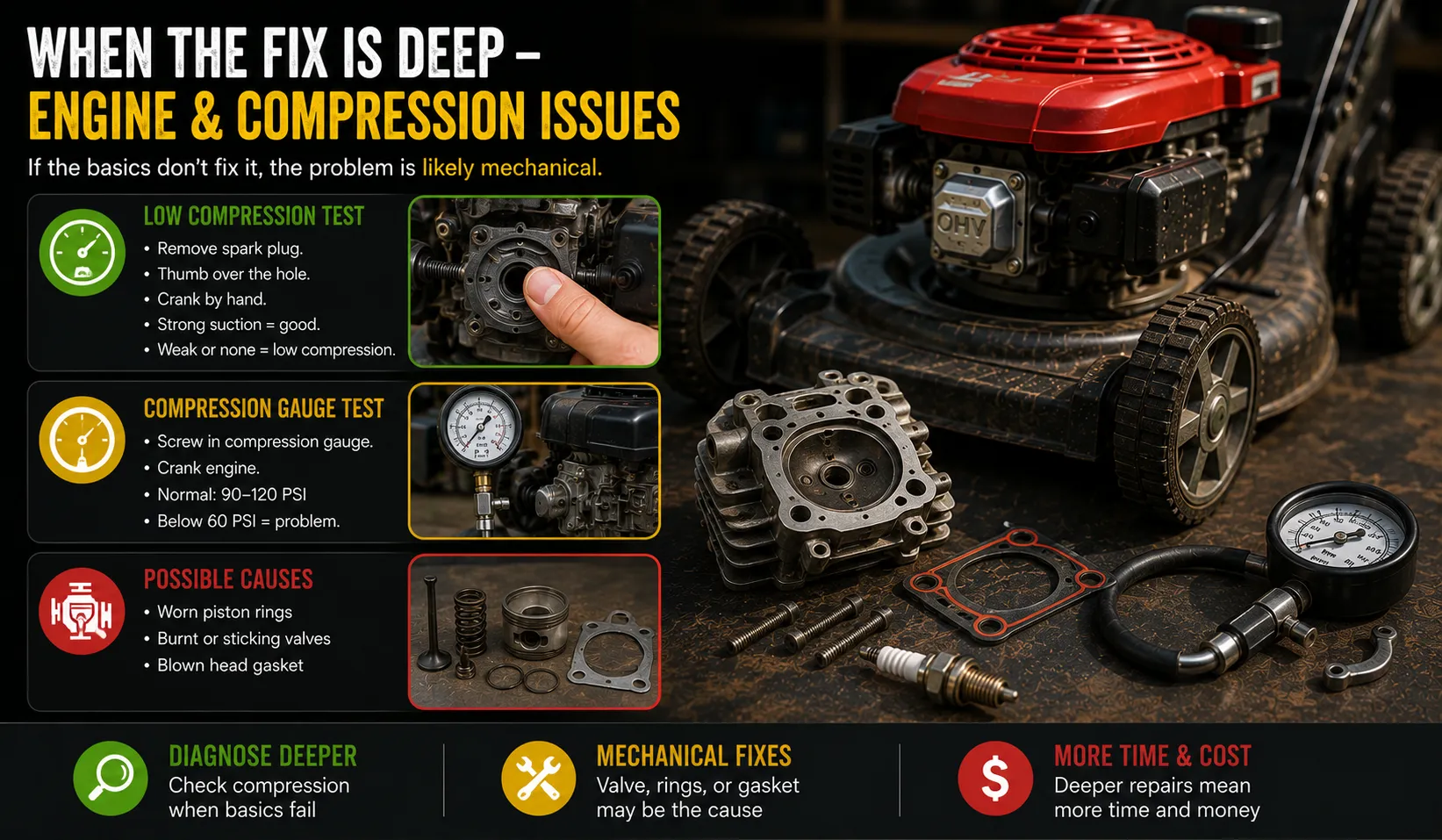
When to Repair vs. Replace
This is an honest conversation worth having. If the mower is a base-model Craftsman or Troy-Bilt push mower worth $150–$200 used, spending $100 in parts plus three hours of your time to fix a valve problem doesn’t make financial sense.
Here’s a rough guide:
| Problem | Repair Cost (Parts) | Repair Difficulty | Verdict |
|---|---|---|---|
| Carburetor clean or replace | $12–$25 | Easy | Always worth it |
| Fuel filter + cap | $8–$15 | Easy | Always worth it |
| Spark plug | $3–$6 | Easy | Always worth it |
| Air filter | $4–$8 | Easy | Always worth it |
| Safety switch | $8–$20 | Easy-moderate | Usually worth it |
| Ignition coil | $20–$45 | Moderate | Worth it on quality mowers |
| Head gasket | $15–$30 parts | Difficult | Only on mowers worth $300+ |
| Engine rebuild/rings | $60–$120 parts | Very difficult | Almost never worth it |
Step-by-Step Diagnosis – Start Here Before Spending Money
Work through this in order. Each step takes 5–10 minutes. Most people find the problem in the first three.
The 5-Minute Triage Checklist
Step 1: Check the fuel.
Open the gas cap and smell the tank. Fresh gas smells like gas. Stale gas smells sour or chemical. If it’s been sitting for more than 30 days without stabilizer, drain it and add fresh fuel before doing anything else.
Step 2: Test the gas cap.
Let the mower die, then loosen the cap a half-turn and try again. Runs fine? Replace the cap.
Step 3: Inspect the air filter.
Remove the filter. If it’s dirty, try running the mower without it for 30 seconds to see if that changes anything. (Don’t run long without a filter — dust enters the engine.)
Step 4: Pull the spark plug.
Check the gap and condition. Replace if there’s any doubt.
Step 5: Check the fuel filter.
Disconnect the line at the carb and let fuel gravity-flow into a cup. Weak flow or no flow means the filter or line is the problem.
Step 6: Inspect the carburetor float bowl.
Remove it. Look for gunk, varnish, or water. If you see any, the carb needs cleaning or replacement.
Step 7: Test safety switches.
For riding mowers, press hard on the seat. Try engaging the blade with the chute blocked. For walk-behinds, check the bail bar connection.
Step 8: Check compression.
If all else fails, do the thumb test. Confirm with a gauge if needed.
Tools You Need (Most People Already Have Them)
- Flathead and Phillips screwdrivers
- 3/8″ drive socket set with spark plug socket (typically 5/8″ or 13/16″)
- Needle-nose pliers
- Carburetor cleaner spray
- A cup to catch fuel during testing
- Compressed air (a $15 can of air works in a pinch)
- Replacement spark plug, fuel filter, and air filter for your mower (under $20 total for most common models)
Common Mistakes People Make When Troubleshooting
Most troubleshooting mistakes cost money. The two big ones are almost universal.
Replacing Parts Without Diagnosing First
The most expensive version of this: someone buys a new carburetor, installs it, and the mower still dies — because the actual problem was a clogged fuel filter or a faulty gas cap that never got checked.
Work through the checklist in order. The $4 air filter and the $5 gas cap get eliminated in under 10 minutes. The $18 carburetor gets replaced only after you’ve confirmed the carb is actually the problem.
Ignoring Fuel Age and Storage Habits
This is the one piece of advice I wish someone had hammered home to me earlier: the entire “starts then dies” problem becomes rare if you manage fuel properly.
Use fuel stabilizer any time you store a mower for more than three weeks. Run the carb dry before storage (let the engine run until it dies on its own). Or drain the tank completely. These two habits eliminate about 60% of all carburetor-related starting problems.
In the Midwest and Pacific Northwest, where mowers sit unused from October through April, this is especially important. Ethanol-blended fuel starts degrading fast in a humid, sealed tank. By spring, what’s in there can cause every symptom in this guide.
My Final Recommendation
In my experience, the first thing to do with any “starts then dies” problem is drain and replace the fuel, then clean the carburetor float bowl. That combination fixes the problem in roughly 70% of cases. It costs under $5 and takes 20 minutes.
If that doesn’t do it, replace the spark plug, air filter, and fuel filter as a set before moving to anything more involved. You’re probably under $15 in parts at this point, and you’ve done basic maintenance that the mower likely needed anyway.
Call a shop — or buy a replacement mower — when the diagnosis points to low compression, a valve problem, or a blown head gasket. Compression work on a small engine is doable at home if you’re mechanically inclined and have a few hours, but on a mower worth less than $200 in working condition, the math rarely adds up. A new Toro Recycler or Honda HRX runs $350–$600 and comes with a warranty. Sometimes that’s the right answer, and there’s no shame in it.
DIY Repair: What’s Worth Fixing Yourself vs. What’s Not
| Repair Type | DIY or Shop? | Why |
|---|---|---|
| Fresh fuel + fuel stabilizer | DIY – 5 minutes | Zero skill required |
| Gas cap replacement | DIY – 5 minutes | $5 part, one screw |
| Air filter replacement | DIY – 5 minutes | $4–$8 part, no tools needed |
| Spark plug replacement | DIY – 10 minutes | $5 part, just need plug socket |
| Fuel filter replacement | DIY – 15 minutes | $4–$6 part, basic hand tools |
| Carburetor cleaning | DIY – 30–60 minutes | Watch a YouTube video for your specific engine model |
| Carburetor replacement | DIY – 30 minutes | Often faster than cleaning, usually under $20 |
| Safety switch replacement | DIY – 20–30 minutes | Moderate difficulty; connectors can be fiddly |
| Ignition coil replacement | DIY (if comfortable) | Must set air gap correctly; gap tool helps |
| Head gasket replacement | Shop recommended | Multiple hours, easy to damage engine without experience |
| Valve adjustment | Shop recommended | Requires feeler gauges and mechanical confidence |
| Engine rebuild | Buy a new mower | Labor value almost never pencils out on consumer mowers |
Frequently Asked Questions About Lawn Mower Starting Issues
Why does my lawn mower start then die after a few seconds?
The most common cause is a partially clogged carburetor — specifically the idle jet, which blocks when old fuel leaves varnish deposits. The engine fires on the starting circuit, then dies when the idle circuit takes over and can’t supply enough fuel. Drain old fuel, clean or replace the carburetor, and check the gas cap vent.
How do I know if my carburetor needs cleaning or replacing?
If you see varnish, brown residue, or a dry float bowl when you remove the bowl, the carb needs cleaning at minimum. If the passages are blocked and you don’t have a carburetor cleaner soak kit and compressed air, replacement is often faster and cheaper — most common carbs for Briggs & Stratton and Tecumseh engines run $12–$18 online.
Can a bad spark plug cause a lawn mower to start then die?
Yes, though it’s less common than a carburetor or fuel issue. A fouled plug with a carbon-bridged gap will cause misfires and stalling, particularly under load when the engine is trying to run at higher RPM. A new plug costs $3–$5 and takes 10 minutes to install — always worth doing as part of basic diagnosis.
Why does my riding mower die when I engage the blades?
This usually means either the PTO (blade engagement) switch is failing, or the engine can’t handle the increased load — pointing to carburetor problems, air filter restriction, or low compression. Check the PTO switch first by testing it with the switch bypassed. If the mower runs fine with blades engaged after bypassing, replace the PTO switch. If it still dies, the problem is fuel or compression.
Is it safe to bypass a safety switch to diagnose the problem?
Bypassing a switch temporarily to confirm it’s the cause of the problem is a reasonable diagnostic step — but always install the correct replacement before returning the mower to use. Safety switches on riding mowers prevent the engine from running without an operator seated, and on walk-behinds they ensure the engine stops if you release the handles. These systems prevent real injuries.
What fuel should I use to avoid starting problems?
Use 87-octane regular gasoline with no more than 10% ethanol (labeled E10). Avoid E15 or E85 in small engines — most manufacturers do not recommend it and it degrades faster. Add Sta-Bil or a similar fuel stabilizer any time the mower will sit unused for more than three weeks (STA-BIL, 2024).
When does it make sense to replace a lawn mower instead of repairing it?
When the repair cost — parts plus your time valued honestly — approaches or exceeds 50% of what a comparable working mower would cost used. Compression problems, valve work, and head gasket repairs on a base-model push mower almost always cross that line. On a quality mower (Honda, Husqvarna, or a well-maintained Toro), repairs deeper into the engine can still make financial sense if the rest of the machine is in good shape.