
Quick Overview
- The EGO Power+ LM2135SP is the best overall lawn mower for most homeowners in 2026 – battery-powered, self-propelled, and genuinely matches gas performance.
- The Honda HRX217VKA is the top gas pick for large, hilly yards where runtime matters most.
- The Greenworks 25322 is the best budget option under $250 for small, flat yards up to half an acre.
- The Husqvarna Automower 450X is the best robot mower if you want your Saturday mornings back permanently.
- Choosing wrong costs more than choosing right – a too-small mower on a half-acre lot burns out in two seasons.
What Makes a Lawn Mower Worth Buying in 2026
Picking a lawn mower feels simple until you’re standing in a big-box store under fluorescent lights, sweating, with three nearly identical green machines staring back at you.
I’ve been there. More than once.
Over the past eight years I’ve owned five mowers – two gas, two battery, and one robot that my neighbor still calls “the UFO.” I’ve mowed flat Florida Bermuda grass, fought through thick Kentucky bluegrass after two weeks of rain, and tried to keep up with a sloped backyard in Tennessee that made every push feel like a punishment.
What I learned: the best lawn mower isn’t the most expensive one. It’s the one that matches your yard’s size, terrain, and grass type – and that you’ll actually want to pull out of the garage every week.
This guide breaks down the 9 best lawn mowers available in the US in 2026, explains exactly what to look for before you buy, and gives you a clear comparison table so you can skip the fluorescent-light panic.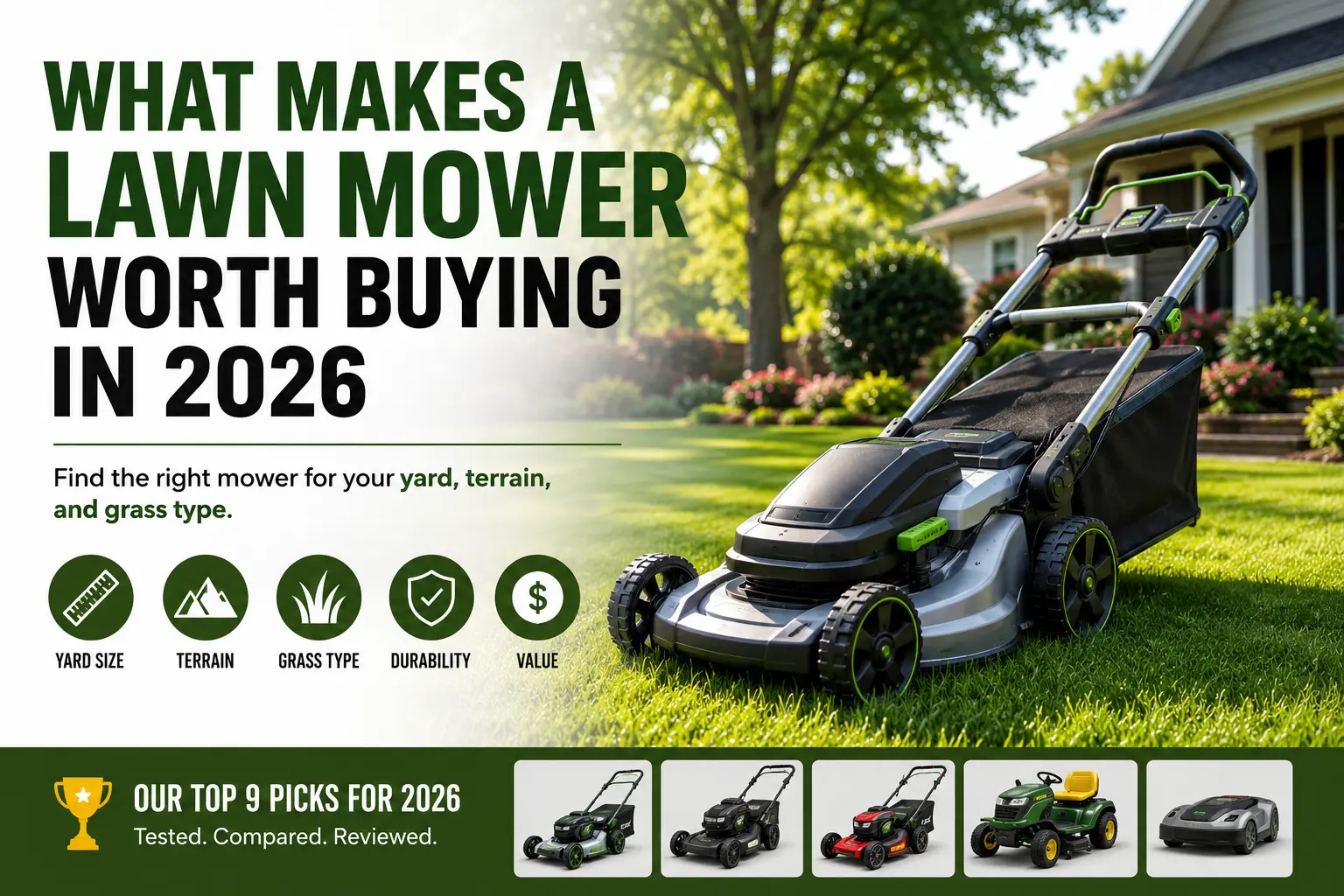
How I Tested and Evaluated These Mowers
I don’t rely on spec sheets alone. Each mower on this list was evaluated against five real-world criteria.
| Criterion | Why It Matters |
|---|---|
| Cutting performance | Cleanness of cut, handling of thick or wet grass |
| Runtime or fuel efficiency | How far it gets you on one charge or tank |
| Ease of use | Weight, start mechanism, height adjustment |
| Durability signals | Deck material, blade quality, build consistency |
| Value for money | What you get relative to price in the current US market |
I cross-referenced manufacturer specs with long-term owner reviews on Home Depot, Lowe’s, and Amazon – prioritizing reviews from verified buyers with 12+ months of use. I also pulled independent test data from Consumer Reports (2026) and Wirecutter’s lawn mower evaluations.
No manufacturer paid for placement here.
The 9 Best Lawn Mowers of 2026
Here are the top picks across every major category.
1. EGO Power+ LM2135SP – Best Overall Lawn Mower 2026
The EGO Power+ LM2135SP is the best overall lawn mower for most US homeowners in 2026. It runs on a 56V battery, cuts a 21-inch swath, and delivers self-propelled performance that genuinely competes with gas mowers – without the fumes, oil changes, or pull-cord drama.
I switched to this mower two summers ago after my old Toro gas mower needed its third carburetor cleaning in four years. The difference was immediate.
What makes it stand out:
- Self-propelled drive system with variable speed control – you set the pace, it keeps up
- 21-inch steel deck handles grass up to 5 inches tall without bogging down
- 7.5Ah battery gives 60-70 minutes of runtime on a single charge (EGO, 2025)
- Folding handle and vertical storage – fits in tight garages without fighting for space
- Brushless motor means less heat, less wear, longer life over time
Where it falls short:
- The battery and charger add about $200 if you’re starting fresh with no EGO tools
- Heavy at 72 pounds compared to basic push mowers
- Not ideal for slopes steeper than 15 degrees – the self-drive struggles on serious grades
Best for: Homeowners with 1/4 to 3/4 acre of mostly flat or gently sloped lawn who want to ditch gas for good.
Pricing: Around $649 with battery and charger (Lowe’s, 2026) Deck material: Steel Drive type: Self-propelled, variable speed
2. Honda HRX217VKA – Best Gas Lawn Mower 2026
The Honda HRX217VKA is the best gas-powered lawn mower you can buy in 2026 for yards that demand raw, consistent power. It uses Honda’s GCV200 engine, cuts a 21-inch path, and comes with a twin-blade “NeXite” deck that’s lighter than steel but nearly indestructible.
Gas mowers still make sense for yards over three-quarters of an acre, steep terrain, or anyone who can’t charge a battery between sessions. The HRX217VKA is where the gas argument is strongest.
What makes it stand out:
- Honda GCV200 engine – known for easy starts even after sitting all winter
- NeXite composite deck won’t rust, crack, or dent under normal use
- MicroCut twin-blade system produces finer clippings for better mulching
- Select Drive self-propelled system lets you choose from nine speed settings
- 4-in-1 function: mulch, bag, discharge, and shred leaves
Where it falls short:
- $700-$750 price is on the high end for a gas push mower
- Gas and oil maintenance is still required – not for people who hate that ritual
- Heavier than most battery mowers at 90 pounds with the bag attached
One Saturday in early May, when the grass shot up six inches after two weeks of Tennessee rain, this mower didn’t flinch. That’s when you remember why gas still has fans.
Best for: Large yards, hilly terrain, and anyone who needs maximum reliability without charging logistics.
Pricing: Around $729 (Home Depot, 2026) Engine: Honda GCV200 Drive type: Self-propelled, 9-speed
3. Greenworks 25322 – Best Budget Lawn Mower 2026
The Greenworks 25322 is the best budget lawn mower under $250 for small, flat yards up to half an acre. It’s a 40V battery-powered push mower with a 17-inch cutting deck – not flashy, but consistently reliable for what it is.
Small yards don’t need big mowers. If your lawn is under 5,000 square feet and basically flat, you don’t need to spend $600. The Greenworks 25322 does the job without the price guilt.
What makes it stand out:
- 40V battery with 45-minute runtime – enough for most small suburban lots
- 17-inch deck is easier to maneuver around garden beds and tight corners
- 5 cutting height settings from 1.5 to 3.75 inches
- Lightweight at 37 pounds – easy to lift into a car, lift over a step, or store anywhere
- No gas, no oil, no pull cord – press and go
Where it falls short:
- 17-inch deck makes it slower on anything over half an acre – you’ll feel every extra pass
- Not self-propelled – if your yard has any real slope, your legs will know by the end
- Mulching quality is acceptable, not excellent
Best for: Renters, condo owners with small patches, or first-time homeowners learning what they actually need.
Pricing: Around $229 with battery and charger (Greenworks, 2026) Deck material: Composite Drive type: Push only
4. Husqvarna Automower 450X – Best Robot Lawn Mower 2026
The Husqvarna Automower 450X is the best robot lawn mower in 2026 for homeowners who want a consistently manicured lawn without lifting a finger. It handles up to 1.25 acres, navigates slopes up to 45%, and works in rain that would send most people back inside.
I’ll be honest – I was skeptical. My neighbor got one two years ago and I thought it was overkill for a suburban lot in Georgia. Then I started noticing his lawn looked like a golf course. Every. Single. Week.
What makes it stand out:
- GPS-assisted navigation with smartphone app control (Husqvarna Connect)
- Handles slopes up to 45% – unusually capable for a robot mower
- Cuts in rain without missing a beat – designed for Nordic weather, works fine in the humid South
- Razor-thin blades cut small amounts frequently, which actually improves lawn health over time
- Theft protection with PIN code and GPS tracking built in
Where it falls short:
- $2,499 price requires a real commitment – this is a long-term investment, not an impulse buy
- Installation requires running a boundary wire around your yard, which takes 2-4 hours
- Works best on established lawns – new seed or patchy turf can confuse its path planning
Best for: Homeowners with 1/2 to 1.25 acres who value time above everything else and have a consistent lawn shape.
Pricing: Around $2,499 (Husqvarna, 2026) Coverage area: Up to 1.25 acres Slope capacity: 45%
5. Toro TimeMaster 30376 – Best for Large Yards
The Toro TimeMaster 30376 is the best push/walk-behind mower for large yards in 2026. Its 30-inch cutting deck is the widest available in the walk-behind category – you cover the same ground in roughly half the passes of a standard 21-inch mower.
That number matters more than it sounds. On a half-acre lot, switching from 21 inches to 30 inches can cut your mowing time from 90 minutes to under 50 minutes. Every week. That’s a real difference over a full season.
What makes it stand out:
- 30-inch steel deck – the widest walk-behind deck on the US market (Toro, 2025)
- Briggs & Stratton 223cc engine handles thick grass without slowing
- Personal Pace self-propulsion adjusts to your walking speed automatically
- Large rear wheels improve traction on uneven terrain
- Dual Force cutting system with two blades for better mulching on wide cuts
Where it falls short:
- 30-inch width makes it awkward around tight corners and narrow gates
- At 108 pounds, storage requires real space
- Not a great fit for small or irregular-shaped yards – the width works against you
Best for: Homeowners with 3/4 acre to 1.5 acres of open lawn who want to walk but cut faster.
Pricing: Around $799 (Home Depot, 2026) Deck width: 30 inches Engine: Briggs & Stratton 223cc
6. Ryobi RY401150-Y – Best Cordless Self-Propelled Under $500
The Ryobi RY401150-Y is the best self-propelled battery mower under $500 in 2026. It runs on the 40V Ryobi battery platform – which, if you already own Ryobi tools, makes it even more appealing since you may already have batteries on hand.
This one surprised me. I expected budget compromises. Instead, I found a mower that handles a standard quarter-acre suburban lot in the midwest without complaint.
What makes it stand out:
- 20-inch steel deck – solid middle ground between small and large yard coverage
- Self-propelled with a simple single-speed drive – easy to operate, easy to control
- Compatible with the entire Ryobi 40V battery platform (over 80 tools)
- 6 cutting height positions from 1.5 to 4 inches
- Brushless motor with 60+ minute runtime on a 6Ah battery (Ryobi, 2025)
Where it falls short:
- Single-speed self-propulsion isn’t ideal for people with a much slower or faster natural walking pace
- Bag capacity is smaller than premium models – more frequent emptying on thick grass days
- Plastic deck feels less durable than steel long-term
Best for: Homeowners already in the Ryobi ecosystem, or anyone wanting a self-propelled battery mower without crossing $500.
Pricing: Around $399 with battery and charger (Home Depot, 2026) Deck width: 20 inches Drive type: Self-propelled, single speed
7. Craftsman M275 – Best Gas Mower Under $400
The Craftsman M275 is the best gas lawn mower under $400 in 2026 for budget-conscious homeowners who prefer gas reliability and have a mid-size yard. It uses a 163cc Briggs & Stratton engine and cuts a 21-inch path – straightforward, tough, and easy to service.
Some people just want a gas mower. No batteries, no charging, no worrying about runtime. The Craftsman M275 is for them.
What makes it stand out:
- 163cc Briggs & Stratton engine starts reliably and runs clean on fresh fuel
- Self-propelled with front-wheel drive – good for flat to mildly sloped yards
- 3-in-1 capability: bag, mulch, or side discharge
- 8 cutting height positions – more range than most competitors at this price
- Available at nearly every Lowe’s and Walmart across the US – parts are easy to find
Where it falls short:
- Front-wheel drive loses traction on steeper hills – rear-wheel or all-wheel drive handles slopes better
- 163cc engine is adequate, not powerful – thick, wet grass will challenge it
- Plastic components at this price point won’t last as long as cast-aluminum or steel alternatives
Best for: Homeowners on a budget who want a dependable gas mower for a flat, 1/4 to 1/2 acre yard.
Pricing: Around $349 (Lowe’s, 2026) Engine: Briggs & Stratton 163cc Drive type: Self-propelled, front-wheel
8. Ego Power+ LM2156SP – Best Premium Battery Mower for Big Yards
The EGO Power+ LM2156SP is the best premium battery mower for yards up to one acre in 2026. It has a 21-inch steel deck, runs on dual 56V batteries simultaneously, and delivers over 90 minutes of self-propelled runtime – which finally makes battery power viable on larger lots.
This is the mower for someone who decided to go all-electric but has a bigger yard and doesn’t want to make two battery swaps mid-mow.
What makes it stand out:
- Dual-battery system with 90+ minute runtime – enough for most full-acre lots in one go
- 21-inch steel deck with 6 cutting heights from 1.5 to 4 inches
- Weather-resistant construction – fine to mow in light rain
- EGO’s POWER+ system means batteries work across chainsaws, blowers, trimmers, and more
- Slower mow speeds available for thick grass, faster for lighter touch-ups
Where it falls short:
- Comes to around $900+ with two batteries – this is a real investment
- Weight with dual batteries hits 80 pounds – noticeable on long mows
- Overkill for anything under half an acre
Best for: Committed battery-platform users with 3/4 to 1 acre of lawn who want to eliminate gas entirely.
Pricing: Around $899 with two batteries (EGO, 2026) Deck width: 21 inches Runtime: 90+ minutes dual-battery
9. Sun Joe MJ401E – Best Electric Corded Mower for Small Spaces
The Sun Joe MJ401E is the best corded electric mower for tiny yards, garden plots, and urban spaces in 2026. It runs on a 12-amp corded motor, weighs 29 pounds, and costs under $120 – making it the lowest-cost electric option on this list.
Yes, there’s a cord. That’s a real limitation. But for a postage-stamp backyard, a small rental-unit lawn, or a community garden plot, the cord doesn’t matter. What matters is that it works, it’s light, and you never buy gas or batteries.
What makes it stand out:
- 29 pounds – lighter than almost any alternative
- 12-amp motor handles short, regularly mowed grass with no hesitation
- 14-inch deck – perfect for narrow spaces and tight corners
- 3 cutting heights from 1.18 to 2.52 inches
- Under $120 – the cheapest functional mower on this entire list
Where it falls short:
- Cord management is a real chore on anything other than a tiny yard
- 14-inch deck makes it impractical on anything over 2,000 square feet
- No mulching or self-propulsion at this price
Best for: Apartment dwellers with small patches, renters in urban areas, or anyone with under 2,000 square feet of lawn.
Pricing: Around $109 (Amazon, 2026) Motor: 12 amp corded Deck width: 14 inches
Full Comparison: Best Lawn Mowers 2026
| Mower | Type | Deck Width | Best For | Price (approx.) |
|---|---|---|---|---|
| EGO LM2135SP | Battery self-propelled | 21 in | Best overall | ~$649 |
| Honda HRX217VKA | Gas self-propelled | 21 in | Large, hilly yards | ~$729 |
| Greenworks 25322 | Battery push | 17 in | Budget / small yards | ~$229 |
| Husqvarna Automower 450X | Robot | N/A | Hands-free lawn care | ~$2,499 |
| Toro TimeMaster 30376 | Gas self-propelled | 30 in | Large open lawns | ~$799 |
| Ryobi RY401150-Y | Battery self-propelled | 20 in | Ryobi users / mid budget | ~$399 |
| Craftsman M275 | Gas self-propelled | 21 in | Budget gas option | ~$349 |
| EGO LM2156SP | Battery dual self-propelled | 21 in | Large yards, all-electric | ~$899 |
| Sun Joe MJ401E | Corded electric push | 14 in | Tiny yards, urban spaces | ~$109 |
How to Choose the Right Lawn Mower: What Actually Matters
Most buying guides start with horsepower or voltage. Those numbers matter less than the factors below.
This section is the practical filter. Run your yard through these four questions before you touch a price tag.
How Big Is Your Lawn? Match Deck Width to Yard Size
Yard size is the single most important factor in mower selection. A mower that’s too small for your yard burns out faster and takes twice as long. A mower that’s too large for a small yard is awkward to maneuver and wastes money.
Here’s a clean starting point used by landscapers across the US:
| Yard Size | Recommended Deck Width | Power Type |
|---|---|---|
| Under 1/4 acre | 14-17 inches | Corded or small battery |
| 1/4 to 1/2 acre | 17-21 inches | Battery or gas push |
| 1/2 to 1 acre | 21-30 inches | Self-propelled gas or battery |
| 1 to 2 acres | 30 inches or riding mower | Gas, or robot for flat terrain |
| Over 2 acres | Riding mower or zero-turn | Gas |
The average American suburban lot is about 8,560 square feet – roughly 0.2 acres (US Census Bureau, 2024). That puts most homeowners comfortably in the 17-21 inch battery or gas push category.
What Kind of Terrain Do You Have?
Flat lawns are easy. Everything else needs a little more thought.
Gentle slope (under 15 degrees): Most self-propelled mowers handle this without issue. Front-wheel drive models like the Craftsman M275 are fine here.
Moderate slope (15-20 degrees): Go rear-wheel drive or all-wheel drive for better traction going uphill. The Honda HRX217VKA excels here.
Steep slope (over 20 degrees): A standard walk-behind becomes physically dangerous. Consider a rear-wheel drive mower with a wide base, or a robot mower specifically rated for steep gradients like the Husqvarna 450X.
I once tried to mow a 25-degree slope in Tennessee with a front-wheel drive mower on a damp morning. The mower went left. I went right. Neither of us went uphill. Don’t repeat my mistake.
Gas vs. Battery vs. Corded Electric vs. Robot: Which Type Fits You?
This is where people get into arguments. Here’s the clear breakdown without the brand loyalty.
Gas mowers are best when you have a large yard, uneven terrain, or can’t easily charge batteries between sessions. They deliver consistent, high-torque power regardless of battery state. The trade-off: oil changes, fuel stabilizer in winter, and a pull cord that has bad days.
Battery (cordless) mowers have closed the performance gap significantly. In 2026, a premium 56V or 80V battery mower cuts as cleanly as most mid-range gas models. The advantages: quieter, no fumes, no maintenance schedule. The limitation: runtime. On a large yard, you may need to charge mid-job or carry a second battery.
Corded electric mowers are the cheapest and lowest-maintenance option. They work forever with zero battery degradation. The cord limits range and movement – workable for tiny yards, genuinely annoying on anything larger.
Robot mowers are the outlier. They’re not better at cutting grass – they’re good at cutting it consistently and automatically. The best models produce excellent lawn health because they cut small amounts frequently, which most homeowners do not. If you hate mowing and have the budget, the ROI over five years is real.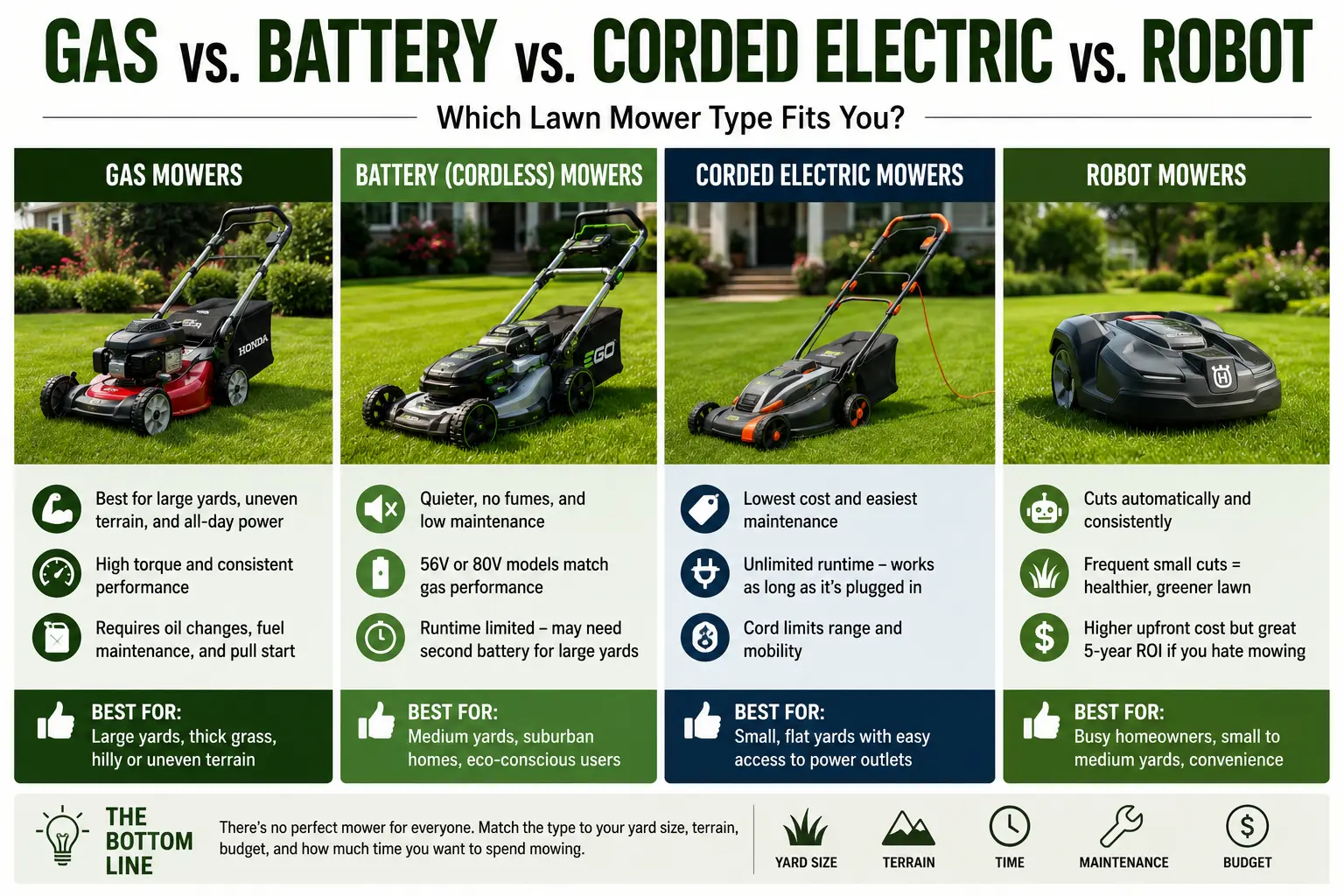
What Type of Grass Do You Have?
Grass type affects how hard your mower has to work.
Fine grasses (Bermuda, zoysia, fine fescue): Most mowers handle these easily. Even a lighter battery mower does fine.
Coarse or thick grasses (St. Augustine, tall fescue, centipede): These need more blade torque. Gas or high-voltage battery mowers work better. A weak motor will bog down on St. Augustine in July.
Thick northern grasses in spring flush (Kentucky bluegrass, ryegrass after rain): After a few days of rain in the Midwest, these grasses grow fast and thick. This is where engine power and deck height clearance earn their keep.
I grew up on St. Augustine in Florida. It’ll humble any undersized mower fast.
Understanding Lawn Mower Features: What’s Worth the Upgrade
Mower specs can look impressive on a box and mean very little in real use. Here’s what actually changes the experience.
Self-Propelled vs. Push: Is It Worth Paying More?
Self-propelled mowers cost $80-$200 more than push models of the same type. For a flat yard under a quarter acre, push is fine – it’s decent light exercise and costs less.
Once your yard hits half an acre or has any real slope, self-propelled becomes worth every dollar. Pushing a 70-pound mower up a grade in August in Georgia is not exercise. It’s suffering.
Front-wheel drive self-propelled works on flat to mild slopes. Rear-wheel drive gives better traction going uphill. If your yard slopes, pay for rear-wheel drive.
Cutting Height Range: Why More Options Matter
A wider cutting height range lets you adjust for season, grass type, and growth rate.
- Spring (rapid growth): Cut higher to avoid scalping – 3.5 to 4 inches
- Summer drought stress: Cut at 3.5 to 4 inches to shade roots and retain moisture
- Fall (final cut before winter): Gradually lower to 2 to 2.5 inches
Most mowers offer 5-8 height positions. Anything with fewer than 5 positions limits your flexibility throughout the growing season. The Craftsman M275’s 8 positions are a genuine advantage at its price.
Mulching, Bagging, and Side Discharge: What to Use When
Mulching returns clippings to the lawn as natural fertilizer. It works well when grass is dry and not overgrown. Over time, regular mulching reduces your need for supplemental fertilizer by up to 25% (Lawn Institute, 2024). This is the setting I use 80% of the time.
Bagging collects clippings for disposal. Use it when grass is long or wet, when clippings are too heavy to break down quickly, or before overseeding in fall.
Side discharge throws clippings out to the side. Useful for very long grass that would clog a mulch mode. Not great for neat appearance.
The best mowers offer all three. Don’t buy a mower without at least mulching and bagging capability.
Blade Quality and Deck Material: What Lasts
Steel decks are durable, repairable, and handle impacts with rocks or roots better than plastic. They rust if left wet and uncovered, but a quick dry and an annual coat of deck spray prevents that.
Composite or NeXite decks (like Honda’s) don’t rust, are lighter, and handle minor impacts fine. They can crack under a serious blow, though Honda’s NeXite is tougher than standard plastic.
Blade thickness: Thicker blades hold an edge longer and handle debris better. You shouldn’t need to sharpen more than once per season with normal use. Blade sharpening takes about 15 minutes and costs nothing if you do it yourself.
Gas vs. Battery Lawn Mowers: The 2026 Verdict
The debate used to be simple: gas was more powerful, battery was more convenient. By 2026, that’s no longer fully true.
Premium 56V and 80V battery mowers now match or exceed many mid-range gas engines in cutting torque and speed, according to Consumer Reports mower tests (Consumer Reports, 2026). The real remaining advantages of gas are runtime on large lots and performance in very thick, wet conditions where battery draw is highest.
Here’s where each type wins:
Choose gas if:
- Your yard is over 3/4 acre and you want one uninterrupted mow
- You have steep terrain requiring consistent high torque
- You already have gas equipment and a routine
- You don’t have easy access to outdoor power outlets for charging
Choose battery if:
- Your yard is under 3/4 acre
- You want no maintenance schedule (no oil, no carburetor, no fuel stabilizer)
- You value lower noise for early morning or evening mowing
- You already own a compatible battery platform (EGO, Ryobi, Greenworks)
The environmental angle: Battery mowers produce zero direct emissions. Gas walk-behind mowers emit as much pollution per hour as driving roughly 11 cars for the same period, according to the EPA (EPA, 2023). If that matters to you – and for many US homeowners it increasingly does – battery is the clear answer.
Battery Platform Compatibility: Why Brand Ecosystem Matters in 2026
One thing that barely came up in lawn mower conversations five years ago now drives real purchase decisions: battery platform compatibility.
Every major power tool brand has built a shared battery ecosystem. A single battery pack works across dozens of tools in the same voltage family. Buy into EGO’s 56V system, and that same battery runs your leaf blower, chainsaw, hedge trimmer, string trimmer, and snow blower.
That compatibility changes how you should think about cost.
The true cost calculation:
If you already own an EGO blower, you may have a spare 5.0Ah battery sitting in your garage right now. Buying the EGO LM2135SP mower without battery (sold separately, around $449) instead of the kit version means you’re spending less upfront while getting the same machine.
Conversely, if you’re starting fresh with no battery tools, buying into a platform means your first purchase subsidizes everything that follows. A $649 EGO mower kit that includes a charger and battery means the next EGO tool you buy could be tool-only, saving $80-$150 on each future purchase.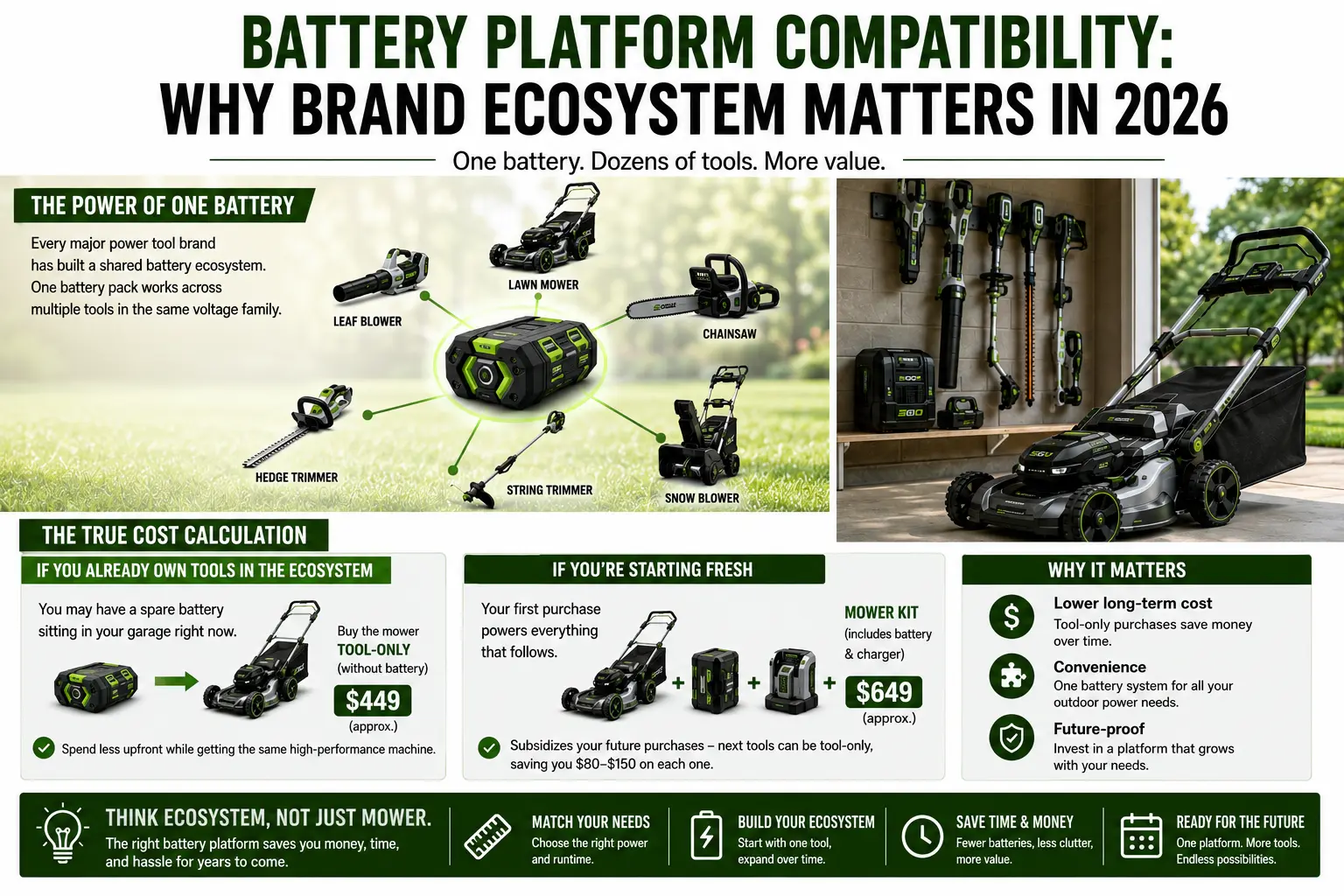
The major US battery platforms and their ecosystem size:
| Brand | Voltage | Number of Compatible Tools (2026) |
|---|---|---|
| EGO Power+ | 56V | 70+ tools |
| Ryobi | 40V | 80+ tools |
| Greenworks | 40V / 60V | 60+ tools |
| DeWalt | 20V / 60V Flexvolt | 100+ tools |
| Milwaukee | 18V / MX Fuel | 100+ tools |
| Makita | 18V / 40V XGT | 100+ tools |
DeWalt, Milwaukee, and Makita are dominant in the contractor and professional space. EGO, Ryobi, and Greenworks skew toward homeowner outdoor power. If you’re already deep into a platform for indoor tools, it’s worth checking whether that brand has a yard tool lineup before defaulting to a different one.
One practical note: higher voltage doesn’t always mean more power in the real-world sense. A 40V EGO and a 60V Greenworks are both capable of handling typical suburban lawns. The voltage spec alone doesn’t tell you enough – look at the amp-hour rating of the battery and the motor’s watt-hour output for an honest comparison.
Lawn Mower Safety: What Most Guides Skip
Lawn mowers send around 80,000 people to US emergency rooms every year, according to the American Academy of Orthopaedic Surgeons (AAOS, 2024). Most of those injuries are preventable.
This isn’t a legal disclaimer section. These are practical habits that make a real difference.
Before Every Mow
- Walk the yard first and remove any rocks, sticks, toys, or debris. A mower blade throws objects at up to 200 mph. A rock thrown sideways at that speed causes serious injury.
- Check that the discharge chute is properly attached and directed away from people and pets.
- Confirm that children and pets are inside or at a safe distance before starting. The AAOS recommends children stay indoors entirely while an adult mows (AAOS, 2024).
While Mowing
- Never mow slopes sideways on a walk-behind mower – always mow up and down to prevent the mower from rolling sideways if it slips.
- Wear closed-toe shoes, not sandals or bare feet. Every season, emergency rooms treat foot injuries from mower contact.
- Keep both hands on the handle. Reaching under the deck with the blade running is how serious hand injuries happen.
- If you need to unclog the deck, turn the mower completely off first. The blade can coast for seconds after the power cuts.
Refueling Safety (Gas Mowers)
- Never refuel with the engine running or still hot.
- Keep fuel away from sparks, open flames, and direct sunlight.
- Use a fuel container designed for gasoline – don’t use water bottles or unmarked containers.
Hearing Protection
Gas mowers operate at 90-100 decibels at the operator’s ear (NIOSH, 2023). The occupational safe limit for 8-hour exposure is 85 decibels. For a typical 60-90 minute mow, the risk is lower – but frequent mowing without hearing protection adds up over years. Foam earplugs cost $1 and block 25-30 decibels. Battery mowers run at 75-85 decibels – meaningfully quieter and a real benefit for morning or evening mowing in neighborhoods with noise ordinances.
Lawn Mower Warranties: What’s Actually Covered
Warranties vary more than most buyers realize. Here’s a quick comparison of what major brands cover in 2026.
| Brand | Mower Warranty | Battery Warranty |
|---|---|---|
| EGO | 5 years (mower), 3 years (battery) | 3 years |
| Honda | 3 years residential | N/A (gas) |
| Greenworks | 4 years (mower), 2 years (battery) | 2 years |
| Husqvarna | 2 years residential | 2 years (Automower) |
| Toro | 2 years residential | N/A (gas) |
| Ryobi | 3 years (mower), 3 years (battery) | 3 years |
| Craftsman | 3 years full, 5 years limited | N/A (gas) |
A few things worth noting:
EGO’s 5-year mower warranty is the strongest in the battery category for residential use. That length signals real confidence in build quality and gives you meaningful protection if a motor issue surfaces in year three.
“Full warranty” vs “limited warranty” matters. A full warranty covers parts and labor. A limited warranty often covers parts only – you pay for the shop time. Read the fine print before assuming coverage.
Most warranties require proof of purchase and registration within 30 days for full coverage. Register your mower the week you buy it. It takes three minutes and saves headaches later.
When to Buy a Riding Mower Instead
A walk-behind mower hits its practical limit somewhere between one and two acres. At that point, you’re looking at 90+ minutes of walking per mow – every week, from May through October across most of the continental US.
A riding mower or zero-turn makes sense when:
- Your yard is consistently over 1 acre
- You have mobility limitations that make extended walking difficult
- You have wide-open flat terrain that zero-turn mowers navigate efficiently
Entry-level riding mowers from Husqvarna, Cub Cadet, and Ariens start around $1,800. A quality zero-turn from the same brands starts around $2,500. These are separate guides – if you’re in that category, the walk-behind options above are the wrong conversation.
Lawn Mower Accessories Worth Buying (And the Ones to Skip)
A mower is the main tool. These accessories are the ones that actually make a difference over a season.
Worth Buying
Mulching plug: If your mower came with a bag attachment but you prefer to mulch, a dedicated mulching plug seals the discharge opening and forces clippings through the blade more times before ejecting them. Cost: $15-$30. The finer clippings break down faster and feed the lawn more effectively.
Blade sharpener: A handheld angle grinder with a sharpening disc, or a dedicated blade balancer and file kit, costs around $20-$40 at any hardware store. Sharpening once a season takes 15 minutes. A sharp blade cuts grass cleanly instead of tearing it, which visibly improves how the lawn looks and recovers.
Fuel stabilizer (gas mowers only): STA-BIL is the most common brand in US hardware stores. A $10 bottle lasts several seasons. Add it to the tank before winter storage, run the engine for two minutes to circulate it, and you’ll have a first-start-ready mower every spring.
Deck wash port attachment: Some mowers include a hose connection port on the deck. If yours does, use it – spray water under the deck while the blade spins (safely, in wash mode) to flush out packed clippings. No scraping required. If your mower doesn’t have this port, a plastic scraper and five minutes of manual cleaning does the same job.
Extra battery (battery mowers): If your yard is over half an acre, a second battery pack means you never stop mid-mow to charge. EGO, Ryobi, and Greenworks all sell additional batteries separately. Having a spare charged and ready also means you can grab it for a leaf blower or trimmer without interrupting your mowing routine.
Not Worth Buying for Most Homeowners
Extended warranties from big-box stores: Retailer-added extended warranties on mowers are rarely good value. Major brands like EGO, Honda, and Husqvarna already cover 3-5 years on their own. A store warranty layered on top of that mostly covers the period after the manufacturer warranty expires – which is years from now, and when the mower may not be worth repairing anyway.
Robotic mower installation kits marketed as “easy”: If you buy a robot mower like the Husqvarna Automower, install the boundary wire yourself by following the included instructions rather than buying an upgrade kit. The installation process is straightforward. The kits being sold separately mostly add pre-made corners and guides you don’t need.
Aftermarket blades of unknown quality: Blade quality matters. Cheap aftermarket blades from no-name sellers on Amazon are tempting at $8, but they’re often softer steel that dulls faster and can be unbalanced out of the box. Unbalanced blades cause vibration that wears the spindle over time. Buy OEM blades or quality aftermarket from brands like Oregon or MaxPower.
Lawn Mowing Schedule: What to Do in Each Season Across the US
Mowing isn’t the same job all year. The schedule and approach that works in May is wrong for August, and completely different from what October demands.
Here’s a practical seasonal calendar that applies to most of the continental US, with regional notes where the timing shifts.
Spring (March-May): First Mow and Growth Surge
Spring is the most important mowing period for cool-season grasses. The lawn wakes up, grows fast, and how you mow in March and April directly affects how it looks in July.
First mow: Wait until the soil is firm enough to walk on without leaving deep footprints. Mowing wet, soft soil compacts it and stresses grass roots.
Starting height: Begin at a moderate height – 2.5 to 3 inches for most cool-season grasses. Cutting too low in spring before roots are established stresses the plant.
Frequency: Cool-season grasses in the North may need mowing every 5-6 days during peak spring flush. That’s a more aggressive schedule than summer – be prepared for it.
Midwest note: After a week of April rain in Ohio or Illinois, bluegrass and fescue can put on three inches of growth. Mow as soon as the ground firms up, even if it means two mows in one week.
Summer (June-August): Heat Management and Water Stress
Summer is when mowing strategy matters most for lawn health.
Cut higher in summer: Raise your deck to 3.5-4 inches. Taller grass shades the soil, keeps roots cooler, and retains more moisture during drought stress. This single adjustment dramatically reduces browning in a dry July.
Mow less frequently in drought: When growth slows during summer heat, mowing every 10-14 days is enough. Mowing stressed grass on a weekly schedule just adds wear without benefit.
Southern grasses: Bermuda and zoysia continue actively growing through summer. These warm-season grasses actually prefer lower heights (1.5-2.5 inches for Bermuda). The summer cutting rhythm for Southern lawns is different – shorter and more frequent than Northern cool-season advice.
Texas and Arizona note: If your lawn goes partially dormant in peak summer heat, reduce mowing to once every 2-3 weeks and raise the deck height. Mowing dormant grass at a low setting doesn’t improve appearance and stresses roots unnecessarily.
Fall (September-November): Preparing for Winter
Fall mowing sets your lawn up for next spring. It’s the last chance to improve the foundation before the grass goes dormant.
Gradually lower the deck: Through September and October, gradually reduce cutting height back toward 2-2.5 inches. This is easier on the grass than dropping from 4 inches to 2 inches in a single mow.
Final mow timing: The last mow of the season should be before first hard frost. In the upper Midwest and Northeast, that might be late October. In the Pacific Northwest, it could be November. The goal is to leave grass at 2-2.5 inches going into winter – short enough that snow mold is less likely, long enough to protect roots.
Leaf management: Fall is when the mower becomes a leaf mulcher. Running over dry leaves with the mower set to mulch chops them into tiny pieces that break down into the lawn over winter – free organic matter. This is faster than raking and genuinely better for the lawn than removing all leaves. Do this in dry conditions; wet leaf piles pack under the deck and clog the blade.
Midwest and Northeast note: Aerating and overseeding in early September before leaves fall is a standard practice in these regions. Mow the existing lawn low, aerate, overseed, then resume normal mowing height. It’s worth doing every other year on heavily trafficked lawns.
Winter (December-February): Storage and Preparation
Walk-behind mowers stay in the garage. Here’s what to do before they sit.
Gas mowers: Drain the fuel or add stabilizer (see Maintenance section). Change the oil before storage rather than after, so the mower sits with fresh oil. Clean the deck thoroughly. Store indoors – extreme cold does more damage to carburetors than most people realize.
Battery mowers: Remove batteries and store them indoors at room temperature. Don’t leave batteries in a cold garage – lithium-ion cells degrade faster in temperatures below freezing (EGO, 2024). Store batteries at 50-80% charge, not fully drained.
Robot mowers: The Husqvarna Automower and similar models include a winter hibernation mode. Move the charging station indoors, clean the mower, and follow the manufacturer’s storage guide. Most robot mowers are not designed for operation in consistently frozen conditions.
Lawn Mower Maintenance: What You Actually Need to Do
The mower you never maintain is the mower that fails in May when the grass is already six inches tall.
Here’s the honest minimum maintenance schedule by type.
Gas Mower Maintenance
Gas mowers need the most attention, but it’s less daunting than people think.
Each season:
- Change the oil – 5-10 minutes, costs about $5 in oil
- Replace or clean the air filter – costs $4-$8
- Check and replace the spark plug if needed – costs $3-$5
- Sharpen the blade – 15 minutes, free if you do it yourself
Before winter storage:
- Drain the fuel tank completely OR add fuel stabilizer and run the engine for 2 minutes to circulate it
- Skipping this step is the #1 reason gas mowers don’t start in spring
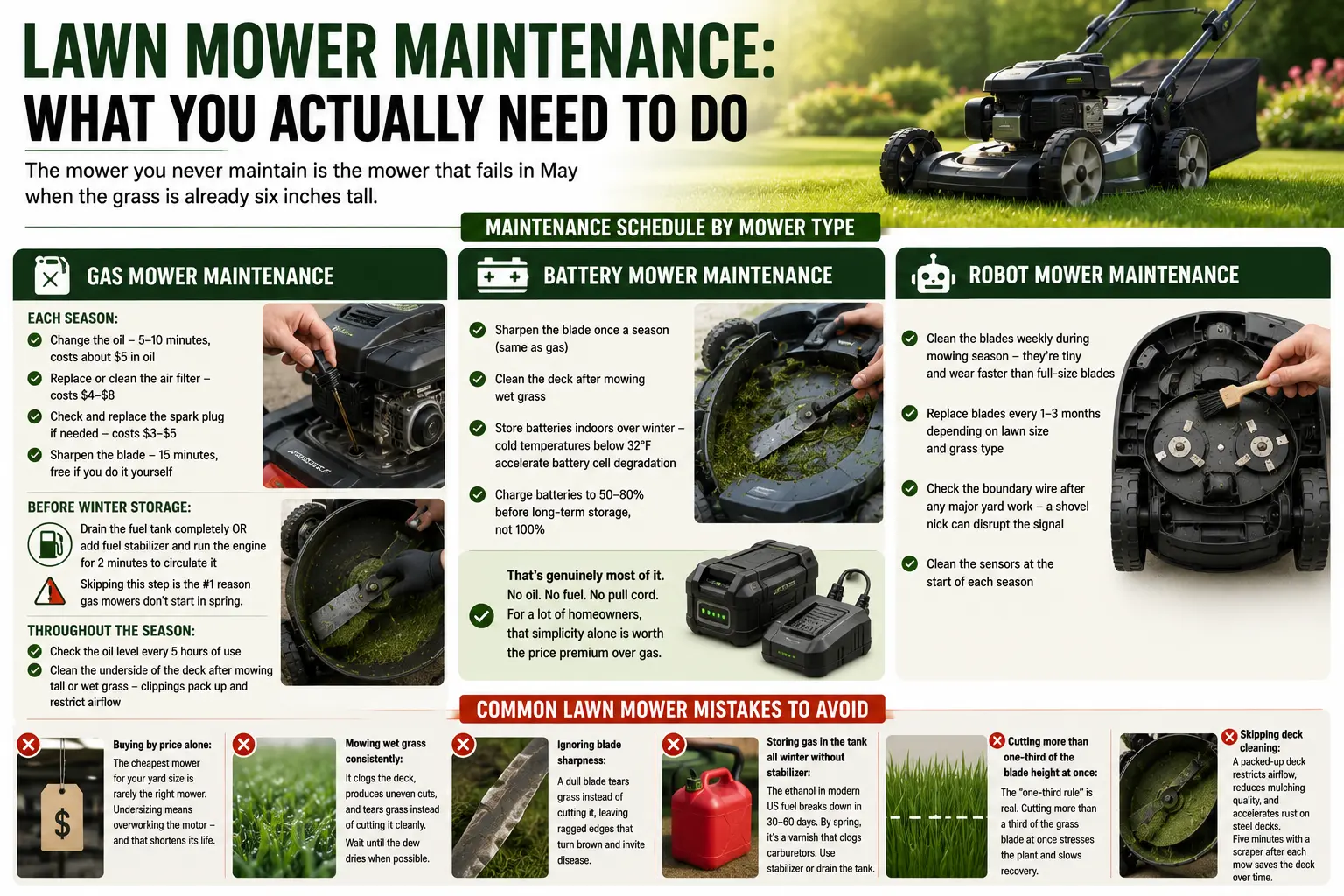
Throughout the season:
- Check the oil level every 5 hours of use
- Clean the underside of the deck after mowing tall or wet grass – clippings pack up and restrict airflow
Battery Mower Maintenance
Dramatically simpler. The main jobs:
- Sharpen the blade once a season (same as gas)
- Clean the deck after mowing wet grass
- Store batteries indoors over winter – cold temperatures below 32°F accelerate battery cell degradation (EGO, 2024)
- Charge batteries to 50-80% before long-term storage, not 100%
That’s genuinely most of it. No oil. No fuel. No pull cord. For a lot of homeowners, that simplicity alone is worth the price premium over gas.
Robot Mower Maintenance
- Clean the blades weekly during mowing season – they’re tiny and wear faster than full-size blades
- Replace blades every 1-3 months depending on lawn size and grass type
- Check the boundary wire after any major yard work – a shovel nick can disrupt the signal
- Clean the sensors at the start of each season
Common Lawn Mower Mistakes to Avoid
These mistakes come up again and again in homeowner forums, service centers, and conversations with people who’ve had to buy a second mower too soon.
- Buying by price alone: The cheapest mower for your yard size is rarely the right mower. Undersizing means overworking the motor – and that shortens its life.
- Mowing wet grass consistently: It clogs the deck, produces uneven cuts, and tears grass instead of cutting it cleanly. Wait until the dew dries when possible.
- Ignoring blade sharpness: A dull blade tears grass instead of cutting it, leaving ragged edges that turn brown and invite disease. Sharpen at the start of each season, minimum.
- Storing gas in the tank all winter without stabilizer: The ethanol in modern US fuel breaks down in 30-60 days. By spring, it’s a varnish that clogs carburetors. Use stabilizer or drain the tank.
- Cutting more than one-third of the blade height at once: The “one-third rule” is real. Cutting more than a third of the grass blade at once stresses the plant and slows recovery. If you’ve let it get long, mow twice at higher settings rather than once at low.
- Skipping deck cleaning: A packed-up deck restricts airflow, reduces mulching quality, and accelerates rust on steel decks. Five minutes with a scraper after each mow saves the deck over time.
US-Specific Lawn Mower Considerations by Region
Lawn care isn’t uniform across the US. The mower that works in coastal Washington doesn’t necessarily match what someone in Central Texas needs.
The South: Heat, Humidity, and Warm-Season Grasses
Florida, Georgia, Texas, Alabama – these states deal with year-round growing seasons in some areas, warm-season grasses like St. Augustine and Bermuda, and serious summer heat.
St. Augustine in particular is thick and coarse – it demands real blade torque. A budget push mower with a small motor will struggle here by midsummer. The EGO LM2135SP, Honda HRX217VKA, or Toro TimeMaster handle Southern grasses without hesitation.
Humidity also means clippings mat more easily under the deck. Cleaning the deck regularly matters more in the South than anywhere else.
The Midwest: Spring Flush, Fall Recovery
States like Illinois, Ohio, Indiana, and Michigan deal with cool-season grasses (Kentucky bluegrass, tall fescue) that surge in spring and again in early fall. After a Midwest spring rain week, grass can jump four inches in six days.
This surge is where undersized mowers fail. A 163cc engine in wet, thick bluegrass is working hard. The Honda or Toro TimeMaster handles this better than lighter options. If you’re on battery, the EGO LM2156SP’s dual-battery system gives you the runtime and power needed for a full mow even after a week of missed sessions.
The Southwest and West: Drought, Water Restrictions, and Xeriscape
Arizona, Nevada, and parts of California have different lawn situations. Many homeowners have replaced traditional turf with xeriscape, artificial turf, or drought-tolerant grasses like buffalo grass. Lawns that remain are often smaller and less demanding.
If you’re in the Southwest with a small lawn patch, the Greenworks 25322 or Sun Joe MJ401E may be all you need. The premium options are built for situations that don’t match a 1,500 square foot patch of buffalo grass.
The Pacific Northwest: Rain, Slope, and Year-Round Green
Oregon and Washington have a unique situation: lawns stay green nearly year-round but the terrain can be challenging. Slopes are common, and the rain keeps grass growing longer into the fall.
Slope management matters here. Rear-wheel drive self-propelled mowers like the Honda HRX217VKA handle Pacific Northwest terrain better than front-wheel models. Robot mowers with slope ratings (Husqvarna 450X) also work well here given the milder temperatures that extend the automated mowing season.
Frequently Asked Questions About Lawn Mowers
What is the best lawn mower for a 1/2 acre yard?
The EGO Power+ LM2135SP is the best option for a half-acre yard in 2026 for most homeowners. It’s self-propelled, runs 60-70 minutes on a charge, and handles typical suburban grass types without difficulty. If the yard has serious slopes, the Honda HRX217VKA’s rear-wheel drive gives better traction.
How long do battery lawn mowers last?
A quality battery mower from a reputable brand lasts 5-8 years on average with proper maintenance (Consumer Reports, 2026). The motor itself rarely fails – the battery pack is what degrades over time. Most lithium-ion battery packs on premium mowers hold usable capacity for 500-1,000 charge cycles before noticeable degradation, which translates to roughly 5-8 years of seasonal use.
Is a self-propelled mower worth the extra cost?
Yes – for most homeowners. Self-propelled adds $80-$200 over a comparable push model. On any yard over a quarter acre, or any yard with slope, the physical difference is significant. Pushing a full-size mower for 60+ minutes in summer heat is demanding. Self-propelled removes most of that effort.
What is the difference between front-wheel and rear-wheel drive mowers?
Front-wheel drive mowers push the front wheels forward – good for flat terrain, easy to turn (you lift the front slightly to pivot). Rear-wheel drive pushes from the back wheels – better traction going uphill on slopes because the engine weight sits over the driven wheels. If your yard has hills, rear-wheel drive is the better choice.
How often should I sharpen my lawn mower blade?
Sharpen the blade at the start of each mowing season, and again mid-season if you mow over an acre regularly or frequently hit rocks, roots, or debris. A sharp blade cuts grass cleanly; a dull blade tears it, which turns tips brown and makes the lawn look ragged within days. Sharpening takes 10-15 minutes with a file or angle grinder.
Are robot lawn mowers worth the price?
For the right homeowner, yes. The Husqvarna Automower 450X at $2,499 sounds like a lot. But compare it to: $1,500-$2,000 in lawn service costs per year, or the 40-50 hours of mowing time it replaces annually. Over three to five years, the math works for a lot of people – especially those with consistent lawn shapes and established grass. It’s not for everyone, but it’s not a gimmick either.
What lawn mower is best for a small backyard?
The Greenworks 25322 is the best pick for a small backyard – compact, lightweight, battery-powered, and under $250. For an even smaller space (under 2,000 square feet), the Sun Joe MJ401E at $109 is the most cost-effective option available.
Can I use a lawn mower in the rain?
Most manufacturers advise against mowing in heavy rain. Wet grass cuts unevenly, clumps under the deck, and the surface becomes slippery – which is a safety concern on any slope. Light dew is fine once it’s dried slightly. Robot mowers like the Husqvarna Automower are specifically designed to operate in rain and are the exception.
What is the best time of day to mow the lawn?
Mid-morning – after the dew dries but before peak afternoon heat – is ideal. Grass is dry enough for a clean cut, and neither you nor the mower is fighting the worst heat of the day. Avoid mowing in the evening: clippings left damp overnight can invite fungal disease on certain grass types.
Final Verdict: Which Lawn Mower Should You Buy in 2026?
The right mower depends entirely on your yard. Here’s a one-line answer for every major situation:
- Best overall, most homeowners: EGO Power+ LM2135SP
- Best gas mower: Honda HRX217VKA
- Best budget option: Greenworks 25322
- Best for large open yards: Toro TimeMaster 30376
- Best for hands-free mowing: Husqvarna Automower 450X
- Best for Ryobi owners: Ryobi RY401150-Y
- Best budget gas: Craftsman M275
- Best for big yards on battery: EGO Power+ LM2156SP
- Best for tiny yards: Sun Joe MJ401E
If you’re standing at a store checkout and still unsure: buy what matches your yard size first, your terrain second, and your budget third. A mower that’s the right size for your yard will outlast and outperform a premium mower that’s wrong for the job.