
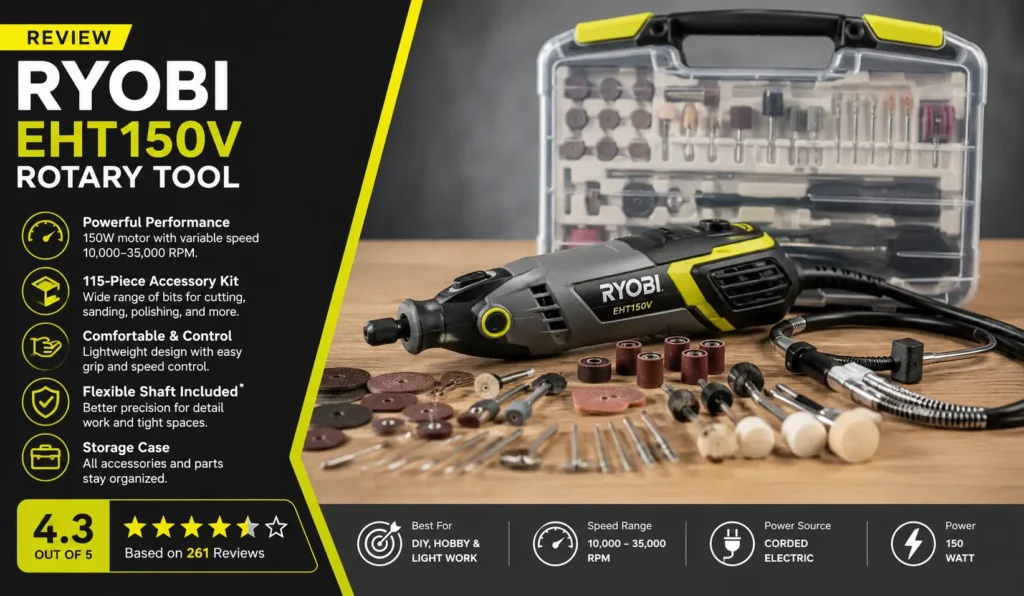
If you’ve been looking for a budget rotary tool that doesn’t feel cheap, the Ryobi EHT150V review results might just surprise you. I picked this up after months of debating between entry-level options, and honestly, it held its own better than I expected. It comes packed with 115 accessories, spins up to 35,000 RPM, and fits right into any hobbyist’s toolkit. Stick around — I’ll walk you through everything, the good, the not-so-good, and whether it’s right for you.
Table of Contents
- What I Like
- What Could Be Better
- My Personal Experience with the Ryobi EHT150V
- Comparing With Other Brands
- Recommendation
- FAQs
What I Like
Let me be real with you. When I first opened the case, I didn’t expect much. But the Ryobi EHT150V surprised me in more ways than one. Here’s what stood out:
- Solid Build for the Price: The body feels firm in your hand. It’s not flimsy plastic. When I gripped it and ran it at full speed, there was no flex, no rattle. For a 150-watt tool at this price point, that’s impressive. I’ve held more expensive rotary tools that felt cheaper than this one.
- Ball Bearing Shaft: This is a big deal. A lot of budget rotary tools skip the ball bearing and use a plain bushing instead. The EHT150V has a proper ball bearing on the shaft. That means less wobble, less vibration, and a cleaner cut or grind over time. I noticed this right away when I started doing fine detail work on a small metal piece.
- Wide Speed Range (10,000 – 35,000 RPM): You get full control here. Low speed for polishing soft metals or plastic, high speed for cutting and grinding hard surfaces. The dial is smooth and easy to adjust mid-task. That range is more than enough for everyday hobbyist and DIY work.
- Compatible with Dremel Accessories: This was a game changer for me. I already had a small collection of Dremel bits. Every single one I tried fit the Ryobi EHT150V collet perfectly. That means you’re not locked into a single brand’s ecosystem. You can buy cheaper aftermarket bits and still get great results.
- 115-Piece Accessory Kit: It comes in a hard plastic case with compartments. Opening it felt like unpacking a proper toolkit. There are cutting discs, grinding stones, polishing pads, a flexible shaft, a telescopic stand, and two collet keys. Most of what you need for light to medium work is right there in the box.
- Flexible Shaft Attachment: Not every rotary tool at this price includes a flex shaft. The EHT150V does. It’s fantastic for precision work — carving, engraving, or working in tight spaces. When the motor sits in the stand and you use the flex shaft as your “pen,” the control is incredible. Think of it like holding a pencil instead of a power drill.
- Telescopic Stand Included: I set this up in under five minutes. It holds the tool overhead so you can work hands-free with the flex shaft. For anyone doing jewelry work, model making, or intricate craft projects, this setup is a dream.
- Power Indicator Light: Small feature, but useful. You can tell at a glance when the tool is powered on. No guessing, no accidental startups.
- Shaft Lock Button: Changing bits is quick. Press the lock, swap the bit, release. No need to hold the shaft steady manually. It saves time and prevents stripped collets when you’re working fast.
What Could Be Better
I want to be honest here. No tool is perfect, and the Ryobi EHT150V has a few areas that could use some attention.
- The Flexible Shaft Can Be Inconsistent: This was my biggest frustration. The flex shaft works well when everything aligns right. But getting it to seat properly took me a few tries. I’ve read from other users — even engineers — that they struggled to get it working at all. Ryobi should make this connection more intuitive or foolproof. It’s too good a feature to have attached to a frustrating setup experience.
- Accessory Quality Is Mixed: Out of 115 pieces, 72 are cutting discs. They’re small, thin, and fragile. Great for occasional cuts, but don’t expect them to last through heavy projects. The polishing pads are finish-grade only (think final polish, not heavy compound work). If you need specialized bits, plan on buying aftermarket ones. The kit is a solid starter, but it’s not a replacement for quality dedicated accessories.
- Aluminum Collets Are Soft: The included collets are aluminum. They do the job, but they’re softer than steel alternatives. Over time, especially if you’re swapping bits often, you might see wear or find that bits slip under load. This is a common cost-cutting move in this price range, but it’s worth knowing.
- Case Compartments in the Lid Are Loose: When you open the case, the lid compartments tend to fall open. Small accessories can slide around or fall out. It’s a minor annoyance, but if you’re moving the kit between job sites or storing it on a shelf, it adds up. A simple latch fix would solve this entirely.
- Not Easy to Find in Stores: Ryobi is a massive brand, but the EHT150V isn’t always on shelves. In the US, you’ll mostly find it through online retailers. If you need it in a hurry, that’s a problem. Local hardware stores often don’t stock it.
- No Engraving Bits Included: With 115 accessories, I was surprised not to find a single engraving bit. If you want to personalize metal, glass, or wood — a very common use case for rotary tools — you’ll need to buy those separately.
- Flex Shaft Requires Regular Lubrication: The manual says everything is pre-lubed, but in practice, you’ll want to add a drop of sewing machine oil or light grease periodically. Without it, the flex shaft can get noisy and generate extra heat. Not a dealbreaker, but it’s an extra step that new users might not expect.
My Personal Experience with the Ryobi EHT150V
I want to take a moment to share exactly how I’ve been using this tool, because I think it tells you more than any spec sheet ever could.
I picked up the Ryobi EHT150V to help with a mix of hobby and light home projects. I work on small metalwork, occasional wood carving, and I restore old tools as a side hobby. I needed something versatile without spending $100+ on a Dremel setup.
Here’s what my experience looked like across different tasks:
- Metal polishing: I used the included polishing pad on a stainless steel mug. The results were genuinely impressive. The 10,000 RPM low-end setting was perfect for this — enough speed to work the surface, slow enough not to overheat.
- Wood carving: I grabbed a carbide bit from my old Dremel set and carved a small design into a wood block. The tool tracked smoothly. No chatter, no slip. The ball bearing shaft made a real difference here.
- Plastic cutting: I cut through thin ABS plastic at around 15,000 RPM. It didn’t melt. It cut clean. I was careful to keep moving and not let the disc sit in one spot.
- First few days — break-in period: During the first two or three uses, the tool smelled a bit like burning. That’s normal. The carbon brushes in the motor need to wear in. It settled down by the third session and never came back.
- Overheating during heavy use: During one longer session, the tool got hot and slowed down noticeably. I gave it a five-minute break and it was fine. The lesson here: work in intervals for heavy tasks. Fifteen minutes on, a few minutes off.
- Flex shaft test: I finally got the flex shaft working on my third attempt. Once it seated correctly, it was a revelation. I did some fine detail work on a model car — tiny rivets, small panel lines — and the control was exceptional.
- Telescopic stand test: Super easy to set up. I hung the tool, attached the flex shaft, and worked hands-free for about 20 minutes. Incredibly comfortable. My hand didn’t fatigue at all.
- Bit slippage test: Using the aluminum collets with a heavier grinding bit, I noticed slight slippage under pressure. I tightened the collet more firmly and it resolved. Just be mindful when using wider-shank bits.
- Overall impression: For the price, this tool delivers. It’s not a professional Dremel 4300. But for DIY projects, hobbyist work, and weekend crafts, it punches well above its class.
Comparing With Other Brands
I’ve also used the Dremel 3000 extensively over the past few years, and it’s the most natural comparison point for the Ryobi EHT150V. The Dremel 3000 is a household name in the rotary tool space — trusted, widely available, and backed by decades of reputation. But it also costs significantly more and doesn’t always come with as full an accessory kit out of the box.
Here’s how they stack up side by side.
Ryobi EHT150V vs Dremel 3000: Quick Comparison
| Feature | Ryobi EHT150V | Dremel 3000 |
|---|---|---|
| Power | 150W | 130W |
| Speed Range | 10,000 – 35,000 RPM | 5,000 – 32,000 RPM |
| Accessories Included | 115 pieces | 28 pieces (varies by kit) |
| Flexible Shaft | Included | Sold separately (~$20) |
| Telescopic Stand | Included | Sold separately |
| Ball Bearing Shaft | Yes | Yes |
| Collet Material | Aluminum | Steel |
| Weight | ~370g | ~650g |
| Availability (US) | Online mostly | Wide retail availability |
| Price Range | Budget | Mid-range |
| Dremel Bit Compatibility | Yes | N/A |
| Noise Level | Moderate | Moderate |
| Best For | Hobbyists, DIY | Hobbyists + Light Professional |
The bottom line: The Ryobi EHT150V wins on value. You get more accessories, a lighter tool, and a higher wattage for less money. The Dremel 3000 wins on reliability, steel collets, and retail availability — critical if you’re in the US and need a replacement part fast.
Ryobi EHT150V vs WEN 2305: Quick Comparison
| Feature | Ryobi EHT150V | WEN 2305 |
|---|---|---|
| Power | 150W | ~100W equivalent |
| Speed Range | 10,000 – 35,000 RPM | 8,000 – 30,000 RPM |
| Accessories Included | 115 pieces | 80 pieces |
| Flexible Shaft | Included | Included |
| Ball Bearing Shaft | Yes | Yes |
| Variable Speed | Yes | Yes |
| Weight | ~370g | ~400g |
| Noise Level | Moderate | Moderate-Low |
| Price Range | Budget | Budget |
| Build Quality | Good | Good |
| Best For | Hobbyists, crafters | Budget crafters, beginners |
The WEN 2305 is a legitimate competitor, especially for first-time buyers in the US market where WEN is well-distributed through Amazon and Home Depot. The Ryobi edges ahead on power and accessory count, but the WEN is often easier to get quickly.
Ryobi EHT150V vs Black+Decker RTX-6: Quick Comparison
| Feature | Ryobi EHT150V | Black+Decker RTX-6 |
|---|---|---|
| Power | 150W | ~135W |
| Speed Range | 10,000 – 35,000 RPM | 12,000 – 30,000 RPM |
| Accessories Included | 115 pieces | 30 pieces |
| Flexible Shaft | Included | Not standard |
| Telescopic Stand | Included | No |
| Collet Sizes | 1mm & 6mm | 3.2mm standard |
| Variable Speed | Yes | Yes |
| Weight | ~370g | ~500g |
| Ease of Bit Change | Tool-required | EZ Twist (tool-free) |
| Price Range | Budget | Budget-Mid |
| Best For | All-around hobbyist | Casual DIY, quick changes |
The Black+Decker RTX-6 scores big on its tool-free bit change system — really handy if you swap attachments often. But it loses ground on accessories and doesn’t include a flex shaft. If you’re doing detail work, the Ryobi is a stronger choice. If you value quick bit changes above everything else, the RTX-6 is worth a look.
Recommendation
So who should buy the Ryobi EHT150V? Here’s my honest take.
Buy it if you are:
- A hobbyist who works on crafts, models, jewelry, or small home repairs
- Someone who wants a full starter kit without buying accessories separately
- A DIYer who already owns Dremel bits and wants a compatible, lower-cost tool
- Someone who plans to do light polishing, cutting, sanding, or grinding
- Looking for a gift for a creative or technically-minded person
Do more research if you are:
- A professional who needs a tool for heavy daily use — this isn’t built for that
- Someone who works exclusively with hard metals and needs steel collets from the start
- A US buyer who needs same-day availability from a local store — stock is limited
- Someone who relies heavily on the flexible shaft, since setup can be tricky
One thing I’d say specifically to US buyers: The Ryobi EHT150V is a 230V tool, designed primarily for European markets. In the US, standard outlets run at 110–120V. Before purchasing, confirm the voltage compatibility of the specific version being sold to you. Some listings include a voltage converter, others don’t. This is critical — using a 230V tool on 110V without a converter will result in poor performance, and using it incorrectly can damage the motor.
If you’re buying for use in the US, double-check the listing or go with a US-specific rotary tool like the Dremel 3000, WEN 2305, or Black+Decker RTX-6, which all run natively on 110V.
For everyone else — if the voltage works for your region — the Ryobi EHT150V is a genuinely good tool at a fair price. Don’t expect miracles. Do expect solid performance for light to medium tasks, a useful accessory kit, and a build quality that punches above its price tag.
FAQs for Ryobi EHT150V Review
Is the Ryobi EHT150V good for beginners?
Yes, it’s a great beginner rotary tool. It comes with 115 accessories and an adjustable speed dial. You don’t need prior experience to get started. The speed range of 10,000 to 35,000 RPM gives you room to learn safely. Start at low speed and work up.
Can I use Dremel bits with the Ryobi EHT150V?
Yes. The Ryobi EHT150V is compatible with Dremel accessories. Most standard Dremel bits fit the included collets. This is one of the tool’s best features. It saves you money because you don’t have to buy a whole new accessory set.
What is the RPM range of the Ryobi EHT150V?
The Ryobi EHT150V runs between 10,000 and 35,000 RPM. You adjust speed with the dial on the body. Low speed works well for polishing and soft materials. High speed is better for cutting and grinding hard surfaces.
Does the Ryobi EHT150V work in the USA?
The EHT150V is a 230V tool built for European markets. US outlets run at 110–120V. You will need a voltage converter to use it safely in the US. Without one, performance will be poor and you risk motor damage. Check the listing carefully before buying.
How long can I run the Ryobi EHT150V continuously?
For regular tasks, you can run it continuously. For heavy work like sustained cutting or grinding, work in 10 to 15 minute intervals. Let the tool cool for a few minutes between sessions. This prevents overheating and extends motor life. The same rule applies when using the flexible shaft.
Is the flexible shaft easy to attach?
It takes a little patience. You remove the collet and attach the flex shaft in its place, then hang the tool in the stand. Getting it to seat fully may take a couple of tries. Once locked in, it works smoothly. Apply a drop of sewing machine oil periodically to keep it quiet and cool.
What accessories are included with the Ryobi EHT150V?
The kit includes 115 pieces total. The majority (72 pieces) are cutting discs. You also get grinding stones, polishing pads, a flexible shaft, a telescopic stand, two collet keys, and two collet sizes (1mm and 6mm). Engraving bits are not included and must be purchased separately.
How does the Ryobi EHT150V compare to the Dremel 3000?
The Ryobi EHT150V offers more power (150W vs 130W), more accessories (115 vs 28), and includes a flex shaft and stand at no extra cost. The Dremel 3000 wins on steel collets, better retail availability, and long-term reliability. For value, the Ryobi wins. For professional use, Dremel is the safer bet.