
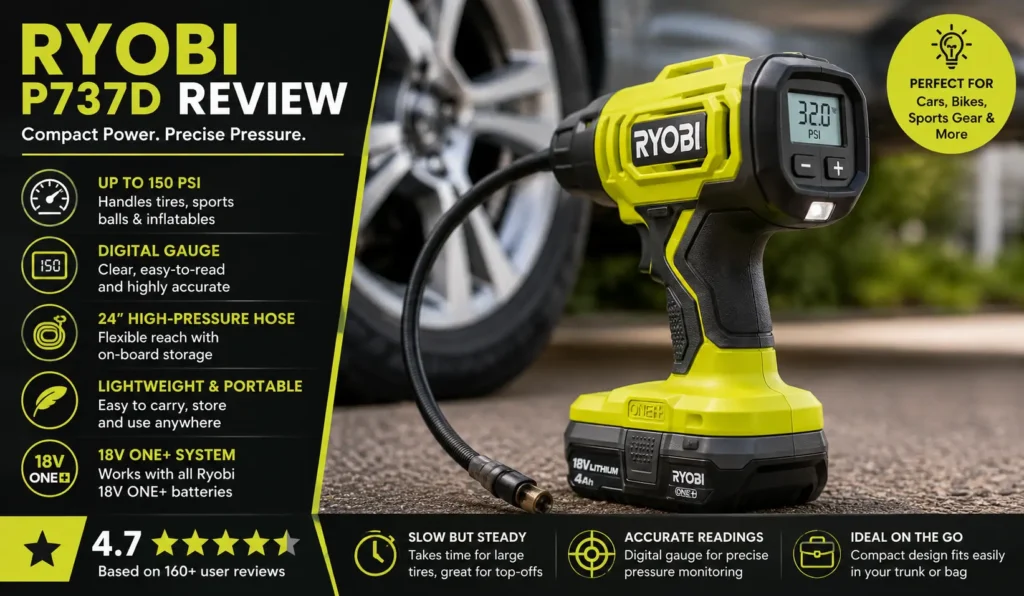
Ryobi p737d Review readers usually want one clear answer: yes, the Ryobi P737D is worth it if you already use Ryobi 18V ONE+ batteries and need a small tire inflator for quick jobs. I found it best for topping off car tires, bike tires, balls, and small inflatables. It is not a shop air compressor, but it is a very handy tool to keep in the garage or trunk. If you want a simple, honest review before buying, this guide will help you decide.
The Ryobi P737D is a cordless high-pressure inflator that runs on the Ryobi 18V ONE+ battery system. That means it works with the same battery used by many Ryobi drills, saws, lights, and yard tools. This is the main reason many DIY users in the USA like it. If you already own Ryobi tools, you may only need the bare tool.
This inflator is made for pressure, not high air volume. That point matters a lot. It can push air into a tire, but it will not fill large inflatables as fast as a high-volume pump. So, the short answer is simple: the Ryobi P737D is great for small and medium pressure jobs, but slow for large air volume jobs.
RYOBI lists the P737D as an 18V ONE+ high-pressure inflator with a digital gauge, nozzle accessories, and use for sport balls, car tires, bike tires, and other small tires. The official product page also shows the P737D as discontinued, while newer Ryobi inflators like the PCL001B and PCL031B are now more common in stores.
Quick Verdict on This Ryobi P737D Review
The Ryobi P737D is a smart buy if you want a low-cost cordless inflator for tire top-offs and small inflation tasks. It is easy to carry, easy to store, and simple to use. The main trade-off is that it can be slow on large tires and the gauge may not match a separate tire gauge every time.
If I had to sum it up in one line, I would say this: the Ryobi P737D is a convenience tool, not a speed tool. That means it saves effort, but it may not save a lot of time when a tire is fully flat.
For most home users, that is fine. Most people are not filling a tire from 0 PSI every week. They are adding 3 to 8 PSI before a road trip, before work, or when the TPMS light comes on. For that job, this tool makes sense.
Ryobi P737D Specs at a Glance
This table gives a fast view of the key specs and real-world meaning.
| Feature | Ryobi P737D Details | What It Means in Real Use |
| Product type | Cordless high-pressure inflator | Best for tires and balls |
| Battery platform | Ryobi 18V ONE+ | Good if you own Ryobi batteries |
| Max pressure | Up to 150 PSI | Enough for most car and bike tires |
| Gauge type | Digital gauge | Easy to read, but check accuracy |
| Hose | Built-in hose | Handy for car tire valves |
| Accessories | Needle and nozzle accessories | Useful for balls and small inflatables |
| Auto shut-off | No | You must hold the trigger |
| Best use | Tire top-offs | Great for adding a few PSI |
| Weak point | Low air volume | Slow for big flat tires |
| Current status | Discontinued on Ryobi site | Newer models may be easier to find |
The main spec to remember is this: the Ryobi P737D is high pressure, but not high volume. That means it can reach tire pressure, but it moves air at a modest pace.
What Is the Ryobi P737D?
The Ryobi P737D is a handheld cordless inflator for people who want air on demand. It looks a bit like a drill, and it works with a trigger. You connect the hose to a valve, pull the trigger, and watch the digital PSI readout.
The tool is part of the Ryobi 18V ONE+ system. That is a big deal for USA buyers because Ryobi tools are widely sold at Home Depot, and many homeowners already have ONE+ batteries. Home Depot’s Ryobi inflator listings also show the newer PCL001B and PCL031B models, which are now common options in the same family.
The P737D is best for car tires, bike tires, sports balls, and small tires. It can also help with small pool floats, but it is not the best tool for large air mattresses or big towable tubes. For those, a high-volume inflator is better.
In simple terms, the Ryobi P737D is the tool I would grab when my car tire is low, not when I need to fill a giant raft from empty.
What I Like
- It is very easy to carry: I like that I can keep it in a trunk, garage shelf, or tool bag without much space. For quick tire checks, that matters. The best part of this ryobi p737d Review is how simple the tool feels in real use.
- It works with Ryobi 18V ONE+ batteries: I like this because I do not need a special battery if I already own Ryobi tools. This makes the bare tool a better value for many home users.
- The digital gauge is simple to read: I like that I can see the PSI on the back of the tool while filling. It is not perfect, but it is much easier than guessing.
- The onboard accessories are useful: I like that the sports needle and small adapters stay with the tool. Small parts are easy to lose, so built-in storage helps.
- It is great for top-offs: I like using it when a tire is just a little low. It saves me from driving to a gas station air pump.
- It is affordable when found at the right price: I like the value most when it is sold as a bare tool at a low price. For USA shoppers, Ryobi deals can vary a lot during sales events.
- It is helpful in an emergency: I like having a tool that can add air on the side of the road or in a parking lot. It gives peace of mind, even if it is not fast.
The best thing about the Ryobi P737D is convenience. It removes the need to drag out a compressor for small air jobs.
What Could Be Better
- It needs auto shut-off: The biggest thing I miss is a pressure set point. With the P737D, I have to hold the trigger and watch the gauge.
- The gauge can be off: I would not trust the digital gauge as my only pressure check. I suggest using a separate tire gauge for final accuracy.
- It is slow on large flat tires: It can fill a flat tire, but it may take several minutes. This is normal for a small high-pressure inflator.
- The hose can get hot: After a longer run, the hose and front area can get warm or hot. I would not run it hard without breaks.
- It is not ideal for large inflatables: It can inflate some small floats, but a high-volume inflator is better for air mattresses and pool toys.
- It is discontinued: Since Ryobi lists the P737D as discontinued, it may be harder to find new. The newer PCL001B and PCL031B may be easier to buy today.
The main weakness is not power. The main weakness is control and speed. A newer auto shut-off model may be better if you want a set-and-walk-away style tool.
My Personal Experience with Ryobi P737D
I see the Ryobi P737D as one of those tools that feels small until you need it. Then it feels very useful. I would not call it exciting, but I would call it practical.
When I use a cordless inflator like this, I care about three things. I want it to connect fast, show pressure clearly, and add air without making a simple job feel hard. The P737D does those things well for normal tire top-offs.
Here is how I would describe my personal experience with it:
- I like it most when a car tire is a few PSI low.
- I do not like standing there with the trigger held for a long time.
- I always prefer to check the final PSI with a manual tire gauge.
- I feel better keeping it in the car during cold months.
- I like it for bike tires and sports balls because those jobs are quick.
- I would not choose it first for a fully flat truck tire unless I had no other option.
- I noticed that small cordless inflators can get warm during longer use.
- I think a 2Ah battery keeps the setup light.
- I think a 4Ah battery is better if you plan to do several tires.
- I like the Ryobi ONE+ battery system because it keeps the tool cost lower.
- I see it as a smart backup tool, not a full compressor replacement.
- I would buy it at a deal price, not at an inflated resale price.
- I would choose a newer Ryobi model if auto shut-off matters most.
- I would still keep the P737D if I already owned it because it does the job.
The best personal use case is simple: keep it ready for low tires and small air jobs. That is where the Ryobi P737D makes the most sense.
Real-World Performance: Tire Top-Offs
The Ryobi P737D performs best when you are adding a small amount of air. For example, going from 30 PSI to 35 PSI is a normal job for this tool. It may take about a minute or a bit more, based on tire size and battery.
This is the kind of job many USA drivers face when the tire pressure light comes on. Cold weather can drop tire pressure. A cordless inflator in the trunk can save a trip to a gas station.
The P737D is not silent. It has the sharp sound you expect from a small compressor. It is not unbearable, but it is louder than some people expect.
The simple summary is this: for tire top-offs, the Ryobi P737D is useful, easy, and worth having.
Real-World Performance: Fully Flat Tires
A fully flat tire is a harder test. The Ryobi P737D can help, but it will take time. In review tests, a large tire from flat to road pressure can take close to 9 or 10 minutes.
That is not fast, but it is still useful in an emergency. If you are stuck in a parking lot with a slow leak, the tool may give you enough air to reach a tire shop.
You should not expect it to act like a garage compressor. A small handheld inflator has a small pump. It builds pressure, but it does not move a lot of air.
The simple summary is this: the Ryobi P737D can handle a flat tire in a pinch, but it is not made for repeated heavy tire filling.
Real-World Performance: Balls, Bikes, and Small Inflatables
This tool feels much better on smaller jobs. A basketball, football, bike tire, or wheelbarrow tire is a good match. These jobs need pressure, but not huge air volume.
The included needle and nozzle accessories help here. I like that these small parts can be stored on the tool. If you have kids, bikes, or yard gear, that is useful.
For pool floats, it depends on the size. A small float is fine. A big raft or air mattress is not ideal. A high-volume inflator will be faster.
The simple summary is this: the Ryobi P737D is very handy for small household air jobs.
Accuracy: Can You Trust the Digital Gauge?
The digital gauge is useful, but I would not treat it as perfect. Some users report good accuracy. Others say it reads high or low. Home Depot review summaries mention that users like the ease of use and gauge, but some note that the gauge can read slightly higher during use.
This matters because tire pressure affects ride comfort, fuel use, and tire wear. If the gauge reads 2 PSI high, your tire may be lower than you think.
My best advice is simple. Use the Ryobi gauge to fill the tire. Then use a separate tire gauge to confirm the final number. This takes a few extra seconds, but it gives better confidence.
The simple summary is this: the digital gauge is good for guidance, but a separate tire gauge is best for final accuracy.
Battery Life and Ryobi ONE+ Value
The Ryobi P737D uses Ryobi 18V ONE+ batteries. This is one of its strongest points. If you already own a Ryobi drill or yard tool, you may already have the battery and charger.
A small 2Ah battery keeps the tool light. A larger 4Ah battery gives more runtime. For one or two tire top-offs, a small battery is usually fine. For more tires or a flat tire, I prefer a larger battery.
For new buyers, the math changes. If you do not own Ryobi batteries, the total cost can rise. You may need the tool, battery, and charger. At that point, compare kits and other brands.
The simple summary is this: the Ryobi P737D is the best value for people already in the Ryobi ONE+ system.
Heat and Noise
Heat is normal with small inflators. The pump works hard, and compressed air creates heat. After a long fill, the hose and front part can get hot.
I would not touch the hose right after a long run. I would also let the tool rest after a hard job. This can help protect the tool and make it safer to handle.
Noise is also part of the deal. The P737D is not a quiet shop compressor. It has a small, loud pump sound. For short jobs, it is fine. For long jobs, it can be annoying.
The simple summary is this: the Ryobi P737D is safe and useful when used with care, but it can get hot and loud.
Ryobi P737D Pros and Cons Table
| Pros | Cons |
| Very portable | No auto shut-off |
| Works with 18V ONE+ batteries | Gauge may need checking |
| Good for car tire top-offs | Slow on large flat tires |
| Digital display is easy to read | Hose can get hot |
| Includes small accessories | Not best for big inflatables |
| Good value as a bare tool | Discontinued model |
| Useful for emergencies | Trigger must be held |
This table shows the real trade-off. The Ryobi P737D is easy and useful, but not the most advanced Ryobi inflator today.
Comparing With Other Brand
I’ve also used and compared cordless tire inflators from Milwaukee and DeWalt in the same general class. These brands often feel more premium, but they also tend to cost more. For many home users, the Ryobi P737D wins on value if they already own Ryobi batteries.
The key point is simple. Ryobi is often the budget-friendly choice. Milwaukee and DeWalt may be better for heavy users, but they are not always needed for basic tire top-offs.
Ryobi P737D vs Milwaukee M18 Inflator: Quick Comparison
| Feature | Ryobi P737D | Milwaukee M18 Inflator |
| Battery platform | Ryobi 18V ONE+ | Milwaukee M18 |
| Best buyer | Homeowner, DIY user | Pro user, heavy user |
| Pressure control | Manual trigger | More advanced controls on many models |
| Auto shut-off | No | Common on newer Milwaukee inflators |
| Portability | Very good | Good, but often larger |
| Speed | Good for top-offs | Often faster |
| Price feel | Budget-friendly | Premium |
| Best use | Light to medium jobs | Frequent tire work |
| Value | Best if you own Ryobi batteries | Best if you own Milwaukee batteries |
The simple summary is this: Ryobi P737D is better for budget use, while Milwaukee is better for speed and pro-style use.
Ryobi P737D vs DeWalt 20V MAX Inflator: Quick Comparison
| Feature | Ryobi P737D | DeWalt 20V MAX Inflator |
| Battery platform | Ryobi 18V ONE+ | DeWalt 20V MAX |
| Tool style | Handheld trigger inflator | Larger inflator body |
| Digital gauge | Yes | Yes on many models |
| Auto shut-off | No | Yes on many models |
| High-volume mode | No | Available on some DeWalt models |
| Storage | Easy to store | Takes more space |
| Best for | Quick tire top-offs | Tires and larger inflatables |
| Cost | Usually lower | Usually higher |
| Best buyer | Ryobi users | DeWalt users |
The simple summary is this: DeWalt may offer more features, but the Ryobi P737D is smaller and often cheaper.
Ryobi P737D vs Newer Ryobi PCL001B / PCL031B: Quick Comparison
| Feature | Ryobi P737D | Ryobi PCL001B | Ryobi PCL031B |
| Product type | High-pressure inflator | High-pressure digital inflator | Dual function inflator/deflator |
| Battery | 18V ONE+ | 18V ONE+ | 18V ONE+ |
| Max pressure | Up to 150 PSI | Up to 160 PSI | Up to 160 PSI |
| Auto shut-off | No | Yes | Yes |
| High-volume mode | No | No | Yes |
| Best use | Basic tire top-offs | Set-and-stop tire filling | Tires plus inflatables |
| Current availability | Discontinued | More common | More common |
| Price level | Low if found used/new old stock | Budget to mid | Higher |
| Best buyer | Existing owner or deal hunter | Most tire users | Pool, tube, and tire users |
Ryobi’s newer PCL001B is listed with precise filling up to 160 PSI and auto shut-off, while the PCL031B adds dual-function inflating and deflating. This makes the newer tools better if you want more control and less trigger holding.
The simple summary is this: if buying new today, the newer Ryobi models may be the smarter pick unless the P737D is much cheaper.
Is the Ryobi P737D Still Worth Buying?
Yes, the Ryobi P737D is still worth buying if the price is low and you already own Ryobi 18V batteries. It is simple, useful, and easy to store.
But I would not overpay for it. Since it is discontinued, some sellers may list it at odd prices. If the price gets close to a newer Ryobi auto shut-off model, I would buy the newer one.
For USA buyers, Home Depot often has Ryobi inflator deals, special buys, and kit options. It is smart to compare tool-only and kit prices before buying. Home Depot listings show many Ryobi 18V ONE+ inflator options and sale pricing can change often.
The simple summary is this: buy the P737D only if the price is right.
Who Should Buy the Ryobi P737D?
You should buy the Ryobi P737D if you already have Ryobi ONE+ batteries and want a simple tire inflator. It is also a good fit if you want a backup tool for the car.
It is best for:
- Homeowners
- DIY users
- Ryobi battery owners
- Drivers with slow tire leaks
- Bike owners
- Parents with sports balls to inflate
- People who dislike gas station air pumps
- Anyone who wants a small trunk tool
This tool makes the most sense when convenience matters more than speed. If that sounds like you, the P737D fits well.
Who Should Do More Research First?
You should do more research if you need to fill large tires often. You should also compare newer models if you want auto shut-off.
Do more research if:
- You do not own Ryobi batteries
- You need fast inflation
- You fill truck tires often
- You want set-and-forget pressure control
- You need high-volume inflation for rafts
- You want the newest Ryobi inflator
- You need pro-grade daily use
The simple summary is this: the Ryobi P737D is not the best tool for heavy or frequent tire service.
Recommendation
My recommendation is clear. I would buy the Ryobi P737D if I found it at a fair price and already had Ryobi 18V ONE+ batteries. I would use it for car tire top-offs, bike tires, sports balls, and emergency air.
I would not buy it as my only inflation tool if I often fill large inflatables or fully flat tires. For that, I would look at the Ryobi PCL031B or a larger inflator with high-volume mode.
For USA buyers, I would check Home Depot first because Ryobi tools are widely sold there. I would also check whether a newer Ryobi inflator is on sale. Sometimes the newer model costs only a little more and gives auto shut-off.
If you are a casual user, the P737D is enough. If you want comfort and better control, buy a newer auto shut-off model.
The simple summary is this: the Ryobi P737D is a good budget inflator, but newer Ryobi models are better if prices are close.
Best Ways to Use the Ryobi P737D
Use the Ryobi P737D for short jobs. That is how it performs best.
Here is my simple method:
- Check your target tire pressure.
- Attach the hose to the valve.
- Pull the trigger and watch the display.
- Stop near your target PSI.
- Check with a separate tire gauge.
- Add or release air if needed.
- Let the hose cool after longer use.
This method gives better results because it does not rely only on the built-in gauge.
The simple summary is this: use the P737D as a fast top-off tool, then verify pressure with a separate gauge.
Common Mistakes to Avoid
The first mistake is expecting it to work like a large compressor. It will not. It is a small cordless inflator.
The second mistake is trusting the digital gauge without checking. The gauge is helpful, but tire pressure should be confirmed if accuracy matters.
The third mistake is running it too long without a break. Small inflators can get hot. Give it time to cool after hard use.
The fourth mistake is using it for large air mattresses. It can move air, but it is not the right tool for high-volume inflation.
The simple summary is this: the Ryobi P737D works well when you use it for the right jobs.
Price and Value
The Ryobi P737D has often been seen as a low-cost bare tool. Older reviews and listings mention prices around the budget range. Current availability can vary because Ryobi lists the P737D as discontinued.
The value depends on your battery situation. If you already have batteries, the tool can be a bargain. If you need to buy a battery and charger, the total cost may not feel as cheap.
For USA shoppers, Ryobi sales can be strong around holiday events, Black Friday, Father’s Day, and clearance periods. It is worth checking kit deals, special buys, and tool-only prices.
The simple summary is this: the P737D is a great value only when the full setup cost stays low.
Safety and Maintenance Tips
Keep the hose stored neatly. Check the hose and connector before use. Do not use the tool if the hose looks damaged.
Let the tool cool after a long fill. Heat can build fast with small inflators. Do not grab the hot hose right after heavy use.
Store the tool without pressure on the trigger. Since the P737D does not have auto shut-off, you do not want accidental trigger use in a bag or trunk.
Keep a separate tire gauge in the same bag. This small habit makes the tool more useful and more accurate.
The simple summary is this: safe use is easy if you watch heat, check pressure, and store the tool well.
Final Verdict: Ryobi P737D Review
This ryobi p737d Review comes down to one main point. The Ryobi P737D is a very useful cordless inflator for quick, light, and emergency jobs. It is not the fastest tool, and it does not have auto shut-off, but it does what many homeowners need.
I like it most for tire top-offs. I also like it for bikes, balls, and small household tasks. I would keep it in the garage or trunk with a charged battery and a separate tire gauge.
I would not overpay for it today because newer Ryobi models offer more features. But if you already own the P737D, it is still worth using. If you find it cheap, it can still be a smart buy.
The simple summary is this: the Ryobi P737D is best for Ryobi users who want a cheap, portable, and practical tire inflator.
FAQs for Ryobi P737D Review
Is the Ryobi P737D good for car tires?
Yes, the Ryobi P737D is good for car tire top-offs. It works best when adding a few PSI, not filling a large tire from fully flat.
Does the Ryobi P737D have auto shut-off?
No, the Ryobi P737D does not have auto shut-off. You must hold the trigger and watch the digital PSI display while filling.
Is the Ryobi P737D gauge accurate?
The gauge is useful, but it may not be perfect. I suggest checking the final tire pressure with a separate tire gauge.
Can the Ryobi P737D fill a flat tire?
Yes, it can fill a flat tire in an emergency. But it may take several minutes, especially with a large car or truck tire.
What battery does the Ryobi P737D use?
The Ryobi P737D uses Ryobi 18V ONE+ batteries. It works best for value if you already own Ryobi batteries and a charger.
Is the Ryobi P737D discontinued?
Yes, Ryobi’s official product page shows the P737D as discontinued. Newer Ryobi inflators may be easier to find today.
What is the best use for the Ryobi P737D?
The best use is topping off car tires, bike tires, balls, and small tires. It is not the best choice for large air mattresses.
Should I buy the Ryobi P737D or a newer Ryobi inflator?
Buy the P737D if it is much cheaper. Buy a newer Ryobi inflator if you want auto shut-off and better ease of use.
Does the Ryobi P737D get hot?
Yes, the hose and front area can get warm or hot during long use. Let it cool after filling a large tire.
Is the Ryobi P737D worth it?
Yes, it is worth it for Ryobi battery owners who need a simple cordless inflator. It is less ideal for heavy or daily tire work.