
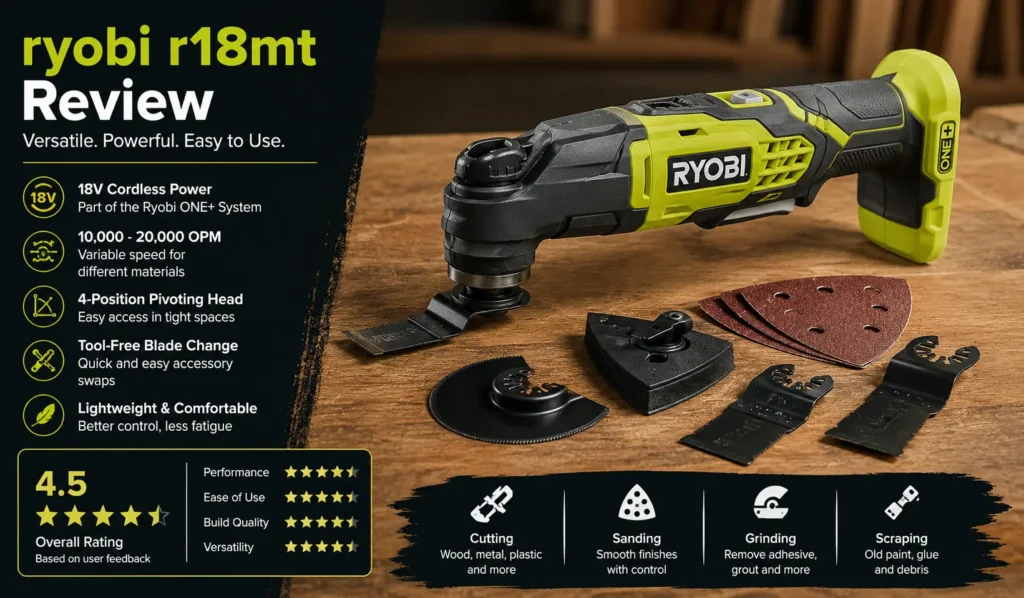
The Ryobi R18MT review I wish I had before buying — so here it is. I picked up this oscillating multi-tool after struggling with a fixed-head cutter on my last renovation project. Within the first week, it had already saved me hours on trim cuts and adhesive removal. If you’re on the Ryobi ONE+ platform, this might just be the most useful tool you add to your kit — but it’s not perfect, and I’ll be straight with you about that.
What I Like
- Plunge cutting is genuinely impressive. The first time I used the plunge cutter attachment on a piece of 2×4, I was shocked at how clean and controlled it was. Even at mid-speed, the blade bit in fast. For cutting notches around door frames or dropping into drywall — this thing is a star.
- The adjustable swivel head changes everything. I never thought a rotating head would matter much to me. Then I had to sand inside a narrow cabinet where I couldn’t fit my hand comfortably. I pressed the button, rotated the head to 45 degrees, and it slid right in. It’s one of those features you don’t know you need until you use it constantly.
- Speed control dial gives real precision. Six positions from slow to full power. I use the lower settings for fine sanding and detail work. Crank it up for grinding old adhesive off a wall. That dial makes the tool feel responsive and smart — not just a one-speed buzzer.
- Tool-less blade change is quick and reliable. Push the lever up, swap the attachment, clamp it down. Done. I’ve changed blades mid-project in under 30 seconds. The clamp holds tight — I never had a blade slip during use, which matters when you’re working near a pipe or trim you don’t want to scratch.
- Compatible with existing Ryobi 18V batteries. If you’re already in the Ryobi ecosystem (and a lot of us in the US are, given how widely available ONE+ batteries are at Home Depot), this becomes outstanding value. You don’t buy a battery — you just grab one off the charger and go.
- Lightweight and comfortable in hand. At about 1 kg without a battery, this doesn’t tire your arm out. The grip is ergonomic with a subtle groove underneath for two-handed use. I’ve run it for 30-minute sessions without hand fatigue — that’s not something I can say about every power tool.
What Could Be Better
- The included consumables are disappointing. I’ll be blunt: the bundled sanding sheets and blades wear out fast. I went through the included sandpaper in one afternoon of paint stripping. You’ll want to invest in quality third-party blades early — Starlock-compatible accessories are worth the upgrade. Budget an extra $20–30 for decent replacements.
- Struggles with hard metals. The segmented cutting blade is listed for metal use, but in practice, it’s really a wood-and-plaster blade. I tried cutting through a thin steel conduit and it barely made progress. For anything ferrous or hard, you’ll want an angle grinder. This isn’t a dealbreaker — just know the tool’s limits.
- No carry case included. For a tool with multiple attachments and accessories, a storage case would be a huge help. Right now everything just piles into a drawer. Ryobi, please sort this out — even a basic bag would be a win.
- Spring tension on blade clamp is stiff. It’s not a major issue, but the lever takes a firm push to open. At first I wondered if I was doing it wrong. You’re not — just push it firmly. It loosens up a little with use, but don’t be surprised at the resistance.
My Personal Experience with the Ryobi R18MT
I’ve had the Ryobi R18MT for several months now, and it has genuinely earned a permanent spot in my kit. I bought it after reading several reviews that called it the best oscillating multi-tool in the Ryobi line — and I’d agree. Here’s a snapshot of how I’ve actually used it:
- Laminate flooring cuts around pipes — used the plunge cutter to drop into the board cleanly. Perfect fit around a radiator pipe, no chipping.
- Grout removal in the bathroom — slow speed, segmented blade. Slow going, but accurate. Saved me from using a chisel.
- Stripping old paint off a window frame — sanding pad with 80-grit sheet. Smooth result, though I went through two sheets.
- Removing dried adhesive from a wall — ran the tool at full speed for about 10 minutes. Ground it down cleanly with no wall damage.
- Cutting plastic pipe cap — the straight blade sliced through it like a hot knife through butter. Took about 4 seconds.
- Sanding tight corners on a bookshelf — rotated the head, got into the 90-degree join cleanly. Couldn’t have done it with an orbital sander.
- Trimming a door frame for new flooring — this is where multi-tools shine. Undercut the architrave perfectly with one pass.
The one thing I’ll say is: buy good blades immediately. Don’t wait for the bundled ones to die — just replace them upfront. The difference in cutting performance is night and day.
Comparing With Other Brands
I’ve also used the Milwaukee M18BMT-0 on a friend’s job site, and before that I owned a Makita TM3010CX2 corded multi-tool for a couple of years. Both are capable machines. But they serve different users in different situations. Here’s how they stack up:
Ryobi R18MT vs Milwaukee M18BMT-0: Quick Comparison
| Feature | Ryobi R18MT | Milwaukee M18BMT-0 |
| Voltage | 18V | 18V |
| Max Speed | 20,000 OPM | 20,000 OPM |
| Head Adjustment | Yes (5 positions) | No |
| Tool-less Blade Change | Yes | Yes (Quik-Lok) |
| Weight (without battery) | ~1 kg | ~1.3 kg |
| Battery Platform | Ryobi ONE+ | Milwaukee M18 |
| Best For | DIY / home use | Trade / heavy-duty use |
| Price (Body Only, approx.) | $79–99 | $149–179 |
| Hard Metal Cutting | Weak | Strong |
| Carry Case Included | No | No |
Bottom line: The Milwaukee wins on raw cutting power for hard materials. But the Ryobi wins on value, weight, and the adjustable head — a feature Milwaukee doesn’t offer on this model.
Ryobi R18MT vs Makita TM3010CX2: Quick Comparison
| Feature | Ryobi R18MT | Makita TM3010CX2 |
| Power Source | Cordless (18V) | Corded (320W) |
| Speed Range | 10,000–20,000 OPM | 6,000–20,000 OPM |
| Head Adjustment | Yes | No |
| Portability | High | Low (cord-dependent) |
| Accessories Included | Basic kit | Extensive kit (37 pieces) |
| Best For | Around-the-house DIY | Workshop / sustained use |
| Price (approx.) | $79–99 (body only) | $129–159 |
| Battery Required | Yes | No (plugs in) |
| Noise Level | Moderate | Moderate |
Bottom line: If you’re doing long workshop sessions, the Makita’s corded power and included accessories are excellent. But for moving around the house without dragging a cord, the Ryobi is simply easier to live with.
Ryobi R18MT vs Dremel MM50-01: Quick Comparison
| Feature | Ryobi R18MT | Dremel MM50-01 |
| Voltage / Power | 18V cordless | Corded (2.3A) |
| Max Speed | 20,000 OPM | 20,000 OPM |
| Oscillation Angle | 3.2° | 3.4° |
| Adjustable Head | Yes | No |
| Tool-less Blade Change | Yes | Yes |
| Accessory Ecosystem | Moderate | Very large |
| Best For | General DIY | Precision / detail work |
| Price (approx.) | $79–99 (body only) | $89–109 (with kit) |
| Battery Platform | Ryobi ONE+ | Corded only |
Bottom line: The Dremel has an enormous accessory ecosystem and is popular for fine detail work. The Ryobi beats it on portability and the swivel head. For someone doing home renovations, Ryobi is more practical. For crafts and fine finishing, Dremel has an edge.
Recommendation
Who should buy the Ryobi R18MT?
- You’re a home DIYer who wants one tool that cuts, sands, and grinds without spending big. This is your tool.
- You’re already on the Ryobi ONE+ platform. If you’ve got ONE+ batteries at home already — from a drill, a saw, a leaf blower — adding this multi-tool is nearly a no-brainer. The body-only price is very fair.
- You do flooring, trim work, or renovation projects. The plunge cutter and swivel head make this excellent for undercutting door frames, trimming laminate, and cutting around pipes.
- You’re a first-time power tool buyer in the US. Widely available at Home Depot and Amazon, with easy returns and good warranty support. Great starting point.
Who should keep looking?
- Tradespeople doing heavy daily use. The R18MT isn’t built for sustained professional work. A Milwaukee or Bosch Professional is worth the extra spend.
- You mainly want to cut hard metals. As I mentioned, this tool struggles there. An angle grinder will serve you better.
- You want a comprehensive accessory kit out of the box. The bundled accessories are basic. If you don’t want to spend more upfront, look at tool kits from Makita or Dremel that include 20–30 pieces.
Overall, I genuinely enjoy using this tool. It does exactly what it says — it’s versatile, light, and user-friendly. It won’t replace a dedicated sander or a tile cutter. But as a multi-tool that handles half a dozen tasks around the house? It earns its place on the shelf every time.
FAQs for Ryobi R18MT Review
Is the Ryobi R18MT good for beginners?
Yes, it’s one of the easiest multi-tools to start with. The blade change is simple, the head adjusts easily, and the speed dial gives you full control. Most beginners find it very approachable.
Does the Ryobi R18MT come with a battery?
No, the R18MT is sold as a body-only tool. You need a compatible Ryobi 18V ONE+ battery and charger separately. If you already own ONE+ tools, you’re all set.
Can the Ryobi R18MT cut metal?
It can cut soft or thin metals like aluminum. But it struggles with hard metals like steel. For ferrous metals, use an angle grinder for better results.
What accessories work with the Ryobi R18MT?
It accepts both standard OIS blades and Starlock blades using the included adapter. Third-party brands like Bosch and Diablo make compatible blades that outperform the bundled ones.
How loud is the Ryobi R18MT?
The noise rating is 84.5 dB — fairly typical for an oscillating multi-tool. It’s louder than a drill but quieter than a circular saw. Ear protection is still recommended for extended sessions.