
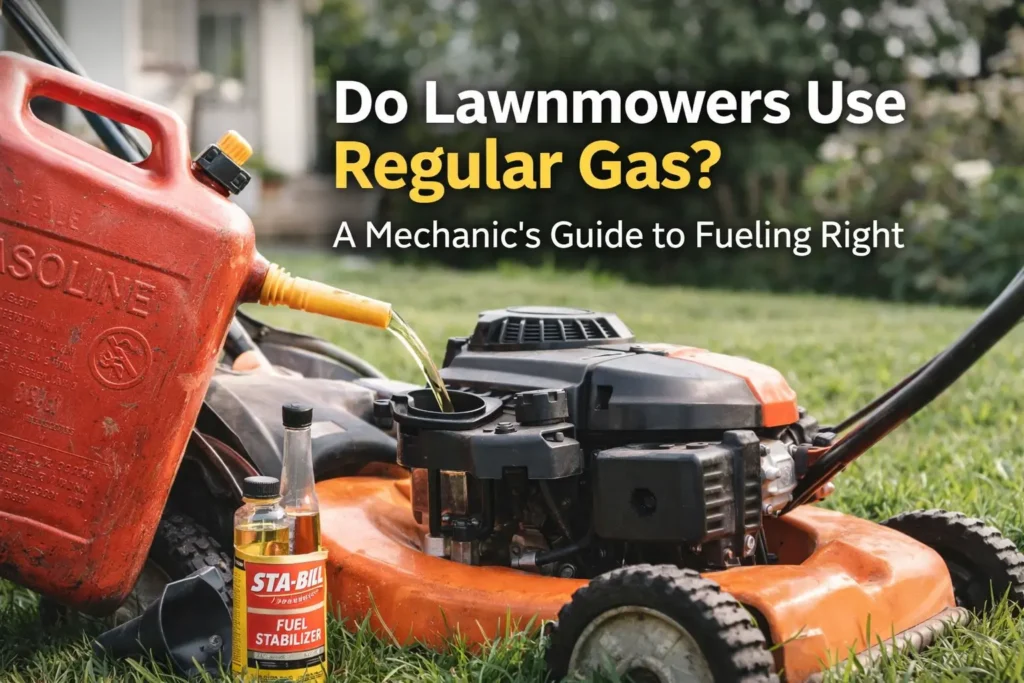
I still remember the day I killed my first mower. It was a hot July morning in Georgia. The air was thick and humid. The grass was wet and growing fast. It needed to be cut early in the day, before the heat became intense.
I ran to the shed, grabbed an old red gas can, poured the fuel in without much thought, and pulled the cord. The engine sputtered. It coughed out white smoke. Then it died.
I pulled the cord again. And again. Nothing happened. My arm hurt. I was sweating. The mower was dead.
That was the day I learned a hard lesson. Not all gas is the same.
You might be wondering, do lawnmowers use regular gas? The short answer is yes. But there is a catch. A big one.
Most gas in the U.S. has ethanol in it. This is fine for your car. Your truck loves it. But your mower? It might hate it. Small engines are weak. They are sensitive.
If you live in Florida, the humidity makes it worse. If you are in the Midwest, the cold winters do damage. I have fixed hundreds of mowers. I have seen the damage bad gas does. It turns into goop. It clogs the engine.
I want to save you that trouble. I want your mower to start on the first pull. Every time. It is not hard. You just need to know the rules. Let’s talk about what to put in your tank.
Understanding Lawnmower Engines: The Basics
Before we pour anything into the tank, we have to look at what is actually under the hood of your mower.
The Difference Between 2-Stroke and 4-Stroke Engines
You need to know your engine type. This is step one. It is vital. If you get this wrong, you break the machine.
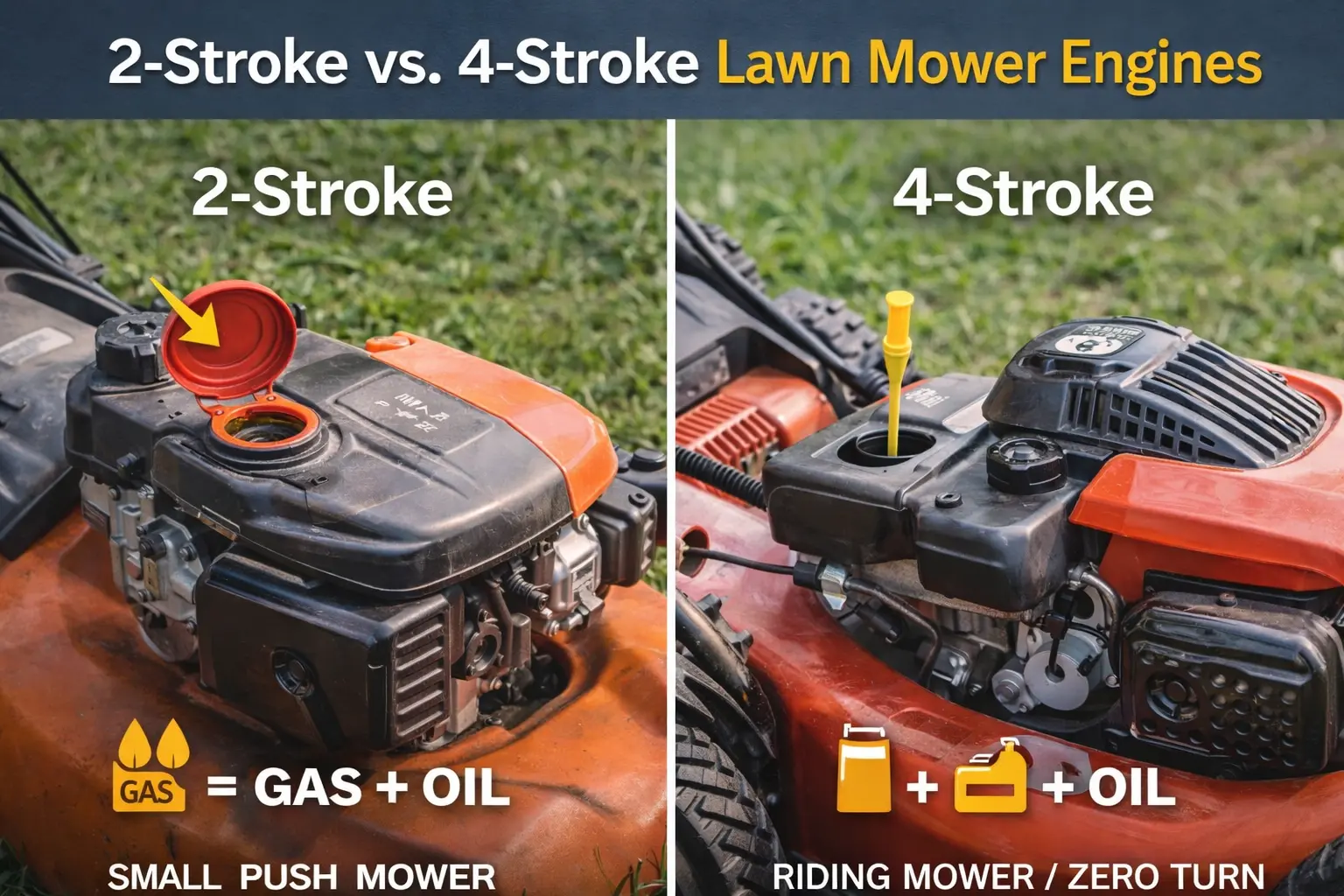
There are two main types. One is a 2-stroke. The other is a 4-stroke. They drink different fuel.
How to Identify Them:
- Look at the fuel cap. Does it say “Mix”? That is a 2-stroke.
- Look for an oil dipstick. If you see one, it is a 4-stroke.
- Check the tank count. A 4-stroke has one spot for gas. It has another spot for oil.
- Listen to the sound. A 2-stroke whines. It sounds high and buzzy. Like a chainsaw. A 4-stroke rumbles. It sounds lower. Like a car.
Why It Matters for Gas:
A 2-stroke needs oil in the gas. You have to mix it. The oil lubes the piston. If you use straight gas, it gets too hot. The metal melts. The engine seizes. It happens fast.
A 4-stroke takes straight gas. The oil lives in the crankcase. If you put mixed gas in it, it will run. But it will smoke. It will foul the spark plug. It is messy.
Why Engine Size Dictates Fuel Needs
Size matters here. A big engine has different needs than a small one.
Small Push Mowers: These are simple. They are tough. But they have tiny carburetors. The jets are small. Smaller than a pinhole. Even a little bit of gum clogs them. Bad gas kills these fast.
Riding Mowers and Zero-Turns: These are beasts. Big engines produce more power, run hotter, require higher-quality fuel, and consume more fuel overall.
Commercial vs. Residential: Look at your brand. Do you have a Toro? Maybe a Honda? These are for homes. They are built for weekend use.
Do you have an Exmark? Or a Scag? These are for pros. These machines are built to run for long hours, generate significant heat, and require stable fuel to stay cool.
Do Lawnmowers Use Regular Gas? The 87 Octane Question
We see the “87” button at the pump every week, but is that “regular” unleaded actually safe for your small engine?
What “Regular” Gas Actually Means in the US
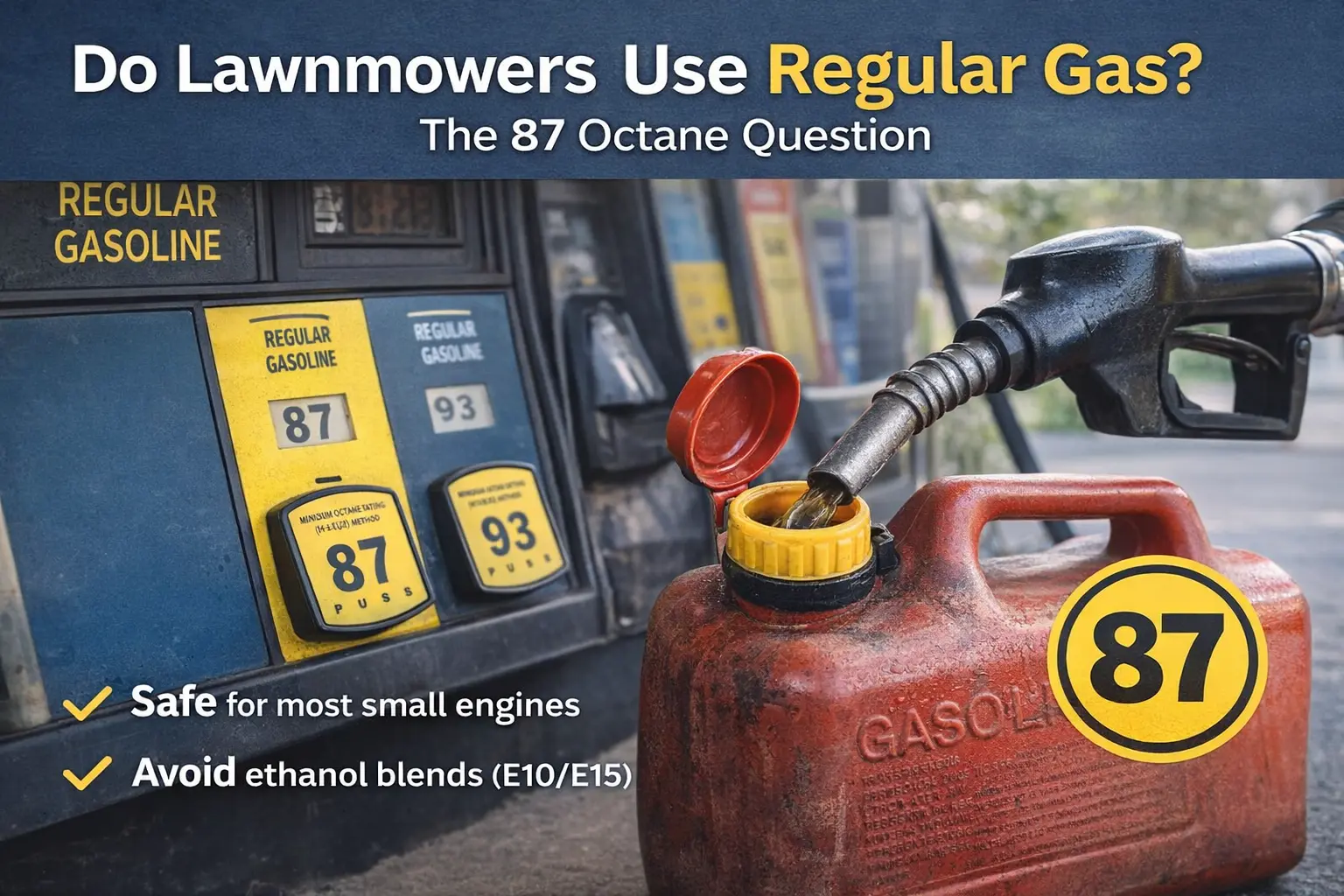
We all know the yellow button. The one that says “87”. We call it regular. It is the cheapest option.
Octane Rating Explained: Octane is not power. It is stability. It stops the gas from burning too soon.
The Standard: Check your manual. Most say “87 Octane Minimum”. Briggs & Stratton says it. Honda says it too. This means regular gas is safe to use. The engine can handle the burn rate.
Elevation Factors: Do you live high up? Maybe in Denver? Or Salt Lake City? You might see 85 octane. This is okay there. The air is thin. The engine has less pressure.
But be careful. If you take that gas to sea level, it is bad. It will cause “knocking”. That sound is bad. It hurts the engine.
The Hidden Danger: Ethanol Content (E10 vs. E15)
This is the real enemy. It is not the octane. It is the corn.
Most U.S. gas has corn in it. We call it ethanol. It is alcohol. Alcohol attracts water. Water is bad for engines.
The 10% Limit: Most mowers can handle E10. That means 10% ethanol. This is standard pump gas. It is legal. It works. But it has a shelf life.
The E15 Warning: Watch out for E15. It has 15% ethanol. It is often cheaper. You see it at Sheetz. Or in the Midwest corn belt.
Never use E15.
- It burns too hot.
- It melts rubber parts.
- It eats plastic lines.
- It ruins the warranty.
I have seen it happen. A customer used E15 to save pennies. It melted his fuel line. The gas leaked everywhere. It cost him $100 to fix. Don’t do it.
When Regular Gas is Okay
You can use regular gas. I do it often. But I follow rules.
- Freshness is Key: Only use new gas. Buy it this week. Use it this week.
- High Usage Seasons: Is it May? Is the grass growing fast? You are mowing every week. The gas flows fast. It doesn’t sit. This is safe.
- The “Sniff Test”: Open the can. Smell it. Does it smell like old paint? Does it smell sour? If yes, toss it. Do not use it.
The Case for Ethanol-Free Gas (Rec 90)
If you want your mower to start on the first pull every single spring, this is the secret sauce you need to know about.
What is Ethanol-Free Fuel?
We call this “Rec 90”. Or “Pure Gas”. This is high-quality fuel with no corn-based ethanol, made from pure fossil fuel.
You find it at marinas. Boats hate ethanol. You find it at rural pumps too. Look for the label “Ethanol-Free”. It is often a separate hose.
Chemical Stability: It is stable and does not grab water from the air. stays fresh for a long time.
Why Mechanics Love It
I love this gas. It makes my life easier.
Phase Separation: Let’s talk about science. Ethanol loves water. In humid places like Louisiana, the air is wet. The ethanol pulls that wetness into your tank.
The water sinks. It sits at the bottom. The fuel pickup is at the bottom too. So your engine sucks up water. Water does not burn. The mower dies.
Ethanol-free gas does not do this. It ignores the humidity.
Corrosion Prevention: Ethanol is a solvent. It cleans things. That sounds good, right? Wrong. It loosens old gunk in the tank. That gunk moves to the carb. It clogs the tiny jets.
Pure gas is gentle. It leaves the gunk alone.
Storage Benefits: You can leave Rec 90 in the tank. It sits there for months. stays good. At does not turn to varnish.
Is It Worth the Extra Cost?
It costs more. Maybe a dollar more per gallon. Is it worth it?
The Math: Think about it. A push mower holds very little. Maybe half a gallon. You might use 5 gallons all summer.
- Regular gas: $3.50 x 5 = $17.50
- Ethanol-free: $4.50 x 5 = $22.50
The difference is $5. That is the price of a coffee. A carb repair costs $80. The math is simple. Pay the $5. Save the $80.
User Experience: The engine runs smoother. It idles better. It just feels happier.
Mixing Gas for 2-Cycle Engines
If you have an older Lawn-Boy or a handheld trimmer, you can’t just fill and go; you have to be a chemist for a minute.
The Ratios: 40:1 vs. 50:1
You have a weed eater. Or maybe a blower. It needs mixed gas.
Reading the Manual: Don’t guess. Never guess. Look at the cap. Look at the book. It will say a number.
The Math Made Easy: I use a cheat sheet.
- 50:1 Ratio: This is common. It is 2.6 ounces of oil. You mix it with 1 gallon of gas.
- 40:1 Ratio: This is richer. It is 3.2 ounces of oil. You mix it with 1 gallon of gas.
Consequences of Being Wrong:
- Too much oil: The engine smokes. It drips black goo. The spark plug gets dirty. It is hard to start.
- Too little oil: This is bad. Very bad. The piston gets hot. It scratches the wall. The engine dies forever.
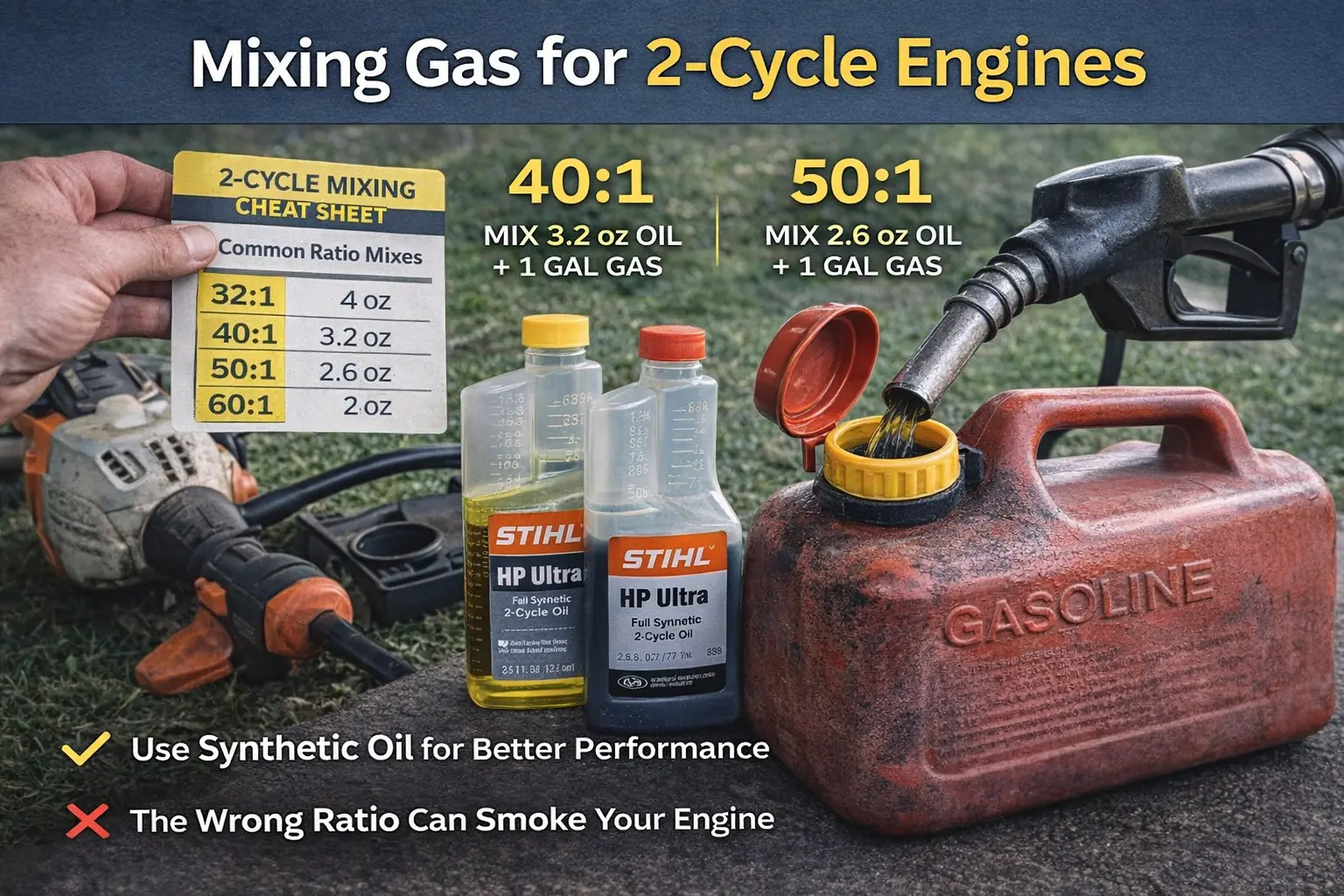
Correct fuel-to-oil ratios are critical for 2-cycle engine performance and longevity
Synthetic vs. Conventional 2-Cycle Oil
Go to the store. You see many bottles. Some are cheap. Some are pricey.
Smoke Reduction: Buy the synthetic oil. It burns clean. You won’t breathe blue smoke. Your clothes won’t stink.
Engine Life: Synthetic lube is better. It protects at high speeds. These engines spin fast. They need good oil.
Brand Loyalty: You have a Stihl? Buy Stihl oil. You have an Echo? Buy Echo oil. It keeps the warranty safe. It is made for that heat.
Pre-Mixed Canned Fuel (TruFuel, VP Small Engine)
I have a secret, lazy sometimes. I use “canned gas”. You see it at Home Depot. It is in a metal can.
The Lazy Man’s Best Friend: It is already mixed. It has high octane. It has zero ethanol. You just pour it in.
Shelf Life: Unopened cans last for years. Even opened, they last a long time.
The Cost Factor: It is expensive. Maybe $6 or $8 a quart. That performance is impressive for a big mower. But for a weed eater? It is great. One can lasts me months. It is worth it for zero hassle.
Perfect for: Do you have a tiny yard? Do you hate mixing gas? Buy the can. It is easy.
Storing Your Gas: Best Practices for US Homeowners
Bad gas kills more mowers than rocks or tree stumps ever will, and it all starts with how you keep it in the shed.
The Jerry Can Matters
Look at your gas can. Is it old? Is it dirty?
Plastic vs. Metal: Most of us use plastic. It is cheap. But in Texas summers, it swells. It gets round like a ball. The heat builds pressure.
Metal cans are better. Brands like Eagle make them. They are safe. They seal tight. But they cost $50.
The Venting Issue: New cans are annoying. They have complex spouts. The EPA makes them this way. They spill gas everywhere.
- Tip: You can buy vent kits online. They fix the flow. It makes pouring easy again.
Fuel Stabilizers: Do They Work?
You see the red bottle. Or the blue one. It is called stabilizer.
Brands to Know: I use Sta-Bil. It is red. I also like Sea Foam. It is white. Star Tron is blue. They all work.
When to Add It: Add it at the pump. Put it in the can first. Then pump the gas. This mixes it well. Do not wait until the gas is old. It cannot fix bad gas. It only keeps fresh gas fresh.
The Limit: It buys you time. Maybe a year. Maybe two. But eventually, gas dies. Don’t trust 3-year-old gas. Even with the red stuff.
Winterization: Wet vs. Dry Storage
Winter is coming. The mowing is done. What do you do with the gas?
Dry Storage: This means an empty tank.
- Start the mower.
- Let it run.
- Wait until it dies.
- Try to start it again.
- Now it is dry.
Best for: Cold places. Minnesota. Maine. Unheated sheds.
Wet Storage: This means a full tank.
- Fill it to the top.
- Make sure it has stabilizer.
- Run it for 5 minutes. This gets the treated gas into the carb.
Best for: Metal tanks. It stops rust. It keeps the seals wet.
Troubleshooting Fuel Problems
You pulled the cord ten times, and your arm hurts, but the mower won’t start; let’s figure out if the gas is the culprit.
Signs of Bad Gas
Your mower won’t start. Is it the gas?
The Smell: Take off the cap. Sniff it. Does it smell sharp? Does it sting your nose? That is varnish. Fresh gas smells sweet. Varnish smells sour.
Visual Check: Pour a little in a glass jar.
- Is it cloudy? That is water.
- Is it dark? That is old.
- Are there floating bits? That is trash.
Engine Behavior: Does it start but run rough? Does it rev up and down? We call that “hunting”. It goes vroom… vroom… vroom. This means the jet is dirty. The gas is restricted. It is starving.
How to Drain a Lawnmower Tank
You have bad gas. You need it out.
Siphon Method: Buy a cheap hand pump. You can get one at an auto store. Stick the hose in. Pump it out.
Disconnecting the Line: Find the rubber hose. It goes from the tank to the engine. Use pliers. Squeeze the clamp. Pull the hose off. Have a bucket ready. It will flow fast.
Disposal: Do not pour it on the grass. It kills the grass. Do not pour it in the drain. It is illegal. Take it to a shop. Or a recycling center. They take old fluids.
Cleaning the Carburetor (The DIY Fix)
The gas is out. But the gunk remains. You need to clean the carb.
Dropping the Bowl: Look at the bottom of the carburetor. There is a metal cup. It looks like a bowl. There is one bolt on the bottom. Unscrew that bolt. Gas will spill. Catch it with a rag.
Cleaning the Nut: Look at the bolt you removed. It has holes. Tiny holes. These are the jets. Use a wire. Poke the holes. Spray them with cleaner.
Carb Spray: Buy a can of Carb Cleaner. Spray everything, bowl and the hole where the bolt goes. Wipe it clean.
- Note: Put it back together. Tighten the bolt. Try to start it. It usually works. If not, you might need a pro.
Regional Considerations for US Gardeners
The weather outside your window changes how your gas behaves, so let’s look at where you live.
The Humid South (Florida, Georgia, Louisiana)
I know this heat. I live in it.
Moisture is the Enemy: The air is water. Your tank breathes. It sucks in that wet air. Advice: Keep your gas can shut tight. Do not leave the vent open. Buy small amounts. One gallon at a time. Use it up fast.
The Hot Southwest (Arizona, Nevada, New Mexico)
It is dry here. But it is hot.
Evaporation: Gas boils. It turns to vapor. If your shed is 110 degrees, the gas disappears. Vapor Lock: You mow. You stop for water. You try to start it again. It won’t start. The gas boiled in the line. Advice: Park in the shade. Keep the gas can in a cool spot. Mow in the morning. When it is cooler.
The Frozen North (Michigan, Wisconsin, New York)
You have long winters. The mower sits for 5 months.
Condensation: Temperature swings cause sweat. The inside of the tank sweats. Water drops form. They mix with the gas. Advice: Use the dry method. Drain the tank in November. Run it dry. Leave it empty until April.
Frequently Asked Questions
These are the questions I get asked while leaning over the fence or standing in the aisle at Home Depot.
Can I use Premium (91 or 93) gas in my mower?
Answer: Yes. You can. The Benefit: It is often better quality. Some brands have less ethanol in premium. The Verdict: It won’t hurt. It won’t make it faster. But it might stay fresh longer. If the price is close, go for it.
What if I accidentally put diesel in my mower?
Answer: Stop. Do not pull the cord. The Fix: Drain the tank. Get all of it out. Flush it with a little gas. Drain that too. Fill it with regular gas. If you ran it: It will smoke. White smoke everywhere. It might die. You have to clean the spark plug. It will be oily. It will clear up after a while.
How long does gas actually last in a gas can?
Standard Gas (E10): 30 days. After that, it starts to turn. Stabilized Gas: 6 to 12 months. Ethanol-Free: 6 months or more. My Rule: I date the can. I use a marker. I write the month on the tape. If it is old, I put it in my truck. My truck burns anything. My mower is picky.
Can I mix old gas with new gas?
Answer: No. Why: The old gas is already bad. Mixing it just makes a larger amount of mediocre gas. It is like adding fresh milk to sour milk. It is still sour.
Does the brand of gas matter?
Answer: Yes. Top Tier Gas: Look for “Top Tier” stations. Shell. Exxon. Chevron. They have more detergents. They keep the engine cleaner. The Cheap Stuff: No-name stations buy the cheapest gas. It has fewer additives. It might be dirty. Avoid it if you can.
Key Takeaways for Every Homeowner
- Freshness: Keep gas fresh. Buy only what you need for 30 days.
- No Ethanol: If you can find it, use ethanol-free gas. It is the best insurance.
- Stabilize: If you can’t find ethanol-free, use a stabilizer in every tank.
- Know Your Engine: Check if it is 2-stroke or 4-stroke. Don’t mix them up.
- Storage: Drain the tank or fill it up for winter. Don’t leave it half-full.
Your mower is a tool. Treat it well. It will treat you well. Happy mowing.
Final Thoughts on Using Regular Gas
If you mow often, fresh regular gas is great for your 4-stroke engine. It is cheap and works well. But if your tool sits or needs a mix, you should use ethanol-free fuel. From my time in the shop, I know fresh gas is the best way to avoid a dead engine.
Read More: The Truth: How Fast Does a Lawnmower Blade Really Spin?