
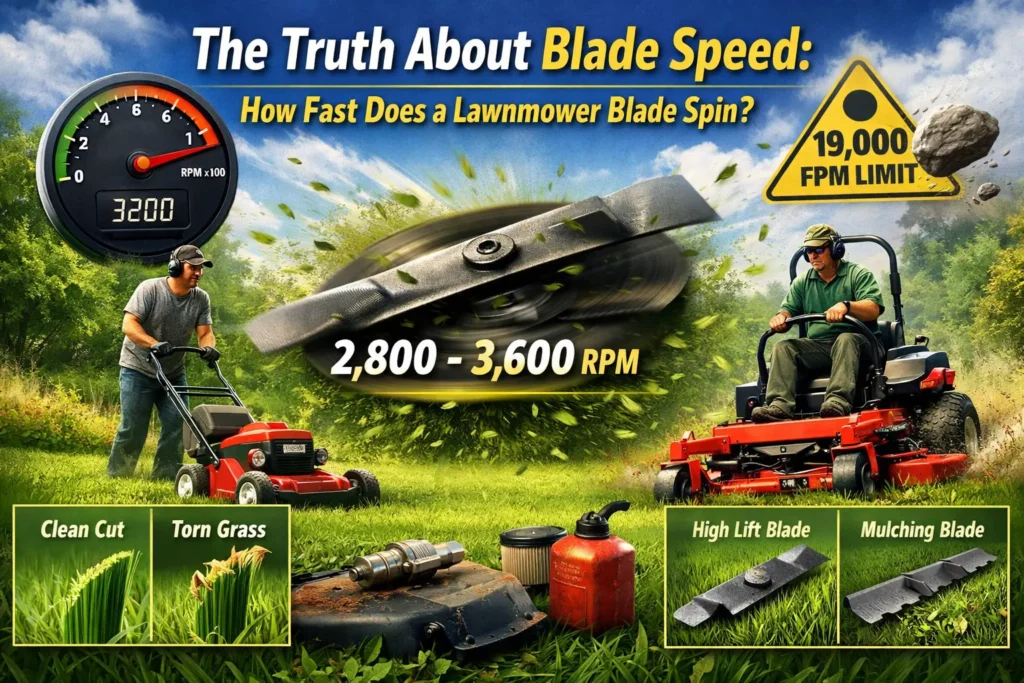
I remember the first time I really paid attention to my mower. It was a hot, sticky Saturday in July. The air felt heavy. I was pushing my old mower through a patch of thick, wet grass. The engine groaned. It sounded like it was dying. The grass didn’t look cut. It looked chewed. That’s when I learned a hard lesson. Speed matters. It’s not just about the noise the engine makes. It’s about the cut.
If you are wondering how fast does a lawnmower blade spin, here is the short answer. Most residential mowers spin between 2,800 and 3,600 RPM.
But numbers don’t tell the whole story. I’ve mowed lawns all over. From the humid heat of a Florida garden to the dry dust of an Arizona yard. The speed changes how the grass flies. It changes how clean the cut is. Let’s dig into the details. I’ll share what I know from years in the yard. We will look at safety, speed, and getting that perfect stripe.
Understanding the Basics of Mower RPM
This breaks down what RPM means for your engine. It explains why that number matters for your Saturday chores.
What is RPM in a Lawnmower?
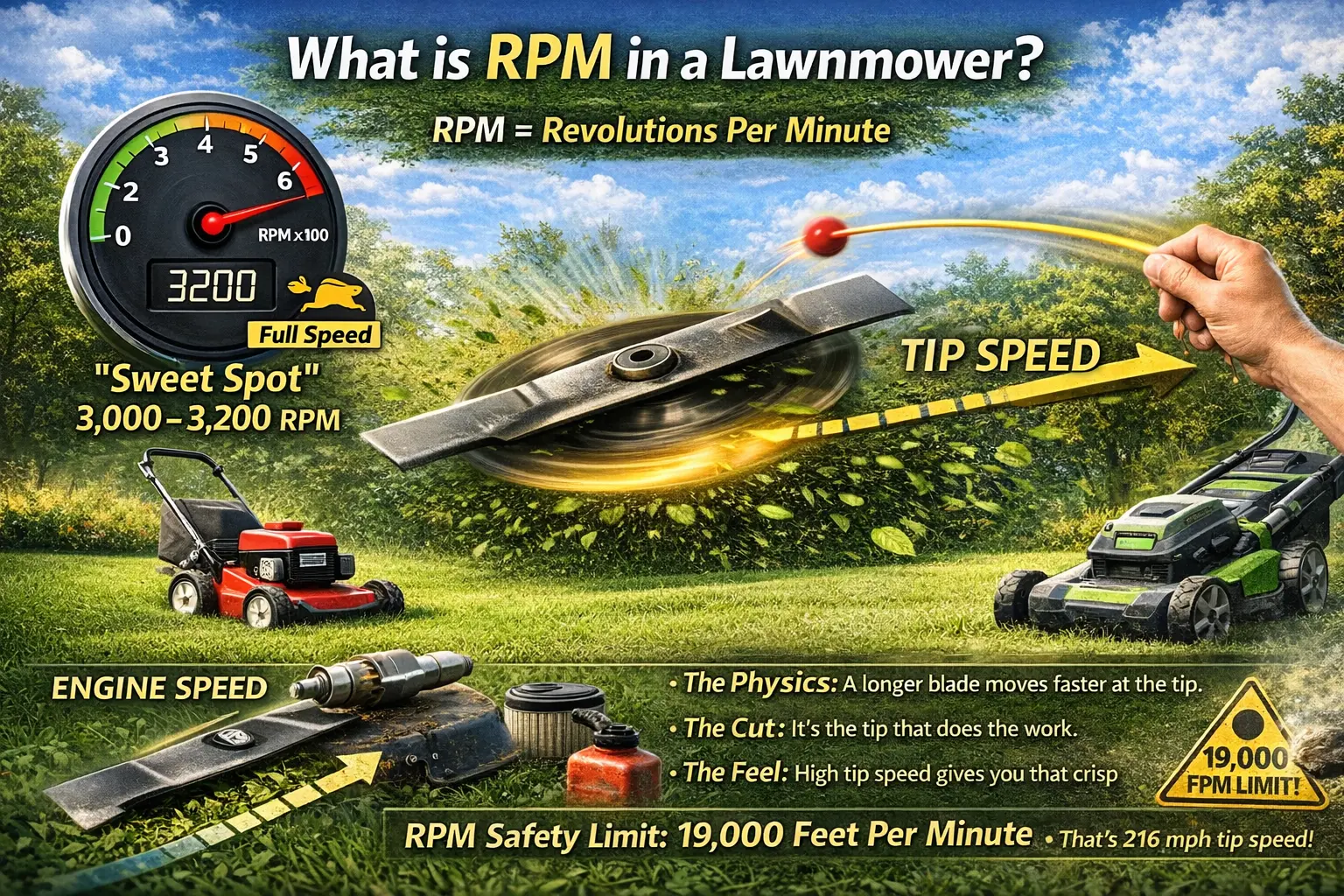
RPM stands for Revolutions Per Minute. It is just a fancy way to say how fast the engine turns. For a gas mower, this is the heartbeat of the machine.
Most home mowers have a “sweet spot.” This is usually around 3,000 to 3,200 RPM. When the engine runs at this speed, it has enough power to cut. It can handle the load of thick grass.
I treat the throttle like a simple switch. I almost always run it at “Rabbit” or full speed. Why? Because slowing down usually hurts the cut. The engine needs that momentum. It needs to keep the blade moving when it hits a clump of weeds.
If you use an electric mower, it feels different. You hit the button, and it is on. There is no ramp-up. It just goes. But the concept is the same. The motor needs to spin fast enough to slice the grass, not hack at it.
Tip Speed vs. Engine Speed
This is where it gets a little technical. But stay with me. It is important. The engine speed is one thing. The tip speed is another.
Imagine you are holding a string with a ball on the end. You spin it around. Your hand is the engine. The ball is the tip of the blade. The ball moves much faster than your hand.
- The Physics: A longer blade moves faster at the tip.
- The Cut: It is the tip that does the work.
- The Feel: High tip speed gives you that crisp, “slicing” action.
Safety rules here in the US limit this speed. The limit is usually 19,000 feet per minute (FPM). That is fast. It is nearly 216 miles per hour at the tip.
Why does this matter to you? Because a big mower deck needs a lot of power. It has to keep those long blades moving fast. If the tip speed drops, the cut suffers. You get missed spots. You get ragged edges.
Why Blade Speed Matters for Your Lawn
Speed isn’t just for power. It is the secret to a lawn that looks like a golf course, not a hayfield.
The Science of the “Lift”
Have you ever looked under your mower deck? It is dirty down there. But look at the blade shape. It has curved wings on the back. These are called “lifts.”
When the blade spins fast, it acts like a fan. It creates suction. This pulls the grass blades up straight. It is just like a vacuum.
- Suction Power: High RPM creates strong airflow.
- Standing Tall: The grass stands up to get cut evenly.
- Debris: It sucks up old leaves and pine needles.
I saw this clearly when I lived in the South. We had St. Augustine grass. It is thick and spongy. If my RPM was low, the mower just pushed the grass over. It didn’t cut it. I had to ramp up the speed to lift that heavy grass.
In dry places, like out West, you need less lift. But you still need that airflow to clear the clippings. If the air stops moving, the deck clogs. Then you have a mess to clean up.
Clean Cuts vs. Tearing
Think about cutting a tomato. If you use a slow, dull knife, you smash it. If you use a fast, sharp knife, you slice it.
Grass is the same. When a blade spins too slow, it acts like a butter knife. It hacks the top of the grass. It tears it.
- The Look: Torn grass turns brown at the tips a day later.
- The Health: Ragged cuts let disease in.
- The Fix: High speed gives a surgical cut.
I can hear the difference. A clean cut makes a sharp “whoosh” sound. A bad cut sounds like a “thump.” If you hear thumping, check your speed. Or check your blade sharpness. Your lawn will thank you.
RPM Differences by Mower Type
Not all machines are the same. A big zero-turn in Texas works differently than a push mower in Chicago.
Push Mowers (Walk-Behind)
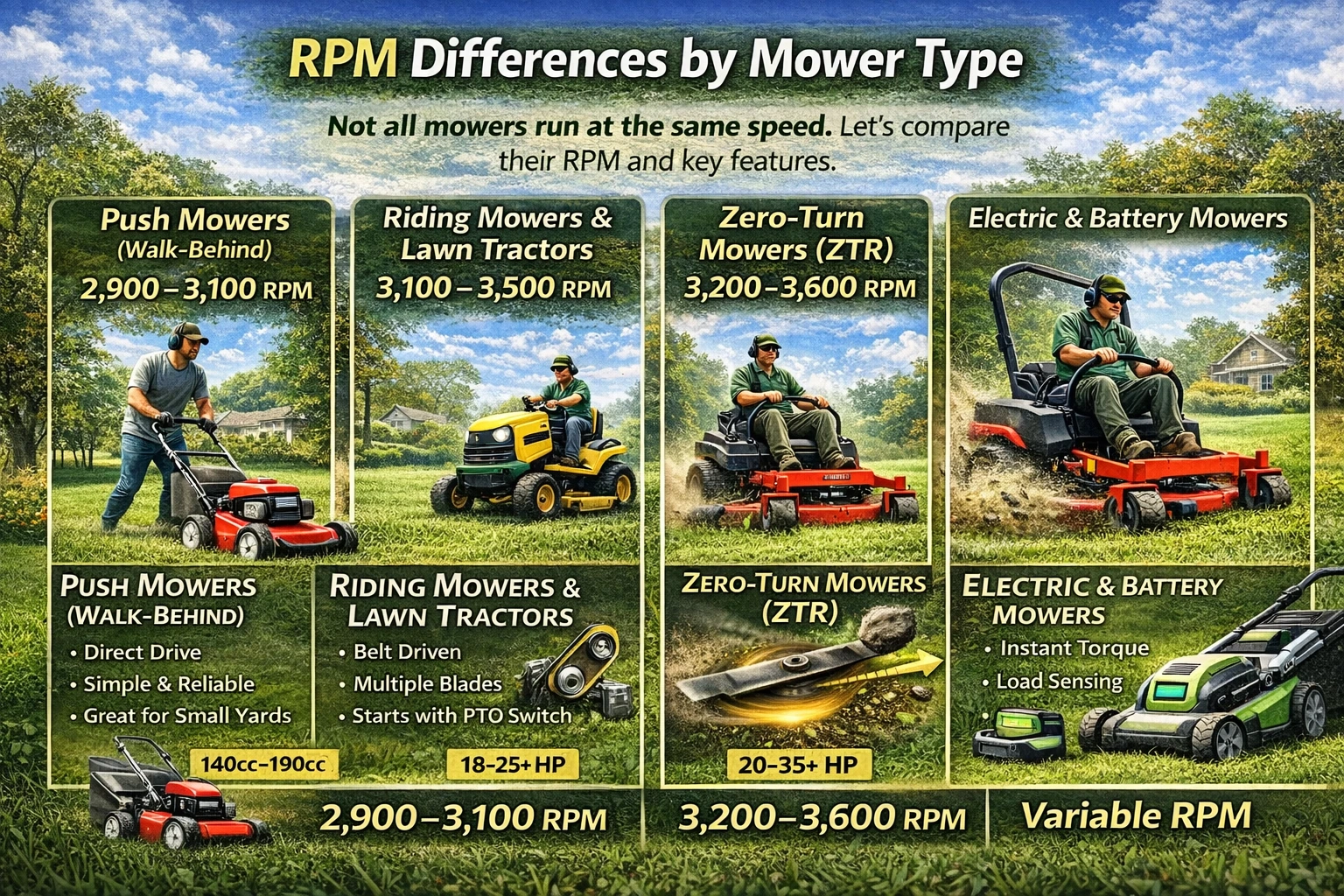
These are the classic mowers. I started with one of these. A standard 21-inch push mower usually runs at 2,900 to 3,100 RPM.
The engine is small. Usually 140cc to 190cc. The blade bolts right to the engine shaft. This is called “direct drive.”
- Simplicity: There are no belts to slip.
- Consistency: The blade speed matches the engine speed exactly.
- Safety: Many have a brake that stops the blade when you let go.
I like these for small yards. They are simple. But they can bog down. If you hit tall grass, you feel it instantly. The engine slows. The blade slows. You have to stop and let it recover.
Riding Mowers and Lawn Tractors
These are for the big jobs. I use a tractor for anything over half an acre. They often run faster, closer to 3,500 RPM.
They use belts. The engine spins a pulley. A belt connects that pulley to the deck.
- Power Transfer: Belts can slip if they get wet or old.
- Multiple Blades: You might have two or three blades spinning at once.
- The Clutch: You flip a switch (PTO) to start the blades.
I remember one time my tractor felt weak. The engine roared, but the cut was bad. It turned out the belt was loose. The blades were barely spinning. The engine was fine, but the speed wasn’t getting to the deck.
Zero-Turn Mowers (ZTR)
These are the hot rods of mowing. You see the pros using them. They are fast.
ZTRs often have the highest tip speeds allowed. They are built for speed. They need to cut grass while moving at 8 or 10 mph.
- High Performance: They keep blade speed up even when driving fast.
- Commercial Grade: Brands like Scag or Exmark are beasts.
- Residential: Even home versions are faster than tractors.
If you have a big yard, a ZTR is a game changer. But be careful. The blades spin so fast they can throw rocks a long way. I broke a window once. It happened in a split second. Never underestimate that speed.
Electric and Battery Mowers
This is the new world. I was skeptical at first. But the new battery mowers are good.
They are smart. They use “load sensing.”
- Thin Grass: The motor spins slower to save battery.
- Thick Grass: It detects the load and ramps up the RPM instantly.
- Torque: Electric motors have instant power.
I tried a 60-volt mower recently. It was quiet. I could hear the birds. But when I hit a patch of clover, it whirred up. It cut just as well as my gas mower. It was impressive.
Factors That Slow Down Your Blade
Sometimes the mower feels weak. You throttle up, but nothing happens. Here is what goes wrong.
The Impact of Tall or Wet Grass
We have all done it. We let the grass get too long. Or we try to mow right after a rainstorm.
Wet grass is heavy. It sticks to the deck. It is like cement.
- Resistance: The blade has to push through that heavy mush.
- Friction: The grass rubs against the blade and slows it down.
- The Result: Your RPM drops. The engine chugs.
I learned a trick for this. It is called the “half-width” pass. Only use half the deck width to cut. It puts less load on the engine. It keeps the RPM high. It takes longer, but the cut is better.
Mechanical Issues affecting RPM
Engines need three things: air, fuel, and spark. If one is bad, speed drops.
- Air Filters: A dirty filter chokes the engine. It can’t breathe.
- Old Fuel: Gas goes bad fast. It gums up the carburetor.
- Governors: There is a spring that controls speed. If it stretches, you lose power.
I check my air filter every month. It is cheap insurance. A clean filter keeps the power up. I also use fuel stabilizer. It keeps the gas fresh. It saves me from cleaning the carb every spring.
Belt Slippage (Riding Mowers)
If you have a rider, check the belt. It is the weak link.
I had a squeal in my mower deck last year. It was a high-pitched screech. That sound means the belt is slipping.
- Wear: Belts stretch over time.
- Pulleys: The springs that keep them tight can rust.
- Debris: Grass packs into the pulley covers.
If the belt slips, the engine spins fast, but the blade spins slow. You lose all your cutting power. Check the tension. Keep it clean.
Safety and the Speed Limit
We want power. But there is a reason for the limit. These metal bars are dangerous.
ANSI B71.1 Standard Explained
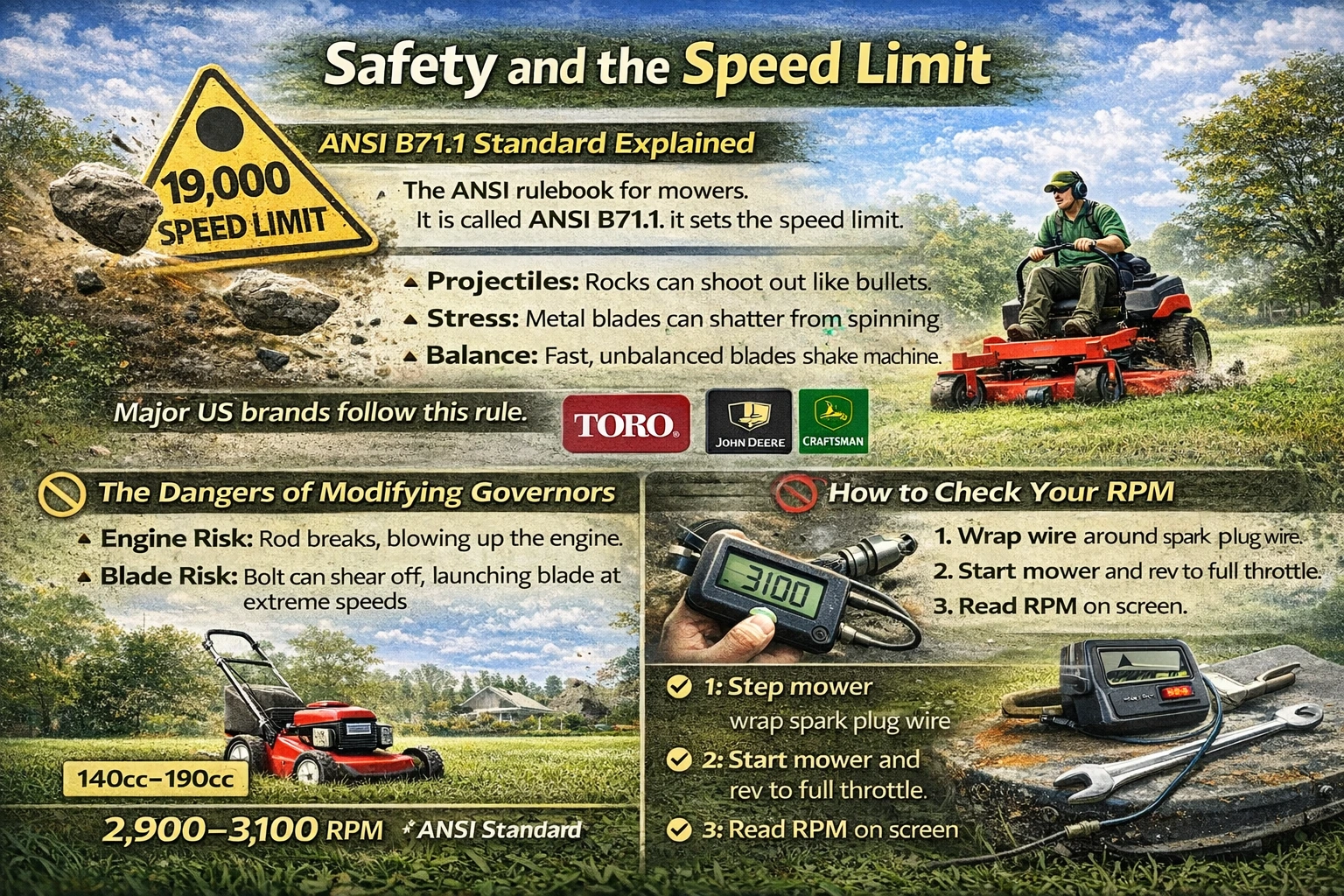
There is a rulebook for mowers. It is called ANSI B71.1. It sets the speed limit.
The limit is 19,000 feet per minute at the tip. Why?
- Projectiles: A rock hit at that speed is like a bullet.
- Stress: If a blade spins too fast, the metal can fail. It can shatter.
- Balance: A fast, unbalanced blade shakes the whole machine.
Major US brands follow this strict rule. Toro, John Deere, Craftsman. They all stick to it. It keeps us safe.
The Dangers of Modifying Governors
I know guys who tinker. They want more power. They mess with the governor spring to rev the engine higher.
Don’t do it.
- Engine Risk: You can blow the engine. The rod can fly right out the side.
- Blade Risk: The blade bolt is not made for extreme speed. It can shear off.
- Warranty: You void your warranty instantly.
I saw a neighbor ruin a good Honda engine this way. He wanted it to sound like a race car. It ran great for ten minutes. Then it made a loud bang. Smoke everywhere. It wasn’t worth it.
How to Check and Adjust Your RPM
You don’t have to guess. With a cheap tool, you can know for sure.
Using a Tachometer
You can buy a tiny tool called a tachometer. It costs about twenty bucks.
- How it works: You wrap a wire around the spark plug wire.
- The Readout: It shows you the RPM on a little screen.
- The Test: Start the mower. Go to full throttle. Read the number.
I use one every spring. It tells me if my engine is healthy. If it reads 2,500 instead of 3,100, I know something is wrong. It takes five minutes. It saves a lot of guessing.
Adjusting the Governor (The Right Way)
If your speed is low, you might need to adjust it. But be careful.
- The Manual: Check your owner’s manual first. Find the spec.
- The Tab: Usually, there is a metal tab connected to the spring.
- The Tweak: You bend it a tiny bit. I mean a tiny bit.
Listen to the engine. Does it surge? Does it hunt for a steady speed? That means you went too far.
If you aren’t sure, take it to a shop. A pro can set it in five minutes. It is better than breaking something.
Choosing the Right Blade for the Speed
The blade shape matters as much as the speed. It decides how the air moves.
High-Lift Blades
These are my favorite for bagging. They have big wings on the back.
- The Tornado: They create huge airflow.
- The Chute: They blast grass up the chute into the bag.
- The Load: They take more power to spin.
You need high RPM for these. If the speed drops, the chute clogs. I use these in the fall for leaves. It works like a charm.
Mulching Blades (3-in-1)
These look wavy. They have more cutting edges.
- The Recirculation: They keep the grass inside the deck.
- The Chop: They cut the clippings into tiny pieces.
- The Feed: The nutrients go back into the lawn.
Mulching needs speed. The blade has to hit the grass three or four times before it drops. If you go slow, you get clumps. Green, slimy clumps. Nobody wants that.
Low-Lift / Sand Blades
I used these when I lived near the coast. The soil was sandy.
- Low Dust: They don’t suck as much air.
- Protection: They kick up less sand and dust.
- Engine Life: They are easier to spin.
If you mow a dirt patch or a dry, dusty field, use these. They save your lungs. They save your engine filters too.
Real-World Mowing Scenarios
Let’s apply this to real life. Here is how I manage speed in different seasons.
The Spring Cut (Rapid Growth)
Spring is tough. The grass grows an inch a day. It is wet. It is thick.
- My Strategy: I go full throttle. Always.
- The Pace: I walk slow. I let the mower eat.
- The Side Discharge: I open the side chute. I don’t mulch yet. It is too thick.
The smell of spring onions and cut grass is amazing. But it is messy. Keep that RPM up to avoid the mess.
The Summer Drought (Dormant Grass)
August is hot. The grass stops growing. It gets dry and brown.
- Throttle Down: Sometimes I lower the speed a tiny bit.
- Why: To reduce dust. To keep it quiet.
- Blade Wear: Dry grass is abrasive. It dulls blades fast.
I check my blades often in summer. A dull blade on dry grass shreds it. It turns the lawn gray. Keep them sharp.
Leaf Cleanup in Fall
This is my favorite time. I love mulching leaves.
- The Blender: I put the mulching plug in. I rev it up.
- The Noise: It sounds like a blender crushing ice.
- The Result: The leaves vanish. They turn into powder.
Set your deck a little higher. Let the leaves get under the blade. The high RPM does the rest. It is satisfying to watch a leaf pile disappear.
Frequently Asked Questions
People ask me these questions all the time. Here are the quick answers.
Does a faster blade cut better?
Yes. Almost always. Faster blades cut cleaner. They lift the grass better. They throw the clippings farther.
Can I make my blade spin faster?
You can, but you shouldn’t. It is dangerous. It breaks rules. It can break your mower. Stick to the factory settings.
What RPM is too slow?
If you drop below 2,500 RPM, you will notice problems. The engine will chug. The grass will look torn. The bagger will clog.
Do electric mowers spin as fast as gas?
Yes. The good ones do. Some even spin faster. And they hold that speed better when the grass gets thick. They are worth a look.
Final Thoughts on Choosing the Right Mower
If you have a large, thick lawn to tame, a high-speed mower is likely the perfect fit for you. However, if you prefer quiet mornings and less maintenance, you might want to consider an electric model. While knowing how fast does a lawnmower blade spin is useful, I found that a sharp blade matters more than raw speed. Trust your gut and pick the tool that feels right for your Saturday chores.
Read More: Lawnmower Blades