
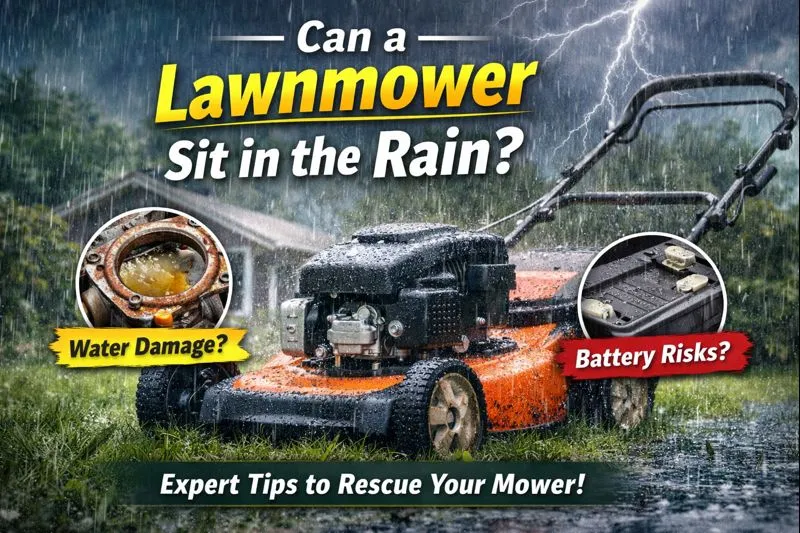
I still remember the feeling. The sky turned gray. Thunder rolled in. I ran for the porch. It was a classic Florida storm. Fast and heavy. I watched the rain pour down. Then I saw it.
My mower was still in the middle of the yard.
I felt a pit in my stomach. We have all been there. You wonder if it will start again. You ask yourself, can a lawnmower sit in the rain without dying? The answer is tricky. It depends on the mower. It depends on how long it sat there.
Water is tough on tools. It gets into places it should not go. It causes rust. It ruins gas. I have fixed many mowers because of this. I will help you save yours. We will look at what to do. We will look at gas and electric mowers. We will keep it simple. Let’s get that machine running again.
The Immediate Impact of Rain on Your Mower
Water works fast. It does not take long to cause trouble. Here is what happens right away when the sky opens up.
Water in the Fuel System
The Sinking Effect
Water is heavier than gas. This is simple physics. But it is bad news for your engine. When rain gets in the tank, it sinks. It goes straight to the bottom.
The fuel line is at the bottom too. So, the engine sucks up the water first. It does not drink the gas. It drinks the rain. Water does not burn. The engine will not run.
- Rain enters through the gas cap vent.
- It settles below the fuel.
- The pickup tube grabs the water.
- The engine tries to burn water and dies.
The Carburetor Clog
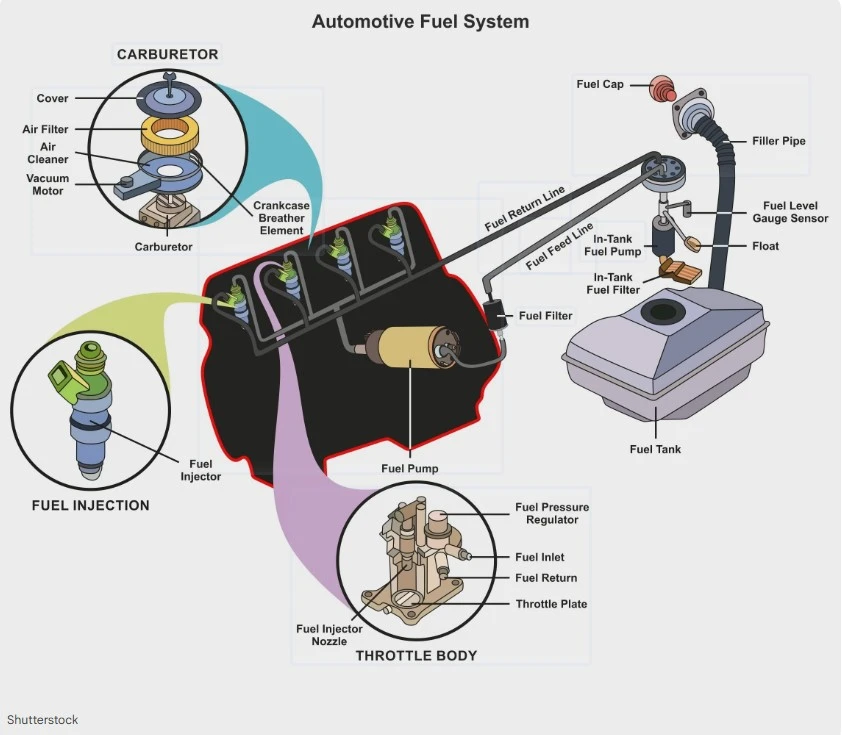
The carburetor is like a heart. It mixes air and gas. It has very tiny holes. We call them jets. They are small.
Water has high surface tension. It forms a bubble. This bubble sits over the jet. It blocks the fuel. The gas cannot get through.
- Water creates a physical block.
- Fuel flow stops completely.
- The engine might sputter.
- Usually, it just won’t start.
Signs of Bad Gas
How do you know if water is in there? You might get lucky. It might start for a second. But listen close.
It will sound rough. It might cough. You might see white smoke. That is steam. It means water is in the heat.
- Hard starting after a storm.
- White smoke from the exhaust.
- Rough idling sounds.
- The engine surges up and down.
Electrical Components and Short Circuits
Spark Plug Issues
The spark plug needs to be dry. It uses high voltage. It makes a spark to light the gas. Water is a conductor. It steals the electricity.
If the boot is wet, the spark jumps. It goes to the metal block. It does not go into the engine. We call this “grounding out.”
- Wet plugs cannot spark.
- Water bridges the gap.
- The energy is lost to the metal.
- The engine turns but won’t fire.
Battery Terminals (Electric Start)
Many US mowers have buttons now. No more pulling cords. This uses a small battery. Rain hates batteries.
Water sits on the posts. It causes corrosion. You will see white fuzz. This fuzz blocks the power. The starter will not spin.
- Corrosion happens quickly.
- Connections get loose or fuzzy.
- Starting power drops to zero.
- You hear a “click” but no spin.
Safety Switches
Every mower has a kill bar. You hold it to run. If you let go, it stops. This is a safety switch. It is usually open to the air.
Rain gets inside the switch. It tricks the system. The mower thinks you let go. It shuts off the spark. It refuses to run to keep you safe.
- Moisture gets in the “kill switch”.
- The mower thinks it is off.
- It refuses to run for safety.
- Drying this part is hard.
The Air Filter Sponge Effect
Paper Filters vs. Foam Filters
Most push mowers use paper filters. Think of a coffee filter. What happens when it gets wet? It turns to mush.
Paper fibers swell up. They close the holes. Air cannot pass through. It is like trying to breathe through a wet towel. Foam filters are different. They hold water like a sponge.
- Paper filters turn to mush.
- Foam filters hold water like a sponge.
- Both stop air flow completely.
- The engine suffocates.
Choking the Engine
An engine is an air pump. It needs air to burn gas. If the filter is wet, no air gets in. But the gas is still flowing.
This floods the engine. The spark plug gets soaked in gas. Now you have two problems. No air and too much fuel.
- No air means no combustion.
- The engine floods with gas.
- You smell raw fuel.
- Risk of pulling water into the cylinder.
Long-Term Damage: What Happens If You Wait?
If you leave it wet, things get worse. Days turn into weeks. The damage goes deep and costs more to fix.
The Rust Factor
The Mower Deck
Most mower decks are steel. Steel loves to rust. Wet grass sticks to the bottom. It holds water against the metal.
I have seen decks rot out. Big holes form. Rocks fly out of these holes. It is dangerous. It happens fast in humid states like Georgia.
- Steel decks rust fast.
- Paint chips trap water.
- Holes can form over time.
- Structural strength is lost.
Internal Cylinder Rust
This is the silent killer. Water gets inside the engine. It sits on the cylinder walls. The piston rings are steel. The walls are iron.
They rust together. We call this seizing. The engine locks up. You pull the cord. It stops dead. It hurts your arm. The engine is ruined.
- Moisture inside the engine block.
- Piston rings get stuck.
- Loss of compression (power).
- Total engine failure.
Cables and Levers
Cables control the speed. They control the brakes. They have a plastic shell. But inside, it is a metal wire.
Water creeps down the wire. It rusts inside the tube. One day, you pull the lever. Snap. The cable breaks. Or it freezes and won’t move.
- Throttle cables freeze up.
- Brake cables snap.
- Hard to control the speed.
- Levers get stuck in “on” or “off.”
Oil Contamination
The “Milky” Oil Look
Oil should look like honey. Or maybe dark tea. It should not look like a milkshake. If it is creamy, that is bad.
That cream color is water. Water mixed with oil acts like an acid. It does not lube the parts. It scrubs them.
- Water mixes with oil.
- It looks like a milkshake.
- It loses lubrication power.
- It causes sludge to form.
Bearing Damage
Engines have bearings. They need oil to spin smooth. If water is in the oil, they get hot. They rub metal on metal.
You will hear a knock. It sounds like a hammer. That is the rod hitting the crank. Once you hear the knock, it is too late.
- No oil means metal rubs metal.
- Internal parts wear out fast.
- Engine knocking sounds begin.
- The rod can break through the block.
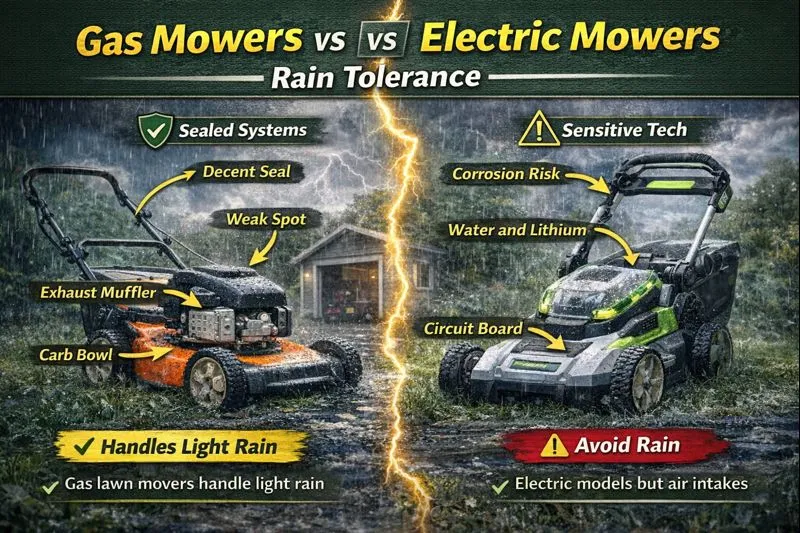
Gas Mowers vs. Electric Mowers: Rain Tolerance
Not all mowers are the same. A gas Toro handles rain differently than a battery-powered EGO. Know your tool.
Gas Mowers vs. Electric Mowers: Rain Tolerance
Not all mowers are the same. A gas Toro handles rain differently than a battery-powered EGO. Know your tool.
Gas Mowers (The Old Workhorses)
Sealed Systems
Gas mowers are tough. They have been around a long time. The gas caps are decent seals. The engines are mostly closed off.
They can handle a sprinkle. I have mowed in light rain. It is not ideal. But the machine usually runs fine.
- Gas caps are decent seals.
- Engines are mostly closed off.
- They can handle light rain.
- Heat from the engine dries things off.
Vulnerable Points
They are not submarines. The air intake is the weak spot. It sucks air in. It will suck rain in too.
The exhaust muffler is another hole. If the mower is off, rain goes in. It goes right to the piston. This causes the rust we talked about.
- The air intake is the weak spot.
- The exhaust muffler can trap rain.
- Cable sheaths hold water.
- The carburetor bowl collects drops.
Electric and Battery Mowers (The Sensitive Tech)
Battery Compartments
I love my battery mower. It is quiet. But it hates water. Water and lithium-ion do not mix.
The contacts are copper. They turn green with corrosion. If water gets inside the battery pack, it is over. The cells ruin. A new battery costs a lot.
- Water and lithium-ion do not mix.
- Risk of permanent battery death.
- Expensive to replace packs.
- Fire risk if shorted out.
Circuit Boards
Modern mowers are computers. They have chips. They have controllers. Water fries the motherboard.
A gas mower can be dried out. A fried circuit board is trash. You have to buy a new part. It is not an easy fix.
- Modern mowers have computers.
- Water fries the motherboard.
- Total failure of the unit.
- Complex wiring harnesses rot.
Motor Casings
Electric motors need to be dry. They have copper windings. They have magnets. Rust freezes the spinning armature.
You might pull the trigger. You hear a hum. But the blade does not move. The rust has glued the motor shut.
- Electric motors need to be dry.
- Rust freezes the spinning armature.
- Humming noise but no spin.
- Overheating happens fast.
Step-by-Step: How to Fix a Wet Lawnmower
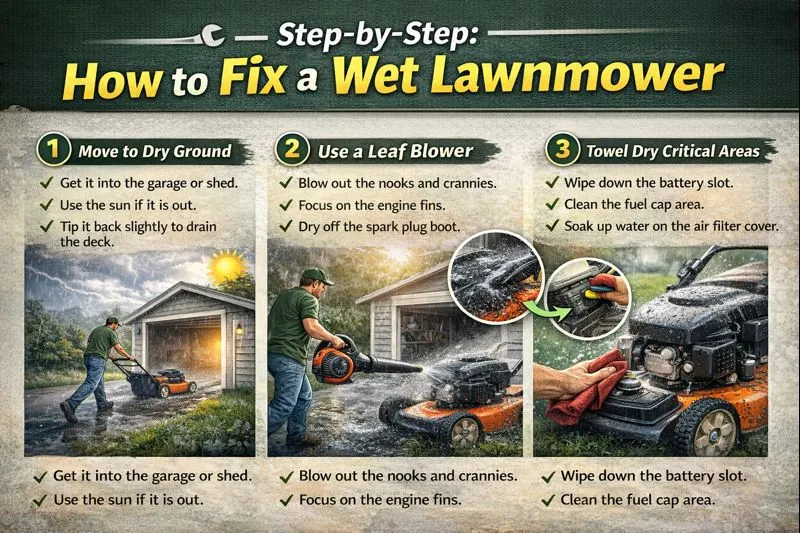
Do not panic. I have saved dozens of drowned mowers. Follow these steps before you pull the cord.
The Drying Phase
Move to Dry Ground
First, get it out of the rain. It sounds obvious. But do it fast. Push it to the garage. Put it in the shed.
If the sun comes out, use it. Park the mower in the driveway. The hot asphalt helps. The sun bakes the moisture out.
- Get it into the garage or shed.
- Use the sun if it is out.
- Let gravity help drain water.
- Tip it back slightly to drain the deck.
Use a Leaf Blower
This is my favorite trick. I use air to fight water. Grab your leaf blower. Turn it on high.
Blow off the whole machine. Aim at the engine fins. Aim at the spark plug hole. Blast the water away. It works better than a towel.
- Blow out the nooks and crannies.
- Focus on the engine fins.
- Dry off the spark plug boot.
- Clear water from the control cables.
Towel Dry Critical Areas
Get a shop rag. Wipe down the details. Dry the battery slot perfectly. Dry the safety bar.
Take off the gas cap. Wipe the threads. Make sure no drops fall in. Cleanliness matters here.
- Wipe down the battery slot.
- Dry the control handles.
- Clean the fuel cap area.
- Soak up water on the air filter cover.
Checking the Fluids
Inspect the Fuel
Open the tank. Shine a light in. Do not use a lighter! Use a flashlight. Look at the bottom.
Do you see bubbles? Do you see blobs at the bottom? That is water. If you see it, the gas is bad.
- Look for water bubbles in the tank.
- Drain the bowl if you can.
- Use a siphon if needed.
- Fresh gas is the best fix.
Check the Oil Dipstick
Pull the stick. Wipe it. Dip it again. Look at the color.
Honey is good. Black is okay. Milky is bad. If it is milky, do not start it. You must change the oil now.
- Look for the milky color.
- Change oil immediately if wet.
- Use fresh SAE 30 oil.
- Dispose of wet oil properly.
The “Magic” Spray
WD-40 for Water Displacement
WD-40 stands for “Water Displacement.” It is literally made for this. It is your best friend right now.
Spray it on the exposed metal.
Spray the cables.
Spray the outside of the spark plug. It pushes water away.
- Spray it on cables.
- Spray exposed metal parts.
- It pushes water away.
- It prevents rust from starting.
Carburetor Cleaner
If you think water got in the air intake, use this. Take off the air filter. Spray a little carb cleaner in the hole.
It helps dry the throat.
It is flammable.
It helps the engine fire up on the first pull.
- Spray into the air intake.
- Helps clear out moisture.
- Helps with the first start.
- Cleans out any gum or grime.
Prevention: Protecting Your Gear in US Climates
The weather changes fast here. From the Midwest freeze to the Southern heat. You need a plan to keep your gear safe.
Storage Solutions
Heavy Duty Tarps
Tarps are cheap. They work well. But there is a trick. Do not wrap it too tight.
If you wrap it tight, it sweats. Moisture gets trapped inside. Leave the bottom open. Let the air move.
- Cheap and effective.
- Use bungee cords to secure it.
- Don’t wrap it too tight (traps moisture).
- Blue tarps degrade in sun; use silver or brown.
Sheds and Garages
This is the gold standard. A roof is best. It keeps the rain off. It keeps the sun off too.
Sun fades plastic. It cracks tires. A shed stops all of that. Plus, it is harder to steal.
- The gold standard.
- Keeps UV rays off too.
- Prevents theft.
- Keeps mice out (usually).
Mower Covers
You can buy fitted covers. They fit like a glove. They fit brands like Honda or Troy-Bilt.
Look for vents. Vents are key. They let the humidity out. They keep the rain out.
- Custom fit for specific brands.
- Vented to let air flow.
- Waterproof material.
- Elastic hems keep them on in wind.
Regional Advice
The Humid South (Florida, Georgia)
I know this heat. The air is wet even when it is not raining. Rust happens fast here.
Wipe your machine down. Don’t leave wet grass on it. The grass ferments. It makes heat and acid. It eats the deck.
- Rust happens faster here.
- Wipe machines down after use.
- Check decks often.
- Store indoors if possible.
The Rainy Northwest (Washington, Oregon)
You guys mow wet grass a lot. It is just life there. You have to be careful.
Clean the underside of the deck. Use a scraper. Wet grass clumps up. It holds water against the blade. It unbalances the mower.
- Mowing wet grass is normal.
- Clean the underside of the deck.
- Wet grass rots and rusts metal.
- Check the blade balance often.
The Snowy North (Michigan, Minnesota)
Winter is coming. It brings snow. It brings salt. You put the mower away for months.
Winterize it. Drain the gas. If you leave gas in, it goes bad. It attracts water from the air. Next spring, it won’t start.
- Winterize before snow hits.
- Drain all fuel.
- Store in a dry corner.
- Fog the engine cylinder with oil.
Final Verdict: Is Rain a Death Sentence for Your Mower ?
A lawnmower doesn’t usually die from one rainstorm—but neglect will kill it fast. Gas mowers can often be saved with proper drying and maintenance. Electric and battery mowers are far less forgiving.
If your mower gets wet:
• Dry it fast
• Check fuel and oil
• Don’t force a start
• Prevent the next soak
A few minutes of care can save hundreds of dollars in repairs.
FAQs for can a lawnmower sit in the rain
Q. Can a lawnmower sit in the rain overnight
Yes, a lawnmower can sit in light rain overnight, but it is risky. Water may enter fuel, air, or wires. Move it to dry ground and dry it before use.
Q. Can a lawnmower sit in the rain and still start
Sometimes yes. Gas mowers may start after light rain once dry. Electric mowers are less forgiving. Always dry the mower fully and check oil and fuel first.
Q. Can a lawnmower sit in the rain without damage
Short rain may not cause harm, but long exposure can cause rust and wet fuel. Damage risk rises fast if water reaches the engine, battery, or air intake.
Q. Can a lawnmower sit in the rain if it is covered
A cover helps, but it is not perfect. Moist air can still get trapped. Use a vented cover and store the mower in a shed or garage when possible.
Q. Can a lawnmower sit in the rain after mowing
It should not. Wet grass sticks to the deck and holds water. This speeds rust. Clean the deck, dry the mower, and store it under cover right away.
Read More: Exactly What Oil a 2-Cycle Push Mower Uses